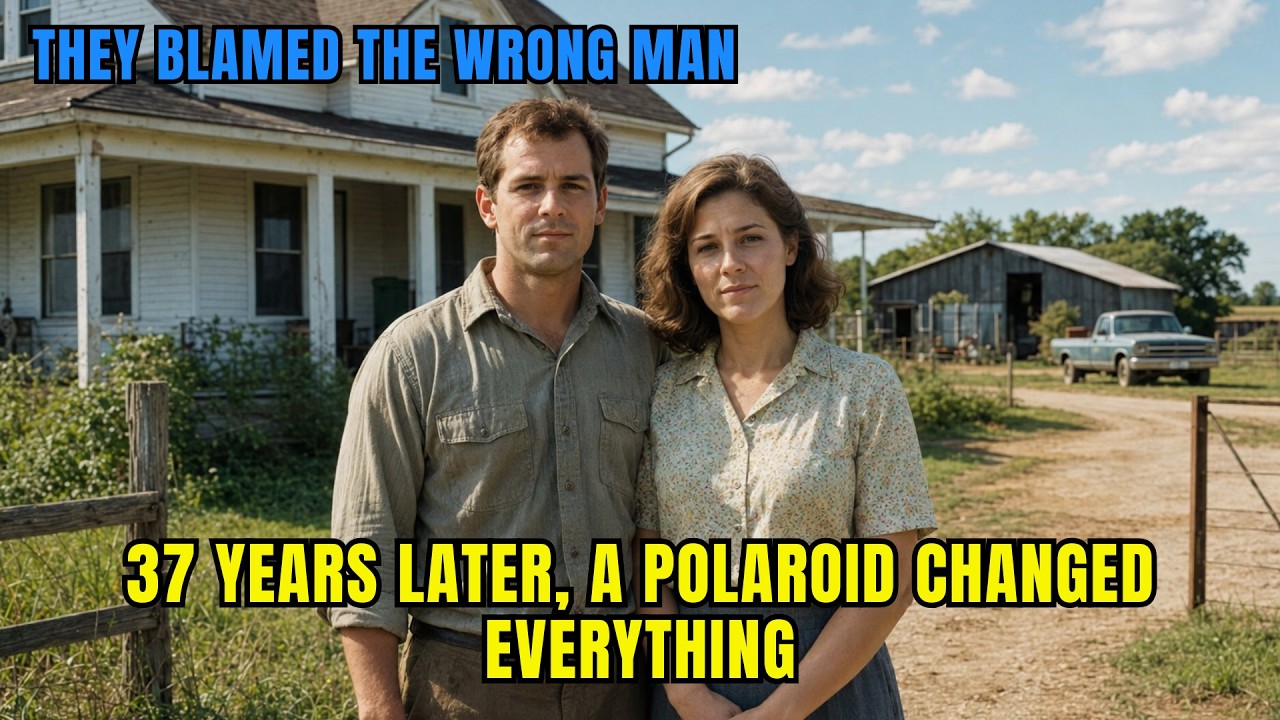
In the summer of 1970, Daniel and Caroline Whitmore ran a small farm outside Brunswick, Missouri, with their eighteen-month-old daughter, Emily. They were a typical young couple building a life on the land, but in the months before that June, a series of unsettling incidents had begun to disturb their peace. A fire broke out in the barn without explanation, a section of fence was cut, a window was pried open, and Caroline’s clothes were pulled from the closet and burned inside the house. Nothing of value was stolen, which frightened Caroline more than any theft could have.
She told her father, Walter Bennett, that whoever was doing these things wanted the family to know he could enter their home at any time. On June 17, 1970, Daniel spoke to an acquaintance about selling a large lot of livestock, and Caroline talked with her father by phone. Her voice sounded normal, and she mentioned nothing about leaving. After that day, the Whitmores were never seen again in Brunswick.
Their phone went unanswered, milk bottles sat untouched on the porch, and mail piled up by the road. When a stock agent could not reach Daniel to confirm the cattle pickup, he called Walter. Walter drove to the farmhouse and found Daniel’s truck still parked by the barn. The front door was unlocked.
Inside, the living room was in slight disarray, with a chair out of place and dark, dried bloodstains on the floor and near the hallway. In Emily’s room, Walter found his granddaughter lying in her crib, dehydrated and so weak she could barely cry. He carried her to a neighbor’s house and called the sheriff. Sheriff Robert Keller arrived with his deputies within the hour.
The house showed signs of violence, but no signs of a robbery. Daniel’s wallet lay on the nightstand with cash inside, the papers for the cattle sale were still on the table, and the couple’s clothes hung in the closet. There was not enough blood to conclude a murder had taken place, but the scene was clearly not one of a family that had planned to leave. Emily was taken to a medical facility, where Dr.
Charles Morgan noted that although the child was weak and underweight, her condition suggested someone might have given her small amounts of water during the days her parents were missing. A woman with light blonde hair had been seen near the farmhouse on June 19 by a farmer named Harold Jenkins, who knew Caroline and insisted the woman was not her. Yet the police could not identify her. As the search expanded across fields, ponds, and the Missouri River, the investigation fixed on Nathan Hail, a man who had once pursued Caroline years before she married.
He admitted to the old courtship but denied any recent contact with the family. Circumstantial details began to accumulate against him: an old trailer axle found in the river that resembled one once owned by his family, copper wire similar to that found in his workshop, and a . 22 rifle that could not be excluded from ballistics testing. In September 1970, a .
22 shell casing was discovered in the garden near the farmhouse, and a lab report suggested it shared characteristics with Nathan’s rifle. The townspeople were convinced of his guilt, and Nathan’s life in Brunswick was destroyed. He lost customers, friends, and his reputation, even though the county prosecutor ultimately refused to bring charges. The case against him rested on too many weak links and no bodies, no witnesses to a murder, and no cause of death.
The investigation went cold. Daniel and Caroline were eventually declared legally dead. Emily grew up under Walter’s care, knowing her parents only through photographs and the stories others told her. Walter died without ever learning what had happened to his daughter.
Meanwhile, Calvin Mercer, a former farmhand whom Daniel had fired after a heated argument over missing money and equipment, had been questioned early in the investigation. His only alibi for the night of June 17 was provided by his sister, Elaine Mercer, who was described in the file as having blonde hair. The police accepted her statement without question and closed that line of inquiry within days. No one connected Elaine’s appearance to the blonde woman Harold Jenkins had seen at the farmhouse two days after the disappearance.
For thirty-seven years, the case remained in a dusty cold case box. Then, in October 2007, Elaine Mercer passed away. While clearing out her mother’s house, her daughter Rebecca found a faded Polaroid. It showed Calvin Mercer standing in front of a wooden house in a wooded area, with a blurry woman visible behind him.
On the back was written in faded ink: “C. Don’t let her near the road. ” The box also contained newspaper clippings about the Whitmore case, kept for decades without explanation. Rebecca contacted the Chariton County Sheriff’s Office, and the case was assigned to Detective Laura Sullivan.
Sullivan reread the old files and began placing details side by side that had never been connected. Elaine Mercer had been the sole confirmation of Calvin’s alibi. Harold Jenkins had described a blonde woman at the farmhouse on June 19. Elaine Mercer was a blonde woman in her late twenties at the time.
A fuel receipt from June 17 showed that the Mercer family pickup had been refueled west of Brunswick, and an old maintenance log revealed the vehicle had traveled far more miles than a simple trip around the property would explain. Sullivan drove south to Douglas County, where the Polaroid had been taken, and found a property controlled by the Mercer family near Ava. There, she discovered records of a couple named Dan and Carol Miller, who had lived on the property since the mid-1970s. They had no birth certificates matching their stated dates, no school records, no marriage license, and no verifiable history before they appeared.
They were entirely dependent on Calvin Mercer, who controlled their money, their paperwork, their transportation, and nearly all their contact with the outside world. Surveillance confirmed that the elderly couple lived quietly in the wooden house. Dan walked with a noticeable limp. Carol rarely left the property.
When Calvin appeared, both grew visibly anxious. Discarded items from the property yielded two DNA profiles, and Emily Whitmore, now thirty-nine years old, provided a sample. The results were conclusive: Carol Miller was Emily’s biological mother, and Dan Miller was her father. Daniel and Caroline Whitmore had never been killed.
They had been living under assumed identities on Calvin Mercer’s property for nearly four decades. On January 28, 2008, police entered the property while Calvin was away. Caroline opened the door and, when Laura Sullivan spoke the name Caroline Whitmore, her face went pale. Her first question was whether Emily was alive.
She was. Daniel was brought in from the workshop, and both were taken to a safe location. Their testimony revealed the full story. On the night of June 17, 1970, Calvin had come to the farmhouse to confront Daniel over the money and equipment.
The argument turned violent. Calvin struck Daniel, drew a . 22 pistol, and forced the couple into a pickup where Elaine was waiting. They were driven to the property near Ava and locked in a cellar.
Elaine returned to Brunswick on June 19, gave Emily water, and left without contacting the police. Calvin used the quilt from the house, bound with copper wire, and threw it into the Missouri River to suggest the couple was dead. When the investigation turned toward Nathan Hail, Calvin realized he was safe. He later showed the couple photographs of Emily, taken from a distance, to prove he knew where their daughter lived.
When Daniel and Caroline attempted to escape in the late 1970s, Calvin found them and warned that next time he would go looking for Emily first. Calvin Mercer was arrested in January 2008. Investigators found false identification documents, financial ledgers showing his total control over the couple, photographs of Emily spanning decades, and seventeen letters Caroline had written to her daughter but never been allowed to send. At trial in 2009, defense attorneys argued that Daniel and Caroline could have left at any time, since the doors were not always locked.
But the prosecution showed that the confinement was maintained through fear, control, and the constant threat to Emily’s life. The jury convicted Calvin on charges of kidnapping, unlawful confinement, and related offenses. He was sentenced to a term that made it virtually certain he would die in prison. Daniel and Caroline did not regain the years they had lost.
Daniel carried the limp from his untreated injury, and Caroline had aged with the grief of a mother separated from her child. Emily had grown up as an orphan. In the months after the trial, the three began to build a new relationship, starting with small meetings, phone calls, and shared stories. They visited the old farmhouse in Brunswick together, but the family of 1970 could not be restored.
What remained was something quieter and more fragile: three people who had lived separate lives for nearly four decades, learning to know one another again.