Pearl Bailey was born on March 29, 1918, in Newport News, Virginia, the daughter of a Baptist minister. Her childhood was shaped by gospel music and southern discipline, but it was clear early on that she had a spark. After her parents divorced, she moved with her family to Philadelphia, a city alive with jazz and possibility. Life was not easy; Pearl left high school early and worked cleaning houses by day while dreaming of the stage at night.
She entered talent shows and kept winning, so frequently that some venues asked her not to compete again. Her big break came in the 1930s and 1940s, singing in Harlem nightclubs and eventually sharing the bill with legends like Cab Calloway. She blended music with humor, slipping sly jokes between verses, charming crowds with her warmth and wit. She did not just sing the blues; she made them laugh.
Pearl’s screen debut came in Variety Girl in 1947. From there, she took roles in films like Carmen Jones and became a fixture on the television variety circuit, appearing on programs hosted by Ed Sullivan and Steve Allen, and eventually starring in her own specials. But her most defining stage moment came in 1967, when she starred in the all-Black production of Hello, Dolly! on Broadway.
The show had already been a hit, but when Pearl stepped into the lead role, it became something else entirely. She did not just perform Dolly Levi; she owned her. Crowds adored her, critics praised her, and the production ran for over a year. By the end of the 1960s, Pearl Bailey was not just a performer; she was a cultural ambassador, invited to sing at the White House, appearing in commercials, and earning honors rarely given to Black entertainers of the time.
But even as she shined in the spotlight, she was building something more personal and far more private behind the scenes. In 1952, she married jazz drummer Louis Bellson, a white musician, at a time when interracial marriages were still illegal in many parts of the United States. Their union made headlines and turned heads, but they remained devoted, defying critics and conventions. Soon after, Pearl stepped into a new role, one no audience could see.
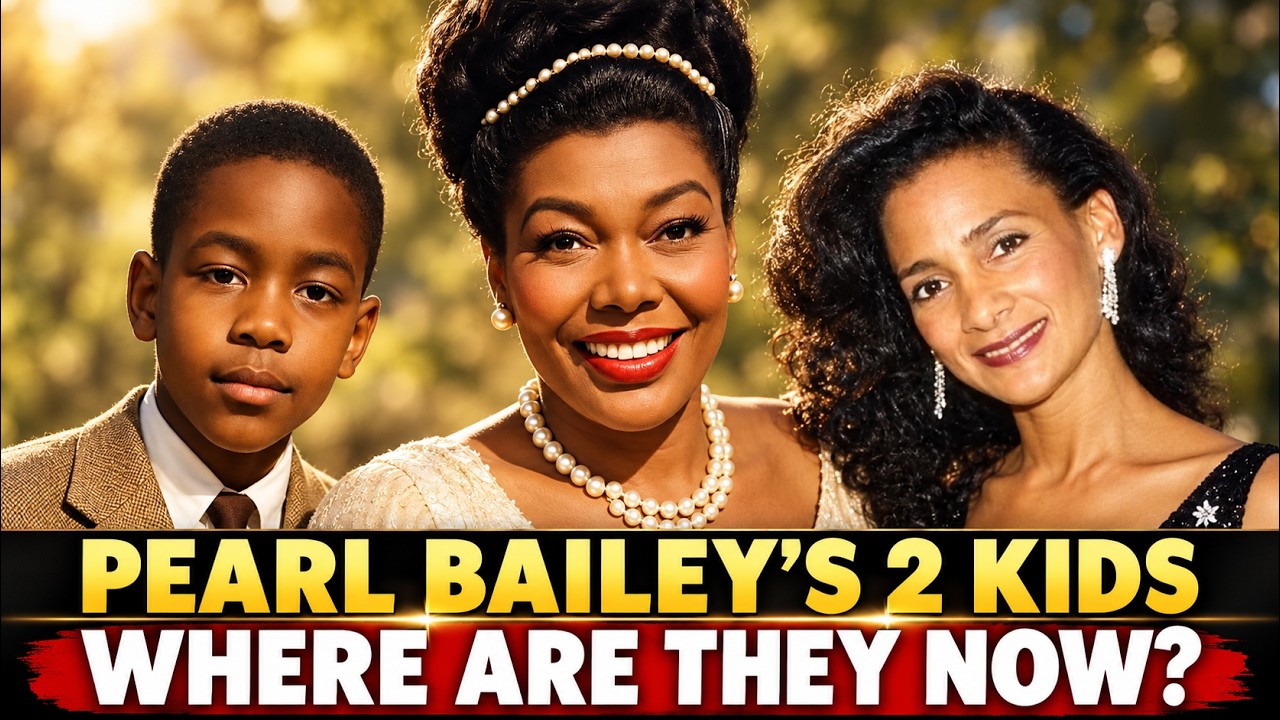
She became a mother. Becoming a mother did not mean slowing down, not for Pearl Bailey. The couple adopted two children: Tony Bellson in the mid-1950s, and later Dee Dee Bellson, born in 1960. In interviews, Pearl often spoke of her home life with warmth and humor.
She once said, “I don’t raise my voice in the house. If you can hold an audience of 3,000 with a whisper, you can raise two children without a shout. ” Parenting for Pearl was not a performance; it was a responsibility. Yet she never fully stepped away from her career.
She simply brought her children along for the ride. While raising Tony and Dee Dee, she continued to dominate the entertainment world. Her starring turn in Hello, Dolly! in 1967 had redefined her as a Broadway powerhouse.
She won a special Tony Award for the role and received high praise from critics. Theater critic Clive Barnes once wrote, “Pearl Bailey doesn’t enter the stage. She arrives like royalty and welcomes you into her kingdom. ” Even at the height of her fame, Pearl insisted on balance.
She would fly home after shows to tuck her children in. As they grew, Tony kept a lower profile, living largely out of the public eye. Dee Dee, however, inherited more than just her mother’s name; she had the music in her blood. As a young woman, Dee Dee Bellson began performing jazz and gospel, eventually singing with orchestras and in tribute concerts for her father, Louis.
She had her mother’s soul and her father’s rhythm, but not the same spotlight. In an interview, Dee Dee once said, “I never wanted to be my mother. I just wanted to carry what she gave me. ” Pearl watched proudly as Dee Dee took her own path, never pushing her to chase fame, only to pursue purpose.
Meanwhile, Pearl’s own career took yet another turn. In 1975, President Gerald Ford appointed her as the United States Ambassador of Love to the United Nations, an honorary title that captured everything she represented: charisma, diplomacy, and grace. Even in diplomacy, she remained uniquely Pearl. “There’s only one race, the human race,” she famously said in a 1976 UN speech.
By the late 1980s, she was still performing, still beloved, still outspoken. She published cookbooks and memoirs, and even earned a college degree at age 67. She authored memoirs like The Raw Pearl and Between You and Me, penned a cookbook, and published a spiritual guide reflecting her growing interest in theology. Then, in a move that inspired the country, she enrolled at Georgetown University at the age of 67.
She graduated in 1985 with a degree in theology and was honored that same year with the Presidential Medal of Freedom, the highest civilian award in the United States. But behind the strength, her health was beginning to fail. Pearl had long struggled with heart problems, and in the summer of 1990, her heart finally gave out. On August 17, 1990, in Philadelphia, Pearl Bailey died of heart failure.
She was 72 years old. Tributes poured in from around the world. Presidents, artists, journalists, and fans all paid tribute to the woman whose charm crossed generations and whose courage crossed color lines. But her greatest audience, her family, faced a more private grief.
Tony Bellson, Pearl’s son, had always kept a low profile. Little is known about his adult life. He never gave interviews and never courted fame. He passed away quietly in 2004 with almost no public record, no obituary in major papers, no fanfare.
He left no known children. Dee Dee Bellson carried more of her parents’ artistic spark. She performed jazz and gospel, often honoring her father’s musical legacy. “I’m not trying to live in their shadow,” she once said.
“I just want to keep their love alive through music. ” But on July 4, 2009, Dee Dee died suddenly of a heart attack in Charlottesville, Virginia. She was just 49 years old. Like her brother, she left no children.
In the literal sense, Pearl Bailey’s family line came to an end that summer. But her legacy did not. It lives on in her music, her words, and her groundbreaking performances. In 1981, she lent her unmistakable warmth to Disney’s The Fox and the Hound, voicing the wise and motherly owl Big Mama.
Her character helped guide the young fox Tod through heartbreak, friendship, and growing up, echoing the kind of loving guidance Pearl gave off stage. One line from the film, delivered with her signature blend of soul and softness, introduced her to a whole new generation: “Darling, forever is a long, long time, and time has a way of changing things. ”
Pearl Bailey did not leave behind a family dynasty in the traditional sense. Her children, Tony and Dee Dee, are gone.
There are no grandchildren carrying the Bellson name. Yet her voice still echoes in jazz standards, gospel records, and film. She once said, “People see me and think I’m just lucky. But luck has nothing to do with it.
I worked, I loved, I gave. ”
What she gave to her art, to her family, and to the public still lingers. Pearl Bailey may no longer walk among the living, and her family may have left this earth, but her spirit, her laughter, and her voice live on in films, in music, and in every young artist who finds the courage to be both brilliant and kind.
Legends like Pearl never really leave; they just change form.