For a hundred and fifty years, the spades have cut into the low Turkish hill called Hisarlik, and layer by layer, the ground has given up the record of a city’s death. The excavators found walls thrown down, bronze arrowheads driven into baked mudbrick, and scorch marks staining the earth a permanent black. They found the dead where they dropped around 1180 BC: a skeleton with a crushed skull near a doorway, slingstones piled where defenders once stood. Every scrap of evidence a court would need to prosecute a murder lay in the dirt—except the weapon.
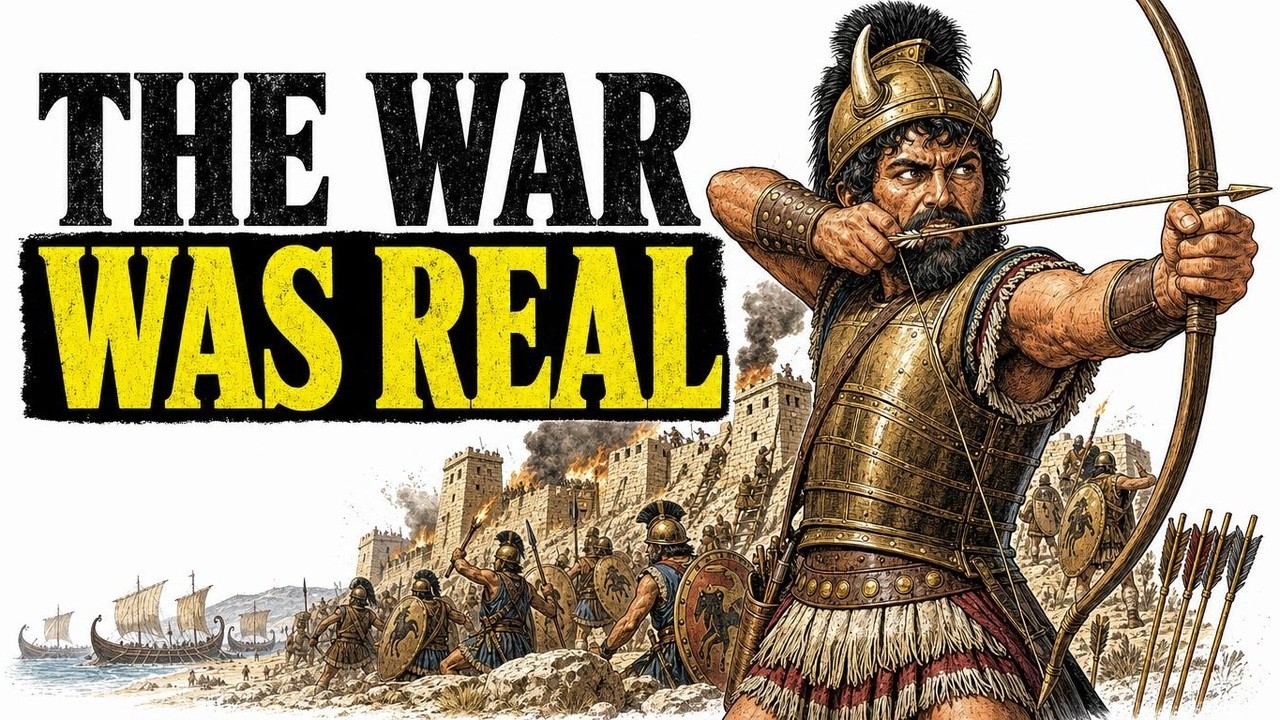
The most famous weapon in the history of warfare has left nothing behind, not a splinter, not a nail, not a trace. The soil remembers the fire and the killing. It does not remember a horse. The story we inherited is spotless.
Ten years of stalemate, then one elegant trick: the Greeks build a hollow wooden horse, hide their men inside, and sail out of sight. The Trojans, reading it as a surrender and a gift to the gods, haul it through their own gates. In the dark, the hidden men climb down, throw open the gates to the returned army, and the city burns. But the wooden horse rests on no witness.
It sits nowhere in the oldest epic of the war, the Iliad, which does not even reach the fall of the city and closes instead on the funeral of Hector. The Hittite scribes who tracked the conflict from their archives never set it down. And the ground itself has forgotten it. So how did Troy actually fall?
Before there was a firestorm, there was a ledger. Before the ledger, there was a hill. Hisarlik overlooks the narrow Dardanelles, the gate to the sea that runs up to the Black Sea and the grain fields beyond. A ship sailing north must fight a current and a wind that funnel down the channel, often waiting weeks on the Trojan shore for the weather to turn.
A city that controlled that shore could charge every captain for the privilege. So the ships kept coming, and the cities on the hill kept dying and rising in the same spot for roughly three thousand years, each paid for by the tolls of men who had no choice but to pass. The first man to dig here with real money was Heinrich Schliemann, a merchant who poured his fortune into a boyhood fixation with Homer. He began serious work in 1871, driving a great trench straight through the mound and blasting downward through centuries of stratified history.
In 1873, he found a cache of gold vessels and jewelry he named Priam’s Treasure, but the date was wrong by more than a thousand years, and in racing down to it, he had cut through and half destroyed the very layer that carried the evidence he claimed to seek. The men who came after him were a different species. Wilhelm Dörpfeld and later the American Carl Blegen dug the site with a discipline that bordered on obsession, logging every potsherd by depth, numbering every bead and scrap of charred bone, and tying each object to the exact band of soil it came from. It was inside those patient records that the real Troy climbed back out of the mess Schliemann had left.
Blegen and Dörpfeld isolated two layers. Troy VI was the grand one, a wealthy city whose walls ran nearly five meters thick and rose more than nine meters high, faced with limestone blocks cut and fitted so tight they needed no mortar. Around 1250 BC, those walls came down. But the destruction was strangely clean: little fire, few weapons in the streets, no bodies cut down in the lanes.
The reading most excavators accept is blunt. Troy VI was not stormed. It was shaken apart by an earthquake, for the hill sits on a fault. But the survivors stayed and rebuilt, and what they built was a different place in every way that mattered.
The grand houses were carved up into small, cramped cells. The broad streets narrowed as people threw up new rooms against the old walls. And across nearly every house, the excavators found large storage vessels sunk deep into the floors with grain, oil, and water sealed below ground in quantities that only make sense if the people expected to be cut off from the fields outside for a long time. This was not the floor plan of a town at peace.
It was the floor plan of a fortress bracing for a siege. Around 1180 BC, that fortress was destroyed in a way that leaves no room for an act of God. Across the whole footprint of the layer called Troy VIIb, there runs a single continuous band of ash and charcoal, in places a full meter deep. It is the fingerprint of a citywide firestorm.
Set inside that ash, the diggers found the hardware of a battle: dozens of bronze arrowheads lying in the lanes and driven into fallen walls, and a large number were of a design associated not with local Anatolian manufacture but with the Mycenaean Greeks across the sea. Arrowheads are the one weapon an attacker cannot recover, loosed by the hundred and left where they land. In the wreckage of the houses, the excavators found people who were never buried: a man left where he fell in a doorway with his skull broken, fragments of others in the rubble and the lanes. A community that leaves its own dead lying in the open is not a community anymore.
The sack was so fast and so total that no one was left free to perform the rites of burial. The crime is not in doubt. A real city, known to the Hittite archives and ruled by kings who signed treaties with an empire, was attacked by an army carrying Greek-pattern weapons, overrun, stripped, and burned to nothing. The date lines up cleanly with the timeline the ancient writers handed down.
The war happened. The war was real. Which leaves exactly one question, and it is the one the soil refuses to answer. Those walls were nearly five meters thick, stepped and towered and built to break a battering ram.
Every trace of the killing sits behind defenses that should have held for years. How did an army carrying nothing but bronze and rope get past a wall built to stop exactly that, and leave no shattered gate, no toppled section, no breach at all? For the method, we have to open the books. The fullest version of the horse we possess was written by Virgil, a court poet in the pay of Emperor Augustus, working around 20 BC, more than a thousand years after the city burned.
His epic, the Aeneid, was engineered to give Rome a founding bloodline running back to the heroes of Troy. Augustus needed his family, the Julii, to descend from Aeneas, so a poem that made Aeneas the seed of Rome made Augustus the flower of a plan the gods had laid down before Troy even fell. The horse arriving in the second book of that poem is magnificent writing, but it is a commission, not a witness. There is, however, a witness who stood nearer the event.
It is a picture on the Mykonos Vase, a large terracotta pot made around 675 BC, the earliest depiction of the fall of Troy ever recovered. On the neck of the vase sits the horse, and it is no graceful sculpture of a stallion. It is a box on four wheels, built of planks with the joints visible, and cut into its flank is a row of square openings. In each opening, the artist has drawn a man with a helmet and a spear held ready, faces looking out through the ports of the machine.
There is no disguise here. Nothing about it says offering to a god. It says military hardware. That single image points to a reading skeptics have advanced for a very long time.
The Trojan horse was never a trick. It was a name, a poet’s word for a siege engine. In the centuries around the fall of Troy, the Assyrians were the masters of the siege, and their palace reliefs show engineers driving heavy timber-framed machines up against enemy walls: wheeled battering rams roofed and sheathed in a wooden shell to shield the crew inside. The crews draped these machines with soaked animal hides, sometimes horse hides.
A Trojan sentry on the eastern wall at first light would have seen a great wooden shape covered in dark wet skins rolling toward his gate. He had no word in his language for a timber assault frame draped in horsehide, so when the poets came generations later to sing of what his grandfathers had faced, they did not call it a mobile assault platform. They called it the wooden horse. There is a second reading that runs alongside it.
Troy sat above underground springs and a high water table, and some who have studied the site argue the horse was a name for a device that broke into the walls at their weakest point, where damp had already loosened the mudbrick. The Greeks tied horses to their sea god Poseidon, who was also the god who shook the earth and moved the waters. The ancient geographer Pausanias reached this conclusion and set it down without flinching, writing that the work of Epeius was a contrivance for breaking a hole in the Trojan wall, and that this was the plain truth of the matter, however much tradition preferred to dress it as an animal. Then the Hittite archive delivers its confirmation.
At Hattusa, the Hittite capital, excavators uncovered the state archive: thousands of clay tablets fired hard in the destruction that ended the city around 1200 BC. Treaties, tribute lists, letters between kings, and field reports from anxious provincial governors. In those documents, the Hittites write repeatedly about a strong kingdom to their west called Ahhiyawa, the Hittite name for the Mycenaean Greeks, the very people Homer’s armies belong to. They write about trouble stirred up over Wilusa, a major vassal city whose name maps cleanly onto the early Greek Wilion, which later softened into Ilios, Homer’s own name for Troy.
In one treaty struck around 1280 BC, the Hittite king binds himself to the king of Wilusa, and that king’s name, stamped into clay more than three thousand years ago, is Alaksandu, the Hittite form of Alexandros, the second name of the Trojan prince the Greeks called Paris. Another fragment names a warlord backed by Ahhiyawa who raided the coast for years, a real freebooter harassing a real frontier. And across thousands of tablets, through every complaint about Ahhiyawan raiders and every note on the wobbling loyalty of Wilusa, the Hittites never once record a ten-year siege, a colossal hollow horse, or a city taken by a trick. An intelligence service sharp enough to track a single warlord across the islands would have filled tablets analyzing a war-winning stratagem like the horse.
They did none of this. The only reading that fits is that there was nothing of the kind to report. So the horse is gone from the crime scene. What remains is real: a burned city, foreign arrows in the streets, the unburied dead.
The Greeks got past the wall, and the answer has to come from the dirt and the language. The first candidate is not an army at all. Grand Troy VI fell to an earthquake, and Poseidon, whose sacred animal was the horse, was also the god of earthquakes. The survivors of the rebuilt city, generation after generation in the cramped rooms, may have told the story that the earthshaker himself struck the foundations, that the horse of the god brought down their defenses.
A real event folded into a single image, hardened across centuries into a wooden horse that fooled the gate. The second candidate keeps the trick but strips out the miracle. The naval historian Francesco Tiboni went back to the words the later poets used for building the horse, and they are the exact technical terms of the shipwright: planking, ribbing, the mortise and tenon joints that lock a hull together. In the Bronze Age, a class of merchant vessel used by Greek and Phoenician traders was carved with a horse’s head at the prow, and sailors called these ships hippoi, horses.
Through the long siege, the Greeks may have taken a Trojan hippos, a vessel the city knew well, beached it on the shore as a parting offering, and rowed the fleet out of sight. At dawn, the Trojans came down to find one of their own famous ships sitting on the sand, hauled it into the city to celebrate, and deep in the cargo hold, a picked detachment of Greek soldiers waited to climb out and open the gates. Every bone of the myth is there, but set back on the solid ground of Bronze Age sailing and war. The forensic layer proves a military conquest by fire and blade.
The Hittite archive proves the war was real and the horse was not. The three sober killers—a siege engine, an earthquake, a captured ship—stand ready to replace the mythical one, and it hardly matters which of them did the work, because each is possible, and the horse of the legend is not. The myth of the horse takes a grinding ten-year war fought for tolls and harbor rights and turns it into a parable about brains beating brawn, then moves the blame. In the legend, the Trojans are not just beaten; they are fools who drag the instrument of their own destruction through their gates, made the authors of their own slaughter.
The story washes a massacre clean and hands it back as a lesson about not trusting gifts. The people of Troy were not fools who fell for a trick. They were the losers of a savage war, and the winners took even their death from them, rewrote it, and dressed it up until the weapon that ended them was remembered not as a tool of killing, but as a work of art. Centuries after the fires, Greek and Roman rulers still sailed to the Troad to stand on the mound and buy the story whole.
Xerxes stopped here in 480 BC and sacrificed a thousand cattle to the Trojan goddess before crossing into Europe. Alexander the Great came in 334 BC, ran naked around what he was told was the tomb of Achilles, anointed the stone with oil, and carried an ancient shield from a temple into his campaigns. Julius Caesar walked the ruins, and Augustus visited and ordered the crumbling temple of Athena at Ilium restored. They came one after another to touch a legend and borrow its shine, and under their feet, unread, lay the meter of ash, the foreign arrowheads, and the man dead in his own doorway.
The true story was in the ground the whole time. It only needed someone to stop reciting the poem and start reading the dirt.