In 1901, a traveling portrait photographer named Elmore Cisk drove his wagon up a lane in the western North Carolina mountains to the house at Sinner’s Bend, a seven-acre bench of ground on the Little Fool River that had changed hands eleven times in twenty-seven years before a man named Roland Thrill finally held onto it. Cisk had come because a note had been left for him at the hotel in the county seat, written in a woman’s careful hand, asking him to make a family portrait of the six of them. The woman was Vada Thrill, and she had signed the note herself, but there were only five in her family. Her fourth child, a girl named Bula, had died of scarlet fever in 1898 at four years old, and Vada had been grieving her ever since.
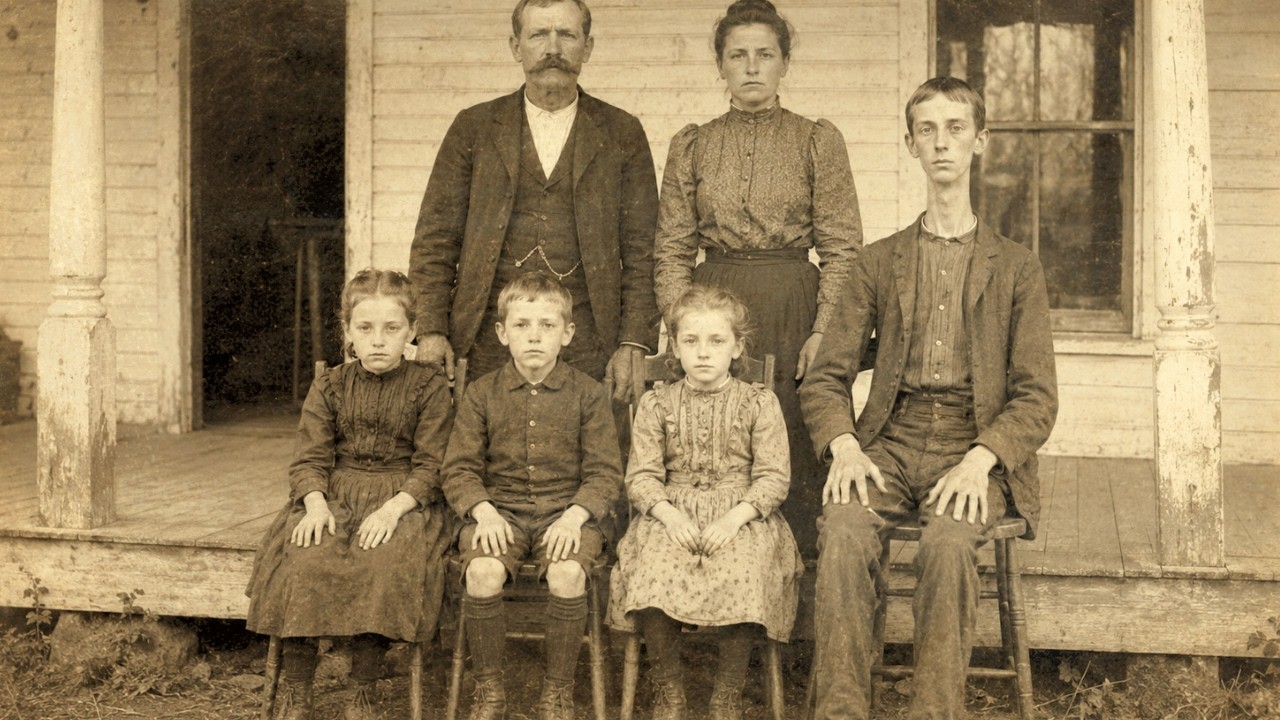
She wrote six anyway, and did not correct it. The Thrills had lived at Sinner’s Bend since 1888, when Isaiah Thrill inherited the house from his uncle Roland. Roland had built the place and lived in it alone for twenty years, refusing to allow anyone to photograph even the house, and once driving off a portrait man with a shotgun. When he died, his will contained an odd warning: do not sit for a picture in this yard, do not let anyone else sit for a picture in this yard, do not build anything that will hold a picture in this yard.
Isaiah read the line and folded the paper away without telling his wife. That was the first mistake. On the afternoon of May 7, 1901, Vada had already been warned more directly. That morning, an old woman named Aunt Nomi Cheek, known across the valley for knowing things, had come to the house unannounced and told Vada three things: do not have the picture made in that yard, because the ground is what gets in through a picture; if you must sit for it, sit indoors; and if the picture comes out with your Bula in it, do not hang it on a wall, wrap it in black cloth, put it in a box, and never look at it at night.
Vada heard the warnings clearly and folded them away. She wanted a picture of what was left of her family. She had lost a child and had never been able to see the shape of what she had lost fit back into place, and a portrait was the closest she could get. The sitting was ordinary.
Cisk arranged the family on the porch, the father standing at the back, the mother seated with her youngest boy in front of her, four children ranked along the step. The first exposure spoiled because Vada moved, feeling a small warm pressure on her forearm at the height of a four-year-old’s hand. She sat still through the second exposure and let the picture take. Cisk developed the plates that night.
The spoiled one was nothing. The clean one came up strange. On the plate was a well-focused family portrait, but the hands were wrong. All eight of the children’s hands were wrong.
The twelve-year-old boy’s right hand was the size of a four-year-old’s. The ten-year-old girl’s hands were too small, the size of a six-year-old’s. And on the shoulder of the smallest girl, coming out of nothing behind her, was a small child’s hand no arm, no body attached. On the pad of its thumb was a healed scar, half an inch long, the exact scar left by a knife cut Bula Thrill had made on her left thumb in 1897, a scar that nobody in the family talked about after she died.
Cisk never delivered the print. He told the family the plate had spoiled again, refunded the dollar and a half, and put the plate in a locked drawer. He never went back into that county again. But the plate was not the door.
The sitting was the door. When Vada chose to sit still and let the picture take, a thing that had waited in the ground under the bend for years came up through the porch step. And the plate going away did not close it. Vada began to notice small wrongnesses in her house within two days.
A sixth cup appeared on the shelf. A penny disappeared and reappeared inside the flour tin. A chair that had belonged to Bula was found pulled out from the table when nobody had been at the table. A towel was folded in a way Vada had not used since childhood, a way her dead daughter had once tried to imitate.
In August, her two-year-old son Juny walked into the front room and described a little girl standing in the corner who was pieces of two of Vada’s daughters put together into a whole child. Vada went to Aunt Nomi Cheek, who told her plainly: it is not your Bula, it is a thing that copies your family, it has your daughter in its copy book, and every day it copies you it gets better. You do not feed it. You do not name it.
You do not answer it. And never, ever go and put your arms around a thing you cannot see and call it by your dead child’s name. On December 12, 1901, at three in the morning, the copiest tried the door in earnest. From just outside the bedroom came the voice of a small child, close to Bula’s voice but not right, asking for help finding a picture in a book.
Vada caught the error, but then understood with a cold clarity that the thing had heard her thought and corrected itself. It was inside her head. It could read her moves before she made them. From that night on, she trained her own mind to go flat.
She refused to weep in her own front room. She refused to laugh out loud at her own table. She never again told her husband plainly that she loved him. For twenty-one years and eight months, she kept a thing in her house and gave it no water.
She counted stovewood in her head at three in the morning. She checked the loft box in daylight only. She never went up to that place after dark. The copiest stayed quiet for years, settling into small weekly incidents that Vada learned to correct without reaction.
Her two children who grew up in the house carried it with them for life: one would not sit in a room with an uncovered mirror after dark, the other would not sit with his back to any door, a rule his mother gave him at five and never explained, and which he kept until he died without ever knowing why. In 1912, Cisk, who had spent eleven years watching the figure appear in the background of his other portraits, learned he could not contain it anymore. He made one print from the original plate and mailed it to Vada with no return address. She opened it alone at night in her kitchen and looked at it for the length of a single Lord’s Prayer.
She saw her family as she remembered them. She saw the wrong hands. She saw the scar on the small hand resting on her living daughter’s shoulder. Then, for the first time in eleven years, she let herself think: Bula is in this picture.
From the loft above her came the small sound of pages turning. She did not go up. She wrapped the photograph back in its black cloth and buried it in the yard, three feet down against the north fence line, giving it back to the ground it had come from. The ground took it.
For the first time in eleven years, she slept through six nights in a row. In the summer of 1922, with the children gone and only Isaiah and Vada left in the house, the copiest stopped trying to reach Vada and went for Isaiah instead. On the night of January 8, 1923, Vada woke to her husband answering questions in a calm voice. He was talking to something that called itself his uncle Roland, dead for thirty-five years, and it knew words that no living person had ever heard him say.
It promised him that the springhouse door led to its release and that his uncle had been down there since 1889, when Isaiah himself had helped build the springhouse. Isaiah stood at the edge of the bed in the cold, in his bare feet, and Vada told him that it was a copiest, a learned thing, that his uncle was gone, and that in the morning they were leaving this place and never coming back. He sat back down on the edge of the bed, and they held hands in the moonlight by the window while the voice tried three more times, once in Roland’s voice, once in the voice of a four-year-old girl calling Mumsy through the door, and once, just before dawn, in Vada’s own voice from the kitchen. Neither of them answered.
At first light, they packed a single carpet bag. They carried out two photographs: the small tintype of Bula from the mantelpiece and their own wedding photograph from the bedroom wall, placing both face down at the bottom of the bag. They did not lock the front door behind them. At the mouth of the lane, Vada turned once and saw, in the small east window of the bedroom, the pale shape of a four-year-old girl standing on one foot, watching the wagon go.
She looked for three seconds, turned back, and did not look again. Isaiah signed the deed over to the county for taxes owed in March of 1923. He got nothing for it. The county never sold it.
It has never sold in the more than a hundred years since. Isaiah died in 1931 and was buried in the churchyard in town, not on the ridge above the bend. Vada lived twenty more years, kept a diary from 1940 to 1943, and in her last years, by her own account, talked in her yard to her actual daughter, Bula, not to the copiest. She was sure of the difference.
She wrote that Bula never asked her to open a door, never knocked, never called from another room. Bula stood beside her while she hung laundry and hummed off key, the way she had hummed at three. The copiest, she said, could only do the shape of a hum. It never got the off key right.
Vada died at seventy-five in 1943 and was buried beside her husband. Her four living children stood at the grave, and a fifth shovel of dirt was taken from the pile at the far end and cast onto the coffin by no hand anyone could name. The original glass plate was found in 1987 in a locked safe in a Charleston photographic studio, wrapped in black cloth. It was donated to the state archive in Raleigh, where it rests today under climate control.
A final count of the hands on that plate, made under magnification in 1994, came out to nine children’s hands in a photograph of four children. The ninth hand rests on a shoulder, coming up out of nothing behind the row. On the pad of its thumb is a small pale line of a healed scar, half an inch long.
And on the flyleaf of a Bible, written in ink in her own hand five months after the picture was made, Vada Thrill wrote three words, which she was never able to explain until the diary of her last years: there are five.