On the morning of June 6, 1944, a young Coast Guard coxswain’s assistant stood in a Higgins boat packed with soldiers from the Army’s 1st Infantry Division, the Big Red One, as it churned through the gray English Channel toward Omaha Beach. He was nineteen years old. Eleven miles of open water separated the transport ships from the shore because the Germans had the 88-millimeter gun, the finest artillery piece of the war, with a range of ten miles. The journey to the beach took two hours.
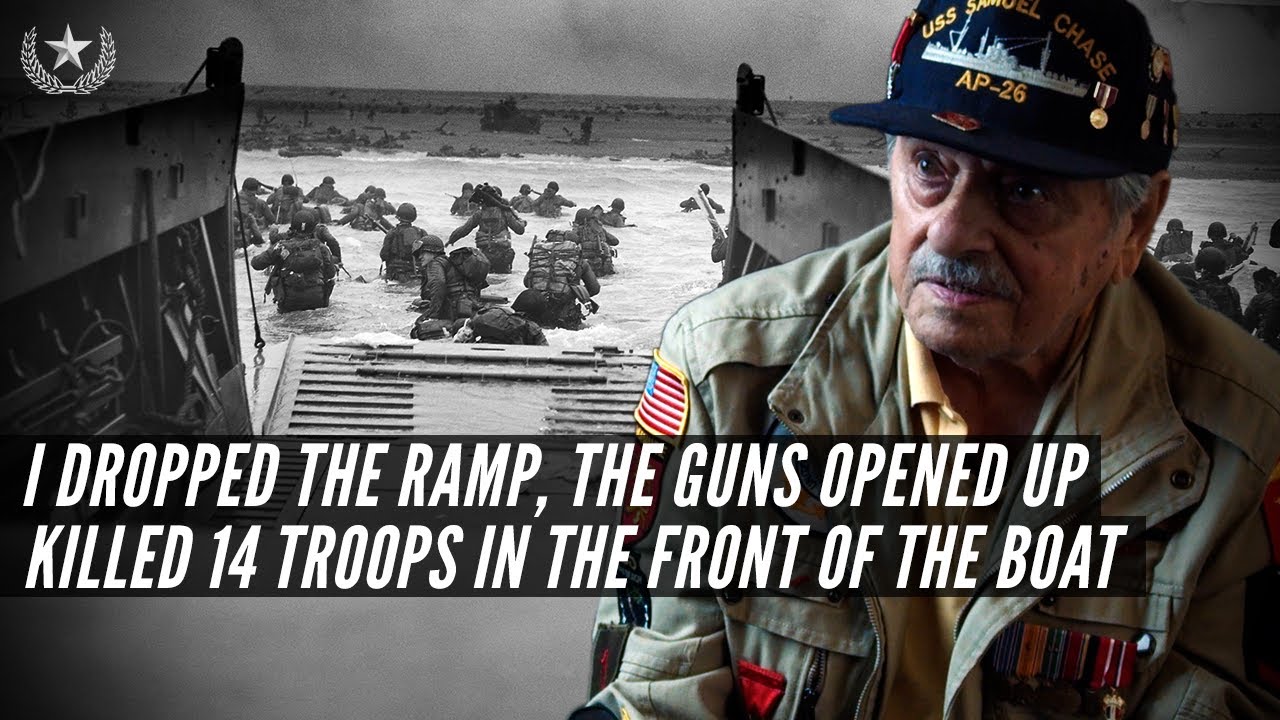
The soldiers around him were singing and laughing, telling jokes, unaware, he later recalled, that they were heading to their deaths. The man was David DeVito, a Brooklyn-born kid who had volunteered for service after Pearl Harbor, like so many others of his generation. He had tried the Air Force first, hoping to be a belly gunner, but failed the physical due to poor peripheral vision. The Navy accepted him but told him to come back in six weeks.
He wanted to go immediately. So he walked next door and joined the Coast Guard. His mother was pleased, thinking he would spend the war patrolling beaches near home. Six weeks after boot camp, he was on a ship bound for Europe.
On the morning of the invasion, the Coast Guard had loaded the troops with bacon and eggs, a full breakfast meant to fortify them. It was a terrible mistake. The men were violently seasick before they ever reached the shore. DeVito’s job, originally a gunner’s mate in charge of four 20-millimeter anti-aircraft guns, had been changed weeks earlier.
Without explanation, his machine gun was taken away, and he was assigned to drop the ramp at the front of the Higgins boat. The ramp was made of thick metal, thick enough that bullets bounced off it as the boat approached the beach. But he knew that once he dropped it, the soldiers inside would be exposed. They got to within about 200 yards of the beach when the German machine guns opened fire.
The coxswain shouted for him to drop the ramp. He could not hear over the roar of the two big diesel engines. The coxswain shouted again. DeVito froze.
He did not want to die. The third time, the coxswain cursed at him, and he pulled the lever. The machine guns cut down fourteen or fifteen soldiers in the front of the boat. DeVito was three-quarters of the way back, shielded by the bodies of the men in front of him.
Two stragglers stayed near him, thinking they would be safer. One was hit in the stomach; the other, a redheaded kid, took a bullet to the head. He fell at DeVito’s feet, crying for help. DeVito had no morphine.
He began to pray the Lord’s Prayer but never finished. The boy slumped and died. DeVito reached down and squeezed his hand, wanting him to know he was not alone. The coxswain ordered him to raise the ramp.
It would not move. DeVito pulled the handle again and again. The ramp was blocked. He had to crawl over the dead bodies to reach it, apologizing to them as he climbed.
There were still about fifteen living soldiers on the boat, and his job was to protect them. When he finally reached the ramp, he found two dead soldiers who had never gotten out. Their bodies, plus the weight of the men’s heavy packs, had pinned the ramp down. Another crewman helped him pull the bodies back into the boat.
Once they were clear, the ramp lifted by itself. The Germans were diabolical, he remembered. Beyond the mines and machine guns, the beach was littered with telephone poles topped with mines, balanced loosely so that bumping the pole would drop an explosive into a passing boat. The coxswain, a little kid from Brooklyn, managed to turn the boat around and head back through the obstacles to the transport ship.
On the way, they spotted a hospital ship with a big red cross. They went alongside, and two men from the hospital ship jumped into the boat. They peeled the dead off the wounded, pulling the wounded men aboard. DeVito did not know how many.
He was in shock. But he was glad those men would receive care. Back on his ship, he was interviewed by a Navy officer and a big Army officer, who tapped him on the shoulder and told him it was all right. The Army officer gave him a piece of advice: the German machine guns could only fire for so long before their barrels overheated and had to be changed.
When they changed barrels, he said, that was when you drop the ramp. You had two or three seconds. DeVito stood on deck alone, covered in blood and vomit, and asked himself whether he could go back. He did not want to die.
But he thought of the replacement they would send in his place, and wondered how he could live with himself if that man was killed. He went back. He made the run to the beach fifteen times that day. Omaha Beach was the worst of the five invasion beaches.
By the end of the day, there were two thousand casualties on it. The Germans held the high ground and slaughtered the troops as they landed on flat sand where there was no place to hide. The men from the first waves were cut down so fast, the coxswains had to try again and again. One destroyer, the Frankfort, came in close to shore and then turned broadside to the German guns, exposing its beam so it could fire all its five-inch guns at once at the German positions on the slope.
It was a deliberate sacrifice, and it took out the machine-gun positions that were slaughtering the infantry. By the fifth wave, the transports had run out of troops, so the 29th Division, originally landed on Utah Beach, was swung over to help the 1st Division. After that, the boats stopped bringing men in and started taking the dead and wounded off. DeVito, who weighed one hundred twenty-five pounds, could not lift the soldiers by himself.
Two or three men together hauled them into the boats. His friend John Ola, a quartermaster, dispensed three hundred eight body bags. DeVito remembered the number because his friend had handed out each one. Then his boat was brought up.
It looked like Swiss cheese, riddled with machine-gun fire. He could not understand how anyone had survived on it. The captain, a man named Fresh, understood what his crew had been through. They sailed back to Southampton, their home base.
Aboard ship, an announcement offered cheese sandwiches and coffee to the crews who had gone into the beach. DeVito did not go. He stank, and he did not want anyone to see him cry. He went back to his 20-millimeter guns and sat alone, reflecting.
He asked himself what the hell had just happened and how he was still alive. When he turned around, he saw the three hundred eight dead bodies stacked like cordwood. He cried himself to sleep. The next morning, when they pulled into Southampton, someone tapped him on the shoulder and told him it was time to unload the dead and the wounded.
His home base was Glasgow, Scotland. He made two more invasions after D-Day: the invasion of southern France and the Philippines, earning three battle stars. The war in the Pacific came after the horror of the two French landings, and he was in Okinawa when the kamikazes came over. They were sinking destroyers and aircraft carriers, not transports, so his ship was spared.
On the way back, his transport hit a coral reef and took a seventeen-foot gash in the hull. The hatches were closed, as they had not been on the Titanic, and the ship limped to the Philippines for a dry dock. From there they sailed to San Diego. He went AWOL to see his mother, with a friend promising to call if the ship came out of dry dock.
He boarded a troop train in San Francisco, ran a mile and a half to his house, and found his mother at the church rolling bandages. When she turned around and saw him, she fainted. He thought he had killed her. He was home for two weeks, and his father, who had served in the First World War, became suspicious.
The old man drove him to Grand Central Station and delivered him to two military police, saying, that kid over there is my son and he belongs back with his unit. DeVito climbed back on the train and returned to his ship. Seventy-six years later, he said he relived D-Day every day. The other battles did not haunt him the same way.
D-Day was the worst, and it never left him. The memory that stuck most was the two thousand dead on the beach. He refused the label of hero. He called himself a survivor.
There was a cemetery in Normandy overlooking Omaha Beach, he said, with ninety-four hundred American kids in the ground. Those were his heroes. They gave their lives for their country. He had one last story.
While serving in the occupation of Japan after the war, a small Japanese woman, about five feet tall, walked up to him. She bowed and then thanked him. He asked why. She said, because the war is over.
It is the big people who make wars, not the common people. They are the ones who get hurt.