It took thirty-five years for someone to finally say what he had seen. In the autumn of 1984, Fair Haven, Connecticut was a town built on old money, quiet influence, and the unspoken rule that appearances mattered more than truth. White-columned homes stood behind stone walls, sailboats dotted the harbor, and the country club had decided who mattered for a century. The fathers commuted to the city, the mothers ran charity events, and the children were expected to inherit bright futures.
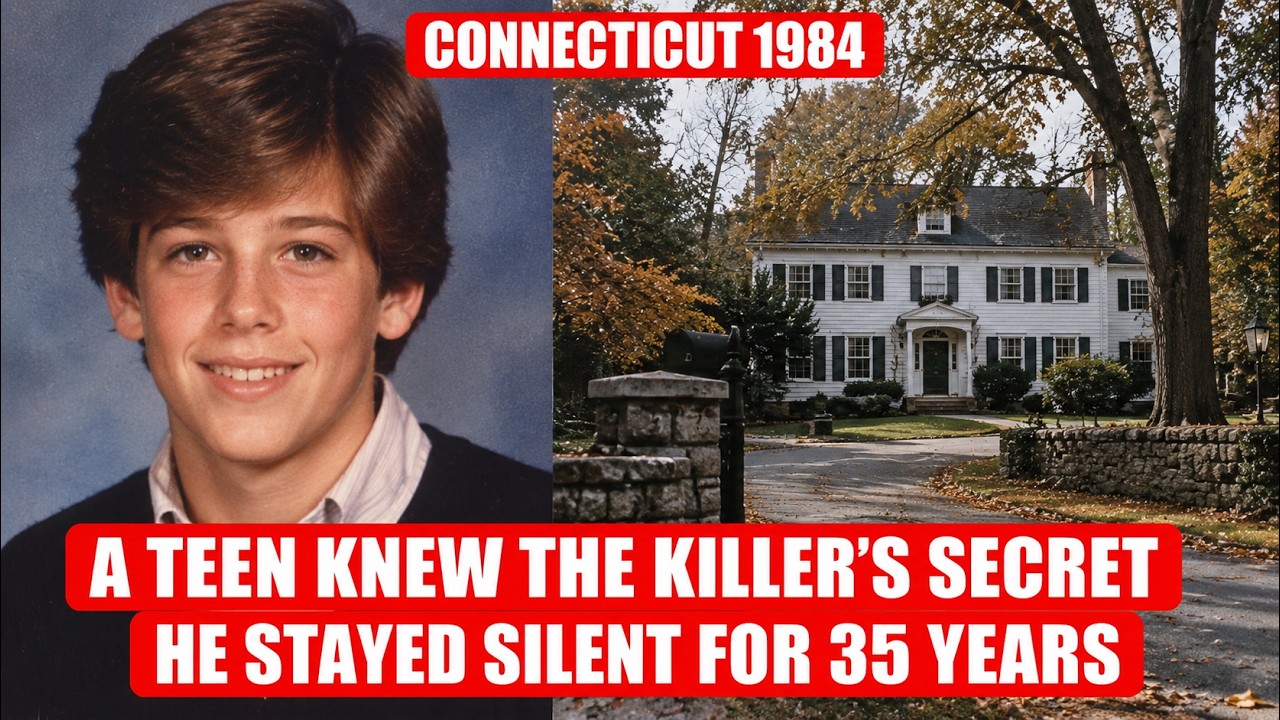
It was a town practiced in making uncomfortable things disappear. The people who cleaned the houses, tended the gardens, and parked the cars were almost invisible to those who lived behind the gates. Twenty-three-year-old Coral Whiteman was one of those people. She worked as a live-in nanny and housekeeper for one of Fair Haven’s most established families, the Ashford Coles, caring for their two young children in their large waterfront home.
She came from a working-class family in a neighboring town, the daughter of a mechanic and a hospital aide. She was putting herself through night school to become a nurse, driving forty minutes each way after the children were asleep. By everyone’s account she was warm, intelligent, and beloved by the two boys she looked after, ages five and seven, who would ask for years what had happened to her without ever getting a real answer. She had a younger brother she helped support, and a fiancé named Danny who fixed cars and was saving for a wedding ring.
She also had a habit known to the Ashford Cole household staff: she wrote everything down in a small notebook she kept in the pocket of her apron. Schedules, homework, shifts, and private notes in her precise, tiny handwriting. That notebook would matter more than anyone could have imagined. On the night of October 11, 1984, during a large party at the Ashford Cole residence, Coral Whiteman was found dead at the bottom of the back staircase leading to the family’s private wing.
Fair Haven handled the death of the young woman who worked for its finest family with remarkable speed and efficiency. The narrative formed almost immediately: a tragic accident, a stumble on a dark staircase during a crowded party, horrible but no one’s fault. The Ashford Cole family doctor, a country club member, readily signed off on the accidental death ruling. The town’s police chief, whose budget and standing depended on the satisfaction of families like the Ashford Coles, conducted what could charitably be called a brief investigation.
The party guests, the very elite of Fair Haven, were barely questioned and certainly not pressed. Coral was buried in her hometown within a week, mourned by her family, and quietly forgotten by the town where she died. The file was closed. Accident.
Move on. The detail that never made sense, and that no one in authority chose to examine, was the staircase and the injuries themselves, which, if looked at honestly, did not match a simple fall. But an honest look was exactly what Fair Haven’s machinery was designed to prevent. There was also the small matter of the notebook, which had been in Coral’s apron pocket and simply disappeared after her death, though no one with the power to ask seemed to notice or care.
The only person in a position of responsibility who refused to believe the story was a young patrol officer named Frank Delgado, twenty-six years old, the son of immigrants, new to the Fair Haven police force and never quite part of it. He had been at the scene. He thought the fall was not natural and told the chief so, only to be told plainly that the Ashford Coles were not a family a young officer wanted to trouble, and that the matter was closed. Frank Delgado recorded his doubts in his own report.
The report was buried. He kept a copy. He kept it for thirty-five years. While the town moved on, Coral’s family grieved for a daughter they were quietly told to feel fortunate had received a decent funeral.
Her fiancé, Danny, never believed it was an accident and said so, and Fair Haven treated him like a hysterical working-class boy who did not understand how things worked. Her brother grew up certain that Coral had not simply fallen, and just as certain that the people who could have asked questions chose not to. But there was someone else who knew the truth, someone who never crossed the minds of anyone in Fair Haven, not then and not for decades. That night, seventeen-year-old Tommy Reyes was parking cars at the edge of the Ashford Cole party, a local boy working as a valet for the catering company, invisible to every guest who handed him keys and a folded bill without once looking him in the eye.
From the darkness of the long, winding driveway, between trips up and down the rows of Mercedes and Jaguars, Tommy glanced at the lit windows of the family’s private wing and saw, on the landing of that back staircase, Coral, whom he knew a little and liked, and a man, and a silent argument. Then the man’s hands, a hard shove, and Coral was no longer on the landing. The light was clear enough that he saw exactly who the man was. And seventeen-year-old Tommy Reyes, brown-skinned, poor, working a shift for tips, understood in that instant that if he told anyone he had seen the son of the most powerful family in Fair Haven do this, his word would mean nothing against theirs.
A catering valet against the Ashford Coles. He knew exactly how that confrontation would end. He had lived his whole life in the shadow of what that family owned. He drove home that night with his hands shaking on the wheel and told no one.
The fear set in his chest like concrete and stayed there for thirty-five years. By 1994, ten years had passed. The Ashford Cole children Coral had raised were teenagers now, sent off to boarding school. If they still remembered the kind young woman who read to them and bandaged their scraped knees, no one encouraged them to say so.
The family’s standing had never been affected. The family patriarch, Bradford Ashford Cole, sat on hospital boards, and a wing of the regional medical center was named for him, his name carved in granite above the door. Frank Delgado left the Fair Haven police to join a state agency, unable to stomach the place and the way it had taught him things worked. He kept his buried report in a file box at home, taking it out sometimes the way you press an old bruise to see if it still hurts.
Tommy Reyes grew up, moved to another state, started a contracting business, married a woman he never told the full story, and raised children. He never said aloud, for all those years, what he had seen through the tall windows on that lit landing. He told himself he had been a child, that he had not been sure, that no one would have believed him anyway. Some nights, he almost believed himself.
In 2010, Coral’s fiancé Danny died of a heart attack at fifty-one, never having married, and those who knew him said something inside him had stopped that October night in 1984. Coral’s brother Michael, now middle-aged, quietly took on the single task of insisting his sister had not fallen down stairs. He petitioned the Fair Haven police twice to reopen the case and was refused both times with polite letters. Accidental death, twenty-six years old.
Old, thin file. No evidence. No basis for reopening. The town had no desire to do so, and neither, understandably unspoken, did the family it would have touched.
It was not until 2019 that the man whose authority had buried the case finally died. Bradford Ashford Cole, the patriarch whose influence had dominated the case from the first night, passed away at ninety-one. With his death, something loosened. Tommy Reyes, now fifty-two, a mature man with children of his own, living in another state far from the frightened boy in the driveway, read the old man’s obituary, full of honors and conspicuously silent about a dead nanny, and felt he could no longer carry it.
The fear that had bound him at seventeen no longer controlled the man he had become. He found the number for the state’s cold case unit, called, and spoke the sentence he had been unable to say for thirty-five years: I saw who did it. The case was reopened not by technology but by the death of the man whose power had bought a town’s silence and the release of the boy that power had forced into fear. Tommy’s testimony reached state investigator Aaron Mackey, and what he described was specific, consistent, and incriminating.
The kind of detail that does not come from invention. The lit landing seen through the tall windows from the darkness of the driveway. The argument, the raised voices he could not hear but could see. The shove, and the man he watched do it.
Not the deceased patriarch, but his son, Spencer Ashford Cole, who had been twenty-five in 1984, the younger brother of Coral’s employer, a man known ever since for a temper. The family had handled the matter with money, lawyers, and a quiet word in the right ear. Spencer was now sixty, living comfortably off the family fortune, never having worked a day he had not chosen, untouched by any consequence of the death in his brother’s house. One witness, after thirty-five years, was not enough, and Mackey knew it.
A defense attorney could dismantle decades-old testimony in a single hearing. So he began searching for anything that could corroborate the account of a long-frightened valet, and two things emerged that changed everything. The first was Frank Delgado, the long-retired officer whose name appeared nowhere in the official file. Mackey only found him after pulling the original 1984 patrol schedule.
When asked, Delgado went up to his attic and brought down the report of doubts his chief had ordered buried thirty-five years earlier, the report documenting injuries that had never matched a simple fall down stairs. The second was the appointment book. Coral’s precise notebook, missing from her apron pocket since the night of her death, had surfaced in the most quietly damning place imaginable: among the personal effects of the late Bradford Ashford Cole, the family patriarch, who had apparently taken it and kept it locked away for thirty-five years to control what it contained. It contained a great deal.
In Coral’s small, precise handwriting were notes from the weeks before her death. Spencer had been frightening her. He had cornered her twice in the house. She had told the children’s mother, who made it clear she was not to make trouble for the family.
The witness, the buried report, and the dead girl’s own words in her own hand were enough, together. Faced with all of it, without the protection of his late father’s authority, Spencer Ashford Cole’s lawyers fought hard, but the case held. He was arrested in 2020 and charged with the murder of Coral Whiteman. When the news broke, Fair Haven reacted the way such towns do when what was swept under the rug is finally exposed: with public shock and private discomfort.
The arrest condemned not only Spencer Ashford Cole but the entire machinery of deference that had protected him. The doctor who signed the death certificate, the chief who closed the case, the guests who said nothing, the town that found it easier to call it an accident. The hardest calculation was how long the community had willingly looked away. Spencer Ashford Cole was convicted in 2022.
His family’s money and lawyers were no longer enough without the patriarch’s power behind them to bend an entire town to a single story. Frank Delgado, the young officer told in 1984 to think of his future and forget what he had seen, lived to sit in that courtroom and hear his buried report read aloud into the record. Every doubt he had documented thirty-five years earlier was finally entered as evidence instead of erased. The hospital quietly began removing the Ashford Cole name from the wing.
And Coral Whiteman, for thirty-five years the nanny who fell, a sad footnote to a prominent family’s party, was finally called in public exactly what she was: a bright, hardworking young woman about to become a nurse, who was killed and then erased by people who simply assumed they would never in their lives face responsibility for the murder or the covering up. Her brother Michael, who had filed the petitions, been refused, and filed them again for decades, stood on the courthouse steps when it was over and said only that he was glad his parents had not had to wait any longer than they had, and that his sister was finally more than just the way she died. Coral Whiteman was twenty-three years old. She worked to put herself through nursing school at night, helped support her younger brother, was loved by the children she cared for, and was precise enough to write the truth of her fear in a notebook she kept in her apron pocket.
She did not fall. She was killed. And a town that treasured its appearances smoothed the surface over her. The officer who doubted the story and was told to forget kept his report for thirty-five years.
The brother who never stopped petitioning lived to hear the verdict. And the seventeen-year-old valet who carried what he saw for three and a half decades finally became free enough to tell the truth. In doing so, he gave Coral back her name.