The British soldiers stepped onto the open field in the cold, foggy Louisiana dawn, their red coats forming neat columns in the gray light. They had marched against Napoleon’s finest in Spain and Portugal, fought through the bloodiest battles of the Peninsula War, and crossed continents with Wellington’s army. They were among the most professional soldiers in the world. Ahead of them lay a flat, bare stretch of ground several hundred meters wide, with nothing to hide behind.
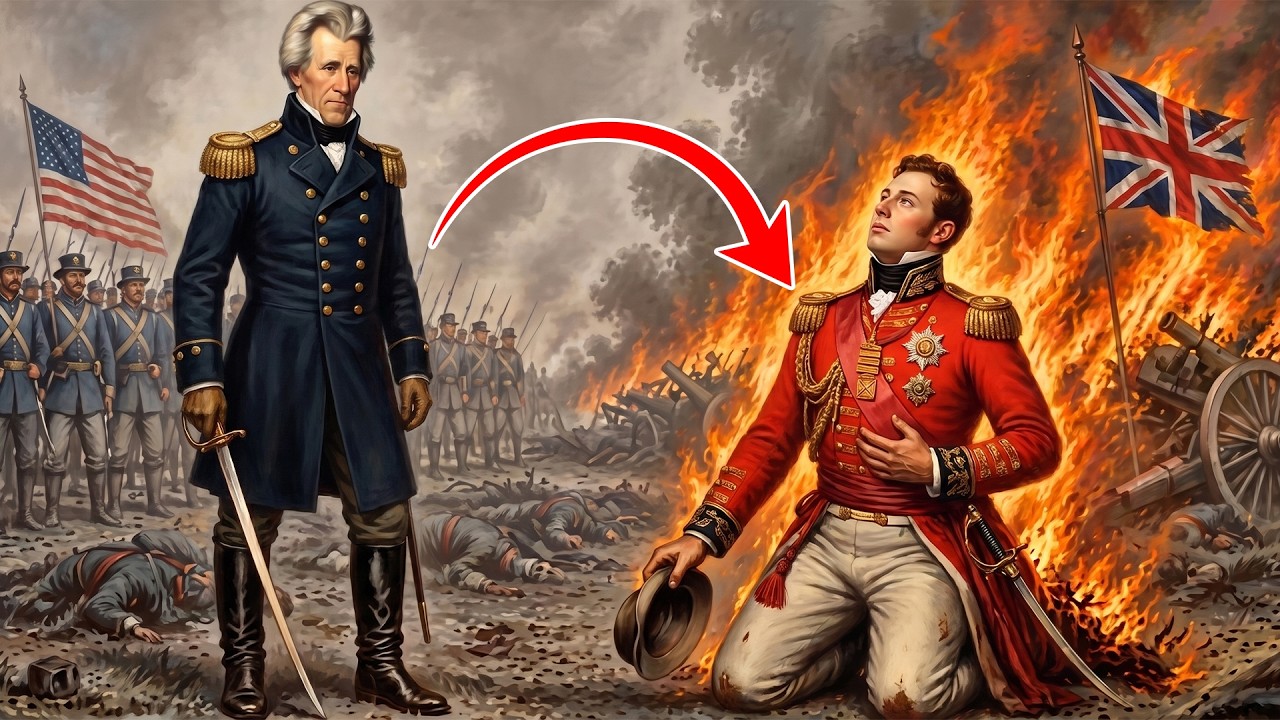
At the far end, behind a muddy embankment and a dry drainage ditch known as the Rodriguez Canal, waited Andrew Jackson’s mixed collection of militia hunters, pirates, free Black soldiers, Choctaw warriors, and Creole volunteers. The British advance took about thirty minutes. Some accounts say less. When it was over, the attacking force lost more than two thousand men killed, wounded, or captured.
The Americans lost thirteen dead. This was the Battle of New Orleans, fought on January 8, 1815, two weeks after a peace treaty had already been signed on the other side of the Atlantic. The battle was the climax of a two-year war that had gone badly for the young United States. When the War of 1812 began, American leaders imagined a quick conquest of Canada.
Instead, they suffered a string of humiliating defeats. A general surrendered Detroit without firing a shot. Border attacks failed. The British Navy dominated the Great Lakes.
In August 1814, British forces marched into Washington and burned the White House and other government buildings. First Lady Dolley Madison saved George Washington’s portrait just before the soldiers arrived. The republic, not yet thirty years old, watched the smoke rise from its own capital. Yet the British could not take Baltimore, where the defenders of Fort McHenry held out through a night of bombardment, an event that inspired Francis Scott Key to write the words of what would become the national anthem.
The war settled into a stalemate, and diplomats gathered in Ghent, Belgium, to negotiate peace. But news traveled slowly, and British military commanders decided on one final stroke while talks dragged on: seize New Orleans. The city controlled the mouth of the Mississippi River, the economic artery of the American interior. Everything from the western states, wheat, cotton, livestock, and grain, flowed down that river to New Orleans and out to world markets.
Whoever held the city held the throat of the continent. A British force of eight to eleven thousand men set sail from Jamaica. These were veterans of the wars against Napoleon, men who had broken French elites on European battlefields. Their commander, Major General Sir Edward Pakenham, was Wellington’s brother-in-law, a brave officer known for leading bayonet charges in Spain.
So confident were the British that some officers brought fine clothes for the balls they expected to attend in the captured city. They spoke of New Orleans as another Calcutta, a new jewel for the empire. On the American side, Andrew Jackson arrived in New Orleans in December 1814, sick with dysentery and barely able to ride a horse. He declared martial law on his first day, a legally controversial move that silenced opposition and allowed him to draft civilians and seize supplies.
His army was ragged on paper, but it was built from the region’s unique human material. There were Tennessee and Kentucky militiamen, frontier hunters who had grown up in the woods and could shoot a squirrel at fifty yards. There were free Black soldiers, whom Jackson promised equal pay, an unusual offer for the time. There were Choctaw warriors who knew every inch of the local terrain.
There were Creole volunteers from the old French families. And there were the Baratarian pirates led by Jean Laffite, a smuggler whose base the American government had raided months earlier. Laffite knew every bayou and hidden waterway of the delta, and he offered Jackson something just as vital: gunpowder and flint, which the city lacked. He had already rejected a British bribe of money and rank, reporting the offer to American authorities.
Jackson accepted his help in exchange for a pardon. Jackson chose his ground with care. The Rodriguez Canal was a dry ditch cutting through a sugarcane field about nine kilometers south of the city. He ordered his engineers to deepen the ditch and pile the earth behind it into a rampart roughly two kilometers long.
The left flank rested on the Mississippi River, the right on an impassable cypress swamp. In the middle lay the open field, soft and swampy, with no cover. Eight batteries holding twenty-four guns were placed along the embankment, many of them manned by Laffite’s men, who had learned naval gunnery at sea. Cotton bales and sugar barrels were stacked in front of the guns, because wet cotton and sugar absorbed bullet impacts.
Firing platforms allowed several ranks of riflemen to shoot at once. The men dug for days, working by torchlight at night. The ground the British had to cross was a shooting gallery. The British approach had been costly before the battle even began.
Their fleet entered through Lake Borgne, where a small American flotilla delayed them and gave away their route. Then came the march through miles of Louisiana swamp. Men sank into the mud, and it sometimes took fifty soldiers to move a single cannon ten meters. Rain and fog did not lift.
Mosquitoes plagued the men at night. Every day of delay gave Jackson more time to strengthen his defenses. On the night of December 23, Jackson launched a surprise raid on the British camp at the Villeré plantation, about fourteen kilometers south of the city. The attack was chaotic, a savage clash in the dark where men sometimes fired on their own ranks.
But it broke British momentum, forced them to pause and entrench, and bought the Americans precious time to finish the embankment. On January 1, Pakenham tried to soften the American position with artillery. The exchange lasted hours, and the American batteries, served by Laffite’s experienced gunners, silenced the British guns one by one. Pakenham’s final plan was classic European doctrine.
A frontal assault of roughly 5,300 men in two columns would strike the American line on the east bank of the river. Simultaneously, about 1,200 men under Colonel Thornton would cross the Mississippi at night, capture the American guns on the west bank under General David Morgan, turn them on Jackson’s line, and open the way for the main attack. Timing was everything. On the night of January 7, the plan began to fall apart.
The boats meant to cross the river were delayed. The canal dug for them was too shallow, and boats got stuck in the mud or broke. The river current was stronger than expected, sweeping the boats miles south of their landing zone. Thornton’s force disembarked long after the scheduled hour.
In the darkness before dawn, Pakenham learned the flanking force would not be in position. He had to decide whether to wait or strike. Waiting meant the fog he wanted for cover would lift, leaving his men exposed on the bare field in full daylight. He chose to attack, trusting the momentum of thousands of veteran soldiers to break the American line.
At dawn, the British columns formed up. Fog rose from the men’s breath in the cold air. Sergeants shouted orders. Fifes set the marching rhythm.
The red-coated ranks moved onto the field, shoulder to shoulder, in the formation that had defeated Napoleon’s best troops on the plains of Europe. Jackson’s men waited behind the embankment. The Tennessee and Kentucky hunters had spent their lives motionless in the woods, waiting for game. Patience was ingrained.
Jackson gave the order: hold fire, let them come close, waste no shot. The British came on. Three hundred yards. Two hundred.
The field was silent except for the sound of boots pressing into mud and the distant drums. Then the American line erupted. The artillery fired first, barrels of grapeshot tearing the morning silence to shreds. Each shot swept through the densely packed British columns, hurling men to the ground and opening gaps in the ranks.
Then the rifles opened up. The frontier marksmen did not use the European synchronized volley. They picked individual targets. Officers on horseback fell first, their bright uniforms making them the most visible marks.
Then sergeants, then flag bearers, and the next man who picked up the fallen flag was shot down as well. The American hunting rifle was far more accurate at long range than the standard British musket, the Brown Bess, which was designed for rapid fire at short distances. The British were advancing in such tight formation that even a missed shot struck someone behind or beside the intended target. Gunpowder smoke thickened into a burning white cloud, but through it the Americans kept firing, a constant flickering curtain of muzzle flashes.
The worst disaster of the assault now revealed itself. The regiment carrying the fascines, bundles of sticks meant to fill the ditch, and the ladders needed to scale the embankment had broken apart under the first volleys. Some sources say the equipment was left behind. Others say the men carrying it fell during the first blast of grapeshot.
Either way, the result was the same. When the first British soldiers reached the edge of the Rodriguez Canal, they found a deep ditch they could not cross and a sheer mud wall rising before them. There were no ladders, no fascines. Some tried to climb up on each other’s shoulders, and the Americans leaned over the top and fired into them from point-blank range.
Seeing his attack unraveling, Pakenham rode forward. It was his style, the example he had set in Spain. Waving his hat, he advanced through the hail of fire, shouting for his men to press on. His horse was shot from under him.
He got up, mounted another horse. He was hit in the arm but kept moving. Then grapeshot struck his back, and he slumped over the horse’s neck. His aides lifted him down and laid him in the mud beneath an oak tree.
Within minutes, he was dead. His soldiers saw him fall. The morale of the columns, already breaking, collapsed. The second in command, Major General Samuel Gibbs, tried to rally the men and was mortally wounded.
Ten minutes into the battle, two senior British commanders were dead or dying. The army was headless. Some units stopped. Some kept advancing, driven by rigid discipline.
Others began to retreat, but retreating across the open field under sustained fire was as deadly as advancing. The American line never stopped firing. Multiple ranks rotated, front rank firing and stepping back to reload while the next stepped forward. Laffite’s pirates worked the artillery with the rhythm of shipboard gunnery, firing every ten seconds.
A few units reached the ditch and jumped in, only to be fired on from above. The 93rd Highland regiment formed one last organized wave, bagpipes rising above the noise. They entered the same tunnel of fire, and the pipes fell silent. Major General John Lambert, commanding the reserves, looked at the field.
The bodies lay in rows like high-water marks, marking the farthest point of each failed assault. The red coats were so dense that the ground seemed to have changed color. Lambert gave the order to retreat. He did what Pakenham could not.
The pullback was its own horror, as men standing to fall back became silhouettes for the American marksmen. When the firing finally ceased and the smoke cleared, the American defenders looked over the embankment in silence. The field was steaming in the cold January air, the heat of the fallen still rising. The mud was crimson, the canal water a rusted brown.
A Kentucky soldier wrote that when the smoke cleared, the field at first glance looked like a sea of blood. It was not blood. It was the red of the British coats, lying so thick that the ground had disappeared. The Americans stepped down onto the field and could not walk without treading on dead or dying men.
The wounded called out for water and for their mothers. Soldiers who had been trying to kill each other minutes before now knelt in the same mud, bandaging wounds and listening to last words. The final numbers were staggering. British casualties were between two thousand and twenty-six hundred, with around 368 dead, more than twelve hundred wounded, and over five hundred captured or missing.
Three generals were lost. American losses were seven to thirteen dead and thirty to fifty-two wounded. For every American who fell, thirty to forty British soldiers were killed, wounded, or captured, all in about half an hour. It was a ratio almost unheard of in the Napoleonic era.
On the west bank, Thornton had arrived late but captured the American guns. Lambert ordered him to abandon the position. There was nothing left to use it for. The only British success was voluntarily given up.
Weeks later, the deepest irony surfaced. On December 24, 1814, fourteen days before the battle, diplomats in Ghent had signed a treaty ending the war. Neither army knew. There was no telegraph, no radio.
Every bullet, every wound, every life was, in the technical sense, unnecessary. Yet this unnecessary battle became the defining event of the war. Before it, America seemed to be losing, its capital burned, its reputation in Europe in tatters. After it, America had stood against the finest soldiers of the British Empire in an open pitched battle and destroyed them.
The victory did not technically win the war, but it reshaped how the nation saw itself. Jackson became overnight the most famous man in America. The legend carried him to the presidency in 1828, and the political movement that grew from his support, Jacksonian democracy, centered on the power of the common man, traced its roots to that muddy embankment. For Britain, the defeat was buried.
Official reports used vague language, emphasizing bad weather and delayed boats rather than command failure. Then, in June 1815, the same regiments that had suffered at New Orleans fought Napoleon at Waterloo and won one of the greatest victories in British history. Waterloo covered everything. Just five months separated the two battles, and the empire’s worst defeat on the American continent was erased by triumph a world away.
Jean Laffite received his pardon but returned to old habits within a few years, allegedly resuming piracy before fading from the historical record. The free Black soldiers who had fought so bravely did not find lasting equality, as Louisiana society soon reclaimed its old hierarchies. But the story of the men on that embankment, farmers, hunters, pirates, aristocrats, and warriors, passed into American frontier memory as a myth of courage and independence: the idea that ordinary people could stand against a vast empire. The British soldiers who died were not cowards or fools.
They were disciplined, experienced men who did what had always worked, and were destroyed by a field designed for them. The victory was no accident. It was terrain, engineering, and the ability to unite diverse communities around a common purpose. The defeat was the price of a doctrine that refused to adapt.
Thirteen Americans lay dead. Two thousand British soldiers never reached the line. one field, one ditch, one mud embankment, stood against two thousand years of military logic and won.