The Dutch do not descend from the ancient Germanic tribes that gave them their name. They are the product of at least four distinct prehistoric populations, one of which has no living descendants anywhere else in Europe. The oldest genetic evidence lies beneath the North Sea, on a landmass that the ocean completely swallowed more than eight thousand years ago. Sixteen thousand years ago, a vast plain stretched between what is now the British coast and the Dutch shore.
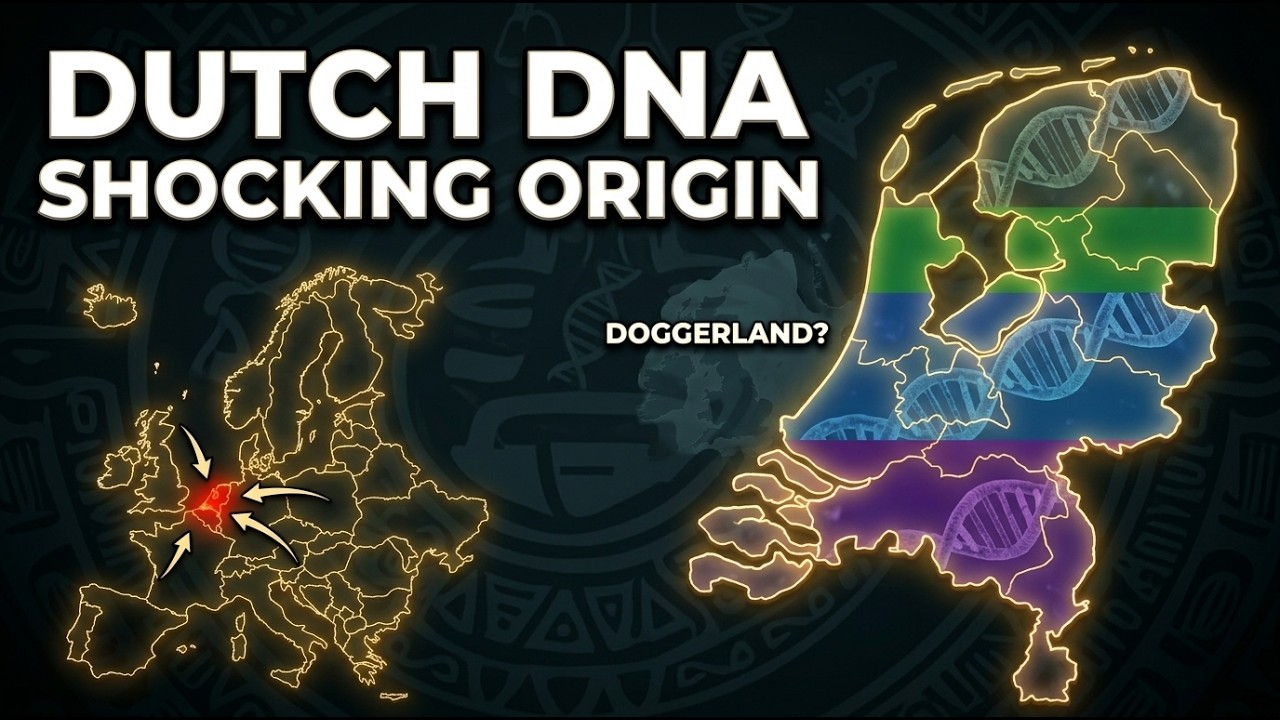
Scientists call it Doggerland. It was a world of winding rivers, dense oak and hazel forests, and marshes full of life. Ancient DNA extracted from deep sediment samples under the North Sea reveals that walnut trees once grew here, a species long vanished from northwestern Europe. The land was not empty.
It sheltered herds of wild game and, more importantly, the first human communities to resettle the region after the Ice Age. But Doggerland’s fate was always tied to water. As glaciers melted, sea levels rose steadily, swallowing land year after year. Then, about 8,150 years ago, a submarine landslide off the coast of Norway, known as the Storegga Slide, triggered a massive tsunami.
Walls of water swept across the plain, washing away forests and reshaping rivers within hours. Even after this catastrophe, pockets of land remained above water for more than a thousand years, their forests and wetlands gradually receding with each new tide. By 7,000 years ago, Doggerland had shrunk to scattered islands. Around 6,000 years ago, the last dry land disappeared beneath the waves.
A thriving landscape became the floor of the North Sea. The people who once hunted along its riverbanks and gathered food from its forests were forced onto higher ground, driving the migrations and genetic mixing that shaped the ancestors of the peoples of the Low Countries. Today, the only traces of this lost world lie trapped in layers of clay and DNA, awaiting researchers who piece together the first chapter of Dutch genetic history. At the edges of the Rhine and Meuse rivers, the oldest Dutch DNA has been preserved in ancient campsites now buried under peat and clay.
Archaeologists discovered a human tooth at Hardinxveld-Giessendam dating to around 5600 BC. Its mitochondrial DNA was classified as belonging to haplogroup U5B2B, a lineage carried by hunter-gatherers in western Europe since the end of the Ice Age. At the nearby site of Swifterbant, two low-coverage genome samples from riverbank burials revealed the same maternal fingerprint, U5B, and a Y-chromosome of type I2A1B, confirming that these Mesolithic people were direct descendants of the first post-glacial settlers. These rare genetic snapshots, though sometimes fragmentary, open a window onto a lost world.
The people of the ancient wetland camps hunted from slow rivers, gathered wild plants, and left behind bone tools and flint blades that echo the drowned plains of Doggerland. Genetic analysis shows their ancestors were mostly Western hunter-gatherers, up to 70 percent in Swifterbant individuals, even as the first farmers appeared on the horizon. Researchers point to a remarkable continuity. The same U5B and I2 lineages still exist in the Dutch population today, particularly in the north.
Across most of Europe, these genetic signals faded quickly under the weight of Neolithic migration waves. In the Low Countries, however, the hunter-gatherer lineage held on for thousands of years, creating a unique genetic foundation. With the arrival of the first farmers, they found land that was not easy to transform. Wheat and barley fields appeared in the southern Dutch plains more than 7,000 years ago, marking a profound shift.
Layers at sites like Elsloo and Geleen reveal the distinctive footprint of the Linear Pottery culture (LBK), whose longhouses and decorated ceramics trace the migration of Anatolian farmers into the heart of Europe. By 5300 BC, these newcomers brought not just crops and livestock, but a new way of life: permanent settlements, cleared fields, and the first boundaries drawn on a landscape once ruled by hunters. Yet the spread of farming was neither rapid nor absolute. In the north, where the land gives way to marshes and sand, the arrival of the Funnel Beaker culture around 4400 BC represented a different kind of encounter.
Here, the hunter-gatherer legacy persisted. The Funnel Beaker people built hunebedden, massive stone tombs constructed from glacial boulders that still stand in Drenthe. These monuments, some dating back more than 6,000 years, required extraordinary collective effort. No wheels or metal tools have been found with them, only the silent testimony of stone and earth.
Excavations show that even as farming communities settled, traces of hunter-gatherer lineages remained in the genetic record. Isotopic analysis of human bones from these early Neolithic sites reveals diets that mixed wild game and river fish with the first cultivated grains. The land itself, shaped by centuries of wetlands and forest, resisted rapid transformation. The story written in pollen, pottery, and DNA is one of gradual change, a mosaic of newcomers and survivors, each leaving a mark beneath the fields and beneath the stones.
At the heart of the Rhine-Meuse delta, ancient DNA tells a story that challenges the standard narrative of prehistoric Europe. While most regions saw hunter-gatherer ancestry fade before waves of incoming farmers, the wetlands of the Low Countries preserved an older genetic legacy. The evidence comes from a landmark study in Leiden, where researchers sequenced 112 ancient genomes dating between 8500 and 1700 BC. Their results reveal a population with a striking degree of continuity.
For nearly 3,000 years after the arrival of Anatolian farmers, the local population in the Rhine-Meuse corridor retained about 50 percent Western hunter-gatherer ancestry. Isotope analysis of human remains from these marsh settlements shows diets based on river fish, wild game, and wild plants long after farming had spread elsewhere. Genetic models built from extensive coverage of Mesolithic and Neolithic burials suggest this was not a brief period of mixing. Instead, hunter-gatherer ancestry remained stable, resisting the rapid replacement seen across most of the continent.
Even as megalithic tombs rose in the north and farming villages spread across southern Europe, the hunter-gatherer genome persisted in the delta, preserved by the region’s mosaic of marshes, floodplains, and shifting river channels. This wetland refuge became a genetic anomaly, a place where the descendants of Ice Age hunters survived as a distinct population until around 3000 BC. Only then, with the arrival of new peoples from the east, did the ancient balance finally shift. Around 2900 BC, a new presence swept across the flat river lands of the Low Countries.
Archaeologists call it the Corded Ware culture, but the real story is written in DNA. Ancient genomes from Dutch burial sites reveal a sudden increase in ancestry rooted in the steppe, the grasslands stretching from modern Ukraine to the Volga. This was not a minor flow. Within a few centuries, steppe pastoralists carrying the Y-chromosome haplogroup R1B M269 became the dominant male lineage in the region.
The genetic change is sharp and unmistakable. Before 2900 BC, local Y-chromosome lineages such as I2 and G2A were still present. Afterward, R1B rose steeply, soon reaching frequencies beyond anything seen in earlier records. The Bell Beaker phenomenon followed closely around 2500 BC.
Their distinctive pottery and burials appear across the Dutch landscape, but the real transformation lies beneath the surface. Comprehensive genetic studies show that Bell Beaker individuals in the Rhine-Meuse delta carried up to 70 percent steppe ancestry, with only a faint echo of early hunter-gatherer and farmer genes. This wave did not merely replace lineages. It brought the genetic foundation of Proto-Indo-European languages that reshaped the linguistic map of Europe.
In the north, the subclade R1BS21 became especially common, cementing a new male-dominated genetic system still present in Dutch male chromosomes today. The steppe migration left a legacy that resonates through ancestry and language, paving the way for the historical layers that followed. Roman legions once patrolled the banks of the Rhine at Nijmegen and Valkenburg, but their presence left more than ruins and coins beneath Dutch soil. Isotopic analysis of skeletons from Roman-era cemeteries reveals individuals who grew up far from the Low Countries.
Some show signatures from the Mediterranean region or North Africa, while others reflect origins deep within the Roman Empire. Comprehensive genome studies confirm that Roman soldiers and traders, along with local women, contributed a subtle but lasting Mediterranean thread to the Dutch genetic fabric. A 2025 survey of male chromosomes from medieval remains found an unusually high frequency of haplogroup T in Eindhoven. Haplogroup T is rare in northern Europe but common among Sephardic Jews from the Mediterranean and the Near East.
Archival records place Sephardic Jewish families in Eindhoven after the expulsions from Spain and Portugal in the sixteenth century. Today, this haplogroup has almost disappeared from the modern population, faded through centuries of intermarriage, but the genetic echo remains detectable in the region. Across the Netherlands, the legacy of these migrations has been mapped in fine detail. A study of more than 1,600 Dutch genomes identified 40 distinct genetic groups, each with roots in local history.
North-south gradients stand out clearly. The northern provinces retain higher proportions of ancient hunter-gatherer and steppe ancestry, while the south shows stronger signals from Anatolian farmers and later Mediterranean arrivals. Roman mobility, medieval diaspora, and the persistence of local lineages have built a genetic landscape as complex as the country’s waterways: layered, regional, and quietly remarkable in its complexity. Today, every Dutch genome encodes a record of vanished worlds.
Hunters, farmers, steppe migrants, and settlers overlapped across ten thousand years. As new genetic evidence rewrites national stories throughout Europe, identity becomes less a matter of descent and more a living archive. The question now is which layers we carry with us, and which we carry into the future.