On the morning of April 9, 1865, in the small Virginia village of Appomattox Courthouse, Confederate General Robert E. Lee and Union Lieutenant General Ulysses S. Grant met face to face in a private home owned by a local man named Wilmer McLean. Their conversation lasted barely more than an hour.
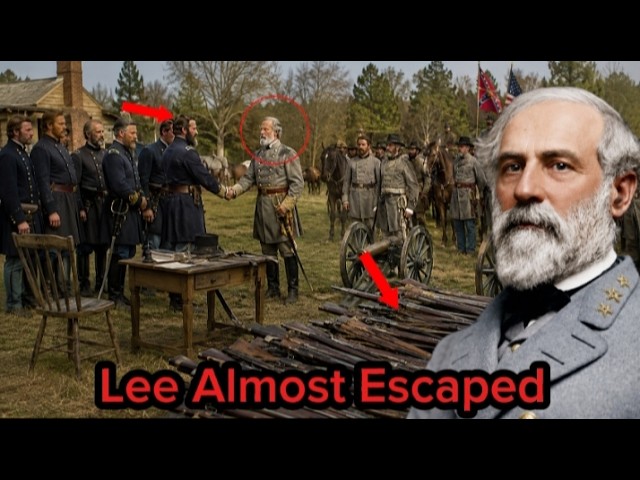
By its end, Lee had surrendered the Army of Northern Virginia, the Confederacy’s most formidable fighting force. Four years of war had been reduced to a single quiet exchange between two adversaries who had spent those years trying to destroy one another. Lee’s army was not what it had been. The retreat that brought him to this point had begun only days earlier, following the fall of Petersburg.
For months, Confederate forces had endured a grinding siege that drained their supplies, their numbers, and their morale. When the Union breakthrough came on April 2, the defensive lines protecting Petersburg and the Confederate capital of Richmond collapsed. Panic swept through Richmond. President Jefferson Davis and other government officials fled in haste, carrying whatever documents and valuables they could as fires broke out across the city.
Lee, ever the pragmatist, ordered a full withdrawal. His plan was bold and characteristically calculated. Lee intended to march his army westward across the Virginia countryside, reach inland supply depots, resupply his starving and exhausted men, and potentially link up with other Confederate forces still active in the South. If he could consolidate those scattered armies, the Confederacy might prolong the fight, force more favorable peace terms, or even transition into a protracted guerrilla struggle that could drag the war into an uncertain future.
It was a desperate gamble, but one grounded in the mobility and knowledge of terrain that had defined his most celebrated campaigns. Grant had other intentions. The Union commander had built his reputation on relentless pressure and an unwillingness to accept anything short of total victory. He understood that Lee’s army was the strategic heart of Confederate resistance in the east.
If it could be captured or destroyed, the Confederacy’s ability to wage conventional war would collapse. Grant mobilized multiple Union armies in pursuit, moving in parallel columns to block escape routes while cavalry under Philip Sheridan raced ahead to seize supply trains, destroy bridges, and harass the Confederate flanks. The retreat quickly became a nightmare. Food supplies dwindled to almost nothing.
Men scavenged for corn kernels and foraged roots, or went days without meals. Ammunition ran critically low. Horses collapsed from exhaustion. Rain turned the roads to mud, slowing the march and sapping what little strength remained.
Desertions increased as soldiers realized this was no longer a strategic withdrawal but a desperate race for survival. By the time Lee’s battered columns approached Appomattox Courthouse, Union forces had already positioned themselves to cut off the western road, the last viable escape route. Lee saw one final opening. If his troops could break through the Union cavalry screening that road, they might slip southward toward potential reinforcements.
On the misty morning of April 9, Confederate forces launched a determined assault. The initial clash was fierce, and for a moment it seemed the gamble might pay off. Rebel yells echoed across the fields as grey-clad soldiers pushed back the Union horsemen and briefly cleared a path. Hope flickered that the army might break free and fight another day.
That hope died within hours. As the Confederates pressed forward, they saw not just scattered cavalry but wave after wave of fresh Union infantry arrayed in battle formation. Grant had ordered larger Union corps to march through the night, and they had silently enveloped the position. What had begun as a cavalry skirmish had become a confrontation with an overwhelming, well-supplied enemy.
Lee received the reports from his officers and faced the devastating truth. His army was effectively surrounded. Union forces blocked the road ahead, pressed from the rear, and threatened both flanks. Any further fighting would be a slaughter, a pointless massacre of men who had already given everything.
Lee had orchestrated some of the war’s most brilliant victories, but the calculation before him was no longer about glory. It was about whether to condemn his loyal soldiers to needless death. He chose surrender. Lee dispatched a messenger under a flag of truce to request a meeting with Grant.
Grant, who had anticipated this outcome after days of relentless pursuit, responded promptly. The two generals agreed to meet that afternoon at the home of Wilmer McLean, a local resident who had moved to Appomattox after his previous home in Manassas had been damaged in the First Battle of Bull Run, the war’s opening clash. Now his parlor would host its symbolic conclusion. Inside that modest brick house, the two commanders sat down as respected adversaries.
Their conversation was courteous, almost gentlemanly, reflecting the mutual admiration that had developed despite the bloodshed. Grant proposed generous terms designed not to humiliate the defeated but to bring about a swift and peaceful resolution. Confederate officers and soldiers would surrender their arms and artillery but would be allowed to return home without prosecution, provided they pledged not to take up arms against the United States again. Enlisted men were permitted to keep their personal horses and mules, vital for rebuilding farms and families shattered by war.
Officers retained their sidearms and private property. These lenient conditions reflected Grant’s pragmatism. They ensured the surrender proceeded without incident or last-minute resistance. Lee, dignified even in defeat, accepted the terms with solemn grace.
By the end of the meeting, the Army of Northern Virginia had laid down its weapons. News of the surrender electrified the nation. Telegraph wires carried the report, newspapers blared headlines, and celebrations erupted across northern cities. In the South, stunned silence fell.
Many immediately viewed it as the war’s effective end. But the Civil War did not vanish overnight. Other Confederate armies remained in the field, including those under Joseph E. Johnston in North Carolina and Richard Taylor in the Gulf region.
Surrenders trickled in over the following weeks and months, with the last Confederate forces not capitulating until late May or even June. Still, Appomattox became the enduring emblem of the Confederacy’s collapse, the moment when its primary army, its strategic heart, conceded the impossible. The surrender prevented further senseless bloodshed. It paved the way for Reconstruction and began the long, painful process of national healing.
Days later, Lee bid farewell to his troops with a simple statement of what he had done for them, while Grant’s magnanimous approach set a tone for reconciliation amid victory. The events at Appomattox were not a simple climactic moment. They were forged in exhaustion, strategic calculation, and the weight of impossible choices.
A desperate retreat across Virginia’s ravaged landscape had culminated in a quiet conversation that irrevocably altered the trajectory of the United States.