She never spoke to her daughter again after that spring. In the summer of 1997, from her farmhouse on the Isle of Seil off the west coast of Scotland, Frances Shand Kydd kept writing letters to Diana, Princess of Wales. The envelopes came back unopened, one after another, over about four months. On August 31, Diana died in a car crash in a Paris tunnel.
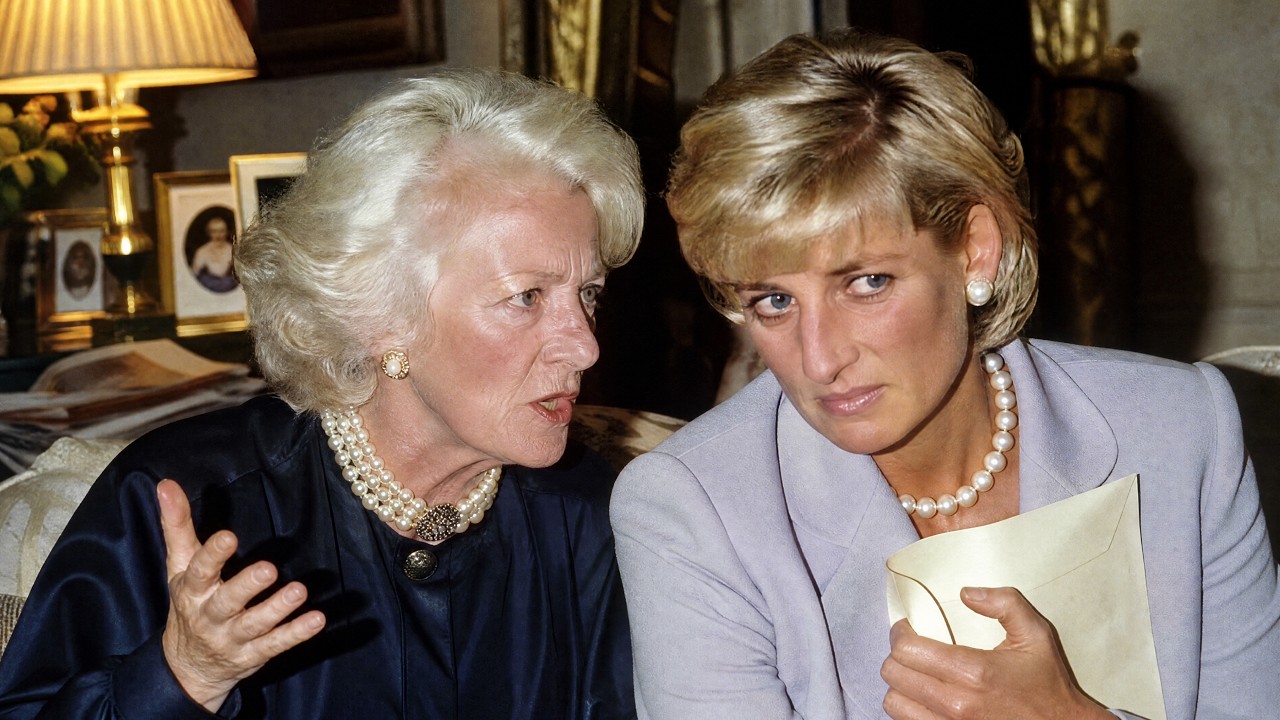
Her mother had not heard her voice since the quarrel that spring. Nearly thirty years earlier, Frances had lost the same daughter in a custody case. The witness who helped her husband win was her own mother, Ruth, Lady Fermoy, a lady-in-waiting to the Queen Mother. Frances was born on January 20, 1936, at Park House on the Sandringham estate in Norfolk.
A mile away at Sandringham House, King George V lay dying; he died that same day. Her father, Maurice Roche, the fourth Baron Fermoy, was a friend of the Duke of York, who later reigned as George VI. Frances’s mother, Ruth, was a gifted pianist, a former student of Alfred Cortot in Paris, and a woman with firm beliefs about marriage. She believed marriage was a duty to be kept at whatever cost to the people inside it.
In 1956 she became an extra woman of the bedchamber to Queen Elizabeth the Queen Mother, and in 1960 she was promoted to full woman of the bedchamber, a position she held for about thirty-three years while rising to become one of the Queen Mother’s closest friends. On June 1, 1954, at Westminster Abbey, an eighteen-year-old Frances married John Spencer, Viscount Althorp, a thirty-year-old former equerry to both the late king and the young queen. The queen and much of the royal family attended. By one recurring estimate, she was the youngest bride to marry in the Abbey since 1893.
The match was arranged inside the court’s orbit, and it carried a single unspoken demand. The Spencer earldom needed an heir, and only a boy could carry the line. Sarah was born in March 1955, Jane in February 1957. Both daughters were healthy.
Neither could inherit. On January 12, 1960, Frances gave birth at Park House to a boy named John. He lived about ten hours. Accounts differ on what was wrong with him; some say he was severely deformed, others cite a lung defect, and still others incorrectly describe him as stillborn.
What all accounts share is that Frances was not allowed to see him. She said years later, “My baby was snatched away from me, and I never saw his face, not in life, not in death. ” One biographer described her struggling from bed and banging frantically on the locked doors of the nursery. The doctors and her husband thought seeing the child would upset her too much.
Then, according to Andrew Morton, she was sent to Harley Street clinics to be examined for her failure to produce a healthy son. Her son Charles later called the baby’s death “probably the root of their divorce,” because the couple never got over it. Diana was born at Park House on July 1, 1961, the fourth child and third daughter. Diana herself would later say she always knew she was “the girl who was supposed to be a boy.
” Charles, the long-awaited son, was born on May 20, 1964. With the heir delivered, the marriage, already strained by grief and humiliation, began to come apart. By the mid-1960s, Frances was in her late twenties with five children born, married to a man twelve years older, and increasingly restless. In 1966, at a London dinner party, the Althorps met Peter and Janet Shand Kydd.
The four went skiing together in Switzerland. Peter, the son of a wallpaper fortune, was an amusing, bohemian man who made Frances laugh. When she explained the affair later, she said, “If Johnny and I had had a strong marriage, it wouldn’t have happened. ” In September 1967, the two eldest girls went to boarding school, and Frances left Park House with Diana and Charles for a rented flat in Belgravia.
She insisted the separation was mutual. Diana remembered it differently, saying her mother had decided to leave. At Christmas 1967, the children went home to Park House, and Frances went with them. Over the holiday, Johnny told her the children would not be returning to London.
He insisted they stay permanently at Park House. She went back to London alone. The weekends now reversed: the children traveled to see her, and she would cry and tell them she did not want them to go. She asked the court for custody in June 1968 and lost.
The law at the time gave no grounds for divorce without fault, and a wife who had left her husband for another man was already marked as guilty. The decisive witness against her was her own mother. Ruth, Lady Fermoy, took the stand and testified on her son-in-law’s behalf. The court record is closed, and no transcript survives, but the Daily Telegraph later wrote that Ruth considered her daughter “a bolter.
” Johnny was granted custody of all four children. Frances married Peter Shand Kydd on May 2, 1969, about a month after her divorce from Johnny went through. She said simply, “I lost the case, and the custody of the children. ” Charles Spencer later described his father in the years after the divorce as “really miserable,” sitting alone in his study.
Charles remembers Diana waiting on the front step of Park House for a mother who had promised to come back and never did. Diana, on tape, remembered the sound of a car engine revving and fading as her mother drove through the gates. Diana, then six or seven, was not told where her mother had gone. She worked out that a court had sent her away.
Both mother and daughter each believed they had been the one left behind. In 1975, Johnny inherited the earldom and the family moved from Park House to Althorp. A year later, without telling his children, he married Raine, the daughter of Barbara Cartland. Diana slapped her father across the face and said, “That’s from all of us.
” Charles sent Raine a bitter letter. The children called her “Acid Raine. ” Frances had moved to the Isle of Seil with Peter, bought a thousand-acre farm, and opened a gift shop in Oban. The children spent summers there, fishing, sailing, and having beach barbecues, and Peter proved a generous, easygoing stepfather.
When the press discovered Diana’s relationship with Prince Charles in 1980, Frances wrote to The Times to protest the harassment of her daughter. In February 1981, she took Diana to Australia to escape the reporters. At the wedding at St. Paul’s Cathedral on July 29, 1981, she sat with her former husband to watch their daughter marry the heir to the throne.
She gave Diana a gold bracelet, which Diana wore that day and kept for the rest of her life. The relationship frayed publicly. In 1982, Frances gave her side of the custody story to a book serialized in the Daily Express, and Johnny called it cheap and hurtful. Diana, caught in the middle, was hurt by the account meant to clear her mother’s name.
Frances’s marriage to Peter ended in 1988; he left her for a younger woman. Diana telephoned her mother when she heard the news. In 1994, Frances was received into the Roman Catholic Church. She spent her later years working with sick and disabled children on pilgrimages to Lourdes, raising money for a Catholic house of prayer on Iona, and supporting the fishing communities of the west coast.
In 1996, she was convicted of drink driving after being stopped with a reading more than two and a half times the legal limit. She said she had been upset by a letter delivered that day whose sender was never named. That same year, she told Hello magazine it was “absolutely wonderful” that Diana had lost the title Her Royal Highness in her divorce. Diana was deeply upset, and the quarrel that followed was their last.
Paul Burrell, Diana’s butler, testified at the inquest into Diana’s death that he had listened on an extension phone in June 1997 while Frances called Diana a disgraced woman and made abusive remarks about her private life. His account rests on his word alone and changed in retelling; Frances, while alive, denied that the rift was about Diana’s private life at all. What is not in dispute is the silence. Frances confirmed under oath that she and Diana had been estranged for four months when Diana died.
She wrote letters through that summer, and Diana returned them unopened. After Diana’s death, Frances issued a statement: “I thank God for the gift of Diana and for all her loving and giving. I give her back to him with my love, pride and admiration to rest in peace. ” She considered not attending the funeral, but she went.
She later said Diana’s funeral was probably “the proudest day of my life as a mother. ” She received some 31,000 letters of sympathy and answered 7,000 by hand. On each anniversary of her daughter’s death, she drove alone to a deserted beach. In 2002, while she was giving evidence in Paul Burrell’s trial at the Old Bailey, her house on Seil was burgled.
The thieves took jewelry valued at £100,000, including the gold bracelet she had given Diana and a ring from her father. None of it was insured. She said the bracelet and earrings were “tangible links to my deceased children. ”
Frances died at home on Seil on June 3, 2004, aged sixty-eight, with a priest beside her.
Prince William and Prince Harry attended the funeral in Oban, where fifteen priests took part in the Requiem Mass. Her son gave the eulogy, calling her “afraid of nothing and of nobody,” and saying her bond with Diana had always been close. She is buried at Pennyfuir Cemetery near Oban, far from the Spencer vault and from the Abbey where she had married at eighteen. In all the words that survive, there is no record of either woman saying she hated the other.
Frances once said of her relationship with Diana, “Of course, we argued. Who wants a wishy-washy mom? ” In her last years, alone on the island, she said of her daughter, “Sometimes I think the only one resting in peace is Diana. ” The letters she wrote that last summer went back unopened, and no one knows what they said.
She kept writing them until the end.