The first man to fall on the east bank of the Little Bighorn River was Lieutenant Benjamin Hodgson, struck down near the water’s edge as the retreat unraveled around him. A quick-thinking trooper grabbed him by the stirrup and hauled him the rest of the way across, but Hodgson was already gone. His body was found on the far bank, his marker standing alone on the prairie today, a haunting reminder of how fast the morning had collapsed into chaos. That morning, June 25, 1876, Major Marcus Reno had launched his attack on what turned out to be an enormous Native American village along the Little Bighorn.
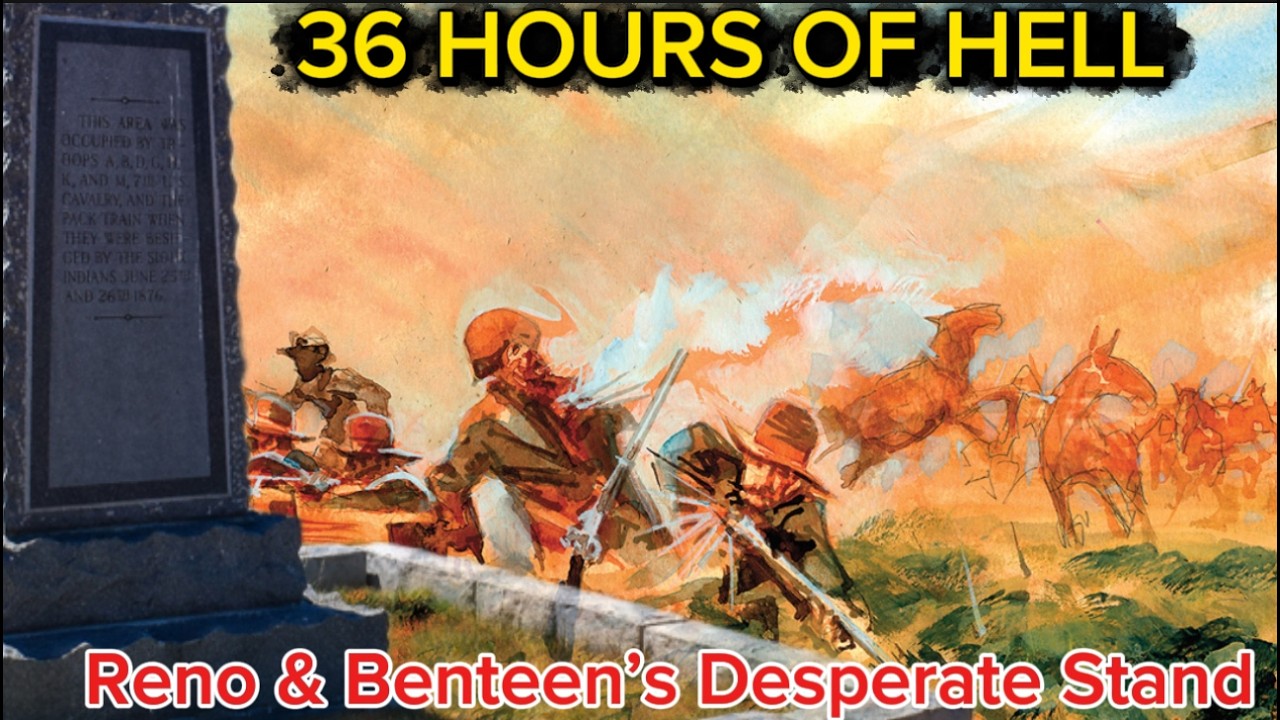
The charge faltered almost immediately, and his men were forced into a desperate retreat back across the river, scrambling up the bluffs through ravines and draws to reach higher ground. Most funneled into the southernmost draw for cover, but a few took different paths. One of them was James D. Wolf, one of the Seventh Cavalry’s three surgeons, who chose a riskier route and was killed for it.
As Reno’s battered survivors consolidated on the bluffs, they were joined by Captain Frederick Benteen’s battalion. Benteen had been riding hard after receiving a frantic note from George Armstrong Custer: big village, come quick, bring the packs. A plea for ammunition and support. Reno showed him the message and gave the order to halt.
“I’ve lost half my men,” he said. Benteen obeyed without hesitation, and from that moment, he threw himself into shaping the defensive perimeter that would keep the command alive for the next thirty-six hours. The ground Benteen chose was smart but far from perfect. It offered elevated ridges with better sight lines, but plenty of low spots left the men exposed to enemy fire, especially from a rise to the north the soldiers soon nicknamed Sharpshooter Ridge.
Company H, Benteen’s own, dug in along the southern ridge, where the pressure would be fiercest. Company B took the western flank, overlooking the bluffs and guarding the precious pack train. The northern flank fell to Companies D and K. Lieutenant George Wallace, commanding Company G, reported in grimly: he no longer had a company, just three men left.
Benteen told him to occupy his sector anyway with those three. Wallace did. Company A covered the eastern side, completing a rough circle. In the center lay a shallow depression, a natural bowl that became the heart of the chaos.
The horses, mules, and pack animals were herded in for whatever cover it offered, and at the very center sat the field hospital run by the lone surviving surgeon, Dr. Henry Porter. He worked under a flimsy tent fly that was constantly shredded by bullets, stitching and saving lives while animals and men dropped around him. It was a slaughter pen, not a safe haven.
Reno and Benteen were an unlikely pair to hold this line together. Reno had a solid Civil War record, earning brevet promotions for battlefield heroism. But in 1874, his wife had died, leaving him to raise their teenage son alone. Grief and pressure drove him heavily to the bottle, and isolation set in.
He had alienated himself from most of the other officers in the Seventh Cavalry before the campaign even began. Benteen, born in Virginia to a Confederate family, had enlisted with the Union Army when the war broke out, a decision that burned bridges with his family and left him with a chip on his shoulder for the rest of his career. Massive ego, a love of drama, and nicknames for nearly every officer made him a difficult man, but on this bluff, his qualities finally found their purpose. The first evening was pure hell.
Through the rest of June 25, twelve men were killed outright within the perimeter and another twenty wounded. The officers looked at the attrition rate and realized it was suicide. At this pace, they would be wiped out by morning. So they started digging like mad.
This was a cavalry outfit, and they had not packed shovels or spades. The men improvised with tin cups, pocket knives, and their bare hands, clawing at the hard prairie soil. They dragged over crates, sacks of coffee beans, and sides of bacon, anything to build up breastworks and rifle pits. Everyone pitched in except Benteen.
He had an optimistic hunch that with nightfall, the village would pack up and melt away into the hills. So he let his exhausted men sleep. Those troopers had been in the saddle for nearly two straight days and had just fought a brutal engagement; they were running on fumes. Benteen himself was wiped out, but he prioritized their rest over fortifications.
The rest of the battalion toiled through the darkness, shoring up every inch of their lines. Dawn on June 26 broke, and the fight reignited right where it had left off. Snipers began picking men off again, and the troopers burrowed into the dirt for their lives. By all accounts, Benteen became the rock of the defense.
He was everywhere, striding the lines, rallying the troops, even catching a quick nap when a bullet clipped the heel off his boot. Survivors’ accounts paint him as a larger-than-life figure, inspiring courage when it was in short supply. Reno, by contrast, came across as hesitant, almost detached, at a time when bold leadership meant everything. Benteen’s sector, Company H on the south, took the worst of it because it had not been fortified overnight.
His men were being whittled down fast. If that line buckled, the entire perimeter would collapse, and it would be over for everyone. Benteen saw it coming and did not hesitate. He turned to Reno and said he was taking Company M and charging south.
They mounted up, thundered down on the warriors pressing in close, and drove them back in a fierce counterattack. That bold move relieved the pressure on the southern flank and bought the defense precious time. A couple of hours later, the northern companies pulled off a similar charge. Together, those actions kept the defense from crumbling.
Then came the water crisis, perhaps the most critical of all. With no supplies and the wounded suffering terribly, the officers called for volunteers. Four men stepped forward to act as decoys and sharpshooters, drawing enemy fire to cover the water runs. Others grabbed canteens, pots, pans, whatever they could carry, and sprinted down Water Carrier Ravine to the river below.
They filled up what they could under a hail of bullets. Several of those volunteers earned the Medal of Honor for their heroism. Without them, the command might have died of thirst before the enemy could finish the job. By the afternoon of June 26, the tide finally turned.
The massive village began breaking camp, packing up and moving south, directly toward the approaching relief columns led by General Alfred Terry and Colonel John Gibbon. As they went, they set the prairie ablaze, likely to obscure their movements and deny the soldiers any easy pursuit. From their hilltop vantage, the hardened Civil War veterans on the bluff stared out in stunned silence. They were used to gauging the size of armies from a distance, but this was something else: thousands upon thousands, warriors, women, children, and lodges stretching as far as the eye could see, likely one of the largest Native American encampments in North American history.
A few troopers later admitted they could not hold back and let out three rousing cheers for the Indians. Warriors honoring warriors, amid the smoke and chaos. Through it all, one question haunted every man on that bluff: where was Custer? Some speculated he was holed up on a nearby hill, fighting his own desperate battle.
Others clung to the hope that he had broken through and linked up with Terry’s forces. But there was no word, no scouts, no signals, nothing. The uncertainty gnawed at them. Finally, on the morning of June 27, the relief arrived, and the awful truth dropped like a hammer.
Custer and all 210 men with him were dead, wiped out on a ridge a few miles north. The survivors on the bluff had thought their grueling stand was the heart of the fight, the main event. It turned out to be the sideshow, the one history would remember less.
But for thirty-six hours on that dusty height, Reno and Benteen held the line, kept their men alive, and turned a potential disaster into a desperate, gritty siege that had kept them breathing against overwhelming odds.