On the cold, quiet morning of April 9, 1865, in a modest brick parlor in the Virginia hills around Appomattox Court House, Robert E. Lee was preparing to surrender his Army of Northern Virginia to Ulysses S. Grant, effectively ending the bloodiest conflict the American continent had ever seen. Forty miles to the east, in a field hospital on the road from Farmville, a 32-year-old Union general from Delaware was dying.
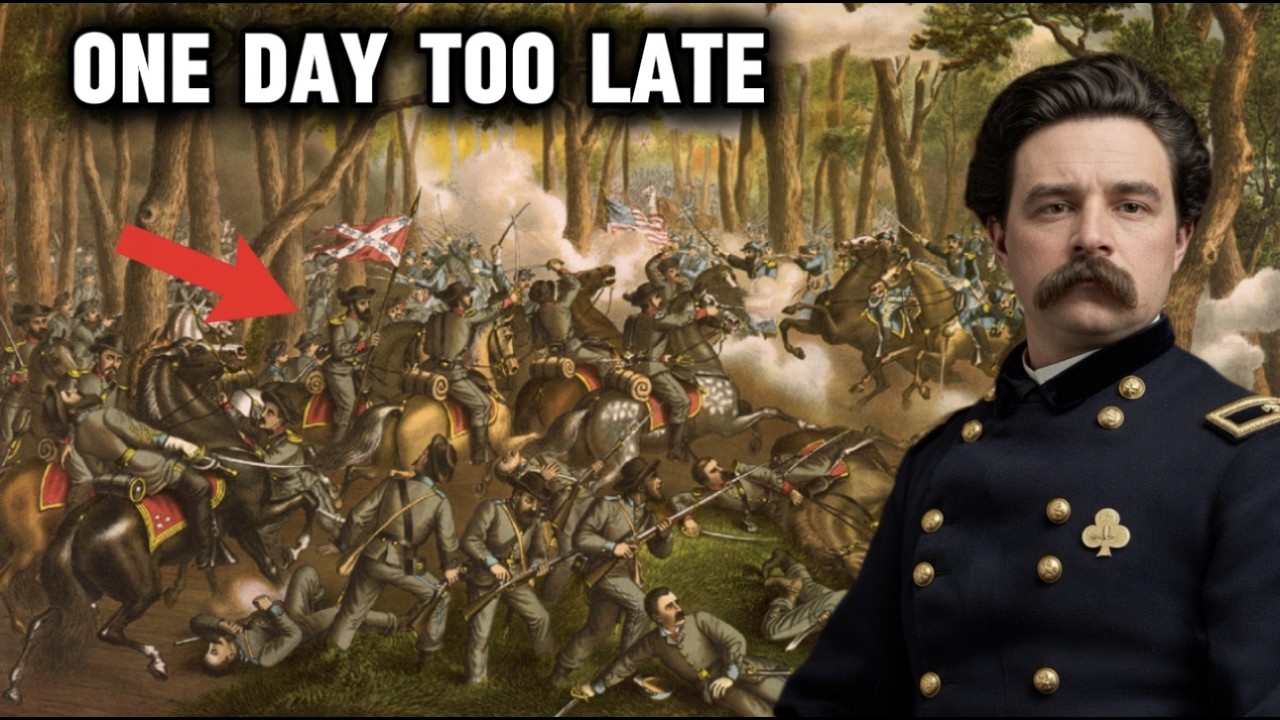
His name was Thomas Alfred Smyth, and he had survived nearly every major battle fought by the Army of the Potomac. Antietam, Fredericksburg, Chancellorsville, Gettysburg, the Wilderness, Spotsylvania, Cold Harbor, Petersburg. Four years of fighting had killed or permanently broken hundreds of thousands of men on both sides. Smyth had come through all of it until a Confederate sharpshooter’s bullet caught him two days before the surrender, during a skirmish on a Virginia road, when the war’s outcome had already been decided in all its important respects.
He never learned of its end. He died with it, at the very hour the men who had fought beside him were finally told they might go home. Thomas Smyth had come to America from County Cork, Ireland, in the 1850s, one of hundreds of thousands of Irish immigrants who crossed the Atlantic during and after the famine years, searching for what their departed country could no longer provide. He was a carpenter by trade, settled in Wilmington, Delaware, and built a decent life in his new country.
When war broke out in the spring of 1861, he felt the sense of obligation that many immigrants of his generation felt toward the nation that had taken them in. He helped organize what would become Delaware’s first infantry regiment. From 1862 onward, he led troops in the field, eventually rising to brigade command and the rank of brigadier general. He was not a professionally trained soldier.
He had no West Point education and no military experience from Mexico. What he had was a quality the war quickly separated from professional credentials. He was extraordinarily skilled at keeping soldiers effective under conditions designed to destroy them. His men trusted him with the particular trust that combat troops place in officers who prove, through repeated and costly trials, that they will not waste lives carelessly.
He was firm when the situation required it, steady when his men needed restraint. Rarely did both qualities meet in a single officer, and that combination made him exactly the kind of leader the Army of the Potomac desperately needed. Antietam was his introduction to major battle. On September 17, 1862, the bloodiest single day in American military history, 23,000 casualties fell between sunrise and sunset in the Maryland farmland near Sharpsburg.
Smyth and the First Delaware fought within the Second Corps, which saw some of the fiercest fighting of that day near the sunken road, a farm lane eroded below the level of the surrounding fields that Confederate defenders had turned into a natural firing position. Union formations attacked across open ground under rifle fire from men they could barely see. The lane itself, later called Bloody Lane, became so choked with dead Confederates that survivors compared it to a mass grave. The fighting along that road cost both sides casualties at a rate that even the Civil War, which had already set new standards of brutality, considered excessive.
Smyth came through it. He passed the first test, survived his first experience of the scale of killing the war had decided to work on, and emerged on the other side still functional, still in command, still able to face what came next. What came next was Fredericksburg in December 1862. If Antietam was brutal, Fredericksburg was closer to institutional slaughter.
Ambrose Burnside sent the Army of the Potomac straight across the Rappahannock River into Confederate positions on Marye’s Heights. A stone wall ran along the base of a long ridge, and behind it Confederate infantry stood in dense ranks, able to load and fire with mechanical regularity, turning the open ground below into ground no Union formation could cross. Fourteen separate federal attacks were launched against that wall through the afternoon, and none reached it. The Army of the Potomac suffered more than 12,000 casualties, most of them men who had charged toward a position no amount of courage could take.
Smyth survived, led his regiment through it, and was ordered to keep going. Chancellorsville followed in May 1863, Lee’s tactical masterpiece and a campaign of accumulated failure for the Union, with Joseph Hooker losing his nerve at the moment his plan was working and withdrawing a force that outnumbered the enemy two to one. The Army of the Potomac took another 17,000 casualties and retreated across the Rappahannock. The pattern had become familiar: fight, take losses, withdraw, reorganize.
Smyth came through that phase as well. Then came Gettysburg. Three days in early July 1863, across the Pennsylvania farmland south of a small college town, in the battle that most Americans who lived through the war would later identify as the moment they fully understood the reality of the conflict. Smyth’s brigade was positioned along Cemetery Ridge on July 3, the high ground that Pickett’s Charge targeted.
Smyth was close enough to the Confederate assault to watch it develop in full detail. 12,500 Confederate infantry emerging from the tree line on Seminary Ridge. A three-quarter-mile march across open ground under artillery fire. The gaps opening in the advancing lines as federal guns hammered them from the flanks.
The collapse of the attack against the Union center. The chaos at the Angle, where the Confederate penetration came closest to breaking the line completely. Smyth’s men helped repulse that penetration. When the fighting ended on July 3 and Confederate infantry began the long withdrawal south, the Army of the Potomac had held.
Smyth held with it. He had now come through Antietam, Fredericksburg, Chancellorsville, and three days of Gettysburg. The accumulated weight of those experiences, stacking one on top of another without enough time between them to absorb what each contained, was something the men who carried it rarely discussed directly. They did not have the language for it.
What they had was the knowledge that the next battle was coming, and that surviving the previous ones did not exempt them from it. The Overland Campaign of May and June 1864 was what Grant conceived, and what the veterans of the Army of the Potomac lived through, as the most savage and sustained period of fighting any of them experienced. Grant moved the army south and kept it in contact with Lee’s forces, fighting continuously at the Wilderness, Spotsylvania Court House, along the North Anna River, and at Cold Harbor, with little of the operational recovery time Lee’s army had grown accustomed to after earlier campaigns. The intent was to press Lee’s army until it could no longer bear the pressure.
Union casualties reached roughly 55,000 over seven weeks. At Spotsylvania, Smyth was wounded. The nature of the injury was not preserved in detail in surviving records, but it appears not to have been serious enough to remove him from command for the duration of the campaign. He was hit and kept fighting.
This was not exceptional by the standards of senior officers in the Overland Campaign. Officers who left command when wounded were often replaced by men promoted under fire, and the pace of operations left little room for the army to function at reduced capacity at any level. On June 3 at Cold Harbor, Grant ordered a dawn assault on fortified Confederate positions that cost the Union army thousands of casualties in the early morning hours. It was one of the darkest tactical decisions of the entire war.
Smyth was present and survived when the Army of the Potomac settled into siege lines outside Petersburg in the summer of 1864. By then Smyth had been fighting almost continuously for two years. He was promoted to brigadier general. He had been wounded once and returned.
He fought successive battles. His service record was a roll call of the places that defined the Army of the Potomac: Bloody Lane at Antietam, the frozen ground before Marye’s Heights, the Angle at Gettysburg, the Bloody Angle at Spotsylvania, the morning assault at Cold Harbor. Each of those places left a distinct mark on the memory of the men who survived them, and Smyth carried all those memories, accumulated and layered, into the nine months of trench warfare that Petersburg required. The siege lasted from June 1864 to April 1865.
It was a war of fixed positions, sharpshooters, periodic assaults on specific points in the lines, the gradual erosion of Confederate supply capacity as Grant’s lines extended westward, and the corresponding shrinkage of Lee’s army. Soldiers on both sides learned the practical misery of living in trenches under intermittent fire for months on end. The brutal winter, disease, and the different tempo of siege time as opposed to open campaigning. Smyth led his brigade through all of it.
Lee’s position at Petersburg finally collapsed on April 2, 1865. The Army of Northern Virginia broke through the siege lines and moved west, then southwest, trying to reach the railroad junction at Danville and link up with Joseph Johnston’s forces in North Carolina to continue resistance. The Army of the Potomac followed the retreating Confederates immediately, pressing hard, maneuvering to cut their path before they could reach a position from which the war might drag on for additional months. On April 6, at a place called Sailor’s Creek, a large portion of Lee’s rear guard was cut off and destroyed.
Nearly 8,000 Confederate soldiers were captured that afternoon, roughly a quarter of what remained of the Army of Northern Virginia. The Confederate army was visibly coming apart as it marched. Grant and Lee had already begun exchanging messages about surrender terms. The end was no longer a question of whether it would happen, only when and where.
On April 7, near Farmville, Virginia, Confederate forces crossed the Appomattox River and burned the bridges behind them to slow the federal pursuit. Union units pressed along the riverbanks and roads, fighting a fierce and disordered battle in continuous pursuit. These were not the decisive battles Smyth had fought for four years, but the kind of sporadic, ongoing combat produced by a retreating army facing an advancing one when both are still armed and close together. Smyth was advanced with his brigade, pressing the Confederate rear, doing the work the final days of the campaign required.
A Confederate sharpshooter’s bullet struck him in the face. The wound left no room for doubt about its meaning. He was taken to the field hospital, conscious at first, then unconscious by April 8. Grant and Lee were exchanging messages about terms.
The remnants of the Army of Northern Virginia were making their final moves toward Appomattox Court House. The roads were crowded with exhausted men, broken artillery, and the wreckage of a collapsing army. The arrangements for the war’s final formal act were being made through letters carried by staff officers between the lines. At about eleven o’clock on the morning of April 9, 1865, as Robert E.
Lee rode toward Wilmer McLean’s house to meet Ulysses Grant and end the war, Thomas Smyth died in the field hospital. He was the last Union general killed in the Civil War. He died without knowing it was over, still in the same position he had held since 1862, a senior officer at the front, in the midst of a war whose end had arrived in a form his consciousness, already gone, could never receive. The story of Smyth narrows the distance between the abstract category of the last casualty and the specific human weight that category contains.
The Civil War produced roughly 620,000 military deaths, a number so large that it is primarily used as a statistic because the human mind has no other mechanism for processing it. Statistics have no service records, no accumulated texture of participation in battles like Antietam and Fredericksburg and Chancellorsville and Gettysburg, experience after experience with no sufficient interval between them. Statistics do not carry the weight of a man wounded and then continuing to lead men through nine months of siege warfare, then struck by a bullet in the face during a pursuit in the final days of the conflict. Thomas Smyth had all of that.
He was a person before he was a statistic, and his entire trajectory, from survival to death, deserves to be understood separately from the aggregate number his death ultimately joined. Smyth survived everything until April 1865. He survived the final collapse of the Confederate line at Petersburg and the pursuit through the Virginia countryside while the Army of Northern Virginia disintegrated around him. He was forty miles from Appomattox when the bullet struck.
Appomattox holds a special place in American memory of the war, the quiet meeting of two generals in a private room, Lee in his dress uniform, Grant in his field coat, Confederate soldiers allowed to keep their horses for spring planting. Grant ordered no celebration because the men being paroled were, in his words, still fellow countrymen. Smyth was not at Appomattox. He was in a field hospital forty miles away, beyond the reach of any news from the McLean house in any form he could have absorbed.
He died in the midst of the war, not on its margins. He died on the margins of a story everyone who lived through it was about to leave. The country gave him the title of last Union general killed in the Civil War, a designation that preserves the historical fact while stripping it of its human weight. Such titles categorize things into classes where the impact of life and death becomes clear as information rather than felt loss.
Thomas Smyth, a 32-year-old Irish carpenter who chose to become a soldier when his new country needed him, who led his men from Bloody Lane at Antietam to the trenches of Petersburg to the final roads of the Appomattox campaign, deserves to be understood as more than a title. He deserves to be understood as a person who gave everything the war demanded over four years, endured everything that war could produce, and was taken by the war’s final accounting at a moment so precise and so cruel that it still registers 160 years later. Wars do not release their soldiers when they end. They release the living from the obligation to continue.
Thomas Smyth did not even get that. He died on the morning the war ended. The war ended without him.