In the autumn of 1947, the world was invited to watch a Greek prince marry the woman who would become Queen of England. Kings and queens came to Westminster Abbey, the scattered royalty of half of Europe gathered to celebrate. But three women who had helped raise that prince were left off the list: his own sisters. Within a single year, they had married German princes.
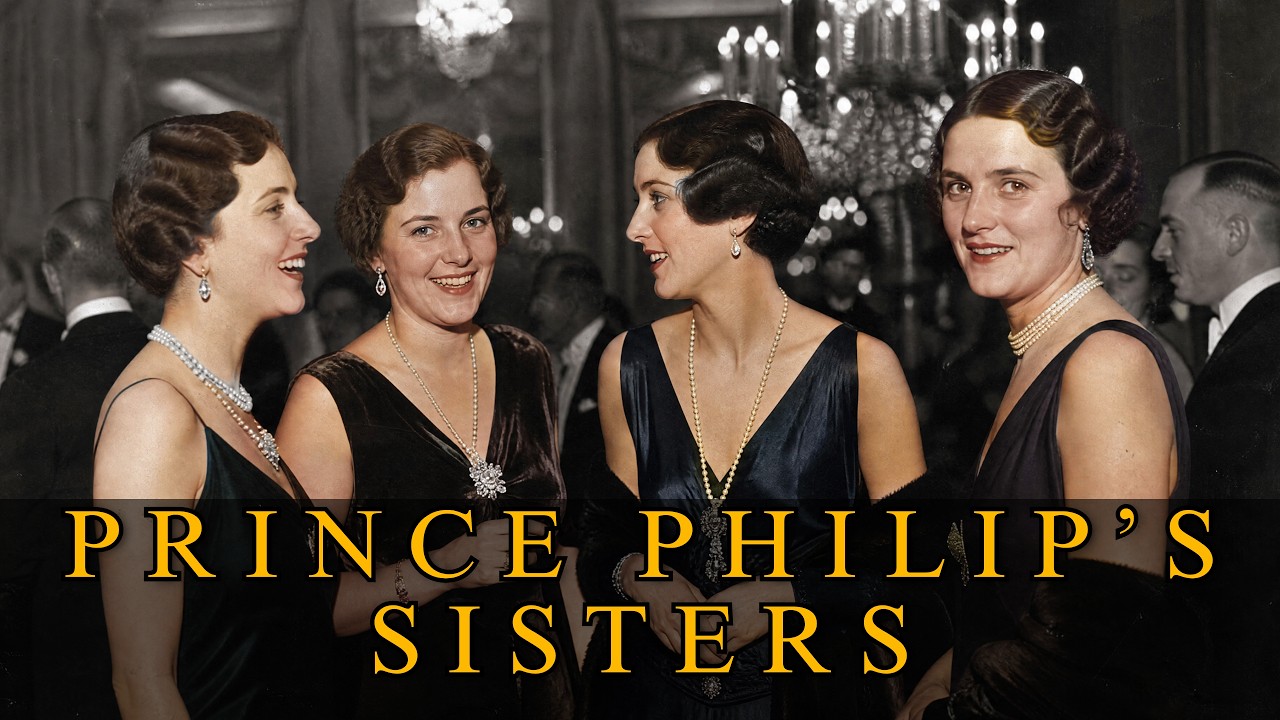
Two of their husbands had worn the uniform of the Reich, one of them the black tunic of the SS. A decade earlier, a boy of sixteen had walked behind one of those sisters’ coffins through a German street, past rows of men with their arms raised in the Nazi salute. The palace had decided the country must never see the rest of them. The story began on the island of Corfu in the summer of 1921, when the last of five children was born into a Greek royal family that already had no country it could count on.
The boy was Philip. His four sisters were Margarita, born in 1905, Theodora a year later, Cecilia in 1911, and Sophie, called Tiny, in 1914. By the time Philip arrived, the eldest was already sixteen, old enough to hold him, old enough to help raise him. In the strange years that followed, that is exactly what they would do.
On paper, the family stood near the summit of Europe. Their father, Prince Andrew of Greece and Denmark, was a son of a Greek king. Their mother, Princess Alice, was a great-granddaughter of Queen Victoria, born inside Windsor Castle itself. Through her, the children were cousins to the royal houses of Britain, Germany, and Russia.
But the grandeur was thinner than it looked. The Greek throne was one of the most unstable in Europe, and the family was not rich. There was no treasury behind them, and money was a quiet, constant worry beneath the ceremony. The children grew up in a Greece tearing itself apart in a disastrous war with Turkey.
Their father held a senior command in that campaign, and he clashed hard with the generals above him, at one point defying an order he judged suicidal for his underfed men. In an army that was winning, this might have been forgiven. In an army that lost catastrophically, it became evidence. In September 1922, the army rose in revolt, and a furious nation went looking for men to blame.
Senior officers and politicians were arrested and shot. Andrew was arrested too, charged with disobeying an order. For a time, it seemed likely that he would face a firing squad as a traitor to his own country. He was saved by the frantic work of royal relatives and foreign governments, who still remembered the web of cousins that bound Europe’s royalty together.
He was found guilty, stripped of his rank, and banished from Greece for life. In December 1922, the family was taken aboard a British warship and carried away in the dark. The baby, Philip, not yet eighteen months old, was carried on board in a cot made from an orange box, a wooden fruit crate. The future husband of the Queen of England left his birthplace as a refugee.
They settled on the outskirts of Paris, in a house lent by a wealthy relative, traveling on Danish passports, princes and princesses of a royal line with no kingdom to return to. They kept up appearances, but the family lived on the kindness of grander cousins, counting the cost of everything. The strain pulled the parents apart. Andrew drifted toward the warmth of the French Riviera.
Alice was pulled deeper into religion, and before long into a breakdown that would take her out of her children’s lives for years. In 1930, she was sedated against her will and taken to a Swiss sanatorium, diagnosed with paranoid schizophrenia. Among the doctors consulted about her case was Sigmund Freud, whose recommendation was that her condition arose from sexual frustration and that she should be treated by bombarding her ovaries with X-rays. It was done.
Alice would spend about two years inside institutions, and her son would go roughly five years with essentially no contact with her at all. It was into that vacuum that the four weddings fell, and they fell in a rush, all inside about eight months. Sophie, only sixteen, married Prince Christoph of Hesse in December 1930. Cecilia married Georg Donatus, heir to the Grand Duchy of Hesse, that February.
Margarita married Prince Gottfried of Hohenlohe-Langenburg in April. Theodora married Berthold, Margrave of Baden, in August. These were solid, respectable aristocratic matches into old German princely houses with land and stability, exactly what the exiled Greek line could no longer promise its daughters. The very choice meant to give the sisters security placed them at the center of the darkest thing the century produced.
Christoph of Hesse was the one who would go furthest into the regime. He joined the Nazi movement early, and in February 1932, more than a year before Hitler took power, he joined the SS. He rose quickly to the rank of Oberführer and came under the wing of Hermann Göring, one of the most powerful men in Nazi Germany. He was given charge of the research office of the Air Ministry, the regime’s secret listening bureau that tapped telephones and intercepted cables.
Christoph of Hesse, husband of a British prince’s sister, sat at the head of Nazi Germany’s wiretapping service. Sophie lived inside that world comfortably. She and Christoph were guests of honor at Göring’s wedding in 1935. Later she joined the National Socialist Women’s Organization.
When one of her sons was born, he was given among his names the name Adolf, in tribute to the Führer. A great-grandson of Queen Victoria was christened in honor of Adolf Hitler. While Sophie settled into that world, the family was making a very different decision about the boy. In the early 1930s, Philip was sent to a school in Germany attached to the Baden estate at Salem, a bold and idealistic school founded by a remarkable teacher named Kurt Hahn.
Hahn was Jewish and an outspoken opponent of the Nazis. When the regime took power, he was arrested, and only pressure from influential friends got him out. Once out, he fled to Scotland and founded a new school from almost nothing, Gordonstoun. Philip lasted barely a year at Salem.
Theodora, who had opened the door for him, saw where Germany was heading and closed it again, pushing him toward safety in Britain. In 1934, Philip followed Hahn to Scotland and enrolled at Gordonstoun. On the first of May 1937, the rest of the family stopped keeping any distance at all. On that single day, Georg Donatus, Cecilia’s husband, joined the Nazi party.
Following his lead, Cecilia herself joined it. Gottfried, Margarita’s husband, signed up the same day alongside his own mother. Only Berthold never signed. The aristocratic families had made a trade, lending the regime their glamour in exchange for a sense that they still mattered.
The family into which the four princesses of Greece had married for the sake of safety had become, by that spring, an outright part of Adolf Hitler’s Germany. That autumn, catastrophe struck. On the sixteenth of November 1937, the Hesse family boarded an airplane to fly to a wedding in London. On board were Georg Donatus, Cecilia, who was eight months pregnant, their two young sons, and Georg’s mother, the Dowager Grand Duchess Eleanor.
Approaching the Belgian coast, the pilot flew into thick fog and struck a factory chimney at a brick works. The aircraft came apart and burst into flames. All twelve people on board died. The official Belgian inquiry reached a terrible conclusion: Cecilia had given birth during the flight itself.
In the burned wreckage, they found the body of a newborn baby. The reason the pilot had been pushing so hard to get down in weather that should have kept him up was that a woman was delivering a child in the cabin. The funeral was held at Darmstadt and drew an enormous crowd. A whole city turned out to mourn a dynasty destroyed in an afternoon.
Around the real grief stood a heavy deployment of soldiers in Nazi uniform, arms raised, swastika banners hanging in the German street. Into that scene walked Philip, now sixteen, come from school in Britain to bury the sister he loved. A photographer took the picture that has outlived almost every other image of this story. It shows the boy who would one day stand beside the Queen of England walking behind his sister’s coffin, flanked by men in Nazi uniform.
Of Georg and Cecilia’s children, one survived because she had not been on the plane. Their youngest, a little girl named Johanna, had been left behind at Darmstadt. She was taken in and adopted by the uncle whose wedding had drawn her family to their deaths. Less than two years later, she caught meningitis and died.
The senior line of Hesse was erased within eighteen months. When war came, the family split cleanly down the middle. Philip served in the Royal Navy with distinction, a young officer earning a reputation for coolness under fire. On the other side fought the men his sisters had married.
Christoph transferred into the air force and flew for the Luftwaffe. Gottfried fought as an army officer on the Eastern Front and was severely wounded. Berthold had already been badly wounded at the fall of France and lived out the war at home. The sisters spent the war in Germany as German wives and mothers inside the country their brother was fighting to defeat.
Their father, stranded in the part of France under the collaborationist government at Vichy, died in Monte Carlo in December 1944, a prince without a country in a room he did not own, leaving his son a share of very little and a debt of some seventeen thousand pounds. Christoph died in October 1943 when his small aircraft flew into a hillside in Italy. Gottfried was caught in the purge that followed the failed plot to kill Hitler in July 1944 and dismissed from the army under suspicion. The movement the husbands had lent their ancient names to had used them up and thrown them aside.
While her daughters had married the regime, their deaf mother was doing the bravest and most decent thing anyone in the family ever did. Alice was living in occupied Athens, having given herself over to a life of religion and service. Among those in danger was the family of Rachel Cohen, a widow whose late husband had once shown kindness to Alice’s father-in-law, King George I. Alice repaid the debt.
She took Rachel and two of her children into her home and hid them, an act punishable by death. When the Gestapo grew suspicious and came to question her, she used her deafness, playing the confused deaf old woman who could not understand what was being asked, stonewalling the secret police until they gave up. The Cohens lived. She also worked to feed the hungry, organizing soup kitchens in the starving city.
Two years after the war, the palace drew up the guest list for the wedding of Lieutenant Philip Mountbatten to Princess Elizabeth, heir to the British throne. Philip’s three living sisters were not on it. So soon after a war against Germany, it was not acceptable for the bridegroom’s German relations, his own sisters among them, to be seen at the abbey. The British royal family was itself German in origin, a fact it had spent thirty years trying to bury, and the last thing the palace wanted was to remind the public that the new husband came trailing sisters who had married Hitler’s princes.
Meanwhile, the abbey welcomed royalty from former Axis nations whose crowns had bent toward Berlin. The line the palace drew was drawn around the single word German, and it caught all three sisters, regardless of what each had actually done. One German relation was not kept away: Philip’s mother. Alice attended in the plain gray habit of the nursing order she had founded, the deaf princess who had hidden a Jewish family from the Gestapo, while her daughters stayed in Germany.
In the summer of 1953, Elizabeth was crowned queen, and this time the sisters were there. Margarita, Theodora, and Sophie came to London and took their places among the guests. Time, more than forgiveness, had reopened the door. There was no ceremony of reconciliation, no word of apology.
The door opened quietly when the danger to the image had passed. In 1994, a quarter of a century after her death, Princess Alice was named among the Righteous Among the Nations, the honor given by the state of Israel to those who risked their lives to save Jews from the Holocaust. Alice had died in 1969 at Buckingham Palace, an old woman of eighty-four, owning almost nothing, having given her possessions away to the poor. Her remains were later carried to Jerusalem, to the church of Mary Magdalene.
When Philip was asked late in life about his mother’s rescue of the Cohens, he said she would have regarded hiding them as nothing worth remarking on, a perfectly natural human reaction to the suffering of people in danger. The four sisters all eventually died, Sophie last of all, in the year 2001, an old woman in a remade Germany, outliving them all by decades. Philip carried the whole story inside him, the exile and the orange box, the mother in the clinic, the four weddings, the burning field at Ostend, the funeral in the forest of swastikas, the sisters kept from his own wedding. He almost never spoke of it in public.
The palace had not been afraid of the truth. It had been afraid of the picture. And the picture it feared most was the one that already existed: a boy of sixteen in a plain dark coat walking through a German street behind his sister’s coffin, with the arms raised all around him. That boy grew up to stand beside the Queen of England for seventy years.
For all that time, the family worked to keep the country from ever setting that image beside the one of the young prince marrying the crown.