In the spring of 1892, a land surveyor named Aldous Mercer Fenn received a single testimony that would consume the rest of his life. The account came from a source he never fully named, and it described a place that no longer existed on any map, a valley called Harrow Hollow, removed from official geography by at least three federal agencies acting in coordination for nearly forty years. Fenn spent eleven years trying to get someone in authority to listen. Nobody did.
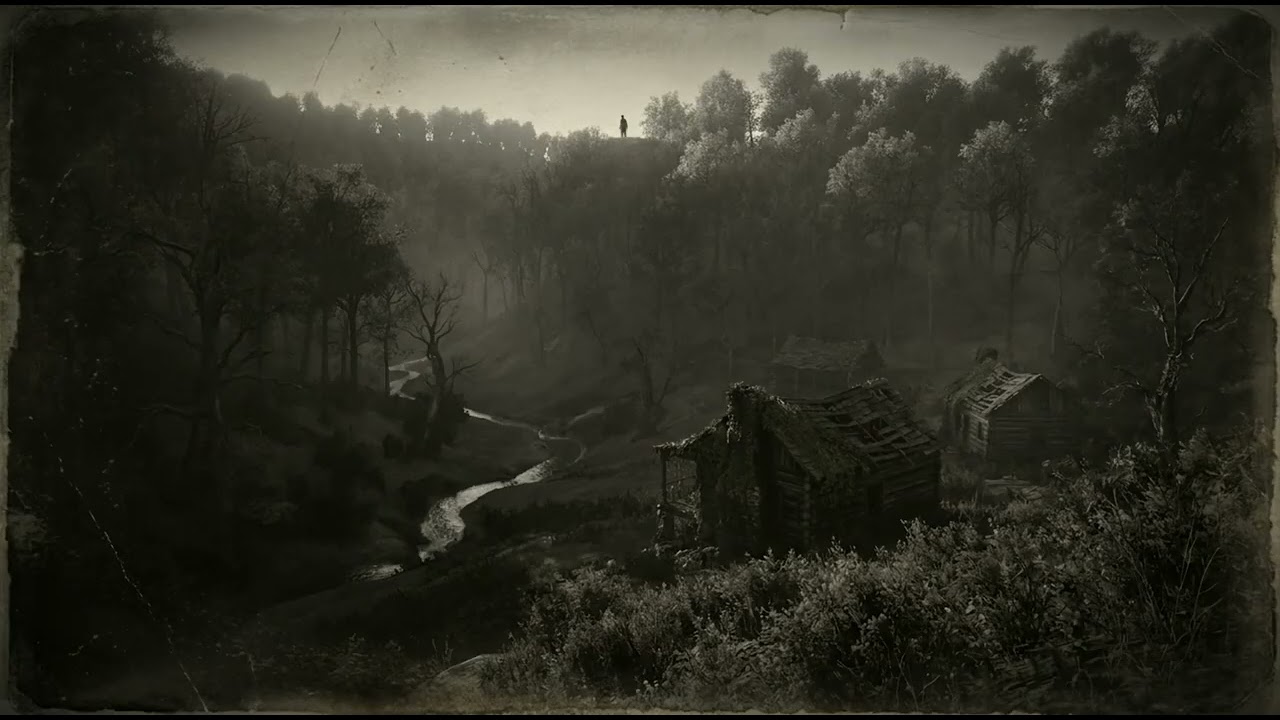
But he kept the transcript, and that transcript, along with other documents, eventually surfaced as the only surviving record of what happened there. Harrow Hollow lay in the Appalachian Range, where the borders of three counties once converged. It was a working community in 1847, home to between sixty and eighty permanent residents, mostly farming families of Scots-Irish and German descent who had settled there in the 1820s and 1830s. That summer, a federal enumerator named Prescott Gale passed through and counted sixty-three residents.
His notes described a valley of unusual depth and stillness, walled on three sides by ridgelines that made it difficult to find. He also wrote three times that the creek ran in the wrong direction. He never explained what he meant. He completed his count, recorded the names, and left.
His census was the last official document to acknowledge the valley’s existence for four years. Among the sixty-three residents was a man named Corvus Hallett. He was thirty-four years old, had been in the valley for six years, and kept meticulous records of weather, soil quality, and the behavior of the creek. That summer, his records began to change.
It started with a smell, a faint mineral odor carrying a secondary quality of something charred, though no fire was visible anywhere in the valley. Hallett noted it on a Tuesday, again that Thursday, then not for ten days, then four times in one week, always between three and five in the morning. He asked other farmers casually whether they had noticed anything unusual in the air. Three of them had.
All described the same thing in different words. None had mentioned it to each other before he asked. By December, Hallett had stopped thinking of it as a curiosity. In the northern end of the valley, a farmer named Gideon Spart reported that his dogs, which had always slept in the barn through winter nights, began refusing to go in after dark.
In January, Hallett saw something himself. At the edge of the eastern tree line, about forty yards from where he stood, was a shape. Upright. Too large for a man.
The posture of it was wrong, as if its proportions had been arrived at by someone who had heard a man described but never seen one. He held up his lantern. The shape did not respond to the light. He stood there, not moving, until it was gone.
He did not see it leave. He waited three days before writing it down, and he noted the delay deliberately. By the end of January, four other residents had reported similar experiences. The sightings were concentrated at the northern end of the valley, most frequent in the hours before dawn, never seen in full daylight, and never moving toward a person.
This pattern held through the spring and into the summer of 1848. Then, in August, Gideon Spart reported a shape standing in his farmyard, eight feet from his back door. His dogs were making a sound he did not recognize, low and sustained. When he opened the door, the shape was there.
He wrote to Hallett the next day that he was not afraid because he did not know what he was looking at. He was afraid because he had the strong feeling that whatever was standing in his yard knew exactly what it was looking at. That same week, Hallett heard a sound for the first time, a low vibration barely below the threshold of hearing, more felt than heard, coming from behind him in his field. When it stopped, the valley was not quiet.
It was the way a room is not quiet after a door closes, emptied by what had just been there. That night he wrote that he did not know what he was dealing with, only that it had been in the valley longer than they had and that it was becoming less patient. By the fall of 1848, the community was afraid. People stopped going out after dark.
Neighbors gathered in the evenings without discussing why. Hallett noticed that one family, the one whose name the census taker had recorded phonetically and whose origins no one could identify, was not afraid. Their behavior had not changed at all. They continued walking toward the northern end of the valley, toward the tree line.
In October, Hallett approached the head of the family, a man he identified only as Reese. He asked whether Reese had seen what others had been seeing. Reese said they had always seen it. What concerned him, he said, was that the rest were seeing it now too.
When Hallett asked what that meant, Reese said it meant it had made a decision. He would not say what decision. In the spring of 1849, a federal land surveyor named Ignatius Colby arrived to do routine boundary work. He was expected to stay two days.
He left before the two days were up, without finishing his survey and without explaining why. When Hallett wrote to the county land office, he received a reply stating that no survey had been submitted and that the county had no record of any surveyor being assigned to that location. Hallett held the letter for a long time. Below it, he wrote that someone outside the valley was watching, and they were already deciding what to do about it.
Families began leaving. By the summer of 1850, fewer than forty people remained. One family that had left wrote back with a single additional line in a different hand: Destroy your records. Whatever you think you are doing, stop.
Hallett did not destroy them. He added the letter to his files. The remaining population continued to thin over the next five years. By the middle of 1855, only three households remained: Hallett, Spart, and Reese’s family.
That summer, Reese died. He was found at the margin of the tree line, lying on his back in the long grass, with no sign of injury or struggle. The doctor could not identify a cause of death. After his death, his daughter Seraphine told Hallett something he recorded in full.
She said he had been watching the presence the way he would watch a storm, something outside himself to measure and survive. But she said the presence was not watching them because they were interesting. It was watching them because they were there, because the valley and the presence in it might not be different things. The land itself might be what he was trying to describe.
If that was true, his records were not an account of something that happened there. They were part of what was happening. Hallett wrote those words down exactly. Beneath them, he wrote one sentence: I think she is right.
The decade that followed was strange in a different way. The presence became less an intrusion and more an accommodation. Hallett saw it once in full daylight and went back to work. The sound changed into something he described as not a communication but a concentrated presence, enormous and old, not angry, not curious, simply there.
In 1862, a man named Wentworth Grail, a former telegraphist who had arrived in the valley by accident four years earlier, told him something that Hallett called the most useful thing anyone had said to him in fifteen years. The thing he kept trying to decide, Grail said, was whether it was a natural phenomenon or something else, as if those were the two options. That was the wrong question. He was asking the question in English, and the thing he was asking about did not have an English answer.
In 1865, a government geologist named Prescott Ames spent four days in the valley surveying mineral resources. On the fourth day he went into the northern end. When he came back, he sat down at Hallett’s table and asked how long this had been going on. Hallett told him everything.
Ames spent the next day reading through his records, took careful notes, and left. He told Hallett he would file an honest report and that he was not certain it would be received the way it should be. At the edge of the valley, he turned and said one last thing: Keep the records. Do not send them anywhere until you know who you are sending them to.
The wrong person having this information is worse than no one having it. The report Ames filed was never received. There is a clean gap in the geological survey records for that portion of the range. In his personal papers, found after his death in 1881, there was a single folder labeled with the valley’s coordinates.
It contained one page with one sentence: What is there is real. It is not going anywhere and the correct response to it is not to pretend it is not there. In 1878, two men from the Department of the Interior arrived. They told the remaining residents the land was being assessed for federal acquisition.
They did not go to the northern end of the valley. They photographed the structures and left. Formal offers of purchase were made and rejected by all three households. In 1880, a public health designation was applied to the valley on the basis of a report whose findings were never made public and whose author was never named.
The designation stated that the land contained properties hazardous to human occupation. Hallett wrote that this was, in a way, the most honest thing they had said in thirty years. But it was not a hazard in the way they meant it. They meant that this thing should not be known.
By 1882, all legal residents had been formally notified to vacate. Grail left in the spring, advising Hallett to separate the records so different pieces would survive in different places. Hallett did. He distributed the composite account across multiple archives and kept the final section for himself.
Seraphine’s family left that autumn. On the day they left, she came to Hallett’s farmhouse and told him that the presence was aware they were leaving. Not upset, but aware. It did not need them to stay to keep existing, but she thought it had appreciated the company in whatever way something that old could appreciate anything.
Hallett spent one final winter in the valley. He was sixty-nine years old. He had been there for thirty-six years. In February 1883, he wrote that he stood on his porch in the blue hour before sunrise and saw the presence at the edge of the upper field.
He described the arrangement of that morning as acknowledgement, like two people who have lived next to each other for a long time and can stand together in the cold and let that be enough. He left in March, escorted to the boundary by a federal marshal. He carried two bags and a locked case containing the final section of his records. At the boundary he stopped, turned, and looked back at the valley for a considerable time.
Then he walked out. In the years that followed, Hallett tried through legal channels to have the valley’s status reviewed. He contacted representatives of the Department of the Interior, journalists, and academics. He was always treated politely and never helped.
He was told the matter was settled, that the designation was final, that the records were sealed for reasons of federal security. He was never threatened. He was simply never helped. He died in 1891 at the age of seventy-seven in a boarding house in Knoxville, Tennessee.
The surveyor Fenn spent three years locating the pieces of the composite account and another two transcribing and assembling them. He filed the assembled record with four institutions. Three returned it without comment. The fourth accepted it, then had it transferred to restricted storage, where it remained for forty years.
During a consolidation of archives, a box was mislabeled and cataloged incorrectly. For four decades, the composite account of Corvus Hallett sat on an open shelf in a university archive in Maryland, technically available to anyone who knew to ask for it under the wrong title in the wrong category. The valley is still there. It is marked on no map.
The road that led to it was reclaimed by vegetation long ago. People who have reached it describe the same experience: the creek still runs in the wrong direction, the northern end is dense with old growth older than the farms, and the feeling of being observed is unchanged. Not hostile. Not welcoming.
Present. Hallett kept records for thirty-six years because he believed that if enough people understood what was actually there, the decision that it should not be known might be revisited. He was probably right. He was also probably right that the people who needed to know were not the bureaucrats who made the original decision.
They were the people who could stand in a field and watch something enormous and ancient and unknown without needing to fit it into any category they had been given. Whether the presence in that valley requires our knowledge of it to persist is doubtful. It was there before anyone arrived.
The mountains, as far as anyone has been able to determine, do not need our permission.