On the night of May 9, 1985, Kathryn “Katie” Eastburn put her three young daughters to bed in their home on Summerhill Road in Fayetteville, North Carolina. Her husband, an Air Force captain, was training hundreds of miles away in Alabama. Cara was five, Erin was three, and Jana was twenty-one months old. Katie never saw the next dawn.
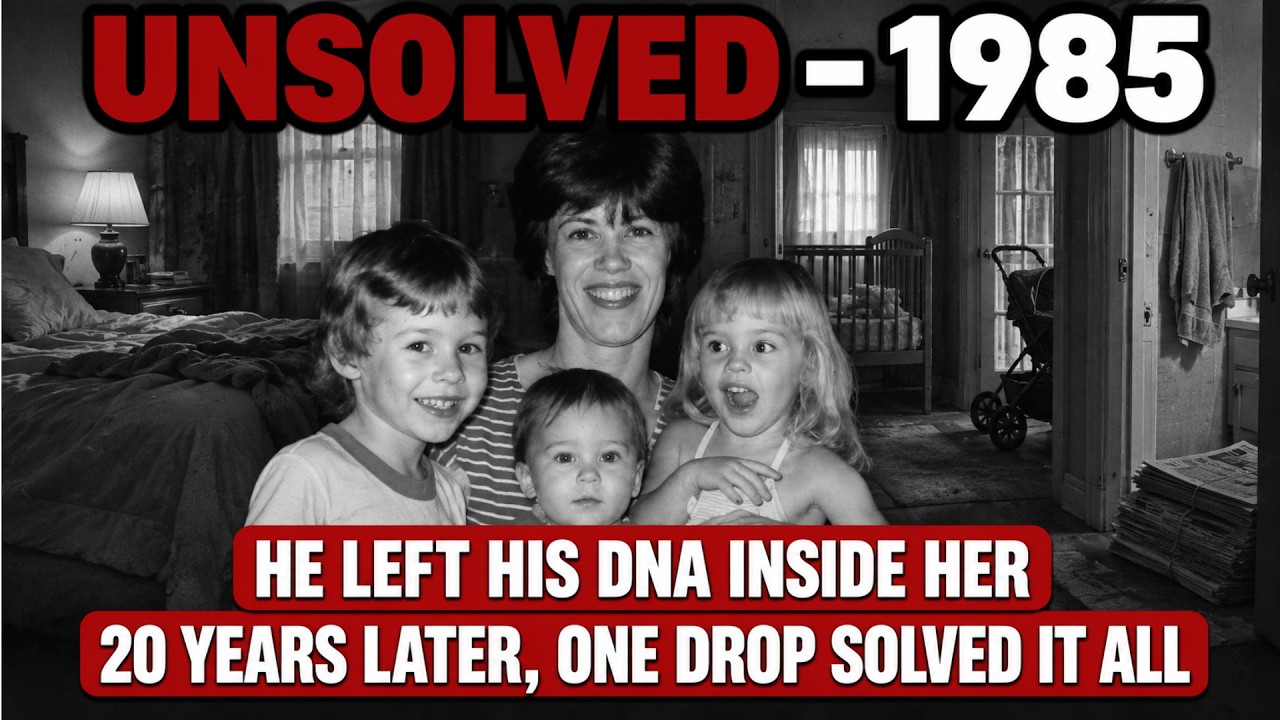
An intruder slipped through an unlocked garage door, sexually assaulted Katie, and stabbed her fifteen times. Cara suffered multiple stab wounds to her chest. Erin was beaten to death. Jana was left in her crib crying among the bodies of her mother and sisters for three days until police broke down the door on Mother’s Day.
The killer left semen on Katie’s body, a witness who saw him leave the house at dawn, and a trail that led to the family’s bank card being used after the victims were dead. Sergeant Timothy Hennis was arrested just seven days later and sentenced to death in 1986. But DNA technology did not exist in courtrooms in the 1980s. By 1989, Hennis was completely acquitted, reinstated in the Army, promoted to sergeant first class, and lived as an ordinary citizen for twenty years.
The Constitution protected him. North Carolina courts could not try him again. It took twenty years, a semen sample in a cold storage room waiting for science to advance, investigators who remembered the case, a constitutional loophole that allowed a military court to retry a man acquitted in a civilian court, and a father who never stopped demanding justice to reopen this cold case. This is the story of how a drop of semen from 1985 became a death sentence in 2010.
And it began with a classified ad for a dog in the local newspaper. To understand why this case took more than two decades to resolve, one must understand who the Eastburn family was and how they lived before that fateful night. Gary Eastburn was a captain in the United States Air Force, an air traffic control officer stationed at Pope Air Force Base, directly adjacent to Fort Bragg in Fayetteville, North Carolina. He met Kathryn “Katie” in the 1970s and married her in 1975.
By 1985, they had three daughters. Their lives resembled those of thousands of other military families across America. The husband served the nation while the wife managed the household. The children grew up accustomed to their father’s absence for weeks, sometimes months at a time.
Katie never complained much. She handled everything from meals to bedtimes with a patience understood only by military wives. In early 1985, the Eastburns received news of a transfer to England, where Gary would take a post as a liaison officer. The family began preparing for the move.
One thing they could not take was the family dog, an English setter named Dixie. Katie placed a classified ad in the local newspaper serving the military community, the Paraglide at Fort Bragg, seeking someone to adopt Dixie. It was a perfectly ordinary ad. Dog for sale.
Leave a phone number. Wait for calls. No one in the Eastburn family could have imagined that six lines of text in a local newspaper would lead to the deaths of three of the five family members. In May 1985, Gary was sent for training at officer school in Montgomery, Alabama.
He left Katie alone with three small children. It was not the first time. It was their normal life. Katie knew how to manage.
On May 7, 1985, a man responded to the ad. Timothy Hennis, twenty-seven years old, a sergeant in the United States Army stationed at Fort Bragg, came to the Eastburn home that evening, spoke with Katie, looked at the dog, and decided to adopt Dixie. His wife Angela and their young daughter already had a spitz dog at home, but Hennis wanted another. He took Dixie and left.
Katie thanked him. The door closed. That was the only recorded meeting between Katie Eastburn and Timothy Hennis. A routine exchange between two military families about a dog.
No conflict, no threats, nothing for Katie to worry about as she locked the door that night. Two days later, on the night of May 9, Katie put her three daughters to bed as she did every night. Gary was in Alabama. The house on Summerhill Road was quiet.
An intruder entered through the garage door, the only door left unlocked. There was no other sign of forced entry. The killer knew which door to use. What happened inside that home that night ranks among the most brutal crimes in North Carolina criminal history.
Katie was sexually assaulted and stabbed fifteen times. Five-year-old Cara was stabbed multiple times in the chest. Three-year-old Erin was beaten viciously on her chest and back until she died. The killer tried to clean the crime scene, using bloodstained towels to wipe the walls and floor of the master bathroom.
A later luminol test revealed traces of blood everywhere despite the wiping. He cleaned the place, but not thoroughly enough. He was careful, but not careful enough. He left his semen inside Katie’s body.
In 1985, he had no reason to worry about that. Forensic DNA technology did not exist yet. No one in the world had ever been convicted of murder based on DNA testing at that time. But science has a longer memory than any killer.
Twenty-one-month-old Jana lay in her crib in her room. She was unharmed. The killer either overlooked her or did not find her in the dark. Jana lay there crying for three days.
No one fed her. No one changed her diaper. No one came. For three days, a twenty-one-month-old child lay a few steps from the bodies of her mother and sisters while the outside world knew nothing.
Sunday, May 12, 1985, was Mother’s Day. Newspapers piled up at the Eastburn door. The family car remained in the driveway. The stroller stayed in its usual place by the back door, but no one had entered or left the house for three days.
Neighbors grew worried. Meanwhile, Gary Eastburn was calling the house repeatedly from Alabama, receiving no answer. After two days, he notified the authorities. A neighbor and fellow officer, William Tollman, was among the first to arrive.
They broke down the front door. What first confronted them was the terrible odor. Then they saw what they saw. In the master bedroom, three-year-old Erin’s body lay on the bed beside her mother.
Katie lay in a pool of dried blood, her clothing torn. Cara lay elsewhere in the room. Blood on the walls, blood on the floor, bloodstained towels in the bathroom, and from the next room, a weak cry. Jana was still alive.
She was severely dehydrated but unharmed. She had lain in that crib for seventy-two hours, alone with the silence of death. The investigative team secured the crime scene quickly. They recovered multiple fingerprints, a pubic hair of a Caucasian near the living room couch, the bloodstained towels, and the semen sample from Katie’s body via a rape kit.
They took dozens of photographs. They recorded every possible detail. On the first night of the investigation, the most important lead came on its own. A man named Patrick Cone, a janitor who began his shift very early each morning and often walked through the Summerhill neighborhood in the pre-dawn darkness, approached the lead investigators, Robert Fidell and Jack Watts, and told them that at about 3:30 a.
m. on May 10, he saw a man leaving the driveway of the Eastburn home. The man was tall, white, wearing jeans, a knit cap, and a Members Only jacket, a style popular in the mid-1980s. He carried a black garbage bag and walked toward a small white car parked nearby.
Cone’s description was detailed enough for a police sketch artist to produce a composite image. The sketch was published in local media. Based on Cone’s statement, investigators determined the murders occurred between 8:00 p. m.
on May 9 and 3:00 a. m. on May 10, 1985. At the same time, investigators discovered that the Eastburn family’s bank card had been used at an ATM after Katie’s death.
Two withdrawals were made. A female witness who arrived at the ATM immediately after the second transaction on May 11 said she saw a blond man matching Cone’s description leaving the machine. A bank card, an eyewitness at the crime scene, an eyewitness at the ATM, and a composite sketch. All leads pointed in the same direction.
When Gary Eastburn rushed back from Alabama, he realized many items were missing from the home, including his bank card. Someone had not only killed his wife and daughters but also rummaged through the household and stolen property. The answer came from the dog. When news of the Eastburn murders spread widely on television and in local newspapers, investigators began tracking down people who had contacted Katie about the dog ad.
They found the family that had adopted Dixie. The family confirmed they had taken the dog and also stated that the husband, Timothy Hennis, drove a white Chevette. The car matched Patrick Cone’s description precisely. When investigators looked at the composite sketch and then at Timothy Hennis, the resemblance was strong enough that they no longer needed to continue searching.
On May 15, after following news of the case, Hennis voluntarily went to the local police station and agreed to be questioned. He admitted going to the Eastburn home on May 7 to pick up the dog but insisted that was his only contact with the family. He denied any involvement in the murders. He said on the night of May 9, he took his wife Angela and their daughter to his in-laws’ home, stopped for gas, and went home.
A simple story and an alibi. But that alibi collapsed almost immediately. A former female friend of Hennis told investigators that on that night, Hennis stopped at her house. He did not go straight home as he had claimed.
He had lied. While Hennis was still at the police station talking to officers, a lineup of five photos was prepared in an envelope and shown to Patrick Cone. Cone selected Hennis. On May 16, 1985, seven days after the murders, Timothy Bilyeu Hennis was arrested.
He was charged with three counts of first-degree murder and one count of rape. The case appeared solved quickly. But to understand why this story stretched on for another twenty-five years, one must understand who Timothy Hennis was and why he was not the type of suspect anyone expected. Born February 24, 1958, in Rochester, Minnesota, Hennis joined the United States Army and was stationed at Fort Bragg.
By 1985, he was a sergeant, twenty-seven years old, married to Angela, with a young daughter. From the outside, Hennis appeared to be the model soldier. Young, disciplined, stable family, no history of violence, no criminal record, nothing suggesting he could commit one of the most brutal murders in Fayetteville’s history. Neighbors described him as polite.
Fellow soldiers said he was a good soldier. His wife trusted him completely. Nothing in Timothy Hennis’s public life suggested he was capable of raping a woman, stabbing her fifteen times, killing two children, and then returning home to sleep beside his wife and child. But evidence does not care about appearances.
The truth in the summer of 1985 pointed to one man. Witness Cone saw him leaving the Eastburn home. His car matched the description. His face matched the descriptions.
His alibi was false. The victim’s bank card had been used after her death. He was the only person with a confirmed connection to Katie Eastburn in her final days. The man who came for the dog.
In the summer of 1986, more than a year after the murders, Timothy Hennis stood before a jury. Prosecutors believed they had a strong case. They had an eyewitness, circumstantial evidence, the financial trail, and dozens of crime scene photographs they believed would sear into the jurors’ minds what Timothy Hennis had done to a young mother and her two daughters. But there was one thing they did not have.
They had no confession. They had no direct physical evidence linking Hennis to the crime scene. No victims’ blood on his clothing. No fingerprints in the house.
No matching fibers or hair. And they had no eyewitness who saw him commit the murders. The prosecution’s entire case rested on circumstantial evidence. Strong, but circumstantial.
The trial began in the summer of 1986. Prosecutors presented the case systematically. Patrick Cone took the stand and pointed to Timothy Hennis, confirming he was the man he saw leaving the Eastburn home at 3:30 a. m.
on May 10, carrying a black garbage bag and wearing a Members Only jacket. The ATM witness described a blond man matching Hennis’s description. The post-mortem use of the bank card was detailed. Luminol results showed someone had tried to clean blood from the master bathroom but failed.
Then prosecutors used the weapon they believed was strongest. Dozens of crime scene photographs were enlarged and displayed before the jury. Katie lying amid dried blood. Cara with stab wounds in her chest.
Erin, the three-year-old, her face covered in bruises. Those images left no room for neutrality. The jury saw exactly what happened in the house on Summerhill Road. After three weeks of trial, the jury deliberated and returned a verdict.
Guilty. Three counts of first-degree murder. One count of rape. The judge sentenced Hennis to death.
Twenty-eight-year-old Timothy Hennis was sent to death row at the North Carolina State Penitentiary in Raleigh. Gary Eastburn finally had an answer. The man who came to the house for the dog returned two nights later and killed his wife and daughters. Justice had been done.
At least that is what everyone believed had happened. But the story did not end there. It had not even reached the halfway point. Hennis’s defense attorneys appealed to the North Carolina Supreme Court.
Their arguments centered on the prosecution’s strongest weapon: the crime scene photographs. They argued that displaying dozens of enlarged, explicitly gruesome, blood-soaked images served no purpose other than to inflame the jury against the defendant. They argued the actual evidence in the case was weak, that no direct physical evidence linked Hennis to the crime scene, and that the jury had reached its verdict based on emotion rather than evidence. The state Supreme Court agreed.
In 1988, they overturned the conviction, ruling that the first trial had been unfair because excessive use of crime scene photographs affected the jurors’ ability to judge objectively, and that the forensic evidence as a whole was weak. Hennis was granted a new trial. He left death row. The second trial began in April 1989, and from the first minute everything was different.
Hennis’s new defense team, led by attorney Billy Richardson, changed tactics completely. Instead of merely challenging the evidence, they attacked every pillar of the prosecution’s case directly. The first pillar to collapse was Patrick Cone. Defense attorneys revealed that Cone had a criminal record, including an attempt to use a stolen credit card at the same ATM where Katie’s bank card had been used.
Cone’s sister lived next door to the Eastburn home. They pointed out that Cone misremembered the weather that night, claiming it was cloudy while weather records showed it was perfectly clear. They reenacted the scene according to Cone’s description and demonstrated that in the faint pre-dawn light, someone standing where Cone claimed could not clearly see the man’s face from that distance. They called two new witnesses, neighbors Chuck and Cheri Ruthke from Summerhill Road, who testified they were out walking early the same morning at the time Cone claimed to have seen the man.
They saw neither Cone nor anyone else. The second pillar was physical evidence. Defense attorneys argued the pubic hair found near the living room couch belonged to no one in the Eastburn family and not to Hennis. The hair on the bed did not match.
Footprints at the crime scene did not match. There was no victims’ blood on Hennis’s clothing, car, or in his home. No fibers from the victims’ clothing were found on him. In a murder so bloody that the killer had to wipe the walls with towels, not a single drop of blood could be traced to Timothy Hennis.
The defense raised the question the prosecution could not answer convincingly: how could a man stab a woman fifteen times, kill two children, clean the crime scene, and return home without a single drop of blood on his clothing, hands, or in his car? They proposed a theory that the real killer was a stranger, perhaps the person who had made threatening phone calls to the Eastburn family before the crime, and that the unknown hair found at the scene belonged to him. They even suggested that investigators should look more closely at Patrick Cone himself, who happened to be near the scene at the right time, had a criminal record, had a relative living near the Eastburns, and had used a stolen card at the same ATM. The ATM witness had originally told police she remembered nothing about that night.
But just before the first trial in 1986, she suddenly confirmed to prosecutors that she had seen a tall, blond man driving a small white car. A description matching Hennis perfectly. Defense attorneys argued this change in testimony was suspicious. Piece by piece, the defense dismantled the prosecution’s case.
They did not need to prove Hennis’s innocence. They only needed to create reasonable doubt, and they did so systematically. After two days of deliberation on April 10, 1989, the jury returned to the courtroom. The verdict: not guilty on all charges.
Three murders, one rape, not guilty. Timothy Hennis walked out of the courtroom a free man. This time the Constitution protected him under the most sacred principle of the American justice system: double jeopardy, the prohibition against trying someone twice for the same crime. North Carolina courts, under any circumstances, could never try Timothy Hennis again.
The case was over, at least on paper. Hennis re-enlisted, not shamefully or quietly, but openly and proudly, as a man unjustly accused and now acquitted. He served several more tours. He steadily rose through the ranks from sergeant to sergeant first class.
He lived with his wife and children. He earned a salary. He paid taxes. He was someone’s neighbor, coworker, and friend.
For fifteen years, Timothy Hennis lived the life of an ordinary citizen and a respected soldier while Gary Eastburn raised Jana alone, without a mother and without sisters. For fifteen years, Jana Eastburn grew up knowing the man who killed her mother and sisters was walking free, wearing a military uniform, receiving honors, and living as if the night of May 9, 1985, had never happened. But there was one thing time could not erase. In the evidence storage room of the North Carolina State Bureau of Investigation laboratory, the semen sample collected from Katie Eastburn’s body via the rape kit was still there.
In 1985, forensic DNA technology barely existed. In 1986 and 1989, during both trials, the semen sample was never used as evidence because there was no way to identify its owner. It was just a biological sample in a tube inside a cold, dark room, waiting for something. Science does not forget.
DNA does not suffer memory loss. During the fifteen years Hennis lived free, forensic genetics technology evolved from primitive to near-perfect precision. In 2004, Hennis retired from the Army after nearly twenty years of service. He received a military pension.
He had completed his duty. He had survived everything. He thought the case was completely forgotten. He was wrong.
In May 2005, twenty years after the murders and sixteen years after Hennis’s acquittal, a seminar on advanced forensic intelligence techniques was held for investigators across North Carolina. Among the attendees was Captain Larry Trotter of the Cumberland County Sheriff’s Office, the county that includes Fayetteville. Trotter had no direct connection to the Eastburn case. He was not one of the original investigators.
He was not even in law enforcement when the murders occurred. But at that seminar, the Eastburn case was presented as a case study, an example of a case containing biological evidence that had not been fully exploited using modern technology. After the seminar, Trotter sought out journalist Scott Wisnant, who had covered both Hennis trials in the 1980s. Wisnant knew more details of the case than anyone outside the Eastburn family.
He told Trotter something most people had forgotten or never knew. During Katie Eastburn’s autopsy in 1985, a medical examiner had collected a semen sample from her body via vaginal swabs and preserved it as part of the rape kit evidence. That sample had never been DNA tested. Not because anyone deliberately hid it, but because in 1985 and even in 1986 and 1989 when the trials occurred, forensic DNA testing technology was not advanced enough to produce reliable results from a degraded biological sample.
That semen sample remained in evidence storage for twenty years. It was not destroyed, not lost, not touched by anyone. It simply remained there in the dark, waiting for the day science could read it. That day had come.
Trotter immediately realized the significance of the information. If the semen sample still existed, and if modern DNA technology could identify its owner, then the question of who raped and killed Katie Eastburn could be answered definitively. Not by eyewitness testimony that could be challenged, not by circumstantial evidence open to multiple interpretations, but by science, by the genetic code, by something that cannot lie. Trotter reopened the investigation.
He contacted the North Carolina State Bureau of Investigation and requested DNA testing of the vaginal swabs from Katie Eastburn’s 1985 rape kit. The sample had degraded after twenty years of storage, but enough genetic material remained for analysis. DNA analysts at the state SBI laboratory began work. The results came back in 2006.
The DNA from the semen found inside Katie Eastburn’s body matched Timothy Hennis. It was not a partial match, not a resemblance, but a complete match. Two testing sets produced the same result. The sample was degraded, but it provided clear results.
Twenty years after that night on Summerhill Road, science finally said what witnesses and circumstantial evidence could not prove beyond doubt. Timothy Hennis was inside that house. Timothy Hennis sexually assaulted Katie Eastburn. If he raped her, he also killed her.
For Gary Eastburn, this was the moment he had waited twenty years for. He never believed in Hennis’s innocence. He never accepted the 1989 acquittal. He lived two decades knowing the man who killed his wife and daughters was free, and now science confirmed what he had always known.
But DNA does not automatically deliver justice. The Eastburn case now entered unprecedented legal territory. Cumberland County prosecutors looked at the DNA results and knew they had convicting evidence, but they also knew they could do nothing with it. Double jeopardy, guaranteed by the Fifth Amendment, protects every citizen from being tried twice for the same crime.
Timothy Hennis had been acquitted by a jury in 1989. That verdict was final. It could not be overturned. There were no exceptions.
Even if a video of him committing the murders existed, North Carolina courts had no authority to try him again. Double jeopardy is not a loophole in the system. It is a foundational pillar, designed to prevent the government from using unlimited state resources to prosecute someone repeatedly until it gets the result it wants. In the case of Timothy Hennis, the principle protected a killer.
Civilian prosecutors were out of options, but Trotter remembered something: a legal precedent from 1987. Civilian courts and military courts are two entirely separate jurisdictions. In the American legal system, double jeopardy applies within the same judicial system. If you are acquitted in a state court, the state cannot retry you, but a military court is not a state court.
Military courts operate under the Uniform Code of Military Justice, an independent legal system with its own judges, prosecutors, juries, and procedures. Under legal precedent, the military can try its members even if they were previously acquitted in a civilian court on the same charges. This is not abstract theory. This is law, and it applied to Timothy Hennis for a specific reason.
When Hennis was acquitted in 1989, he re-enlisted. He served fifteen more years. He retired in 2004 but continued to receive military retirement pay. Under one provision of military law, the Department of Defense has the authority to recall retirees receiving retirement pay to active duty and court-martial them for criminal offenses.
Trotter handed the entire DNA evidence package to the United States Army. The Army began evaluating the case. A team of military prosecutors reviewed the evidence, studied the case history, and analyzed the legal feasibility. They decided to proceed.
In September 2006, the United States Army recalled Sergeant First Class Timothy Hennis to active duty. The sole purpose of the recall order was to bring him before a court-martial. Hennis was ordered to return to Fort Bragg, the same base where he had been stationed when the murders occurred twenty-one years earlier. In November 2006, he was charged with three counts of premeditated murder and one count of rape.
Defense attorney Frank Spinner announced he would fight relentlessly to protect Hennis’s honor and reputation. Hennis maintained the Army had no authority to try him, that recalling a retiree solely for trial was an abuse of power, and that the entire process violated his constitutional rights. A federal judge, Terrence Boyle, reviewed the jurisdictional question but ruled it inappropriate for him to intervene while the military court was pending, allowing the case to proceed in the military justice system. Gary Eastburn followed every development.
Twenty-one years earlier, he had returned from Alabama to find his wife and daughters murdered and his youngest child crying in her crib. He had raised Jana alone. He had lived through the conviction, the hope, the appeal, the acquittal trial, the despair, sixteen years of silence, the DNA results, and now an unprecedented court-martial. He had waited more than half his life, and this time the evidence was not the testimony of a janitor in pre-dawn darkness.
This time, the evidence was the genetic code of Timothy Hennis himself found inside his wife’s body. Before the court-martial could begin, Hennis had to undergo an Article 32 hearing, the military equivalent of a civilian grand jury. The purpose was to determine whether military prosecutors had sufficient evidence to bring the case to trial. The hearing was held at Fort Bragg, and for the first time in the history of the Eastburn case, DNA evidence was formally presented before a judicial body.
SBI DNA analyst Lane took the stand and presented the test results. The semen sample collected via vaginal swabs in the 1985 rape kit, despite degradation after twenty years of storage, provided sufficient genetic material for analysis. The results showed a clear match to both Katie Eastburn and Timothy Hennis. She explained that despite the small size and degradation of the sample, two independent testing sets produced the same result.
Defense attorney Spinner immediately responded. In cross-examination, he raised a question that would become a pillar of the defense strategy throughout the court-martial: who had access to that evidence sample since 1989? Spinner implied that in the sixteen years following Hennis’s acquittal, the semen sample sat in a storage room accessible to many. He questioned the integrity of the evidence chain of custody.
He suggested the sample might have been contaminated or tampered with. He accused no one directly of fabricating evidence, but he planted seeds of doubt. The investigating officer at the Article 32 hearing listened to evidence from both sides and wrote a report to Hennis’s commander. The report recommended proceeding to trial.
Lieutenant General Lloyd Austin, commander of the XVIII Airborne Corps, ordered the case referred to a court-martial. Timothy Hennis would be tried a third time for the same three murders. This time not before a civilian jury in Fayetteville, but before a military panel at Fort Bragg composed of officers and non-commissioned officers. People who wore the same uniform he wore.
The court-martial began in March 2010 at Fort Bragg. Twenty-five years after that night on Summerhill Road. Twenty-one years after Hennis’s acquittal. Timothy Hennis was now fifty-two years old, gray-haired, his face completely different from the twenty-seven-year-old in the 1985 sketch.
But DNA does not change with age. Major Nathan Huff, the lead military prosecutor, stood before the panel and began his presentation with a direct statement. He pointed at Hennis and said this very man committed these crimes. On May 9, 1985, Kathryn Eastburn was raped and stabbed to death in her home.
Her two daughters were killed right beside her, and Timothy Hennis is the one who did it. The prosecution’s strategy was clear and focused. Huff built the entire case around the DNA evidence. He called DNA experts to testify, detailing the testing process, methods of analysis, and matching results.
The experts confirmed that the DNA extracted from the semen found in Katie Eastburn’s body matched Timothy Hennis’s sample. The probability of a random match was minuscule. In other words, that semen belonged to Hennis, not to any other person on earth. Huff also reintroduced all the evidence from previous trials.
The victims’ clothing was shown to the panel. Witness Patrick Cone was referenced through old trial records. Hennis’s connection to the Eastburns through the dog ad was re-established. But DNA was the central pillar.
DNA was what the 1986 and 1989 trials had lacked. DNA was what changed everything. The defense launched a counterattack on multiple fronts simultaneously. Lieutenant Colonel Kris Popp, one of Hennis’s military defense attorneys, attacked the DNA evidence directly.
He noted the semen sample was twenty years old, degraded, and the quantity of DNA recovered was very small. He told the panel that the smaller the amount of DNA, the bigger the problem. He argued the authorities could not prove the sample had not been tampered with since the 1989 acquittal. Who touched it?
Who had access to it? In sixteen years, how many people entered that storage room? Attorney Spinner presented the defense’s most striking argument. He admitted the DNA matched Hennis.
He did not deny the science, but he argued that the presence of Hennis’s semen in Katie Eastburn’s body did not prove murder. It only proved a sexual relationship, and a sexual relationship is not murder. Spinner suggested Hennis and Katie may have had consensual sex, and that someone else entered the house afterward and killed her and the children. Prosecutor Judy Young objected immediately.
She pointed out that in twenty-five years and three trials, there was not a single piece of evidence showing Hennis and Katie Eastburn had any relationship beyond the single meeting on May 7 when he came for the dog. No letters, no phone calls, no witness seeing them meet again, no one in Katie’s or Hennis’s life knowing of any relationship. Most importantly, Hennis himself in both previous trials never claimed to have had a sexual relationship with Katie. Never.
In the 1986 trial when he was sentenced to death, he did not say it. In the 1989 trial when he was acquitted, he did not say it. During twenty years of freedom, he did not say it. Only now, when DNA placed him at the crime scene, did he suddenly suggest a consensual relationship.
Twenty-five years of silence, then suddenly a new story. Popp also emphasized another point. There was no physical evidence linking Hennis to the crime scene except the DNA. No blood, no fibers, no hair, no fingerprints.
The same argument from the 1989 trial, but it now faced a new reality it could not erase. Hennis’s semen was inside the body of a woman who had been raped and stabbed fifteen times. Additionally, unknown DNA was found under Katie Eastburn’s fingernails that did not match Hennis’s DNA. The defense argued this proved Katie had fought against a different attacker, not Hennis.
The prosecution responded that DNA under the fingernails could come from many sources and did not necessarily belong to the killer. The trial was expected to last up to two months with about 120 witnesses. This was the third time the Eastburn murders had been presented to a court panel. The first time, conviction was based on witnesses and circumstantial evidence.
The second time, acquittal came when that evidence was debunked. The third time, new evidence, the kind that cannot be intimidated on the witness stand, cannot be challenged with a criminal record, cannot be explained away by poor lighting or bad weather. DNA has no criminal record. DNA does not misremember the weather.
DNA does not change its testimony between trials. DNA says only one thing, and it says it forever. After three weeks of trial, dozens of witnesses from both sides, every argument made, and every piece of evidence examined, the military panel received the case for deliberation. The panel consisted of officers and non-commissioned officers of the United States Army.
People who wore the same uniform as Timothy Hennis, understood military life, understood the meaning of honor and responsibility, and knew their verdict would set a legal precedent watched by the entire country. In the military justice system, a conviction does not require unanimity. Only a two-thirds majority is required. But if the verdict is unanimous, it opens the path to the death penalty.
The panel deliberated. They reviewed the DNA evidence, expert testimony, prosecution arguments about the link between Hennis and the Eastburns, and defense arguments about consensual sex and the integrity of the evidence sample. They weighed the twenty-five-year legal history of the case, then returned to the courtroom. April 8, 2010.
The verdict: guilty. Three counts of premeditated murder. Unanimous. Not a single member of the panel dissented.
Everyone in the courtroom understood the meaning of unanimity. One week later, on April 15, 2010, the panel issued its sentence: death. Fifty-two-year-old Timothy Hennis was sentenced to death for the second time in his life for the same three murders he had been acquitted of twenty-one years earlier. After twenty-five years since that night on Summerhill Road, justice finally had a formal name.
Gary Eastburn sat in the courtroom as the sentence was read. The man who lost his wife and daughters in a single night, who raised his surviving child alone, who lived through conviction, acquittal, sixteen years of silence, and an unprecedented court-martial, finally heard the word he had waited more than half his life for: guilty. Jana Eastburn, the twenty-one-month-old child who remained crying in her crib for three days among the bodies of her mother and sisters, was now a twenty-six-year-old woman. She had no memory of that night.
She did not remember her mother. She did not remember Cara or Erin. She knew them only through photographs, her father’s stories, and court records. But she knew the man who killed her family had finally been convicted.
Not by the vague testimony of a witness in the dark. By science. By the genetic code he himself left inside her mother’s body. Hennis showed no emotion as the sentence was read.
He was escorted from the courtroom and transported to the United States Disciplinary Barracks at Fort Leavenworth, Kansas, where the military’s most dangerous prisoners are held, including military death row inmates. He joined a small group of fewer than ten men on military death row, where executions are rarely carried out because every military execution requires the personal approval of the President of the United States. Appeals began almost immediately. Hennis’s attorneys argued the court-martial violated double jeopardy, that recalling a retired soldier solely for trial was an abuse of power, that the degraded DNA sample was unreliable, and that the twenty-five-year delay deprived him of a fair trial.
In November 2016, the military appeals court rejected the appeal and upheld both the conviction and the death sentence. The United States Supreme Court declined to review the case. All legal avenues were closed. Timothy Hennis remains at Fort Leavenworth on death row, awaiting a punishment that may never be carried out but will also never be overturned.
The Eastburn case left a legacy that extends beyond one family and one verdict. It became a model taught in criminal investigation training programs across the United States, an example of how biological evidence can remain silent for decades and then speak when technology catches up. Journalist Scott Wisnant, who followed the case since the first trial in 1986, authored a book, Innocent Victims: The True Story of the Eastburn Family Murders, chronicling the entire journey from the dog ad to the court-martial verdict. Three unprecedented trials in American judicial history for the same murder case.
The case also raised legal questions that remain controversial today. Is trying someone a third time for the same crime after acquittal justice or an abuse of state power? Supporters say DNA does not lie, and three lives deserve justice no matter how long it takes. Critics say double jeopardy exists for a reason, and allowing the government to circumvent the law to retry an acquitted person sets a dangerous precedent for every citizen.
Both sides have a point. That is the nature of cases that change laws. They are never simple. But one thing in this story is simple.
On the night of May 9, 1985, a twenty-nine-year-old mother and her two young daughters were killed in their home while her husband served the country hundreds of miles away. The youngest child remained in her crib for three days crying, with no one coming. The man who left his semen inside the victim’s body lived free for twenty years, rose through the ranks, retired, and thought time had erased everything. But time does not erase DNA.
Science does not forget. And some cases never truly go cold. They simply wait.