On April 11, 1945, American artillery rumbled through the valley below the Ettersberg hill, where the gates of Buchenwald concentration camp still stood locked. Inside the wire, starving prisoners had been hiding weapons for months, waiting for the moment the guards would break. Within hours, tanks of the 6th Armored Division would roll up the road, and the world would see what the Nazis had built on a hill that once inspired Germany’s greatest poets. But the woman whose name would echo through the camp for decades was not there.
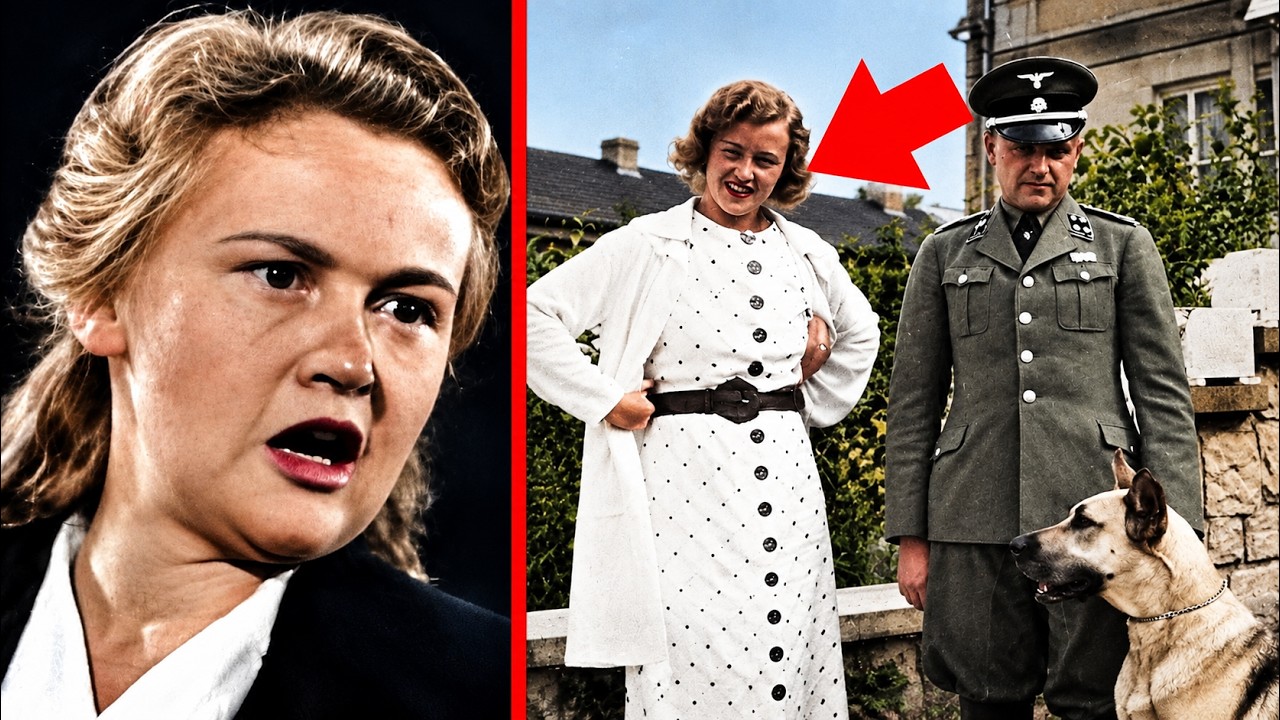
She had left months earlier, been tried, acquitted, and released. Her husband was already dead, shot by his own SS. Her name was Ilse Koch, and the press would call her the Bitch of Buchenwald. Survivors remembered her on horseback, and they feared the sound of hooves.
Ilse Köhler was born on September 22, 1906, in Dresden. Her father was a factory foreman, and the family was modest and respectable. She grew up in a Germany humiliated by defeat in the First World War, ruined by inflation, and shaken by the Great Depression. She trained as a bookkeeper and worked in offices.
In 1932, a year before Hitler became Chancellor, she joined the Nazi Party. She was in her mid-twenties and had chosen her side early. Around 1934, she met Karl-Otto Koch, an ambitious SS officer climbing inside the camp system Heinrich Himmler was building. They married in 1937, the same year Karl was chosen to command a brand new camp on a wooded hill near Weimar, the city of Goethe and Schiller.
The SS called it Buchenwald, meaning beech forest. The first prisoners were political opponents, communists, social democrats, Jehovah’s Witnesses, and men labeled criminals or asocial. After Kristallnacht in November 1938, thousands of Jewish men were sent there as well. Later came Poles, Soviet prisoners of war, Roma, Sinti, and captives from across occupied Europe.
They worked in the quarry, carried stones up steep slopes, and stood for hours at roll call in freezing weather. Beatings, hangings, and shootings were routine. Roughly 280,000 people passed through Buchenwald and its subcamps, and tens of thousands died. The Kochs did not live like prisoners.
They lived like nobility. The SS built a large villa for the family just outside the barbed wire, and the couple enjoyed servants, gardens, parties, and a lifestyle funded by forced labor. Prisoners built and maintained it, cooked, cleaned, and served. Ilse was formally an SS auxiliary, holding a supervisory role over female staff.
She was not the commandant, but in a place where fear controlled everything, her position gave her influence, and she used it. Survivors described her riding through the camp on horseback, often in a summer dress or uniform, carrying a riding whip. Prisoners were ordered to keep their eyes down. If she thought a man looked at her, lingered, or simply irritated her, she might note his number, and later that man could be punished, beaten, or worse.
Some prisoners testified she used her whip directly. Others said she encouraged guards to punish men. Still others said her cruelty was more psychological, that she enjoyed the terror she caused. Not every account agrees, and that matters, because the truth about Ilse Koch is tangled up with rumor, post-war propaganda, and real documented crimes.
Buchenwald built her a private indoor riding hall. Prisoners were forced to construct it under brutal conditions, and several were reportedly killed during the building. Then came the darkest chapter, the one that made her famous. After the war, witnesses claimed that Ilse Koch selected prisoners with distinctive tattoos, that they were killed, and that their skin was turned into household objects, including lampshades.
The story shocked the world. Here is where history and legend collide. It is well documented that Buchenwald had a pathology department where prisoners’ bodies were examined and tattooed skin was preserved under the supervision of SS doctors, including Erich Wagner, who was later found to have made such items. American investigators found preserved tattooed skin and shrunken heads at the camp after liberation.
What remains debated is whether Ilse Koch personally ordered the killings and whether she had lampshades in her home. At her later trials, judges and reviewing officers questioned the strength of the evidence linking her directly to those specific acts. The evidence rested largely on witness testimony, some of it conflicting, given years after the events. That does not erase what happened at Buchenwald, but honest history must separate what was proven, what was claimed, and what was repeated because it was horrifying.
By 1941, the Kochs had left Buchenwald. Karl was transferred to run the Majdanek camp in occupied Poland, and Ilse remained in Germany for a time with their children. But the couple’s world was already cracking from within. The SS prided itself on ruthless loyalty, yet it was riddled with corruption.
Karl Koch had been stealing money and goods that belonged to the state and to murdered prisoners, and he had been accused of eliminating witnesses who knew too much. An SS judge named Konrad Morgen began investigating. In 1943, Karl Koch was arrested, and Ilse was arrested too. Members of the SS who had been part of the machinery of murder were now being prosecuted by their own system, not for killing innocent people, but for corruption and disobedience.
Karl was convicted by an SS court and sentenced to death. He was executed at Buchenwald in April 1945, just days before the camp was liberated, in the same place where he had ruled for years. Ilse’s case ended differently. In late 1944, the SS court acquitted her for lack of evidence, and she was released.
She went back to her home in Ludwigsburg and lived quietly with her children. On April 11, 1945, American forces reached Buchenwald. Prisoners, aided by an underground resistance network, had already taken control of parts of the camp as guards fled. What the soldiers found stunned them: piles of corpses, emaciated survivors, crematoria, evidence of medical experiments, death by neglect.
Investigators began asking who ran this place and who did these things. Survivors began naming names, and one name came up again and again: Ilse Koch. On June 30, 1945, American authorities arrested her at her home in Ludwigsburg. In 1947, she was tried with other Buchenwald staff before an American military tribunal at Dachau.
The trial drew huge public attention. Witnesses described her riding, her cruelty, and the tattooed prisoners. Reporters called her the Bitch of Buchenwald, and the image stuck. She denied the accusations, insisting she had done nothing wrong.
In August 1947, the court found her guilty and sentenced her to life imprisonment. Then she announced that she was pregnant, giving birth in prison to a son conceived while she was in custody. In 1948, General Lucius Clay, the American military governor, reviewed the case. He concluded that the evidence did not prove she had committed the most notorious acts attributed to her, particularly those involving prisoners killed for their skin.
He reduced her sentence to four years and ordered her release. The reaction was explosive. In the United States, newspapers and politicians erupted. Congress launched an inquiry, and Clay defended his decision, saying he had acted on the evidence, not public emotion.
The controversy led to a new legal step. Ilse Koch was not freed. West German authorities took over her case. In 1950, she was arrested again, this time by German prosecutors.
In 1951, a German court in Augsburg tried her once more, charging her with incitement to murder and physical abuse of prisoners. Survivors again testified, and this time the court found her guilty and sentenced her to life imprisonment. She was sent to the women’s prison in Aichach in Bavaria. For years she lived there in relative obscurity, still insisting on her innocence, still appealing, still asking for release.
Her son, taken from her as a baby and raised by others, grew up unaware of who his mother was. In his late teens, he learned the truth. In 1966, he reached out to her and visited her in prison, hoping to understand the woman behind the headlines. On September 1, 1967, Ilse Koch was found dead in her cell.
She had hanged herself with bed sheets. She was sixty years old. Her death came just after her son’s visits, and some reports say she left a note asking him to forgive her. She never confessed.
She never showed remorse in any way that convinced her accusers. To the end, she maintained that she was misunderstood, a scapegoat for crimes committed by men. Some historians argue that she has been turned into a myth, a sensational villain whose story grew larger than the facts. Many men in Buchenwald did far worse, and focusing on a female figure was partly a way of making an unbearable system easier to understand.
Others argue that this does not excuse her. Even by the standards of the courts, she was a willing participant in a brutal regime, a woman who lived in luxury built on suffering, who used her authority to hurt prisoners, and who never questioned the cause she had joined at twenty-five. Both things can be true. She can be exaggerated in legend and still guilty in fact.
Ilse Koch did not come from another world. She came from a clerk’s desk and a family home. She joined a movement, married an ambitious man, and gradually became part of an apparatus that treated human beings as objects. The system did not need monsters.
It needed ordinary people who would look away, obey, and benefit. Buchenwald today is a memorial, where visitors walk through a gate bearing the words “To each his own,” twisted by the SS into cruelty. The woman on horseback is gone.
The hill remains, and it asks still what any of us would have done.