On the morning of June 25, 1876, Lieutenant Colonel George Armstrong Custer led five companies of the U. S. 7th Cavalry into a valley that would become his grave. The Battle of the Little Bighorn, often remembered as Custer’s Last Stand, was a devastating defeat for the U.
S. Army and a defining moment in the clash between the expanding American nation and the Native peoples of the northern plains. Custer, confident in his approach, underestimated the strength and strategy of the Lakota Sioux, Northern Cheyenne, and Arapaho warriors who gathered under leaders like Sitting Bull and Crazy Horse. The fight was swift, brutal, and absolute.
By the time the fighting ended, Custer and every man under his immediate command were dead. The victory belonged to the Native coalition, but the aftermath left a battlefield strewn with the grim evidence of war. According to Native American accounts, including those of participants like White Bull and Wooden Leg, the scene after the smoke cleared was chilling in its own right. Young warriors and children moved among the fallen soldiers, searching the bodies.
Among the things they found were square green paper bills—U. S. currency that carried no meaning in their world. In an almost surreal turn, children later used those bills as makeshift saddle blankets for their toy horses, a stark reflection of how foreign the soldiers’ world seemed to them.
Silver coins were also recovered from the dead, and the Cheyenne melted the metal down to fashion buckles and ornaments. The battlefield was littered with relics of the soldiers’ lives, including bottles of whiskey found by warriors such as Little Hawk and Bobtail Horse, adding to the grim tableau of loss. It took two days for the U. S.
Cavalry to reach the site. When they arrived on June 27, 1876, they found a nightmare. Lieutenant Edward S. Godfrey described the landscape in haunting terms: bodies pale as marble lay scattered across the field, dead horses rotted in the sun, and the once-green grass was stained red with blood and dusted with the region’s ashy soil.
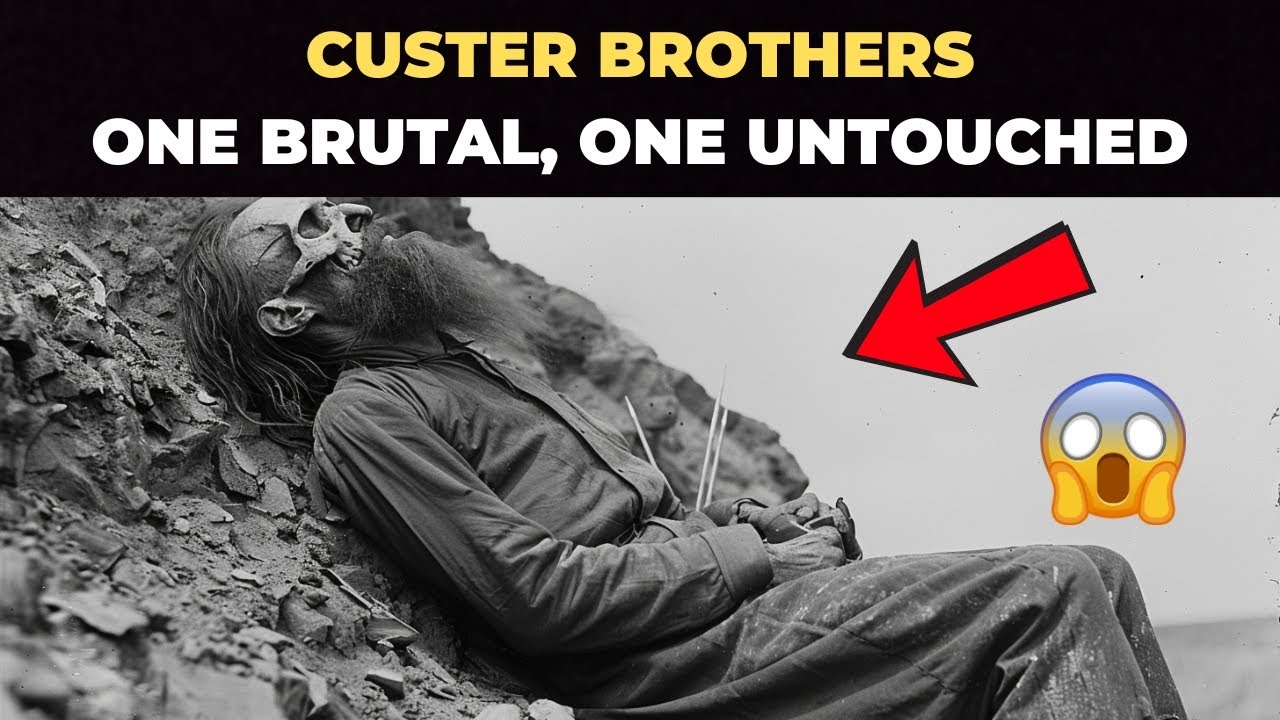
Godfrey’s account spoke of a desolation so profound that the memory would haunt him for the rest of his life. Among the dead was Captain Tom Custer, the general’s brother. His body was found near the top of a hill, brutally mutilated. Arrows had pierced his flesh, one embedded so deeply in his skull that it could not be removed.
His head had been crushed, and he was almost entirely scalped, save for a small patch of hair at the nape of his neck. His brother’s fate was different. George Armstrong Custer’s body lay on its back, hands gently folded across his stomach, a pose eerily reminiscent of how he rested during long marches. He had been shot twice, once in the temple and once near the heart, but his body was left unscalped and largely untouched by his enemies.
The youngest of the Custer brothers, Boston, lay about two hundred yards away, stripped of his clothing but still wearing his white cotton socks—though even those had the name tags carefully cut out. This deliberate removal of name tags from clothing was found on many of the bodies, a chilling attention to detail by those who claimed the battlefield as their own. With few tools and limited resources, the burial detail worked tirelessly, using picks, axes, and spades to dig shallow graves. Each man was buried where he had fallen, a thin layer of earth offering scant protection against the elements and scavengers.
Trumpeter J. P. Martinez recalled one particularly grim discovery: a heap of bodies in a deep ravine between Custer’s position and the river. Among them lay a sergeant entrusted with the soldiers’ pay, with five hundred dollars in torn paper money scattered around his body, a morbid reminder of the cost of the battle.
The horror did not end with the dead. Some soldiers were found decapitated, their heads later seen in the Sioux camp, according to Seventh Cavalry scout George Herendeen. One account described how a white man’s head was tied with a lariat and dragged through the village until it was severed from the body. The fate of captured troopers was equally nightmarish.
Survivor Jacob Adams recounted how some soldiers were lassoed off their horses, dragged into the village, tied to trees, and burned alive. From a distance, Captain Frederick Benteen’s division could only watch in helpless horror, unable to intervene in time to save their comrades. Of the five guidons carried by Custer’s troops, only one was recovered immediately after the battle. This flag was discovered beneath the body of Corporal John Foley, who, after failing to escape on horseback, took his own life rather than be captured.
The flag, later known as the Culbertson guidon, became a powerful symbol of the battle’s grim finality. In 2010, it was sold at auction for an astounding $2. 2 million, a reminder of the lasting historical impact of that fateful day. The Battle of the Little Bighorn was a dark chapter in American history, but it also serves as a powerful reminder of the complexity and humanity of both sides involved.
The bravery, the loss, and the grim reality of that day echo through time, illustrating the brutal consequences of war and the relentless clash of cultures on the American frontier. The victory of the Native forces was short-lived, however. Within months, the U. S.
Army intensified its campaigns against the Plains tribes, and the resistance that had triumphed at the Little Bighorn would soon be crushed. Sitting Bull fled to Canada, and Crazy Horse surrendered the following year. The defeat that stunned the nation accelerated the very forces that would ultimately end the way of life the warriors had fought so desperately to protect.