On a late April morning in 1875, four men crouched along the Pecos River in southwest Texas, firing steadily into a far larger band of Comanche warriors who were driving stolen horses across the water. The scouts had crept to within seventy-five yards and opened fire nearly forty-five minutes earlier, killing three warriors and wounding another. The volume of their shooting convinced the Comanche they faced a much larger force. But the deception did not hold.
The four soldiers belonged to a mixed-race unit known as the Seminole Scouts, attached to the Buffalo Soldiers. Their leader, Lieutenant John Lapham Bullis, was a white Civil War veteran and a strict but beloved commander. His three scouts, Sergeant John Ward, Private Pompey Factor, and Private Isaac Payne, were descendants of escaped slaves who had found refuge among the Seminole people decades earlier. After the Trail of Tears forced the Seminole into Oklahoma, many of their number migrated to northern Mexico, where they lived for nearly two decades under constant attack from Comanche, Kiowa, and Apache raiders.
When the Civil War ended and slavery was abolished, many returned across the Rio Grande and enlisted as army scouts, using their knowledge of the land and their old enemies to serve the United States. The scouts operated with unusual freedom, supplying their own horses and fighting in their own style. They wore the blue jackets of the army but also leggings, moccasins, and necklaces drawn from their native heritage. Their skill at tracking and endurance was legendary even among the hardened Buffalo Soldiers.
The year before, they had served with distinction in the Red River War under Colonel Ranald Mackenzie. Now, on the banks of the Pecos, the four men realized their advantage was slipping away. The Comanche, armed with Winchester lever-action rifles, had finally recognized the true size of the attacking force. A bullet shattered Ward’s rifle stock, and the warriors mounted a full charge.
The scouts decided to retreat to their horses, knowing that a last stand on the open frontier would serve no one. Factor, Ward, and Payne swung into their saddles and rode north toward the main body of Buffalo Soldiers. But Bullis could not mount. His horse, driven wild by the chaos, spun in circles and bit at him whenever he tried to climb into the saddle.
A bullet had also struck the lieutenant in the lower right leg, a flesh wound but enough to slow him gravely. The three scouts were already riding away when they realized their commander was still on the ground. Without hesitation, they wheeled their horses around and charged back into the attacking force, which outnumbered them roughly eight to one. They reached Bullis just before the Comanche closed in around them.
Ward’s second rifle was shot to pieces within moments of the fight resuming, its stock shattered and firing mechanism warped. The battle dissolved into hand-to-hand combat, with the three scouts clubbing and stabbing any warrior who came near while forming a loose perimeter around the struggling lieutenant. For nearly two hours, they fought off charge after charge. Finally, sensing a lull, they made a dash north, Bullis riding behind one of his men and leaving the crazed horse behind.
The four men traveled nearly sixty miles to Fort Clark, alternating who carried the wounded lieutenant, scanning the horizon for more attackers the entire way. They arrived alive, and Bullis immediately filed recommendations for all three scouts to receive the Medal of Honor, crediting them publicly and repeatedly with saving his life. On May 28, 1875, Pompey Factor, Isaac Payne, and John Ward each received the medal, becoming three of only eighteen Buffalo Soldier recipients in history. Bullis continued his army career until 1898, retiring as a brigadier general and later serving as a deputy treasurer in San Antonio until his death in 1911.
Factor farmed in northern Mexico before moving to Brackettville, Texas, where he died in 1928 and was buried in the Seminole Indian Scout Cemetery. Payne also farmed in Mexico, died in 1904, and was later reinterred in the same cemetery. Ward served until 1894, completing twenty-four years in the army, and then farmed in Brackettville until his death in 1911. He rests alongside his comrades.
The fight on the Pecos was one of countless clashes along the Texas frontier during those years, but it was far from the last. The Comanche refusal to surrender to reservation life drove some of the most dramatic campaigns of the era. In October 1871, a young private known to history only as Gregg found himself alone on the open plains of northern Texas, fleeing a Comanche warrior painted black from head to toe, the color of death. The warrior wore a full headdress of eagle feathers and brass hoops in his ears.
Private Gregg’s horse was failing, and escape was impossible. He turned to fight but could not chamber a round in his carbine. As he threw the weapon aside and reached for his pistol, the warrior closed the distance, drew his own revolver, and shot the young soldier through the head. The warrior then wheeled his horse and taunted the rest of the American detachment, facing them down alone.
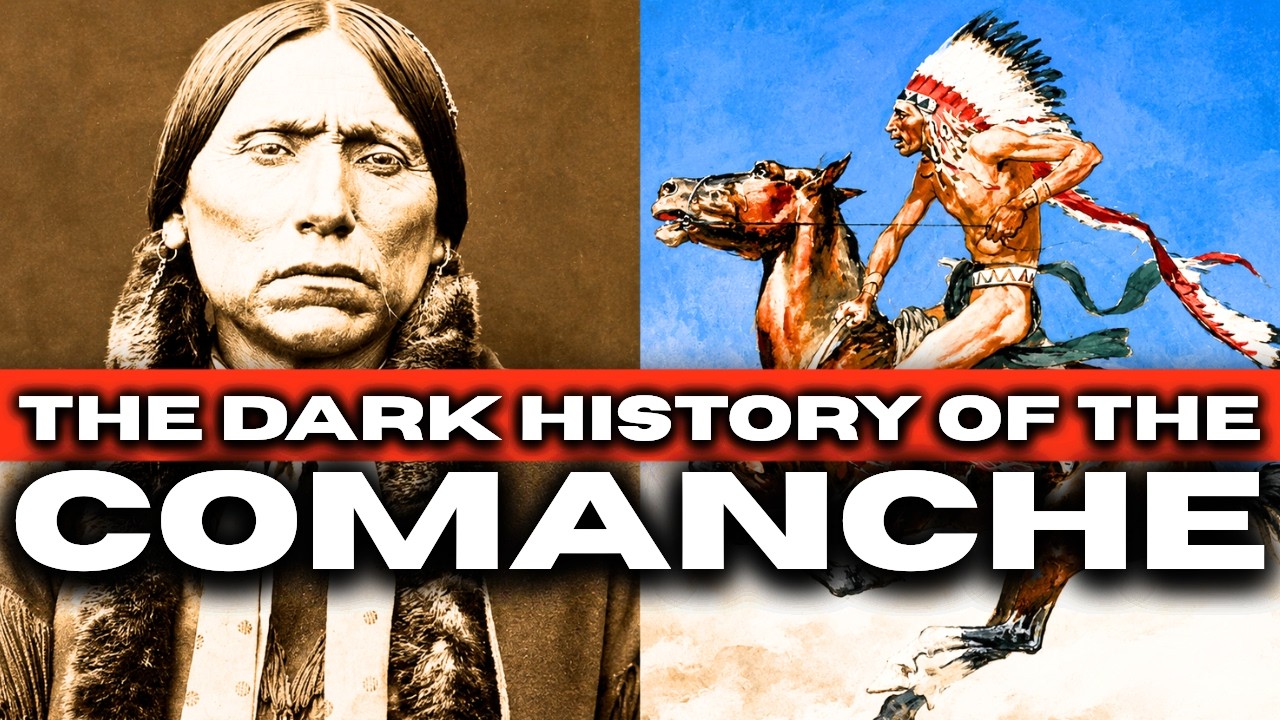
This warrior was Quanah Parker, the son of a Comanche chief and a white mother. In his mid-twenties, he led the Quahadi band, considered the fiercest of the Comanche. The soldiers facing him were green, many of them seeing a Comanche warrior for the first time. Their commander was Colonel Ranald Mackenzie, a thirty-one-year-old Civil War veteran who had been wounded seven times and had lost two fingers at Petersburg.
Mackenzie was new to frontier warfare, and the night before, he had allowed his men to light fires after sunset, a beacon that drew the Comanche into camp. They had stampeded seventy horses and mules before dawn. The next morning, Captain R. G.
Carter and Captain Charles H. Hiatt led small detachments to survey the losses. They spotted Comanche driving off more horses and gave chase into Blanco Canyon. It was a trap.
As they crested a bluff, dozens of warriors swarmed below them. Carter later wrote that the sight came like an electric shock, as the blood seemed to congeal in the realization that they had been led into an ambush. The soldiers dismounted and formed a firing line, and for a rare moment their disciplined volleys scattered the charge. But the battle was only beginning.
Comanche women gathered on the canyon walls, wailing and ringing bells, urging their men forward. After a chaotic exchange, the survivors managed to mount and flee, all except the unfortunate Private Gregg. Quanah turned his horse and rode away, not in retreat but in response to a new threat. Mackenzie and his cavalry, along with their Tonkawa scouts, were arriving.
Quanah chose to protect his families rather than finish off the small detachment. Mackenzie, now intent on total warfare, ordered his Tonkawa scouts to take the Comanche trail. For days they pursued through the open plains, enduring snow and cold. They caught sight of Quanah’s band several times, but the Comanche refused to give battle on unfavorable terms.
When his men grew exhausted, his rations and ammunition ran low, and his command stood one hundred miles from reinforcements, Mackenzie decided against a head-on assault and turned back. On the return to Blanco Canyon, the Tonkawa scouts cornered two Comanche warriors in a ravine. Mackenzie dismounted and went in with Lieutenant Peter Baum, and an arrow struck him in the upper thigh. The surgeon extracted the barbed arrowhead while the Tonkawa killed both warriors in a brief, vicious fight.
Afterwards, Dr. Choate and Lieutenant Wint C. Miller decapitated the bodies and boiled the heads in cauldrons to preserve the skulls for scientific study. Captain Carter, invited to lunch, lifted the lid of a bubbling pot and found the stripped skulls instead of a meal.
He moved his camp downstream out of sight. Mackenzie, in constant pain, spent five more days searching for Quanah before ordering a return to Fort Richardson. The Fourth Cavalry straggled in on October 18 under a snowstorm, having failed to capture the chief but having finally seen the man who had eluded them. Three years later, in September 1874, Mackenzie got his chance.
The Comanche, along with Kiowa, Cheyenne, and Arapaho allies, had gathered in the vast Palo Duro Canyon. Mackenzie and his Tonkawa scouts had located the village after weeks of searching. At five in the morning, his men lowered their horses down a nearly vertical embankment in the dark, trusting their orders and their commander. By seven, they were within striking distance, still undetected.
Then a dog barked. The village erupted. Warrior defenders rushed to hold back the soldiers while women and children fled deeper into the canyon. The attack was overwhelming.
By nine o’clock, roughly sixty defenders lay dead, but most of the Comanche escaped on foot under the leadership of chiefs like Quanah Parker. The price was their horses. Mackenzie’s men captured more than a thousand head, far more than they could feed or take with them. Turning them loose would only return them to the Comanche.
So Mackenzie ordered the slaughter. That afternoon, his men herded the horses into side ravines and shot them all, a macabre symphony of gunfire and screams echoing through the canyon until nightfall. The Comanche evaded the army through the fall, but without horses their way of life collapsed. The harsh winter of 1874 to 1875 drove many to surrender at Fort Sill simply to survive.
Quanah Parker held out until the summer of 1875, then led his band of final holdouts into the fort and officially surrendered. He adapted well to reservation life, becoming a successful businessman and owner of an expansive homestead known as Star House, where he hosted Geronimo and Theodore Roosevelt. He died in 1911 at the age of sixty-two, a legend of the Old West. Mackenzie’s reputation soared after Palo Duro, earning him promotion to brigadier general at forty-two and command of the entire Department of Texas.
But his physical and mental health deteriorated rapidly. By 1884, he was declared unfit for service and forced into retirement. He spent his final years in an asylum on Staten Island, increasingly disconnected from reality, and died in 1889 at age forty-eight, the cause listed as dementia. He was buried at West Point, where his journey had begun.
The horse slaughter at Palo Duro Canyon overshadowed all his achievements, remembered to this day as a profound tragedy for the Comanche, who held their horses in deep reverence. Some accounts claim the hoofbeats and whinnies of the slaughtered herd can still be heard on quiet nights. The frontier produced other legends as well. In 1850, the celebrated Texas Ranger Bigfoot Wallace and a group of inexperienced gunmen were pinned down by twenty-seven Comanche warriors while escorting a mail wagon between San Antonio and El Paso.
Wallace, a six-foot-two veteran of the Mexican-American War who had survived the infamous black bean lottery at Perote prison, ordered his men to run for the wagon and pretend to be terrified. The Comanche, believing the Texans broken, grew careless. When five warriors approached, Wallace ordered his men to wait until they were nearly on top of them, then fire. Two warriors fell instantly, and the rest fled.
The Comanche later returned to rope their dead from behind the ridge, and the Texans let them go. Wallace’s complaints about a cowardly army commander at Fort Inge led to the officer’s discipline and a hundred-mile scouting mission for his troops. Wallace lived to the age of eighty-one, dying in 1899. Long before these conflicts, in the spring of 1837, a small force of Texas Rangers at Fort Colorado, near present-day Austin, spotted a Comanche campfire glowing on a high knoll up the Colorado River.
The warriors’ boldness struck them as arrogance. Captain Andrews, wary of night movement, asked for volunteers. Fifteen Rangers rode out under Lieutenant Wren, including Noah Smithwick, who would later write a celebrated account of early Ranger life. They crept forward on their bellies for hours and found the Comanche sleeping off a night of revelry.
The attack came at dawn. One warrior woke and sang his personal song to the morning sun, unwittingly revealing the position. A shot from Ranger Joe Weeks killed him. The battle moved to a nearby ravine, where the Rangers charged repeatedly.
Private Philip Martin fell dead with a bullet through the head. The Comanche slipped away into the cedar breaks, leaving their horses and belongings behind as spoils. The Rangers returned to Fort Colorado, where Martin was buried with honors. These encounters, separated by decades and hundreds of miles, form a single thread in the long, brutal struggle between the United States and the Comanche nation.
Time and again, small bands of soldiers and scouts faced impossible odds, and time and again, the Comanche fought to preserve a way of life the advancing nation was determined to erase. The names of the men who fell and the battles they fought have largely faded from memory, but the record of their courage and their suffering remains a testament to a violent era on the Texas frontier.