Franklin Roosevelt had been Assistant Secretary of the Navy for exactly two months when Theodore Roosevelt, the man who had given Eleanor away at their wedding, wrote to him with advice. It was not a rebuke, he insisted. It was advice. The fleet must never be divided.
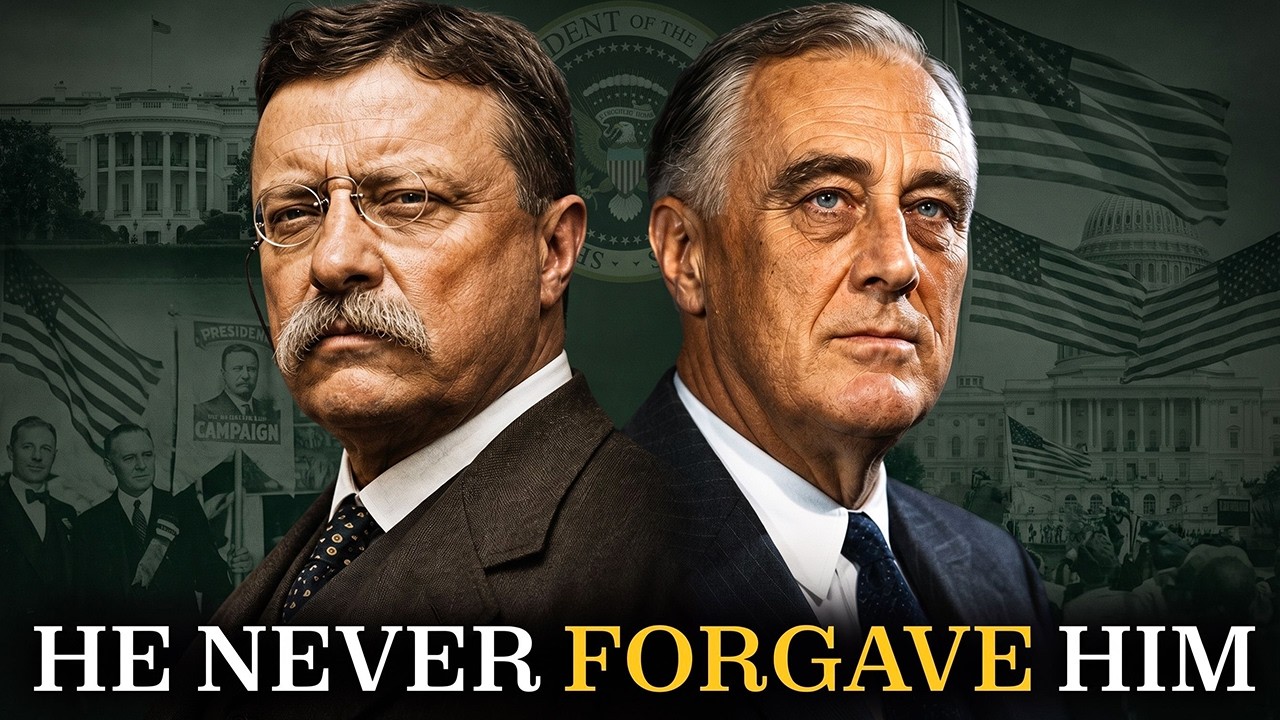
Not a single battleship should sit in the Pacific unless the entire fleet was there. Japan could strike suddenly, and America could be caught split in two. A technical letter, from one naval man to another, sent by the old Rough Rider to the Democrat who had campaigned against him, and the relationship between the two branches of the Roosevelt family had reached its final, complicated form. That relationship had been forged on a March afternoon in 1905, at a wedding that had been arranged around the President’s schedule.
Two adjoining houses on East 76th Street in Manhattan had their drawing-room doors thrown open to create a single long space. Endicott Peabody, the Groton headmaster who had shaped Franklin as a boy, performed the ceremony. Eleanor wore her grandmother’s rose-point lace and her dead mother’s veil. Alice Roosevelt stood among the bridesmaids, dressed in white like everyone else.
Then the President arrived late, noisily, having stopped to watch the St. Patrick’s Day parade on Fifth Avenue, which was the entire reason the date had been chosen. Theodore Roosevelt, Eleanor’s uncle, walked his niece through a borrowed house and handed her to a man whose mother had spent a year trying to stop the wedding. Then, according to Eleanor’s later account, he went into the library and started telling stories, and the guests followed him.
Bride and groom stood alone in the empty room. The famous line he supposedly delivered, that there was nothing like keeping the name in the family, appears in no contemporary document. It is folklore, but folklore that describes a real transaction. That day, the Hyde Park Roosevelts acquired the family name, the niece, the President’s blessing, and the famous photograph.
Theodore’s own children watched their father hand that legacy away, and they never accepted it. Eleanor, the woman standing ignored in that room, would determine the outcome of the story. Her father, Elliott Roosevelt, had been the President’s charming but alcoholic and broken younger brother. The family handled him the way they handled everything, with money and distance.
He was sent abroad, then to sanatoriums, kept away from his children while his wife’s relatives ran the household. Eleanor’s mother, a celebrated beauty, had called her plain daughter “Granny” in front of guests. Her mother died of diphtheria when Eleanor was eight, her younger brother died the next year, and her father died in 1894, estranged from the family that had exiled him. She was nine years old when she learned the lesson that governed her life: families protected their men and left no record.
She was sent to Allenswood, a school outside London run by Marie Souvestre, a unmarried French intellectual who despised conventional women and adored this American orphan. Souvestre taught her to travel, to argue, to write, that her own opinions mattered. In 1902, Eleanor returned at eighteen, fluent and confident. Her grandmother brought her out in New York society, an ordeal she found humiliating.
She was five foot eleven and had been told all her life she was plain, though she had spent three years learning she was an interesting person. Uncle Ted adored her, called her “Little Nell,” invited her to Sagamore Hill, told people she was the best of his nieces. To a girl with a dead mother and a disgraced father, that mattered enormously. That same summer, on a New York Central train up the Hudson, twenty-year-old Harvard student Franklin Roosevelt spotted her in a moving car and brought her to sit beside his mother.
They had known each other for years, but both later counted this as the beginning. She was serious, well-read, doing settlement work on the Lower East Side. He was handsome, charming, ambitious, privately consumed with following the career path of the man in the White House. Marrying her meant access to the President.
He knew it. His mother knew it and hated everything else about the match. Sara Delano Roosevelt was forty-eight, widowed, with one purpose in life. When Franklin told her of the engagement in November 1903, her diary entry was the most restrained sentence in the story.
He had given her a surprising piece of news. Her reaction was not an outburst. It was a campaign. She demanded the engagement stay secret for a year.
She took Franklin on a Caribbean cruise to keep him out of the country. She tried to have him appointed secretary to the American ambassador in London, to put an ocean between them. She bet that a twenty-one-year-old’s love would not survive twelve months of separation. It did.
The engagement was announced in December 1904, a month after Theodore Roosevelt had been elected president in his own right. Sara lost that round. She never lost another one. The wedding date was set by the President’s schedule.
The press treated it as a White House event with a bride attached. The couple spent their honeymoon week at Sara’s house in Hyde Park because Franklin had law exams. The real honeymoon came that summer in Europe, where Eleanor learned she was pregnant and could not answer when a woman in a Scottish hotel asked her to explain the difference between the two Roosevelt families. They returned to New York, and Sara set her brick trap.
For Christmas 1905, she gave them architectural plans. She had bought land on East 65th Street and built two houses, 47 and 49, with a shared entrance and walls, hers and theirs. The dining and drawing rooms on every floor connected through doors that could open between the two houses. She could walk into her son’s home without going outside.
She furnished it. She hired the servants. She hired the children’s nurses. Eleanor, who had never been taught to manage anything and was terrified of being incompetent, let her.
In the fall of 1908, in that new house, Eleanor sat at her dressing table crying. Franklin asked what was wrong. She told him she did not want to live in a house that was not hers in any way. He told her she was being unreasonable, that her feelings would change, and left the room.
Thirty years later, she wrote the scene and added the part that mattered: she cried because she had not yet become the kind of person who could say what she wanted and act on it. The confession, she insisted, was about her failure, not his cruelty. By 1909 she had five children and had lost a son in infancy. She had no house of her own, no money, no work, a mother-in-law who kept the keys.
What she had, though she would not know how to use it for another fifteen years, was the habit of writing everything down and a name that opened every door in America. The friendly relations between the two branches ended when Franklin entered politics. In 1910, running as a Democrat in a district that had not elected one since the Civil War, he won, and the Roosevelt name had done most of the work. Voters in Dutchess County did not draw fine distinctions.
Two years later, Theodore Roosevelt split the Republican Party and ran for president on the Progressive ticket. Franklin campaigned for Woodrow Wilson. Wilson won and repaid the debt on March 17, 1913, which happened to be the Roosevelts’ eighth wedding anniversary, by making Franklin Assistant Secretary of the Navy, the exact post Theodore had used as his launching pad. Franklin accepted the job as if it had been made for him.
The two men, the former president and his young cousin, shared the same professional passion. When war came, Theodore came to Washington to ask permission to raise a division and go to France, and he worked through Franklin to do it. Theodore’s four sons went to war. The youngest, Quentin, a pilot, was shot down over France in July 1918.
Theodore died at Sagamore Hill six months later, at sixty. He had never hated Franklin. He simply could not watch Franklin do the things that had made him famous. But his children watched, and Alice had been keeping score since she stood in that bridal party.
Alice Roosevelt Longworth had been the most famous young woman in America at twenty and one of the unhappiest wives in Washington at thirty. Her marriage to Nicholas Longworth, the future Speaker of the House, had gone bad immediately. He drank and cheated, and everyone knew it. When her daughter was born in 1925, it was acknowledged, even in her own account, that the father was Senator William Borah of Idaho, not her husband.
She and Eleanor were cousins by blood and nothing else. Alice made jokes that hurt people. Eleanor was so earnest she invited mockery. Watching Eleanor exhaust herself in Washington, Alice decided which Roosevelt woman was more attractive, and she began inviting Franklin to dinners without his wife, seating him next to Lucy Mercer.
Lucy Mercer had been hired around 1914 as Eleanor’s part-time social secretary, three mornings a week, about thirty dollars a month. She came from a Maryland Catholic family that had once been rich. Good lineage, no money. Everyone who knew her agreed she was livelier and more sociable than Eleanor.
She sat on the floor of the house on N Street sorting invitations. When the family was short at dinner, she stayed. Eleanor liked her. The relationship grew up inside the house, on the payroll, according to the calendar.
Eleanor herself had maintained it. Alice arranged the dinners and made sure Eleanor knew about them. That was her weapon. In the summer of 1917, Eleanor took the children to Campobello Island, where Sara had a summer house.
Franklin stayed in Washington. His letters that summer mention golf and a party on the navy yacht Sylph, a small group that included Lucy Mercer. He mentioned her name in letters to his wife. Men who are being careful do not do that.
Only men who think they will not be caught do. In September 1918, Franklin came home from an inspection tour of the European battlefront with double pneumonia and influenza. Unpacking his luggage while he lay in bed, Eleanor found the letters, written to her husband by Lucy Mercer. Decades later, without naming anyone, she said her whole world crashed around her.
She offered him a divorce. The sources are consistent on this, though all indirect. What happened next revealed the family system. Sara made clear her son would not get another dollar of Delano money if he left his wife and five children for a meaningless Catholic girl.
Louis Howe, the chain-smoking journalist who had attached himself to Franklin’s career and believed he was managing a future president, told him plainly that divorce would end that career. In 1918, he was right. No divorced man had ever been elected president, and a divorced woman marrying a Catholic in 1918 was not merely frowned upon. It was forbidden.
The story is that Franklin promised never to see Lucy again. The promise comes from later family accounts, told by children selling books decades afterward. There is no 1918 document. What can be verified is what happened.
He stayed. Lucy Mercer married Winthrop Rutherfurd, a wealthy widower with six children, in February 1920. And Eleanor burned the letters. She, who kept everything, who wrote thousands of pages, destroyed the only physical evidence of the central wound of her life.
She stayed, not because she forgave him and not because there was no choice. There was no real choice for a woman with five children, no money of her own, and a country where a divorced mother of five had no social position at all. And perhaps she stayed because she had seen what the family did to her father when they cut him off. What died that fall was the marriage as a marriage.
It took three more years for what replaced it to become visible. In the summer of 1920, the Democrats nominated Franklin for vice president on the ticket with James Cox. He was thirty-eight. The Oyster Bay Roosevelts responded by sending Theodore Roosevelt Jr.
onto the campaign trail to follow his cousin and expose him as a fraud. Ted, wounded and gassed at Soissons, a decorated war hero, told the newspapers that Franklin did not carry on the family traditions. Eleanor rode that campaign train. It was her first close look at the political machine, and she spent it with Louis Howe, the adviser she had disliked for years.
He began showing her the newspapers, asking her opinion of speeches, explaining what reporters needed. She learned the work from the only man who had ever taken her seriously. The ticket lost badly. Franklin returned to law and a vice presidency at a bonding company.
Then came August 10, 1921. After a day of sailing, swimming, and fighting a forest fire on Campobello, he came home with chills and went upstairs. Within three days, he could not stand. It was polio.
He was thirty-nine. Sara knew immediately what should happen next. Her plan was reasonable and it was the end of everything. Her son was now a crippled gentleman.
He would return to Hyde Park, to the house where his mother ruled, and live the life of his father’s final invalid years. Books, the river, his stamp collection, visitors on weekends. She had the money to make that life comfortable forever. It would have been a life of quiet, total erasure.
Eleanor and Louis Howe did not allow it. For weeks, Eleanor slept on a cot in his room, nursed him herself, learned to use the catheter, massaged his lifeless legs. Howe moved into the New York house and took over a bedroom, further infuriating Sara. And the two of them simply refused.
He would not retire. He would keep his name alive in Democratic politics, and until he could walk into the rooms himself, his wife would go for him. That was the moment the balance of power in the marriage shifted, permanently. Sara had controlled Franklin with money and geography.
Eleanor now controlled him with something Sara could never buy: his political future depended on her. She went to work. She joined the Women’s Trade Union League, the League of Women Voters, the women’s division of the New York State Democratic Committee. She learned to speak in public, badly at first, with a nervous high-pitched giggle that came out at the wrong moments, while Howe sat in the back of the hall gesturing for her to stop.
She edited a party newsletter. She built a statewide network of Democratic women, which was hers, not Franklin’s. In 1924, that network was used against her own cousin. Theodore Roosevelt Jr.
was running for governor of New York. He had been Assistant Secretary of the Navy under Harding, innocent of wrongdoing but tainted by the Teapot Dome oil leases that had gone out of the Navy’s control under his signature. Franklin’s people put Eleanor in a car with a huge canvas teapot mounted on it, steaming. She drove it across the state behind her cousin’s campaign, so voters coming to hear Ted Roosevelt speak would see a smoking teapot and a Roosevelt woman explaining what it meant.
Al Smith beat him by more than a hundred thousand votes. Ted Roosevelt Jr. never held elected office again. Eleanor called the stunt cruel and said she was sorry.
She was sorry. She also did it, against the branch of the family that had spent four years telling the country her husband was not a real Roosevelt. The plain niece no one had looked at on her wedding day had removed Theodore Roosevelt’s son from American politics. The next year, she got the thing she had cried for at her dressing table in 1908.
Franklin gave her land, a piece of his property at Hyde Park along the Val-Kill, miles from his mother’s house, hers to use for life. In a letter, he called it, lightly, her domain, where she and her friends could stay. Those friends were Nancy Cook and Marion Dickerman. Together they built a Dutch stone cottage, moved in in 1926, and started a furniture factory behind it, Val-Kill Industries, where local men made colonial-style furniture.
Eleanor invested in a girls’ school in Manhattan, Todhunter, and taught history and current events there three days a week until her husband became president. She had her own house, her own business, her own salary, and a place to sleep that Sara Delano Roosevelt could not enter through a connecting door. This is what agency looks like. Not speeches.
Real estate. Franklin built his own separate world, a warmer one. From 1920 until her stroke made her unable to work in 1941, his secretary Missy LeHand ran both his office and his household. She lived on the third floor of the White House and stayed with Franklin at Warm Springs for months at a time when Eleanor was traveling.
Whether the relationship was physical remains debated and unresolved. But there is no doubt it was the closest daily relationship of his adult life. When they entered the White House in March 1933, the arrangement was fully established, and they were both extremely good at it. He became the most gifted political performer of the century.
She became the most active first lady in American history, in part by creating her own press corps, weekly press conferences open only to women reporters, which forced newspapers to hire women. From 1935 she wrote a syndicated column, “My Day,” six days a week, for twenty-six years. She traveled so constantly that Franklin joked about it in public. The couple in the photographs, the smiling president and the tall wife behind his shoulder, were two people who had not shared a bedroom in fifteen years, joined in a working partnership that governed more than most marriages ever do.
And the agreement they made in 1918 did not hold. Franklin saw Lucy Mercer Rutherfurd again. She was at his first inauguration, in a car he arranged. After her husband died in 1944, the meetings became regular.
When Eleanor was out of town, Lucy came to the White House and to Warm Springs. Their daughter Anna arranged it, acting as her father’s hostess, unable to refuse a dying man. On April 12, 1945, while sitting for a portrait at Warm Springs, Franklin Roosevelt collapsed. Lucy was in the room.
She left a few hours before Eleanor arrived. Eleanor learned that night that Lucy had been there, and over the following days, that her own daughter had been arranging these meetings for more than a year. She never wrote about any of it. She remained in contact with Anna.
There is no letter in which she records what it did to her. The last question determines how history remembers a marriage: who owned the record. Franklin got there first. In 1938, he announced he would give his papers to the government and build a place for them on his mother’s land at Hyde Park.
The first presidential library, dedicated in June 1941, four years before his death, built to his own plan in Dutch colonial stone while he was still in office. No president had ever built his own archive before. He wrote the structure, chose the building, placed it in the yard of the house where his mother had ruled. Eleanor got the rest of the century.
She wrote her first memoir in 1937, another in 1949, a third in 1961. In none of them does Lucy Mercer appear, not by name, not as an event. The letters had been ashes since 1919. Most of Franklin’s early correspondence did not survive.
Her letters to him filled boxes. The most damaging document of the marriage was destroyed by the person it had injured, so what survives is mostly her voice and her careful, later account of her own feelings. But she also left a bomb. The letters to and from Lorena Hickok, thousands of pages of deeply emotional correspondence from the 1930s, were sealed in the library, opened in 1978, sixteen years after her death, and historians had to rewrite everything they thought they knew about her private life.
She could have burned those too. She proved she knew how. She did not. Alice Roosevelt Longworth outlived nearly all of them.
She died in 1980 at ninety-six, still receiving visitors in Washington, still telling the story she had perfected for forty years: that Franklin was one-third mush and two-thirds Eleanor. She meant it as an insult to both. It was the most accurate political analysis anyone in her family ever produced. Look back at that room on East 76th Street.
The President walked his niece through two borrowed drawing rooms, handed her to the Hyde Park branch, and went to the library to tell stories while every guest followed him out. It looks like a charming story about a magnetic personality. It was the last moment Oyster Bay controlled the room. The people who walked out that door spent the next seventy years chasing the spotlight and never got it back.
The two people left standing had eleven good years, then a paperwork problem. They solved it by turning the marriage into an institution. Theodore Roosevelt gave the bride away, and he kept the name.