In the autumn of 1931, a 64-year-old tracker named Silas Runningwater sat down with a young county clerk called Prosper Hendricks and began to speak. He had spent forty years in the Appalachian Mountains, and he had carried what he found there quietly, until he decided someone needed to write it down. Prosper wrote every word, though he later admitted that some of it he almost did not transcribe, not because he doubted it, but because he believed it completely. Silas was born in the spring of 1867 in a small settlement on the western edge of Virginia.
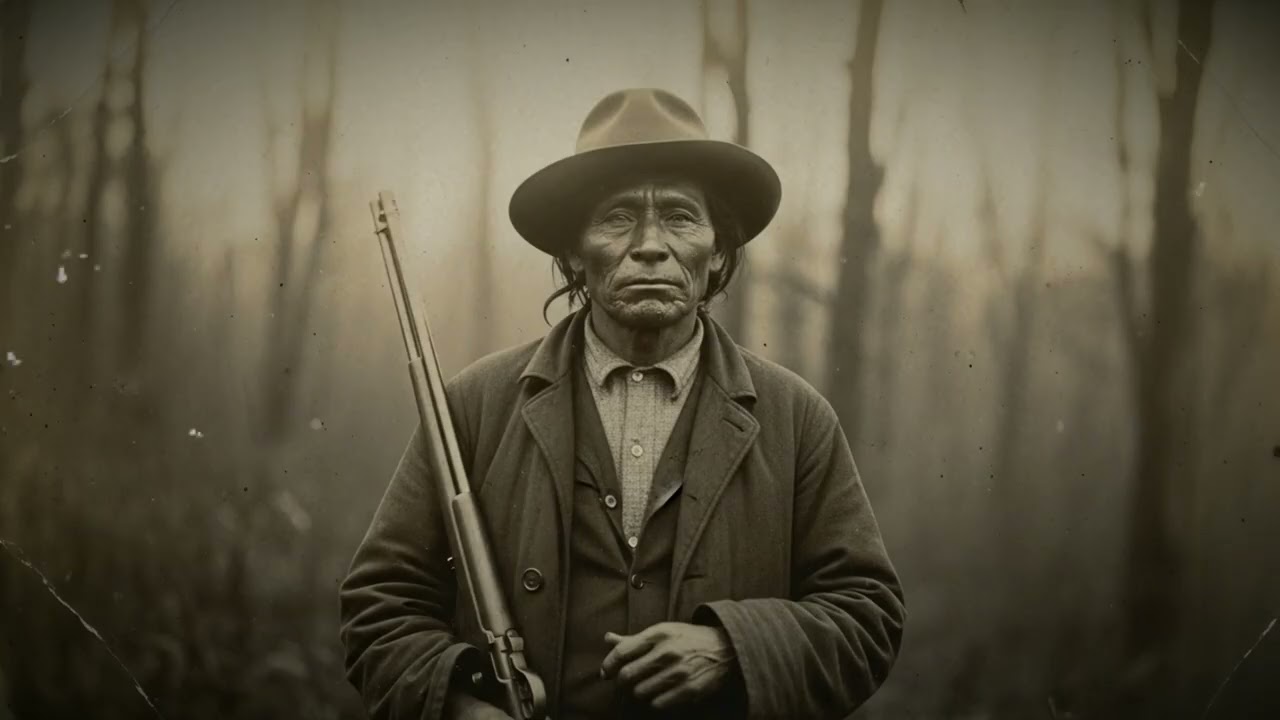
His people had lived in those mountains longer than any written record could account for. He grew up learning his grandfather’s stories and the hard silence of a man who spent most of his hours alone in the woods. By the time he was a young man, he was the one others called when something went wrong in the forest. He tracked missing trappers, found lost livestock, and read the ground with an ease that seemed natural to him.
The story he told began in the summer of 1887. He was twenty years old, newly confident in his tracking, and had been hired by a county manager named Corbett Ash to find a surveying team that had stopped sending reports from the northern ridge. Four men had gone up to map a section of the mountain for a railroad company. They had supplies for three weeks and were expected to send reports every four days.
The first came on schedule. The second never did. Silas packed for a week and left before sunrise on a Tuesday in late June. The heat was already thick.
He knew the northern ridge well, having trapped there since he was sixteen, and he sensed something wrong before he reached the first creek. The birds seemed to call from farther away than they should have, as if they were keeping distance from something he had not yet encountered. He pushed the feeling aside and kept moving. He found the team’s first camp around midday.
It was empty but recently so. The ashes in the fire pit were less than two days old. The equipment was there: theodolites, measuring chains, notebooks, bedrolls, extra boots, and food. Silas walked the perimeter slowly, reading the ground as his grandfather had taught him.
Four men had left heading northeast, and they had left in a hurry. The stride was longer, the heel impressions deeper, the undergrowth clipped on both sides of the path. Then the tracks ended. Not at a cliff, not at a stream, not at any feature of the terrain.
They simply stopped. He checked the ground in a slow spiral. There was nothing. The soil beyond was soft from rain three days earlier and would have held a print without trouble.
Silas sat down on a fallen log and thought for a long time. He spent the night at the camp. His grandfather had a saying: when the ground stops making sense, stop trusting the ground and start trusting the air. Silas had always taken it as metaphor.
That night he began to wonder. He woke at some point in the deep dark, not gradually but instantly, the way you wake when something has changed. The forest was silent in the wrong way. No insects, no small creatures moving, nothing.
He had heard that quiet before, and it always meant something large was nearby. He sat up slowly and listened. He heard a sound he could not identify then or in any later year. It was like something very heavy breathing, except the rhythm was too slow, too deliberate, with a long pause between each exhale.
It lasted perhaps three minutes. Then it stopped, and the forest came back to life as if nothing had happened. Silas did not sleep again that night. He found the first surveyor mid-morning.
The man was alive, sitting at the base of an oak tree, staring at a fixed point on the ground. He did not respond to his name. His eyes were open, his pulse was normal, but he was entirely absent. His name was Reuben Gratch, twenty-nine years old, hired out of Charlottesville.
He had been sitting there, as far as Silas could estimate, for roughly two days. It took an hour of patient work before Reuben came back to himself. The first thing he said was, “Don’t go northeast. ” When Silas asked why, Reuben said, “Because it’s already seen you.
” He would not speak of the ridge again, and his silence was not evasive but blank, as if the experience existed in a part of him that language could not reach. Silas brought him down to the valley and left him with a farming family. Then he went back up. He found the second man, a surveyor named Aldous Penwick, walking in slow circles around a clearing.
When Silas stopped him gently, Aldous said, “You have to keep moving. If you stop, it notices. ” Asked what notices, he said, “I don’t know what to call it. It doesn’t have a shape exactly.
It has a presence, like the feeling in a room where something just happened, except the room is the whole mountain. ”
The third man took two days longer to find. Calhoun Wix, twenty-four years old, had gone further northeast than the others. Silas found him in a hollow between two ridgelines, sitting in the same posture as Reuben, but where Reuben had been blank, Calhoun was afraid.
The fear showed in his jaw and in the way his hands gripped his own forearms hard enough to leave marks. When he finally surfaced, he grabbed Silas by the shirt and said, “It’s the boundary. ” He explained that there was a line you could not see but could feel, like pressure against the chest, as if the mountain itself was leaning toward you. When you crossed it, he said, “it knows you crossed it.
And then it starts. ” Asked what starts, he said you see things that should not be there, not wrong things exactly, just things that do not fit: a fire where no one has lived for a hundred years, smoke rising from the ground, eyes too far apart to belong to anything you know. He said it was not threatening at first, just watching, trying to understand you the way you were trying to understand it. But then the watching grew heavier, as if it had decided something about you.
He would not say what it decided. Silas did not believe he could not remember. The fourth man, Jasper Mull, the team leader, was never found. Silas searched for another four days.
He went as far as he could, and when he felt the pressure in his chest, the sense of something leaning, he stopped. He stood at the edge of what he could only call a threshold. There was no visible marker. He did not cross.
He went back down and told Corbett Ash that Jasper Mull was not findable and that the northern ridge needed to stay closed. Corbett nodded once and said he would put the word around. Silas did not return to the ridge for three years. He thought about it often.
He talked to his grandfather, who was then in his mid-eighties. The old man listened without interrupting. When Silas finished, his grandfather said, “You already know what that is. ” He told Silas that there were seven such places in those mountains, places where something old had settled, like silt in still water.
It does not move, he said. It does not need to. It just waits. But it notices things.
It notices when something crosses into its space, and it considers it. Some people cross the boundary and come back changed. Some come back fine. Some do not come back.
His grandfather said they had never found a pattern. They had just learned to leave it alone. Then he told a story, an old one, about a man from their own people who had crossed the boundary long ago and come back different. He said the size of what he had seen made everything else feel very small, and the smallness was peaceful.
But when he crossed back, he cried for three days, and no one who asked why ever got an answer. Silas went back in the spring of 1890, alone. He felt the boundary further away than before, or perhaps he was more attuned to it. He stopped about a hundred yards short, sat on a flat rock, and waited.
After about two hours, the ordinary sounds of the forest stopped gradually, the way a concert hall goes quiet before a performance. Then he felt it: a pressure that was also a kind of attention, like standing in a dark room knowing someone else is there. He spoke quietly in the language of his grandfather’s stories. “I know you’re here.
I’ve known since I was twenty. I’m not here to cross. I’m here to understand. ” And then something happened that took him four decades to describe.
The physical world stayed where it was, but something behind it moved, the way a river is both the water you see and the channel carved beneath it. He felt it notice him. Then consider him. Then, this part took Prosper three attempts to write down, he felt it remember him, not from three years earlier, but from much further back, from a time when his grandfather’s grandfather was young.
The mountain held traces of all of them, the way a rock in a streambed holds the trace of every flood that has passed over it. His family had been in those mountains for a very long time. The mountain had been watching for all of it. He went back perhaps six or seven times over the next decade, always alone, always staying on his side of the boundary, sitting in patient stillness until the mountain turned its attention toward him.
Over time, he began to understand things about the ridge he could not have known by observation. He knew which slopes would be productive each season. He knew when the weather would turn in ways that surprised even experienced farmers. He knew which routes were safe and which were not.
He used none of this to profit. He used it to help lost men and struggling families. He never explained where the knowledge came from, telling Prosper that it lived in the body more than the mind, the way you know where furniture is in a dark room. The event that changed everything came in the summer of 1903.
A mining company, represented by a man named Rutherford Cain, had acquired the mineral rights to the northern ridge and wanted to begin preliminary excavation before winter. Silas went to see Corbett Ash, now retired, and told him plainly that the men who went up there would come back wrong, and some might not come back at all. He warned that once they started digging, the mountain would respond. Corbett said he could not stop them legally.
Silas asked only that Corbett remember in a few months that he had been told not to let it happen. The excavation crew of eight men arrived in August. They were fine for two weeks. Then small things went wrong.
Tools went missing and turned up where no one had put them. One man reported hearing his dead wife’s voice from the tree line. Another could not sleep for the sense that he was not alone in his tent. The foreman, Grover Satterlee, kept a log.
By mid-September, three men reported having the same dream: standing on the ridge in the dark with something very large and very old behind them, not threatening, just present, and the feeling was not fear but smallness, like standing at the edge of the ocean and understanding that it was there before you and will be there after you are gone. On September 24th, the foreman wrote, “Rennick is gone. Not his gear, not his boots, just Rennick. ” The excavation was halted the next day, not by the company but by the seven remaining workers, who informed the foreman they would not go back up for any amount of money, then walked off the mountain together.
Rennick was never found. The coal seam was never extracted. Over the next twenty years, three more attempts ended the same way, with equipment failures, workers refusing to continue, and at least two more disappearances attributed to accidents without any investigation. Cain eventually sold his rights at a loss.
Silas went up alone in late October. He sat on his flat rock and waited. When the mountain’s attention came, it felt changed, not angry, but disturbed, like a very old and still body of water after something has passed through it. He said, “I tried to stop them.
I should have tried harder. ” He walked down before dark. He told Prosper he cried on the way, though he was not entirely sure why. “It was like watching someone break something that they didn’t understand was irreplaceable,” he said.
“But the mountain is still there. I don’t think we can break it. We can disturb it, like throwing rocks into a deep lake. Eventually the lake is just the lake again.
I think we are very short-term things, and whatever is in that mountain is not. ”
There are four final things in Prosper’s notes. In 1913, Silas spoke with a folklorist named Desmond Farr, who said he had found parallels in indigenous oral traditions from other mountain regions and suggested there were old things in old mountains, so old they had become part of the geology. Silas told him his grandfather had taught him to listen with more than his ears.
Starting around 1917, Silas began having a recurring dream, not a nightmare, but something stranger, that left him feeling full rather than frightened. In it he stood on the ridge at night in a light that came from no source, and the presence behind him communicated not in words or images but in something older, a direct transmission of meaning. It told him his family had been watched for a long time, that they had learned to pass through rather than take hold, and that he had gotten closer than was usual. “You have become, in some small degree, a part of what we keep,” it said.
Silas decided to treat this as information rather than honor or threat. In 1924, following tracks on the lower slope, Silas found a cairn, a deliberate arrangement of stones about two hundred yards from the boundary, with lichen suggesting it was at least a century old. At its base lay flat stones with old markings, a green copper ornament, and deteriorated woven material. He did not touch any of it.
He sat near it and felt something smaller than the mountain’s attention, more human-sized, and understood that someone from his own tradition, in an earlier generation, had done exactly what he had done, sat near the boundary, learned to listen, and left this marker to show that the path was known and the listening was intentional. He left it exactly as he found it. Near the end of his conversation in 1931, Silas made his final point. He said he was not claiming there was a spirit in the mountains in the way people used that word, not a god, demon, or ghost.
He said there was something old, old enough that the word barely applied, something that had been in those rocks and that soil longer than anything they thought of as alive had been alive. And it was aware, not in the way humans were aware, but aware. He said his family had always known it was there, and somewhere in the knowing, in the choosing to sit near it rather than run from it or try to take from it, they had become known. They had become part of its record.
He said, “I don’t know whether that’s a gift or a responsibility or just a fact. I think probably it’s just a fact. The mountain knows my family’s footsteps. That’s all.
”
Silas Runningwater died in the winter of 1935, at sixty-eight, in his chair by the window looking at the mountains. The woman who found him said he looked like a man who had finished thinking through something he had been thinking through for a very long time. The northern ridge remains undeveloped to this day, officially due to geological instability and insufficient resources. But those who go up there, and the source account does not suggest you should, report places where the forest goes quiet in a particular way, where footsteps sound too loud, where the air has a pressure unlike anything else, and where you get the unmistakable feeling that something very large and very old has just noticed you are there and is considering what you are.
Most people turn around. Some sit down and stay a while. And a few, across a very long span of years, stay long enough that the mountain starts to remember their footsteps. What happens after that, Silas never fully explained.
He said it was not something that could be explained, only experienced slowly, over time, in the way everything worth knowing is experienced. Just the sitting. Just the listening. Just the willingness to be present in the company of something that has been present for longer than you can imagine.
The mountain is still there. The boundary is still there. And somewhere in the lichen on the stones, in the way the animals move around certain sections of the ridge, in the accounts that keep filtering down from hunters and hikers and the occasional surveyor who goes a little further northeast than intended, the record continues.
Silas Runningwater’s footsteps are in it.