At 6:40 on the morning of February 11, 1987, Marion Eckles pulled back the curtain above her kitchen sink in Winslow Hollow, Vermont, and saw the yellow glow of a porch light burning across the road. The Hargrove house always went dark by nine. Harold and Eunice Hargrove were in their seventies and kept the hours of people who had spent a lifetime waking before sunrise. Marion had been their neighbor for sixteen years.
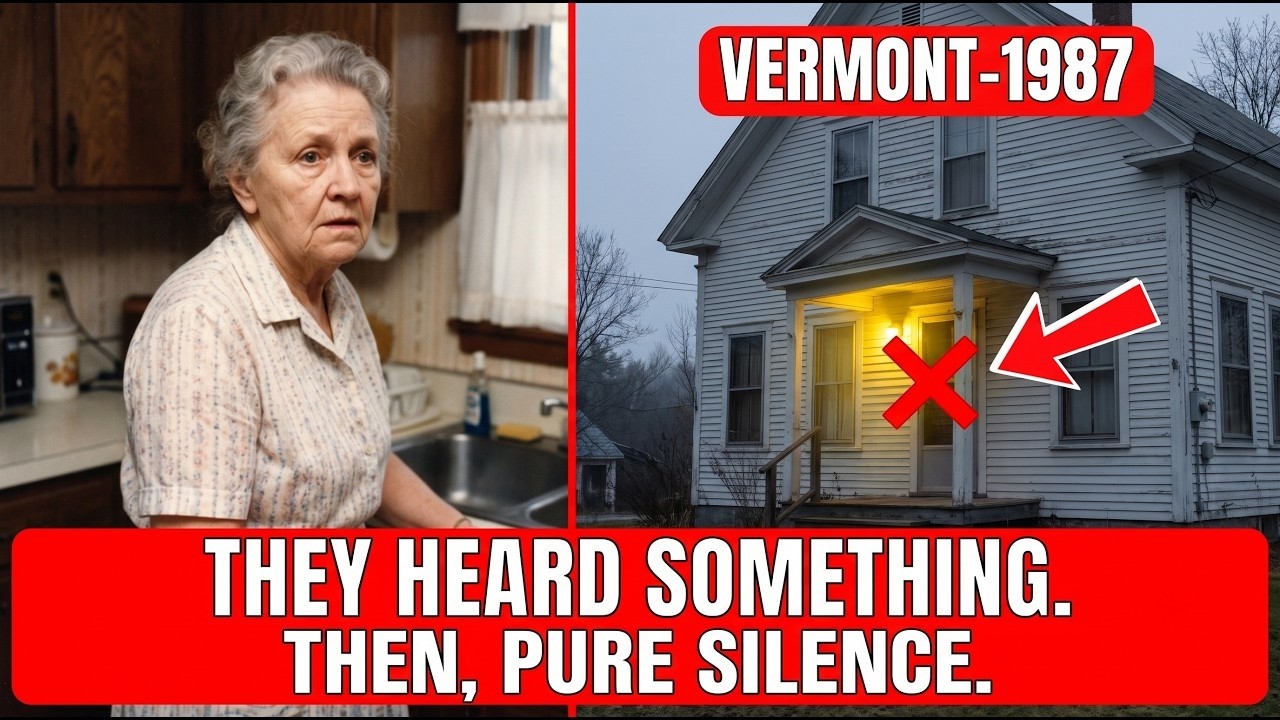
She knew their rhythms the way you know the weather when you have lived somewhere long enough. At 7:15, when the sky had come up enough to see clearly, she walked across the road and knocked. There was no answer. She tried the handle.
The door was unlocked. She opened it two inches and called Harold’s name into the warmth of the house. The smell of burnt coffee reached her from somewhere inside. She stepped back, closed the door, and walked to the end of the driveway.
Then she went home and called the constable. What had happened inside that house in the hours before Marion crossed the road would take twenty-eight years, two generations of investigators, and a genealogy database that did not yet exist to answer. To understand what was taken from Winslow Hollow that winter, you first have to understand who Harold and Eunice Hargrove were. Winslow Hollow sat in the Northeast Kingdom of Vermont, up near the Canadian line, where winters arrived in November and did not fully release until April.
The town had a general store, a congregational church, a volunteer fire department, and a school that ran through eighth grade. Everyone knew everyone’s name. Harold Hargrove had farmed the same forty-three acres on County Road 9 since 1951, when he came back from Korea with a Bronze Star and a bad left ear and bought the property for cash. He grew hay, kept a small herd of beef cattle, served on the select board for eleven years, and was the sort of man who showed up to help someone move without being asked and never mentioned it afterward.
Eunice had grown up twelve miles south, the daughter of a school principal. She had taught Sunday school for thirty years, organized the town’s maple festival for a decade and a half, and kept a kitchen garden that people drove past slowly in August to look at. She made rhubarb jam that she gave in labeled jars every Christmas, and the recipient families rationed it carefully through the following year. Their daughter Nora lived in Burlington and drove up on the last Sunday of every month without fail.
She had spoken to her mother by phone on the evening of February 10, a Tuesday, around 8:30. Eunice had sounded fine. They talked about whether Nora’s older boy was going to try out for the spring soccer team. They talked about a quilt Eunice was finishing.
Eunice said Harold had gone to bed early with a headache and she was about to follow. She said she loved Nora. Nora said she loved her back. That was the last time they spoke.
Constable Dale Foss arrived at the Hargrove property at 7:52 a. m. He found the front door unlocked. He found the kitchen in apparent order, except for a percolator on the stove that had boiled dry, the source of the burnt smell.
The back door, which opened from the kitchen onto a narrow mudroom, was also unlocked. The storm door had not been fully latched and was moving in the wind. Harold and Eunice Hargrove were found in the rear bedroom. Both were deceased.
The Vermont State Police Major Crimes Unit arrived from St. Johnsbury by noon. The lead detective was Sergeant Paul Audet, a forty-four-year-old, sixteen-year veteran who had worked homicides in Chittenden County before transferring north. He was thorough and unhurried, with a habit of asking one more question after everyone else had stopped.
The scene told him several things immediately. The percolator had been running when something interrupted the evening. There were two cups on the kitchen table, Harold’s with coffee still in it, Eunice’s empty and pushed to one side. They had been sitting together before bed.
The unlocked back door was an anomaly. Both Hargroves were meticulous about locking up at night, always, without exception. Someone had come through that door. On the mudroom floor, partially obscured by a rubber boot mat, Paul Audet found a single work glove.
Dark green canvas with a rubber palm. Men’s large. It did not belong to Harold Hargrove. Audet photographed it, bagged it, and logged it into evidence inventory that same afternoon.
It was the first thing he logged. Within seventy-two hours, the medical examiner confirmed that both Harold and Eunice had died as the result of criminal acts. The investigation was now a double homicide. Nora Hargrove drove up from Burlington that afternoon.
She told Paul Audet that her parents had no enemies she was aware of. She did not know if anything was missing from the house. Audet checked the pantry. A coffee tin where Harold kept a small amount of cash was there, undisturbed.
State police canvassed every residence within two miles of the property and interviewed forty-three people in the first ten days. A traveling appliance repair technician named Robert Glover had been seen in Winslow Hollow that Tuesday. He became the investigation’s first significant focus. Audet spent six weeks on him, requesting service records, phone logs, and customer statements.
He found two witnesses who placed Glover at a diner in Newport at 7:15 Tuesday evening, nearly an hour’s drive from Winslow Hollow, and confirmed a motel receipt in Newport at 8:45 the same night. The timeline did not fit. Glover was cleared in late March. The green work glove was sent to the FBI laboratory in Quantico.
In 1987, the science of forensic DNA profiling was barely two years old and not yet admissible in Vermont courts. The lab returned a report noting the glove contained trace biological material, but that the technology to develop a usable profile from it did not currently exist. The glove was returned to the Vermont State Police Evidence Facility in Waterbury. It was logged.
It was sealed. It went into storage. Audet noted in his case file that the glove was the best thing they had. He wrote himself a reminder in the margin of his investigation notebook: when the science catches up.
Five years passed with no arrest. Audet had pursued four other persons of interest across those years, each investigated carefully and eliminated. The case received attention from the Burlington Free Press in the first year and a half, then near silence, as unsolved cases tend to disappear from public view when there is nothing new to report. The reward Nora posted, five thousand dollars, everything she had in savings, generated more than sixty tips in the first two years.
Every one led nowhere. By 2000, thirteen years had passed. Audet had retired from the state police in 1998, having never made an arrest on the Hargrove case. He kept a copy of his investigation notes.
He kept the photograph of the green work glove, the original, the one he had taken on the first afternoon before the light faded, in a folder on the desk in his home office. He looked at it occasionally, not because he expected it to tell him something new, but because he didn’t want to forget that it existed, that the answer was somewhere. That someone somewhere had put on that glove and driven to Winslow Hollow on a February night in 1987 and was still alive, probably, and had never been held accountable. Every year without fail, Nora Hargrove submitted a written request to the Vermont State Police Cold Case Unit asking whether there had been any new developments.
Every year, a detective sent a letter back confirming the case remained open and active. In the winter of 2015, Detective Corporal Renee Gerard of the Cold Case Unit attended a training seminar in Montpelier on forensic genealogy, a technique that had begun transforming cold case investigations across the country. She drove back to Waterbury the same afternoon and pulled the evidence log on the Hargrove case. She found the entry for the green work glove.
She found the notation that the glove contained trace biological material, logged in 1987. She called the state evidence facility to confirm the glove was still in storage. It was. On a Thursday morning in March 2015, Gerard sat across a lab table from a forensic specialist with the glove in an evidence bag between them.
It had been in sealed, climate-controlled storage for all those years, which preserved biological material in ways open-air environments cannot. The rubber palm had protected the inner surface from contamination better than expected. The lab extracted a workable DNA profile from the inner surface of the glove’s palm on the second attempt. The profile was uploaded to two genealogy databases in April 2015.
The results came back in June. There were four partial matches. Four people who shared enough genetic markers with the glove’s profile to suggest they were related to the same individual within two to three generations. All four lived in New England.
Three had family trees traceable through Vermont county records going back to the nineteenth century. Gerard picked up the phone and called Paul Audet, who was seventy-two years old and gardening in St. Johnsbury. “Paul,” she said.
“I think I have something. ” He said, “The glove? ” She said, “The glove. ” He was in her office the following morning.
The name that emerged from the genealogy analysis after six weeks of cross-referencing family trees and eliminating individuals who did not fit the age range and geographic location was a man named Dennis Carrier. In February of 1987, Carrier had been thirty-one years old and living in Derby, twenty-two miles northeast of Winslow Hollow. He had worked intermittently as a day laborer throughout the Northeast Kingdom. His connection to Harold Hargrove was not immediately obvious.
But Audet, reading through his own twenty-eight-year-old notes, found it on page thirty-one of his second investigation notebook. In the early weeks of the case, a neighbor had mentioned in passing that Harold had had a dispute the previous fall with a laborer he had hired briefly to help with hay baling, a young man he had let go after two weeks for what the neighbor described as trouble with honesty. The neighbor had not been followed up with. The note sat on page thirty-one for twenty-eight years.
A Vermont Department of Labor records search confirmed that Dennis Carrier had been paid by Harold Hargrove for nine days of agricultural labor in September of 1986, five months before the February night someone came through the Hargroves’ back door. Dennis Carrier was sixty years old when detectives arrived at his home in Newport in August of 2015. He had been living there for eleven years, working as a handyman, married with a stepson who played youth hockey. His neighbors described him as quiet, kept to himself, but always willing to clear someone’s driveway after a big storm.
Nobody had ever had trouble with Dennis Carrier. A DNA swab was obtained under warrant. It matched the profile from the glove with a probability the laboratory confirmed as greater than one in 700 billion. Carrier was arrested on the morning of August 19, 2015, and charged with two counts of first-degree murder.
He did not speak when the handcuffs went on. At trial in 2016, the prosecution built its case on the DNA match, the labor records connecting Carrier to the farm, and the testimony of Paul Audet, who walked the jury through twenty-eight years of investigation in a calm, precise voice that the Burlington Free Press described afterward as carrying the weight of someone who had waited a very long time to say all of it out loud. Carrier’s defense argued contamination and questioned the genealogy methodology. The jury was not persuaded.
Dennis Carrier was convicted on both counts of first-degree murder on March 14, 2016. He was sentenced to two consecutive life terms without parole. He was taken from the courtroom without speaking. Nora Hargrove was seventy-two years old when the verdict came in.
Her son David drove her to the courthouse and sat beside her through all four days of the proceedings. When the jury foreman read the verdict, Nora reached over and took David’s hand and held it. That was all. She had been submitting those annual letters to the cold case unit for twenty-eight years.
She had never stopped believing the case was open. She had been right. She drove to Winslow Hollow the following Sunday, as she always had on the first Sunday of the month. She parked in the driveway of the farmhouse.
A new family lived there now, a teacher and a carpenter with three children, who had planted things in Eunice’s kitchen garden the previous summer. Nora sat in the driveway for a while, then drove home. David opened the jar of rhubarb jam that spring. He said it was still good.
Eunice’s handwriting on the label said: Rhubarb 1986. Paul Audet attended the trial every day. When Renee Gerard asked him afterward what it felt like, he said he didn’t have the right word for it. Then he said the glove was always there.
It was just waiting for the science. What stays with you about this case is not the arrest. It is not even the verdict. It is Marion Eckles standing at her kitchen sink in the gray February morning, noticing that a porch light that should have been off was still on, and knowing in the particular way that neighbors who have watched each other for sixteen years know things that something was wrong.
She crossed the road. She knocked. That small act of attention was the first link in a chain that ran from February 1987 to August 2015 to a courtroom in Burlington. And it began with one woman who paid close enough attention to notice that her neighbors’ light was burning when it should have been dark.
The evidence that finally convicted Dennis Carrier had been sitting in a sealed storage facility for twenty-eight years. Justice was never impossible. It was only waiting for the moment when the tools matched the need.