On February 25, 1957, a young man named John was checking his muskrat traps on land owned by the Sisters of the Good Shepherd near Susquehanna Road in Fox Chase, a quiet, rural edge of Philadelphia. He was trespassing, and when he spotted a cardboard JC Penney box propped upright in the brambles, his first instinct was caution. He thought it might hold discarded furniture or trash. But the flaps had been pressed down in a hurry, and something made him step closer.
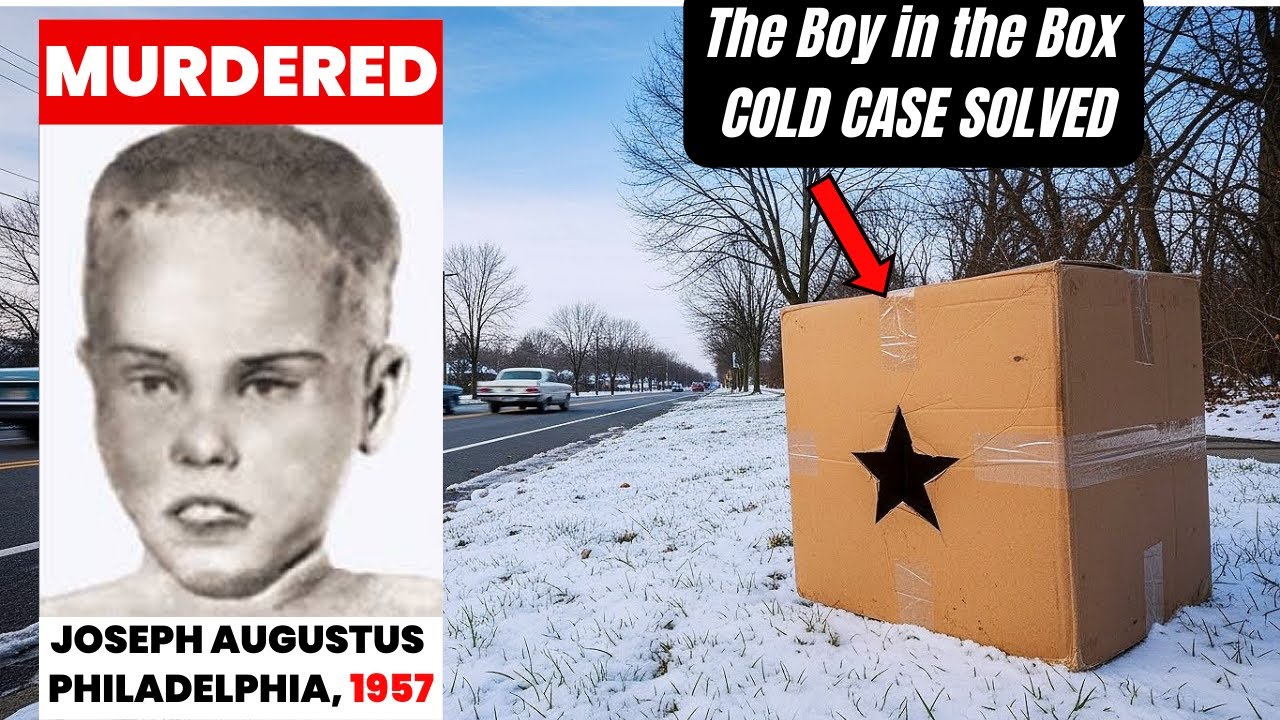
Inside, wrapped in a cheap flannel blanket, was the small naked body of a boy. The child was no more than four or five years old. His hair had been crudely and unevenly cut, with clumps still clinging to the blanket. His ribs were visible through his skin.
His arms and legs were thin, and beneath them lay deep bruises, old and new, layered across his tiny frame. His face was swollen, his lips pale. Terrified that admitting he had been trespassing would cost him money and drag him into something he could not explain, John closed the box and walked away. Hours later, he returned, hoping he had been mistaken.
He was not. This time, he called the police. Officers arrived quickly. When they lifted the boy out of the box, the silence among them was immediate and heavy.
The child weighed just thirty pounds. He showed signs of long-term malnutrition and years of neglect. His nails had been trimmed, his body washed, his hair cut shortly before death, possibly to disguise his identity. Beneath his chin was a small healed scar from a past medical procedure.
His face bore injuries consistent with repeated blunt force trauma. His cause of death was ruled multiple impacts to the head. Someone had tried to erase who he was. The cardboard box offered the first clue.
It had once held a baby’s bassinet sold at a local JC Penney. Investigators traced every bassinet purchase in the region, but none matched the boy. The blanket was traced to a factory in North Carolina, where thousands of identical blankets had been sold. A small tan corduroy cap found nearby was traced to a South Philadelphia store, but the owner remembered selling it to hundreds of customers.
Every lead evaporated. There were no clothes, no toys, no documents, nothing to suggest who the boy was or where he had come from. He had been discarded with the deliberate intention of erasing him. The child was checked into the county morgue under a temporary name: unidentified male child, Caucasian, estimated age four to six.
Within days, a new name spread across police radios and newspapers: the Boy in the Box. It would follow him for sixty-five years. The Philadelphia Police Department launched one of the most extensive investigations in its history. Detectives printed twenty thousand copies of the boy’s photograph and mailed them across the country.
Hospitals, orphanages, and social workers were contacted. No missing child report matched his description. No parent stepped forward. Not one person identified him.
The boy became the most photographed unidentified child in American police history, and still no name emerged. Detectives canvassed every house, farm, and business within a two-mile radius of the discovery site, then widened the search to five miles, then ten, then citywide. Nothing. Theories multiplied.
Some believed the boy belonged to a traveling carnival family that had moved on. Others thought he came from an institution, given his crude haircut and signs of neglect mixed with occasional basic care. One theory suggested he had been bought and sold through a black-market adoption network. Detectives investigated all of them.
Each ended in disappointment. A woman claimed the boy had lived in a foster home near the discovery site and described a brutal beating by the foster mother. Her story had inconsistencies and was later disproven by DNA evidence, but it cast a shadow over the case for more than twenty years. Psychics wrote letters with visions that went nowhere.
A mentally unwell man falsely confessed. By the 1990s, detectives privately acknowledged what they rarely said publicly: this crime was almost certainly committed by someone who lived close by. Still, the investigation stalled. Witnesses died.
Records from the 1950s were destroyed or misplaced. Families moved and changed names. But the case never closed. In 1998, forty-one years after the boy was found, the Philadelphia Police Department exhumed his remains.
Forensic scientists extracted genetic material, not enough to solve the case with the DNA technology of the late nineties, but enough to preserve for a future that investigators desperately hoped would exist. The boy was reburied with a new headstone bearing the words: America’s Unknown Child. The case re-emerged in national consciousness through television programs, documentaries, and online forums. People wrote letters from every state and from as far away as Germany and Australia.
More leads, more hope, and every one collapsed into nothing. By the early 2000s, investigators realized something astonishing. The boy likely had a family. He had a birth name.
He had relatives still alive. But the people connected to him had chosen silence. Not one birth certificate flagged. Not one school record matched.
Not one medical office recognized him. Someone who should have reported him missing never did. By 2012, fifty-five years after the discovery, the case reached its coldest point. Most original investigators had died or retired.
But forensic genealogy, a technique that had already solved several impossible cases, was advancing rapidly. The tissue sample preserved by the medical examiner’s office became the key. In 2016, investigators partnered with genetic genealogists who specialized in long-standing cold cases. They re-extracted the boy’s DNA, built a partial genetic profile, and uploaded it to public genealogy databases.
Distant matches began to appear, then clusters, all pointing to an extended family with deep roots in Pennsylvania. By 2021, genealogists had constructed a tree with more than three thousand branches. On one small branch, they noticed a sibling group from Philadelphia. One child had no living records, no school enrollment, no medical files, no death certificate.
A boy whose paper trail simply ended in the early 1950s. The age matched. The time matched. Investigators located living relatives, and one by one, they agreed to provide DNA samples.
Each sample tightened the net. In late 2022, sixty-five years after the boy was found inside that cardboard box, forensic science delivered the answer. The Boy in the Box was Joseph Augustus Zarelli, born in Philadelphia in January 1954. The press conference announcing his identity was emotional.
Detectives who had inherited the case decades after it began struggled to keep their voices steady. Some cried. Some stood in stunned silence. Joseph finally had a name.
But the breakthrough also revealed something chilling. Joseph’s biological mother was alive when his body was discovered in 1957. She lived in Philadelphia, less than an hour from the field where he was found. She never came forward.
She never filed a missing person report. She said nothing. Investigators discovered that Joseph had siblings who had no idea he existed. The secrecy in that household had been absolute.
Relatives described a home marked by violence, neglect, and fear, a house where children slipped through the cracks. One relative admitted, We always thought something happened, but nobody asked too many questions. Another said, In that family, silence was safer. Joseph’s biological father had died before investigators reached his side of the lineage.
There were no photographs of him with Joseph, no evidence he raised the child, no indication he ever searched for a missing son. Investigators cannot determine whether he even knew Joseph existed. Based on the injuries documented in 1957, investigators rebuilt a likely scenario. Joseph lived in a chaotic home characterized by physical discipline and neglect.
He suffered long-term abuse before his death. The final blow, a violent strike to the head, was fatal. His death was not accidental. It was not the act of a stranger.
Everything pointed inward to the house where he lived. Someone realized Joseph was dead. Panic spread, not grief, fear. In a household already monitored by child welfare agencies, another incident could mean arrests or prison.
So instead of calling for help, instead of reporting the death, they placed the small battered body in a cardboard bassinet box and drove north toward the quiet outskirts of Philadelphia. They left him in the brush alone, exposed to the winter air. They erased him. Nearly everyone capable of answering the final question, who killed Joseph, is dead.
The mother, the male relative described by witnesses as the household’s authority figure, the female relative known to have punished too hard, all gone. Detectives have strong theories, and many believe multiple adults participated in the coverup, but the evidence is now decades old. The identity mystery was solved. The killer’s identity remains locked behind more than sixty years of silence.
After the identification, the cemetery at Ivy Hill added a new plaque to the headstone: Joseph Augustus Zarelli, January 26, 1954, February 1957. Two dates, a beginning and an end, a name where none had existed before. Visitors still come. Some kneel and pray.
Some talk to him. Some simply stand in silence. The case became a landmark moment in forensic history, and in the months that followed, several unidentified child cold cases were solved, directly inspired by the Boy in the Box breakthrough. The case has not been closed.
Law enforcement continues to comb through records, follow tips, and interview elderly relatives. The hope is not necessarily to prosecute, since most suspects are deceased, but to uncover the full truth. Joseph Augustus Zarelli finally got his name back after sixty-five years buried under anonymity.
The justice he deserved remains lost to time.