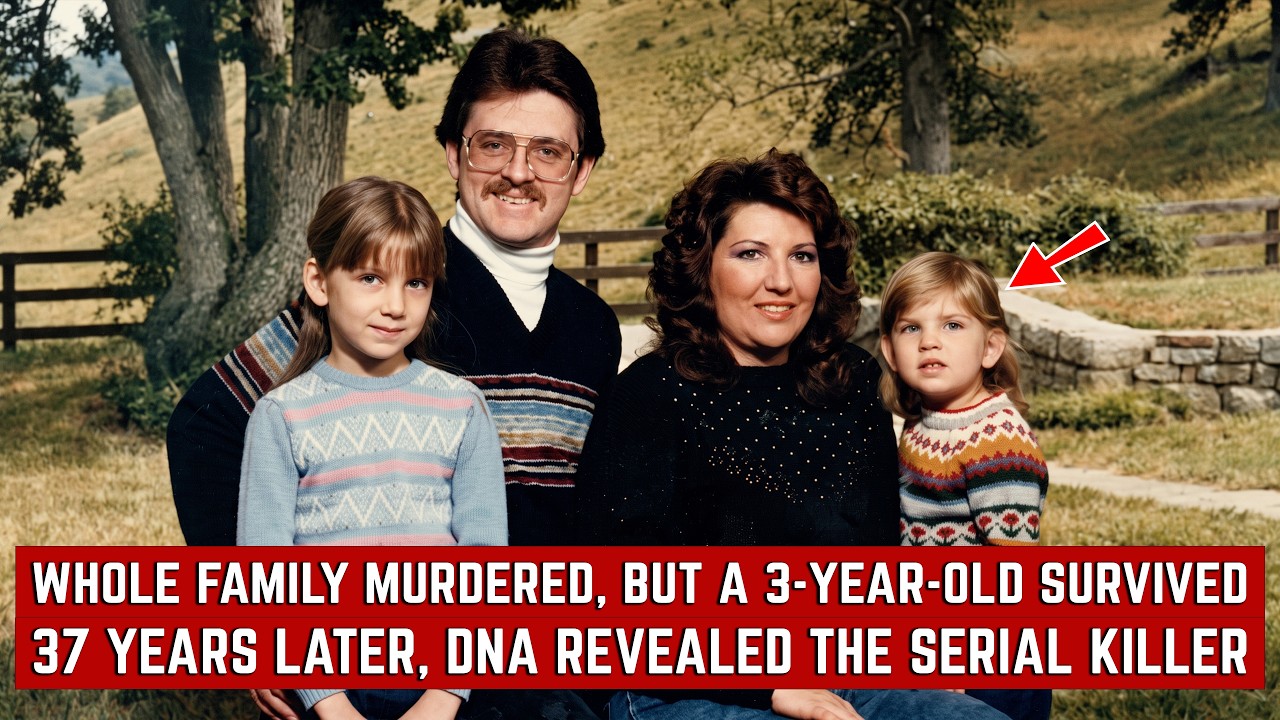
The January 1984 murder of a young family in Aurora, Colorado, remained one of the state’s most haunting cold cases for decades. The brutal attack on Bruce and Debra Bennett and their eight-year-old daughter Melissa shocked the quiet suburb and left investigators with few answers. For 36 years, the case sat in file cabinets, waiting for a breakthrough that would finally come from an unexpected source: a DNA sample taken from a convicted felon in a Nevada prison.
On the morning of January 16, 1984, Connie Bennett arrived at her son’s home on East Center Drive after several unanswered phone calls. Using her own key, she opened the front door and walked into a scene that would define the rest of her life. Her 27-year-old son Bruce lay near the stairs, his head bludgeoned and his throat cut.
In the bedroom, she found 26-year-old Debra, beaten beyond recognition. Eight-year-old Melissa was found dead in the girls’ room, sexually assaulted. Three-year-old Vanessa was barely alive, buried under the debris of the bedroom.
A firefighter found her and rushed her to Denver Children’s Hospital, where doctors did not expect her to survive the day.
The family had gone to bed on what seemed like an ordinary Sunday night. Bruce, a former Navy man studying to become an air traffic controller, had spent the evening at the kitchen table with his books. Debra had put the girls to bed, humming softly.
The garage door, as was their habit, had been left open. It was the only entry point into the home, and no one had thought to close it.
Vanessa survived, though her injuries were catastrophic. She suffered deep wounds to her head, brain damage, and a broken jaw. She remained in a coma for weeks.
When she woke, she was too young and too hurt to tell investigators anything about the attack. The only physical evidence left behind was a set of footprints in the snow outside the garage, leading away from the house. The murder weapon, believed to be a hammer, was never found.
The investigation quickly stalled. Neighbors heard nothing. No one saw a suspicious vehicle.
Detectives interviewed friends, coworkers, and relatives, but every lead dissolved. The case joined a growing stack of unsolved files in the Aurora Police Department.
What investigators did not know at the time was that the Bennett murders were not an isolated incident. They were the final act in a 23-day wave of violence that had swept through the Denver metro area and beyond.
On January 4, 1984, Kim and Jim Henchfield were attacked in their Aurora home while sleeping. Both survived, but the assault left them permanently changed. That same night, Donna Homm was attacked in her garage as she returned from shopping.
She was beaten and sexually assaulted. Her attacker left the hammer at the scene.
On January 10, 50-year-old interior decorator Patricia Smith was attacked in her Lakewood home in broad daylight. She was beaten with a hammer and sexually assaulted. Her daughter found her hours later.
The hammer was left behind.
On January 15, the Bennett family was attacked. Five days after that, on January 27, Roy Williams was attacked in his home in Kingman, Arizona, nearly 800 miles away. He was struck with a 25-pound piece of granite while he slept.
Miraculously, he survived.
The attacks shared a pattern. The perpetrator entered through open garages. He did not steal valuables.
Each attack was more violent than the last. The Denver media began calling the unknown assailant the “Hammer Attacker,” though no one yet connected the cases across jurisdictions.
The breakthrough came almost by accident. In Kingman, Arizona, police arrested 23-year-old Alex Christopher Ewing for the attack on Roy Williams. Ewing was a drifter who worked construction jobs.
He had obtained a Colorado driver’s license the previous summer, but no one in Arizona had any reason to connect him to crimes in Colorado. The three states had no shared database, and the files remained separate.
Ewing was held in Kingman on attempted murder and burglary charges, then transferred to a detention center in St. George, Utah, while awaiting trial. On August 9, 1984, deputies were transporting him back to Arizona for a court hearing.

During a stop in Henderson, Nevada, Ewing escaped. That same night, he broke into a nearby home and attacked a couple with an axe handle. He was captured two days later by park rangers near Lake Mead.
A Nevada jury convicted Ewing of escape and the axe attack. He was sentenced to 110 years in prison. The Arizona charges were quietly dropped, and Ewing disappeared into the Nevada prison system.
For years, no one in Colorado thought about him.
But the evidence from the Colorado crime scenes remained. In 2002, forensic analysts at the Colorado Bureau of Investigation confirmed that DNA from the Bennett and Smith crime scenes matched the same unknown male. It was a significant finding, but without a name attached to the profile, it led nowhere.
The DNA sat in a database, waiting for a comparison that would not come for another 16 years.
In 2013, Nevada began requiring DNA samples from convicted offenders. In 2016, the state attorney general extended the requirement to inmates who had been sentenced before DNA testing existed. Alex Ewing, serving his 110-year sentence, was swabbed along with hundreds of other prisoners.
Within 24 hours of his sample being uploaded to the national database, it matched the DNA profiles from the Bennett and Smith crime scenes.
Detective Steve Conner, who had been one of the first officers on the scene in 1984 and had kept the case file open for decades, received the news in the summer of 2018. After 34 years, the case finally had a name.
When Colorado investigators traveled to Nevada to interview Ewing, he showed no emotion. Shown a photograph of Patricia Smith’s crime scene, he recoiled. Told that his DNA matched evidence from the scene, he said there must be a mistake.
He admitted he had lived in the Denver area in 1984 and worked construction and plumbing jobs, but he offered no explanation for how his DNA ended up at the crime scenes. He never confessed.
Colorado issued an arrest warrant charging Ewing with 13 counts, including six counts of first-degree murder, attempted murder for the attack on Vanessa, sexual assault on both girls, and burglary. But Ewing’s legal team fought extradition for nearly 20 months, taking the case from Nevada courts to federal appeals and finally to the U. S.

Supreme Court, which declined to intervene.
In late February 2020, Ewing was flown to Colorado and booked into the Arapahoe County Detention Center without bail. At his first court appearance, he stood in a red jail jumpsuit and orange sandals, chains rattling with every movement. He spoke only five times during the hour-long hearing, answering the judge’s routine questions in a quiet voice.
The trial began in the summer of 2021. Prosecutors called 25 witnesses, including Vanessa, now in her forties, who testified about her fragmented memories of that night. The most critical witness was Yvonne “Missy” Woods, a DNA analyst with the Colorado Bureau of Investigation.
She told the jury that genetic material collected from the bedroom quilt in 2001 and again in 2018 matched Ewing’s DNA every time. The probability that it belonged to anyone else, she said, was approximately 1 in 3 nonillion—a 3 followed by 30 zeros.
The defense argued that none of the 31 fingerprints found in the Bennett home matched Ewing. They pointed out that investigators in 1984 had handled evidence without gloves, and that 36 years of storage and testing had ample opportunity for contamination. At one point, the defense moved to dismiss the case over concerns about how evidence had been preserved.
The jury deliberated for two days. On August 6, 2021, they found Ewing guilty on all counts in the Bennett murders. Eleven days later, Judge Darren Vahle sentenced him to three consecutive life sentences, telling the court he had rarely seen crimes so heinous in his 25 years on the bench.
Under the laws of 1984, the sentence guaranteed Ewing would die in prison.
The following spring, a second jury in Jefferson County convicted Ewing separately for the murder of Patricia Smith. Her family released a brief statement, saying it was difficult to imagine how full their lives might have been had she not been taken from them.
Vanessa Bennett, the three-year-old who survived, is now a woman in her forties. She still has a metal plate in her forehead and carries the physical and emotional scars of that night. In court, she addressed the judge rather than the killer.
She spoke of losing her parents and sister, but also of losing her trust in people, her sense of dignity, and the person she might have become. She declined to compare Ewing to an animal, saying that animals have a purpose in this world.
Connie Bennett, who found her son’s family that January morning, told reporters outside the courthouse that a huge weight had been lifted. She acknowledged it was not an ending, but said the family had learned to live with what happened and were doing their best to move forward.
The case was solved not by a confession or an eyewitness, but by a routine DNA swab taken from a man already serving a 110-year sentence for a different crime. The technology that finally brought justice to the Bennett and Smith families did not exist in 1984. It took 36 years, but the evidence never went away.
The open garage door on East Center Drive was never the lesson. The lesson was that even the most ordinary oversight can become a doorway for someone waiting for exactly that kind of carelessness. For the Bennett family, that doorway stood open on a cold January night, and nothing was ever the same again.