In 1972, an elderly Black man sat in a Detroit he no longer recognized, a city he had helped build with his own two hands. He was past sixty-five, his back bent and his hands scarred from a life spent mostly in hard labor. He had come to Detroit as a young man half a century earlier, and his life story was, in many ways, the story of Black America in the twentieth century. He was born under the shadow of Jim Crow in the South, likely in Alabama, Georgia, or Mississippi, and as a young man he joined the largest internal migration in American history.
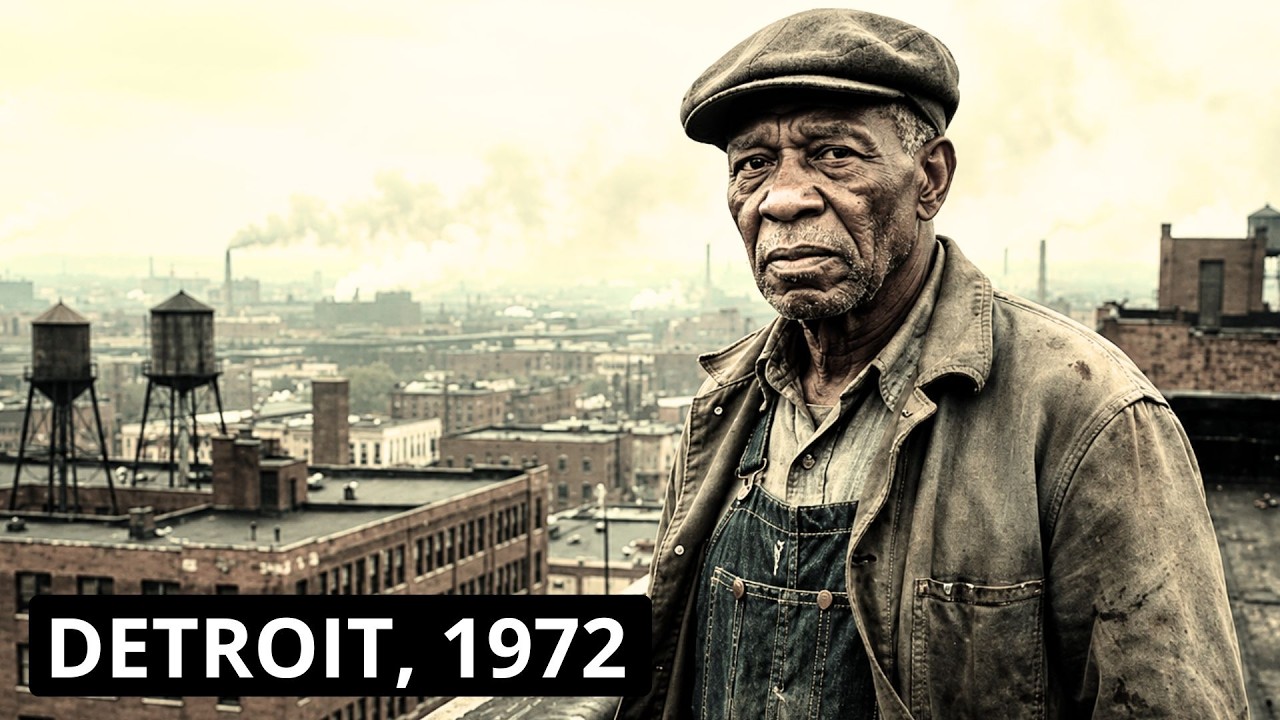
Detroit, with its roaring automobile plants, was his promised land. For fifty years he gave that city everything he had. Now, in his old age, he watched it fall apart. His life offers answers to difficult questions: why the very company that hired him when no one else would sent him into a furnace so dangerous and hot that white men refused to work there, why the vibrant Black neighborhood where he raised his children was erased from the map and buried under a highway, and how it was that in a northern city, police killed more Black people in a single year than died in the city’s worst riots.
The answers extend from the cotton fields of the South to the foundry floor of the Ford Motor Company, from the music halls of Paradise Valley to the rubble left by bulldozers, and through the fires and gunfire of a city in crisis. The promise that pulled him north can be reduced to a single number: five dollars a day. In an era when a Black farmer in the South might work an entire year only to end up in debt to the plantation, the idea of earning five dollars for a single day’s work was almost unbelievable. It was the echo of a different life, and it drew Black Southerners to Detroit by the hundreds of thousands.
Between 1910 and 1920, nearly half a million Black people left the farms and towns of the South for the industrial North in what became a fifty-year migration of millions. They were fleeing the social and political repression of Jim Crow, the sharecropping system, and violence. They were seeking the wages offered by the booming factories of the North. Detroit, with its automobile industry and wartime plants, was one of the great destinations, but the auto industry did not welcome them at first.
Despite its desperate need for labor, the sector largely refused to hire Black men. Until 1920, only five of the sixty-seven automobile plants in Detroit employed Black workers at all. The doors of the great factories were, for the most part, locked against the very migrants who had traveled so far to reach them. There was one exception, and it changed everything.
The Ford Motor Company, under its founder Henry Ford, opened its doors to Black workers when its competitors refused. Ford hired Black men partly through his personal connections with leading Black pastors in Detroit, who sent their congregants to him. By 1920, Ford employed more than 1,600 Black workers, making it the largest employer of Black labor in the entire city, a distinction it held throughout the 1920s and 1930s. The impact on Detroit’s Black community was profound.
By 1920, about 80 percent of working Black men in the city were employed in the automobile industry and its related trades. The factory became the foundation of Black life in Detroit, the engine that powered the churches, businesses, and neighborhoods of the migrant community. The five-dollar day and the work attached to it drove the massive growth in the city’s Black population. For a young man newly arrived from the South, getting a job at Ford was a major victory.
He had escaped the cotton fields. He had a steady wage, paid in real money for the first time in his life. He could send for his family, rent a room, and walk into a store with cash in his pocket. After the powerlessness of the South, the simple dignity of a paycheck felt like freedom itself.
But this promise had a price. For most Black men, the doors Ford opened led to only one part of the plant, the hottest, most dangerous, and most exhausting section of all: the iron foundry. The foundry was the heart of the Ford complex, the place where raw metal was melted in towering furnaces and poured white-hot into molds that became engine blocks and mechanical parts. It was a place of fire, smoke, and deafening noise, and it was reserved for Black workers by deliberate design.
The work in the foundry was the most brutal in the entire plant. Men worked in extreme heat near deadly furnaces, breathing air thick with smoke and dust. They suffered burns at a far higher rate than other workers, and they inhaled toxic fumes year after year. It was work that aged a man before his time, leaving scars on his skin and in his lungs, and the company knew it.
That was precisely why those jobs were reserved for Black men. By 1922, Black men made up nearly 26 percent of the workforce at the River Rouge plant. By 1940, half of all Black men employed in the greater Detroit area worked for Ford, and a large number of them were concentrated in that blazing department. Ford’s arrangement was clever and cruel.
The company paid equal wages for equal work, so a Black man and a white man doing the same job earned the same pay, but the company profited from discrimination differently. It placed Black workers in the hot and dangerous foundry jobs that saw high turnover, exploiting the fact that Black men, shut out of better jobs everywhere else in the city, would endure conditions white workers would not accept. Equal pay masked a deep inequality of suffering, and even that equality disappeared when the company found it advantageous. When Ford faced financial difficulties in 1927 and shut down for six months to retool, the reopening came with a harsher deal.
Black workers were assigned to the foundry in greater numbers, and the extra pay that had compensated for the brutal conditions was eliminated. As job segregation became fixed policy, the wage gap at Ford between Black and white workers widened to 11 percent. The Black man now did the worst work in the plant and was paid less for it than before. This was the deal at the heart of the old man’s working life.
He had fled the South, and he had a job that paid him, and he was grateful for it. But the job was slowly destroying his body amid the heat, smoke, and fire of a department reserved for men like him precisely because the company assumed their bodies were more expendable. The foundry took his strength, his lungs, and his years. Yet the same plant that punished him also brought him together with thousands of other Black men living the same situation, and from that shared suffering, something powerful would eventually grow.
When the foundry worker left the factory, he returned to a world built by factory wages, a Black world that flourished in the heart of Detroit. Before 1940, the city’s Black community was concentrated on the East Side in two adjoining neighborhoods whose names still carry weight for those who remember them: Black Bottom and Paradise Valley. Black Bottom was the residential heart, a dense neighborhood of homes where migrant families lived, raised their children, and built their lives. The neighboring Paradise Valley was the commercial and cultural district, the soul of Black Detroit.
It was filled with Black-owned businesses, restaurants, hotels, theaters, and churches, a self-sufficient world built by the men and women of the Great Migration with their own hands and money because the white city would not have them anywhere else. Above all, Paradise Valley was a place of music, one of the greatest centers of Black music in America, where blues and jazz poured from the clubs night after night. The blues legend John Lee Hooker captured the spirit of the neighborhood in his hit recording, a song that echoed from the very streets where people gathered to stroll through Paradise Valley every Saturday night, the sound of a people who had come north with nothing and built something extraordinary. For the foundry worker, this was the reward for his hard and brutal labor.
The wages he earned amid the heat and smoke came back to this neighborhood to build a decent life. Here he paid his rent, bought his goods, courted his wife, and joined his church. He raised his children on these streets among neighbors who knew his name and shared his story. The community was not rich; housing was often crowded and modest, hemmed in by segregation that confined Black Detroiters to these few square miles and allowed landlords to charge inflated rents.
But within those bounds, people built something real. Paradise Valley and Black Bottom were proof that even with the smallest opportunities, migrants could create a thriving world of their own, full of enterprise, faith, and joy. This was the world the old man remembered with great nostalgia in 1972, because it was the world of his youth and strength, the world where he was a young husband and father with his whole life ahead of him. What he did not know in those good years was that this entire world was destined for destruction.
For most of his working life at Ford, the foundry worker had no power or voice. Henry Ford ran his plants like an absolute fiefdom, crushing any attempt at labor organization, using a private security force to spy on and intimidate his employees. A man who complained could be fired on the spot. The five-dollar day came with the expectation of blind obedience.
For years, workers, Black and white, had no means of resistance. That changed in 1941, in a struggle the old man would remember with pride for the rest of his life. By that time, the United Automobile Workers union was organizing across the auto industry and had won recognition at General Motors and Chrysler, but Ford resisted and refused to deal with the union entirely. The decisive confrontation came at the River Rouge complex in Dearborn, the largest factory in the world, employing about 90,000 workers.
In the spring of 1941, the workers went on strike, shutting down the massive plant. The question of how Black workers would respond was central. Ford had long counted on the loyalty of its Black employees, the men it had hired when no one else would, hoping they would cross the picket lines and break the strike. For a tense moment, the future of the union depended on what the Black workers in the foundry would do.
They chose the union. The Black workers who had endured the brutality of the foundry and watched their extra pay stripped away decided their future lay in standing with their fellow workers rather than remaining alone at the mercy of the company. Their support helped make the strike successful, and the anti-union Ford Motor Company finally had to recognize the UAW. That victory brought a gain that meant a great deal to men like him.
The Ford contract signed in May 1941 included an important anti-discrimination clause, the work of a Black union organizer named Shelton Tappes. For the first time, there was a written commitment backed by a union with real power against the discrimination that had governed the worker’s entire life. It was not a cure, and discrimination did not disappear, but it was something he had never had before. It was leverage.
It was a voice. The union meant a Black worker could no longer be simply discarded at the whim of a foreman. It meant grievances could be filed, seniority claimed, and dignity demanded. It was the closest thing to citizenship his working life had ever offered him.
The greatest loss of the old man’s later years was not a job or a wage. It was a place. The neighborhood that had been the heart of Black Detroit, Paradise Valley and Black Bottom, where he had built his life, was deliberately destroyed by decisions from the city’s white leadership in the name of progress. The destruction came through what was called urban renewal and the construction of highways that reshaped American cities in the 1950s and 1960s.
Between 1953 and 1967, these projects changed the entire racial and geographic map of Detroit. Planners declared the old Black neighborhoods slums in need of removal and routed new freeways directly through the heart of those neighborhoods. The bulldozers came to Black Bottom and Paradise Valley and did not stop. By the 1960s, both neighborhoods had vanished completely.
Paradise Valley, that vibrant district of music, business, and Black enterprise, fell to the wrecking ball and was paved over for the Chrysler Freeway and new institutional development. The streets that once flowed with John Lee Hooker’s blues from the clubs became concrete lanes for cars heading to the suburbs. Thousands of families were uprooted from their homes and from a neighborhood they had spent decades building. The historian Thomas Sugrue recorded in his study of the city how one Black businessman described what was left behind: a wasteland of deterioration and abandonment.
A whole world, with its churches, shops, and gathering places, was scattered and erased, and people were pushed into other parts of the city that were already overcrowded. The city decided that the home of the Black community was worth less than a road, and it carried out that decision. Twice in his life in Detroit, the old man watched his city burn. The first time was in 1943, when a race riot erupted amid wartime tensions, exposing deep racial fractures.
The second time, in the summer of 1967, was on a scale that shocked the entire nation, and it happened partly in the very area where displaced Paradise Valley families had been pushed. It began in the early hours of Sunday, July 23, 1967, when Detroit police raided an illegal bar known as a blind pig, above a print shop at the corner of 12th Street and Clairmount. Inside were 82 people gathered that night to celebrate the safe return of two local men from the Vietnam War. Police arrested everyone, and as they did, crowds gathered in the street and the accumulated anger of years overflowed.
What followed was one of the most violent civil disturbances in American history. The unrest lasted five days. When it was over, there were 43 dead, more than 400 injured, over 7,000 arrested, and about 1,400 buildings burned or looted, with entire neighborhoods reduced to ruins. The governor called in the Michigan National Guard, and President Johnson sent the 82nd Airborne Division of the army.
Tanks rolled down Woodward Avenue in an American city against American citizens. The causes were no mystery to the old man, because the causes were the story of his own life. The official commission that investigated the violence, the Kerner Commission, named them plainly: unemployment and underemployment, extreme and persistent poverty, racism and segregation, police brutality, lack of economic and educational opportunity, deindustrialization draining good jobs from the city, housing discrimination trapping Black families in deteriorating neighborhoods, and the destruction of communities like his own. In 1968, the Kerner Commission issued its conclusion in words that have never lost their power, warning that the nation was moving toward two societies, one Black and one white, separate and unequal.
For the old man, that was not a prediction. It was a description of the city he had lived in for half a century. The jobs that had drawn him north were now disappearing. The automobile plants that had attracted the Great Migration, that had given him his five dollars a day and his hard years in the foundry, were leaving the city, automating, and closing their doors.
The process had been underway for decades, but it was relentless. Beginning in the 1950s, the major automakers automated their assembly lines and moved parts production to suburban subcontractors and increasingly overseas. Every new plant was built somewhere other than the city. Every round of automation meant fewer hands needed.
The East Side of Detroit alone lost more than 70,000 jobs in the decade after World War II, and the bleeding never really stopped. For Black workers, the impact of the loss was the hardest, as it had always been. They were the men with the least seniority and the lowest job grades, those pushed out of skilled trades and crowded into departments like the foundry. When the cutbacks came, the rule that had governed their entire working lives held firm.
The Black worker who had been hired last and promoted least bore the brunt of the layoffs and shutdowns. Young Black men in the city found that the industrial jobs that had lifted their fathers simply no longer existed. The people who could afford to leave fled. White flight from Detroit, already underway, exploded after the 1967 uprising.
In that year alone, the number of white residents leaving the city doubled to more than 40,000, and the numbers doubled again the following year. They took with them the tax base, the businesses, and the investment. Insurance companies refused to issue policies in Black neighborhoods, declaring entire sections of the city too risky to cover. Detroit entered a long decline from which it never recovered.
But the hardest blow of his final years came from a danger that wore a police badge. In 1971, the Detroit Police Department, under Commissioner John Nichols and Mayor Roman Gribbs, created a special unit with a deceptively cheerful name: STRESS, an acronym for Stop the Robberies, Enjoy Safe Streets. In reality, it was a plainclothes decoy operation, with officers posing as potential victims to lure people into committing crimes, and it quickly became one of the bloodiest police operations in the country. Between 1971 and 1973, Detroit police killed at least 108 people, the highest rate of police killings per population of any major American city.
The victims were not a diverse cross-section of the city. They were almost all young Black men, and the majority were unarmed. To grasp the scale, consider the disasters the old man himself had lived through. In 1943, in one of the worst race riots in Detroit’s history, the police killed about 28 civilians.
In 1967, during the five days of the great uprising, police killed about 25 people. But the annual death toll at the hands of Detroit police during the STRESS years exceeded both figures. In other words, the police were now killing more Black people in an ordinary year than they had killed in the city’s most violent disturbances. The brutality of the unit sparked widespread outrage.
In the fall of 1971, a white STRESS officer shot and killed two unarmed Black teenagers. Those killings helped ignite a mass movement against the unit. Black Detroiters organized in numbers the city had never seen, demanding an end to what critics accurately described as a death squad operating under the cover of law. The old man had fled the South to protect his family from this very kind of terror, the killing of Black people without consequence.
Now, in his old age, he had to fear for his grandchildren every time they left the house, not because of a Southern lynch mob, but because of the police of the city he had given everything to build. Yet even in this darkest hour, the old man lived to see his city do something it had never done before, something unimaginable for the young man who had stepped off the train from the South. The mass movement against STRESS, the largest movement against police violence in the city’s history, flowed into the city’s politics and found a champion. In the fall of 1973, the residents of Detroit elected Coleman Young, a Black state senator and one of the harshest critics of police racism, as the first Black mayor in the city’s history.
Young had campaigned on a promise to eliminate STRESS, and once in office, he kept that promise, disbanding the unit in 1974. For the old man, the meaning of that election defied words. He had been born in the Jim Crow South, in a world where a Black man had no right to vote, to hold office, or even to look a white man in the eye without risking his life. He had crossed the country to a city that, despite all its opportunities, had denied Black people power for his entire life.
Now, in his final years, he watched that same city choose a Black man to lead it. The descendants of the enslaved were electing one of their own. The old man had come from the South with nothing. He gave his body to the foundry.
He helped build the union. He raised his family in a neighborhood the city destroyed, and he survived the fires, the decline, and the street killings. He carried the entire history of Black America in the twentieth century in his scarred hands.
The city he helped build, the union he helped win, and the political power his people finally seized were all built on the endurance of men like him, who kept walking through every betrayal and lived long enough to see their dream fulfilled.