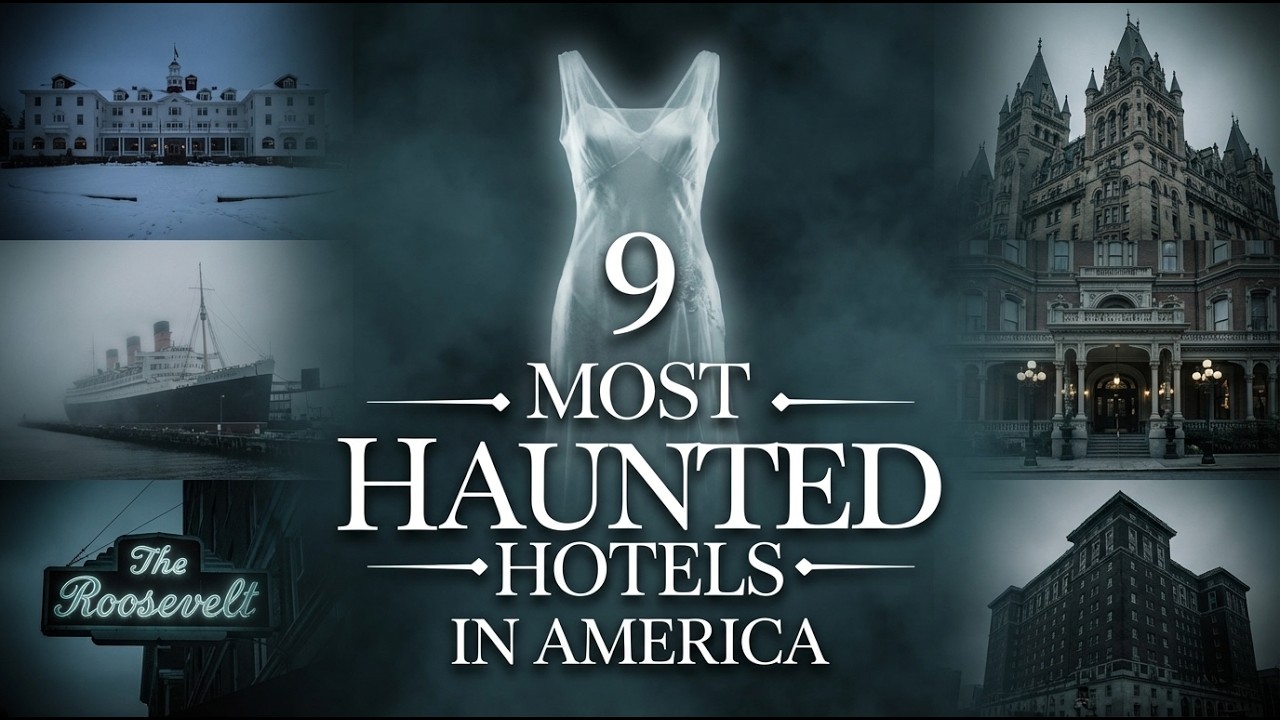
The Roosevelt Hotel opened in 1927, its Spanish colonial revival facade rising just steps from what would become the Hollywood Walk of Fame. Two years later, it hosted the very first Academy Awards, setting a standard for glamour that drew stars like Marilyn Monroe, who lived in suite 1200 during her rise to fame. Today, staff and guests report seeing her reflection in a full-length mirror that once stood in her suite, along with unexplained cold spots and fleeting shapes in the halls. The Roosevelt’s reputation rests less on tragedy than on memory, an unbroken parade of famous visitors that blurs the line between nostalgia and the unexplained.
In Austin, the Driskill Hotel rose in 1886 as a monument to Gilded Age ambition. Its builder, cattle baron Jesse Driskill, saw his fortune evaporate within three years, and his bankruptcy in 1889 cast a shadow over the marble halls and grand ballroom that had once drawn Texas’s political elite for legislative gatherings and inaugural balls. Reports of laughter echoing through empty corridors on the upper floors and shadow figures slipping past doorways late at night are inseparable from that story of opulence and ruin, as if failure itself left a mark on the property. The Palmer House in Chicago is bound to the city’s greatest catastrophe.
The original hotel opened its doors in 1871, only days before the Great Chicago Fire swept through downtown, reducing the building to ashes and much of the city to ruins. By 1873, a grander Palmer House rose from those ashes, a symbol of personal resilience and a city’s collective determination to rebuild. It now stands as the oldest continually operating hotel in the United States. Apparitions are most often reported in the service corridors and the main ballroom, shadowy figures glimpsed in the periphery and the faint clatter of dishes echoing through empty hallways.
These accounts speak less to individual tragedy than to the layered history of a place that survived disaster and never closed its doors. Boston’s Omni Parker House, founded in 1855, sits at the intersection of American literary ambition and political intrigue. Its gilded dining rooms and velvet-draped parlors became a gathering place for the Saturday Club, where figures like Longfellow, Emerson, and Hawthorne held conversations that echoed through the corridors. Charles Dickens stayed here during his American tour, and the room named for him remains the subject of whispered voices late at night, according to staff and guests.
The third-floor hallway, lined with portraits and heavy doors, is a focus for reports of floating orbs and fleeting shadows. Unlike hotels marked by disaster or scandal, the Parker House’s reputation is built on the residue of thought and memory, where the boundary between history and haunting is measured in the soft cadence of a recited poem. Milwaukee’s Pfister Hotel, opened in 1893, was designed to awe with its double marble staircase, soaring ceilings, and what is now considered the largest collection of Victorian art in any American hotel. That meticulous preservation has become the backdrop for an unusual pattern of modern encounters.
Visiting athletes from Major League Baseball and the NBA have reported flickering lights, electronics switching on and off, and heavy furniture moving on its own in locked suites. The double staircase, with its polished banisters and shadowed landings, is the site most often linked to fleeting apparitions. In the Pfister, grandeur and unease walk side by side, suggesting that the preservation of luxury can heighten the sense that something unseen still moves through these halls. The Crescent Hotel in Eureka Springs stands apart for the disturbing clarity of its documented past.
Built in 1886 as a luxury resort, its reputation took a darker turn in the late 1930s when Norman Baker, a self-proclaimed doctor, converted it into a cancer hospital. Baker promised miracle cures but delivered only false hope and unlicensed procedures. By 1940, federal authorities had convicted him of mail fraud. In 2019, an archaeological excavation beneath the old hospital wing uncovered more than 500 glass jars, each filled with preserved tissue labeled in Baker’s own hand.
Now cataloged by the local museum, they offer forensic evidence of the suffering that took place within these walls. Staff and visitors describe cold drafts, the sharp scent of antiseptic, and apparitions near the former operating theater. The Crescent’s legacy is anchored by physical remains and documented abuse, making its haunted status difficult to dismiss. The Stanley Hotel in Estes Park draws its power from both mountain solitude and literary legend.
Built in 1909 by F. E. O. Stanley as a grand retreat for the elite, its remote setting in the Colorado Rockies always lent itself to stories of isolation and unease.
Then, in 1974, Stephen King checked into room 217. His brief stay, marked by unsettling dreams and the eerie quiet of the nearly empty hotel, became the seed for his novel The Shining. Since then, visitors have flocked to the same corridors that inspired King’s Overlook Hotel. Reports of unexplained piano music drifting from the music room at night, doors opening on their own in room 401, and a persistent presence felt in room 217 have only deepened the mystique.
The Stanley’s reputation is amplified not just by whispered stories but by its place in the global imagination, a rare case where fiction and reported phenomena feed each other. The Hotel del Coronado opened in 1888 as a Victorian seaside destination for presidents, celebrities, and travelers drawn to its grand wooden turrets and ocean views. It was the death of Kate Morgan in October 1892 that transformed room 3327 into the epicenter of its haunted reputation. Morgan, traveling alone under the name Mrs.
G. P. Carroll, checked in and spent five days wandering the grounds, reportedly ill and waiting for a companion who never arrived. She was found dead on an exterior staircase, a revolver by her side.
The coroner’s inquest listed suicide, but inconsistencies in the investigation left the case unresolved. Since then, guests in room 3327 have reported flickering lights, sudden cold drafts, and the faint scent of perfume. Staff describe a persistent feeling of sadness lingering in the hall outside her door. The Del’s haunting is anchored in a single documented loss, one that continues to draw visitors seeking answers in the silence of the third floor.
The RMS Queen Mary, launched in 1936, began as a marvel of British engineering, a floating palace designed for transatlantic luxury. With the outbreak of World War II, her identity shifted overnight. Repainted battleship gray and stripped of ornament, she became the Grey Ghost, transporting more than 800,000 Allied troops across perilous waters. In October 1942, she collided with her escort, HMS Curacao, slicing the smaller ship in two and sending over 300 men to their deaths within minutes.
The Queen Mary pressed on, forbidden by wartime orders to stop. Decades later, the loss lingers in the steel and silence of her hull. Ship logs and coroner records document at least 49 deaths aboard, from wartime accidents to peacetime misfortune. Among the most cited is the 1966 death of John Pedder, a crewman crushed by a watertight door in the engine room, a space now notorious for unexplained footsteps and sudden drops in temperature.
Guests and night staff report hearing urgent voices echoing through shaft alley, seeing fleeting shadows in narrow corridors, and even the laughter of children near the former nursery. The Queen Mary’s story is cumulative, a vessel that carried thousands through war, loss, and the relentless passage of time, its haunted status inseparable from the scale of human experience within its hull. Across these storied halls, one pattern endures. Each hotel’s grandeur is shadowed by real tragedies and first-hand accounts that refuse to fade.
In America’s most celebrated lodgings, the past echoes on, and what haunts a place is not myth but memory.