By the summer of 1944, the United States held roughly 370,000 German prisoners of war on its soil. They were spread across camps that stretched from the Arizona desert to Wisconsin dairy farms, from Texas cotton fields to the pine hills of New Jersey.
Most of these men arrived expecting a certain kind of captivity. Their assumptions were built on what Nazi Germany had told them about Americans, what they had seen and done in the war, and the logic of how armies treated each other's soldiers once the fighting stopped. What they found matched none of those assumptions.
Here are seven things German POWs could not believe about American prison camps.
1. The Food
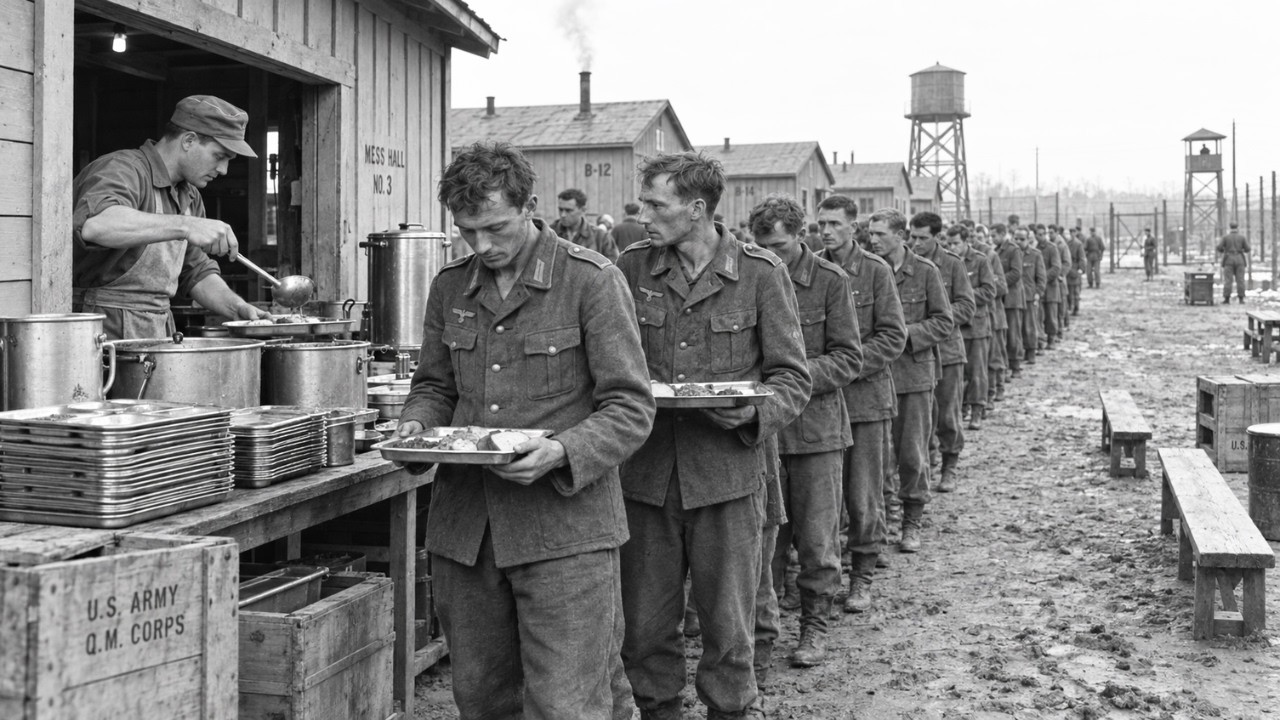
The first shock was not the guards, the fences, or the strangeness of being somewhere that was not a battlefield. It was the food tray.
Under the Geneva Convention of 1929, the United States was legally required to feed German prisoners at the same ration standard as its own soldiers. American military rations in 1944 ran to about 4,000 calories per day. That was nearly double the official allotment for the average German civilian by late 1944.
Most of these men arrived emaciated. They came from North Africa, the Italian front, and the hedgerows of Normandy. Their ribs showed through their shirts.
That kind of thinness comes from months of food shortage, not one bad week.
At Camp Gruber in Oklahoma, the Army Medical Corps began documenting something they did not expect. Prisoners arrived underweight and left overweight. Not by a few pounds, but by 15 or 20.
A German corporal captured outside Cherbourg in July 1944 wrote home that he had eaten beef three times in his first week. More than he had eaten, he wrote, in the previous three months at the front. He asked his mother not to be angry.
He said he was not sure she should read that part to his father.
By late 1944, food rationing inside Germany had deteriorated so badly that civilian diets were medically insufficient to maintain health. The home front was starving. Prisoners in Kansas were gaining weight.
The contradiction was so complete that many men could not speak about it easily. Captivity had physically improved their condition, and there was no comfortable way to accept that reality.
2. The Pay
The second surprise came in the form of something that initially looked like an administrative error: a salary.
Under international law, prisoners of war who performed work were entitled to compensation. The United States honored this. Enlisted prisoners working on camp tasks received 80 cents per day in purchase vouchers.
Officers received pay commensurate with their rank. A German captain held in an Arkansas POW camp was technically drawing a salary.
The pay was not convertible to cash or sendable home, but it could be spent. Every major camp ran a canteen, a small store stocked with cigarettes, chocolate, soap, playing cards, personal items, and in many facilities, beer. The economic life inside these camps was real.
Men saved. Men traded.
At Camp Concordia in Kansas, the prisoner canteen actually turned a profit. Some men ran informal side operations: shoemaking, tailoring, watch repair, barbering. They paid each other and kept informal records.
One prisoner, a former auto mechanic from Stuttgart whose full name was withheld from surviving records, ran a watch repair service from his barracks at Camp Trinidad, Colorado, for eight straight months. He accumulated credit at the canteen and spent it on Lucky Strike cigarettes and a chess set. In an oral history recorded years after the war, he said that period was the most economically stable time he had felt in his adult life.
He said it without any bitterness.
3. The Violence From Within
The third thing that disturbed many of them was something the Americans did not fully control and which received the least attention afterward.
Hardcore Nazis assumed captivity would mean the end of their authority over other men. It did not. In many major POW camps, a secret internal hierarchy formed within weeks of any facility opening.
Prisoners who cooperated too obviously with American staff, attended optional re-education lectures, were heard expressing relief that the war was going badly for Germany, or accompanied Americans in a way suggesting they did not particularly hate them: these men were identified, watched, and in some cases, brought before informal prisoner courts held after lights out. The charge was always the same: defeatism, cowardice, betrayal of the Reich.
Sentences were carried out at night. Men were found strangled with makeshift ropes made from torn bedsheets. Men were beaten in camp latrines with an efficiency that suggested prior coordination.
Investigators who worked after the war attributed at least a dozen deaths inside POW facilities to inter-prisoner violence. Most historians who studied the records believe the actual number was higher.
At Camp Hearn in Texas, the dynamic between the hardline faction and the rest of the prisoners became so dangerous that the administration secretly divided the facility into separate compounds, hoping geographic distribution would achieve what direct intervention could not. The Americans could not penetrate it. The social pressure was total and enforced.
A man who informed on another prisoner immediately became a target himself. The guards were outside the wire. The threat was inside, speaking the same language as the men they watched.
4. The Entertainment
The fourth revelation was cultural, and it took directions the Army had not fully anticipated.
Entertainment was treated as a stability measure in prisoner management. Occupied men were easier to handle than bored ones. Camp recreation officers organized film screenings: American films, the same ones playing in theaters in Cincinnati, Memphis, and Kansas City that summer.
Hollywood productions from studios the Nazi regime had publicly condemned as corrupt and degenerate since 1933. Westerns, comedies, musicals, cartoons, and newsreels.
The newsreels were the element no one had thought through carefully. American newsreels from 1944 and 1945 were produced with the institutional confidence of an economy running at full capacity without interruption. Factories operating around the clock.
Intact, lit cities. Grocery stores with full shelves. Consumer goods.
Cars on clean streets. Department stores bustling with ordinary civilian life. The scale of it confirmed for many prisoners what they had suspected but had not been allowed to say.
Germany was telling them the war was going well. The newsreels showed them what "going well" actually looked like when it was real.
The music accompanied it. Jazz, previously banned in Nazi Germany as "degenerate culture" since the mid-1930s, was played on phonographs in the camps, drifting through open barracks windows on warm southern evenings. Some of these men had never heard a swing band.
A German lieutenant at Camp Shelby, Mississippi, described in a postwar oral testimony sitting on his barracks steps one evening listening to a Glenn Miller record coming from a window 20 feet away. He said it was the first time in about four years he had stopped thinking about anything at all. He was not entirely sure what category that feeling belonged to.
5. The Physical Trust
The fifth thing concerned physical trust, an element these men never expected at all.
The United States faced a severe agricultural labor shortage in 1944. With millions of working-age men deployed overseas, crops went unharvested on a massive scale. Apples rotted on trees in Virginia orchards.
Cotton went unpicked in Texas fields. Sugar beet operations in Michigan fell weeks behind. The local agricultural economy needed workers, and the Army had a large, idle inventory in its POW camps.
The POW labor program was the solution. By late 1944, hundreds of thousands of German prisoners had been distributed into American agriculture. They picked cotton in Arkansas.
They harvested apples in New England and sugar beets in Michigan and Colorado. They worked in canneries in California and logging operations in the Pacific Northwest.
They did this across a country they had been fighting less than 12 months earlier, with guard-to-prisoner ratios that would have seemed reckless by any German assumption about prison management. The Army could not provide the manpower for intensive supervision. At some agricultural sites, one armed guard watched 20 or 30 prisoners across several open acres.
Practically, one American soldier sat in a truck at the edge of the field while German men moved freely between the rows.
Escape attempts were rarer than logic suggested, partly because the incentive calculations had changed in ways that were hard to argue with. A man who escaped traded three meals a day, a paid work assignment, and a bed in a barracks for open countryside in a country where he did not speak the language, had no contacts, no money, and no viable destination. Most did the math and decided to stay.
By the third or fourth month, some stayed because they had stopped wanting to leave.
6. The Re-Education Program
The sixth thing almost no one knew at the time, including the majority of prisoners themselves, was that the Americans were running a systematic ideological operation inside the camps. By most measures, it worked.
The program was organized through the Office of the Provost Marshal General, coordinated with a handful of civilian academics and German emigre intellectuals who had been living in the United States since the 1930s. The mechanism generally worked like this. German prisoners who were anti-Nazi, men who had been skeptical of the regime before the war or whose convictions changed during captivity under the weight of what they saw and heard, were quietly identified through careful screening and individual interviews.
The most useful of them were processed at a facility in Maryland. Then they were returned to the camps, not as ordinary prisoners, but as editors, contributors, and broadcasters for what the Army called the Special Projects Division.
The program's main product was Der Ruf ("The Call"), a newspaper published in German, distributed through the American POW system, and produced entirely by German prisoners who had been persuaded to work for the Allied cause. The paper covered news, literature, history, and political analysis, consistently portraying democratic governance as the logical outcome of German intellectual traditions and National Socialism as a historical aberration. By the end of the war, it was reaching several hundred thousand prisoners regularly.
Hardliners inside the camps knew something was happening. They had a name for the men involved: the "Black Orchestra." Some of them were directly threatened.
A few disappeared from their compounds under circumstances the administrative records described only in vague terms. But the program kept operating. Postwar surveys conducted by American researchers found that a statistically significant proportion of the former POW population returned to Germany with political views substantially different from those with which they had arrived.
The Americans had run a re-education campaign on an industrial scale, and it produced measurable results.
7. The South
The seventh thing, the one that stuck in the minds of those who heard about it and which never received a satisfactory official explanation, was what happened in the American South.
The Geneva Convention required treating prisoners of war according to the standards of the detaining state's armed forces. In 1944, the armed forces of the United States were racially segregated by law and enforced custom. The administrative interpretation of equal treatment in the Jim Crow South produced a result that, once it emerged, was not something anyone in a position of authority could clearly explain.
In many towns adjacent to major POW camps across the South, German prisoners being transported for agricultural or other work were allowed to eat at lunch counters, use public waiting rooms, and enter facilities that were closed, by local ordinance, state law, and a kind of enforcement that required no written rule, to Black American soldiers stationed at those same installations.
This was not deliberate policy. It was what happened when the Geneva Convention, American segregation laws, and an overstressed military bureaucracy trying to comply with both collided unintentionally in the real world. But the result was the result.
Black American soldiers wrote about it. The Pittsburgh Courier, one of the major Black newspapers of the period, reported specific incidents while the war was still ongoing. Army investigators documented these cases.
At one Louisiana site, a Black Army sergeant named Franklin Moton, who had served 18 months in the Pacific and returned home to complete his discharge proceedings, watched from the window of a segregated bus as German prisoners from a nearby camp ate inside a restaurant he was legally forbidden to enter. His written account survived in a collection of wartime correspondence gathered after the war. He did not write it with open anger.
He wrote it with a precise, measured exactness that, when you read the text, lands harder than anger itself.
"They were the enemies," Moton wrote. "I was not."
The German soldier who stepped off that train expecting punishment stood in the mess hall line a few minutes later, holding his tray, still trying to understand what kind of place this was. He never fully processed it.
A man captured in the Falaise Pocket in August 1944 and held at a camp in New Mexico until late 1946 was asked in an interview with a researcher collecting oral histories years after the war what the strangest part of his captivity had been. Not the hardest. Not the scariest.
The strangest.
He thought about it for a long moment.
"The guards called me by my name," he said.
He did not elaborate. He had stood on that platform in the summer heat, listening to a language he did not understand, smelling food being cooked nearby, trying to grasp what was happening to him. He never found the right word to describe it.
He kept thinking about it from time to time for the rest of his life.