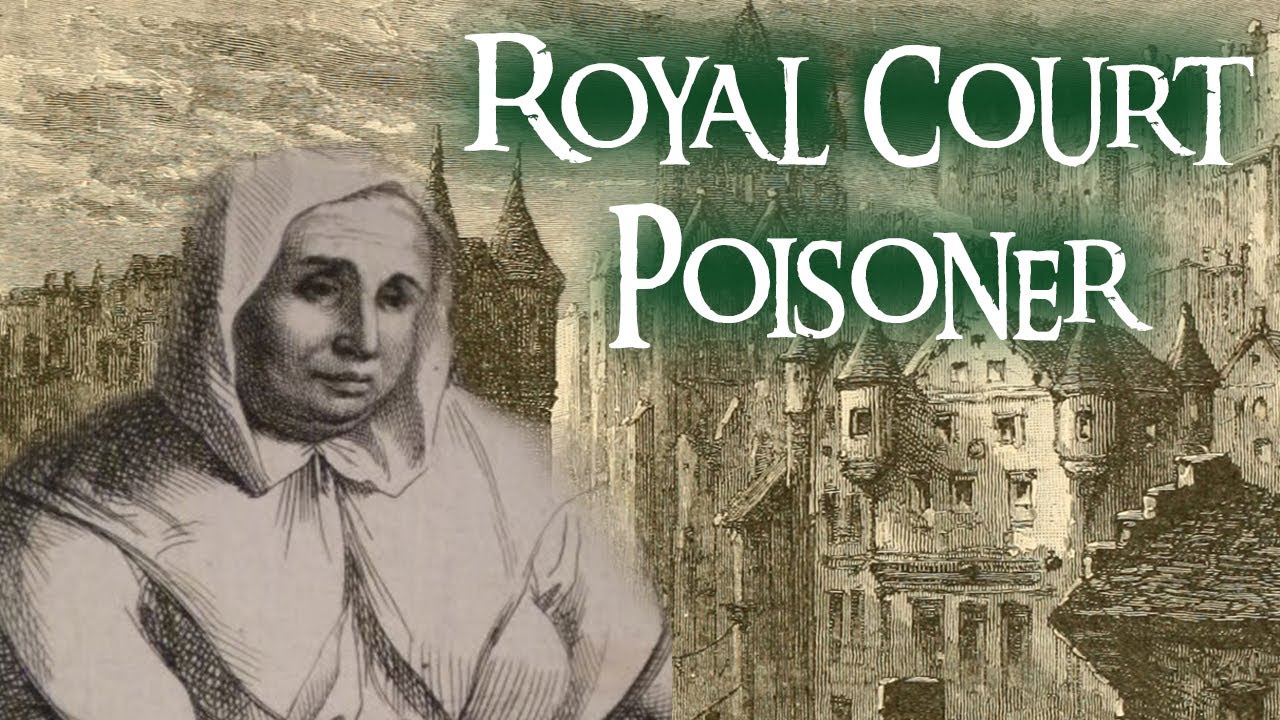
Catherine Deshayes, known to history as La Voisin, was born in Paris around 1640. Her early life left almost no trace in the records, but she likely grew up poor and with little education. As a young girl, she reportedly earned coins on the streets by telling fortunes, claiming she had learned the art at age nine. Most of her predictions came true, and she considered her talent a gift from God.
It would make her a name in Paris, and it would eventually lead her down a dark path. Around the age of twenty, Catherine married Antoine Monvoisin, a businessman who tried his hand as a silk merchant and opened a jewelry store in Paris, with little success. Within a few years, Catherine became a well-known fortune teller, recognized for accurate and useful predictions. But she knew she could earn more if she offered more services.
She acquired enough medical knowledge to become a midwife. Needing money to support her children, her husband, and her mother, she began offering abortions within her midwifery practice. Abortions were illegal at the time, and those who facilitated them risked conviction and punishment. Yet she earned more from ridding women of unwanted pregnancies than from delivering newborns.
When she had to deal with fetuses aborted late in pregnancy, she is believed to have burned them in her furnace and buried the remains in her garden. As word spread, women higher up the social ladder began requesting her help. La Voisin charged higher prices and earned more money. Eventually she had so many clients that she established a network of abortion providers, with her role as a midwife serving as a front for the more dangerous practice.
Despite these services being a cardinal sin under Catholic teaching, she regularly attended Mass. Her fortune telling remained her priority. In 1665, a notable priest questioned her abilities. She was interrogated before professors at the Sorbonne, who asked a series of questions to determine if her fortune telling was legitimate.
La Voisin was persuasive, claiming her gift came from God. She was let go and continued her work. Within a few years, she was earning large sums. To appeal to her increasingly wealthy clients, she purchased finer clothing, including a special robe of crimson red velvet embroidered with eagles in gold.
The robe cost her the hefty sum of fifteen hundred livres, but it created a mystical atmosphere that led more people to believe her prophecies. By the late 1660s, her clientele included many French aristocrats. She was now a wealthy lady, though the work was hard, as she spent virtually all day receiving clients at her home in Villeneuve-sur-Gravois. Despite her humble background, she mixed freely with the upper classes.
She hosted parties where she played the violin for guests and took on many wealthy lovers, including a count, an architect, a magician, and a viscount. One of her lovers, Adam Lesage, grew jealous of her husband and hoped to get rid of him by convincing her to poison him. Initially she agreed, but she later changed her mind. La Voisin soon found herself entangled in conflicts with Marie Bosse, another fortune teller who provided poisoning services and was allegedly a witch.
They became bitter enemies. Whether rivalry or client requests drove her onward is unknown, but her fortune telling eventually led her to practice the dark arts. She created magical objects such as amulets and love powders, and finally she began supplying poisons. Over years of fortune telling, she noticed that most clients wanted three things: someone to fall in love with them, the death of a family member so they could inherit, or the death of a spouse so they could marry someone else.
Previously she could not alter fate, but now she had acquired new abilities. To avoid criticism when wishes went unfulfilled, she stated that only certain wishes that were the will of God would come true. She encouraged clients to take steps that increased the chance of their desires being realized, such as visiting the church of a saint, buying magical objects, or participating in a black mass with the help of priests she employed. She charged a hefty sum for black masses held in the catacombs near her house.
These rituals were the opposite of a traditional Catholic Mass. A naked woman lay down as if she were an altar, a chalice was placed on her stomach, and a priest held a baby above her, pouring its blood down into the cup while those present prayed to Satan. Whether La Voisin used dead or living infants is uncertain, but she had many children at her disposal. She not only provided late-term abortions, but she also aided lower-class women who could not afford to raise a child by getting rid of their newborns.
Her services had certainly become darker, and eventually she took the fatal leap of selling a variety of poisons to clients who wished to end someone’s life. As a known underworld figure, she soon had a network of poison providers working for her. This decision would haunt her. In 1667, La Voisin was hired by Madame de Montespan, a member of King Louis XIV’s court, to make the king fall in love with her.
Montespan used aphrodisiacs, charmed the king, and participated in black masses to win his heart. It worked. By July of that year, she became the king’s official mistress. Yet just two years later, the king began a sporadic affair with Madame de Thianges.
Montespan was not too troubled by it, but in 1673 she noticed the king losing interest in her. Unable to accept this, she went to La Voisin again and participated in satanic rituals to keep his love. As time passed, the king took on more lovers, and it became clear he was no longer interested in Montespan. This was confirmed by his relationship with Angélique de Fontanges in 1679.
Furious at her dismissal, Montespan returned to La Voisin for help, but this time she had something much more sinister in mind. She asked La Voisin to poison both Fontanges and the king. Initially hesitant, La Voisin eventually agreed and, with her co-conspirators, devised a plot to kill the Sun King. On the fifth of March 1679, La Voisin visited the royal court intending to provoke the king’s death.
She carried a poisoned petition, which, when handled by the king, would be absorbed by his skin and kill him. But that day there were too many people trying to give him petitions. Unable to get near him, her plot failed. A week later, while on her way to meet her associate Catherine Trianon, La Voisin was arrested.
At the time, police had no suspicions of her plot to kill the king. They had been ordered to round up alchemists and fortune tellers suspected of selling poisons. This investigation came as a result of the Affair of the Poisons, a major murder scandal that began in 1677. In February of that year, a fortune teller named Magdelaine de La Grange was arrested on charges of forgery and murder.
She tried to bargain her way out, claiming she had information about other crimes involving members of the royal court. The chief of police, Gabriel Nicolas de La Reynie, was tasked with rooting out all poisoners. The investigation led to accusations of witchcraft, murder, abduction of children, and satanic rituals. La Voisin’s enemy Marie Bosse was arrested, and in 1679 she singled out La Voisin as the mastermind behind the secret network of poison distribution.
Following her arrest, La Voisin was imprisoned and interrogated. Her network of associates were also arrested. Unlike others who were questioned, she is believed not to have been tortured at that time. Police knew of her alcoholic ways and provided her with a constant flow of alcohol, meaning she was drunk during interrogations.
Initially she denied all claims, telling authorities that any client wishing to buy poison was referred to Marie Bosse. But by October, she admitted to having sold poison and magical services to several nobles, some of whom were members of the royal court. After that, she was sure not to reveal anything else. When asked to give more names, she replied that Paris was full of this kind of thing and that there was an infinite number of people engaged in this evil trade.
Although La Voisin had admitted to some involvement, her actions did not warrant the death penalty. So her accusers focused on her alleged abortion services. Authorities claimed she injected syringes into the bodies of pregnant women, aborted fetuses, burned the bodies, and buried them in her garden. She denied it all.
Despite a confident front, she was very afraid she would be asked about her visits to the royal court. Fortunately for her, police had no idea about her plot to kill the king. They also did not know about the black masses she conducted or her connection to Montespan. On the seventeenth of February 1680, La Voisin was tried and convicted of witchcraft.
She was sentenced to be burned at the stake. Before her execution, it is believed she was tortured by having her legs crushed. Yet strangely, shortly before her death, a lady described how La Voisin moved so freely and seemed so healthy that it did not seem possible she had been tortured. In any case, she did not confess.
On the twenty-second of February 1680, she was burned alive in public on the Place de Grève. On her way to the stake, she is said to have desperately pushed away the hay piled up around her. It was only after her death that the dark truth of her schemes was revealed. La Voisin’s daughter disclosed her list of clients, the arranging of the black masses, the connection to Montespan, and the attempt to poison the king.
Her words were confirmed by the testimonies of La Voisin’s former associates. It is estimated that she was involved in the deaths of between one thousand and two thousand five hundred people through her network of abortion providers, black masses, and poison.