In November 1864, a Union general did something no American commander had ever done before. William Tecumseh Sherman deliberately severed his own supply lines, told Washington he would be out of contact for weeks, and marched sixty thousand men deep into enemy territory with no way to retreat and no way to call for help. His own officers thought he had lost his mind. His superiors in Washington panicked.
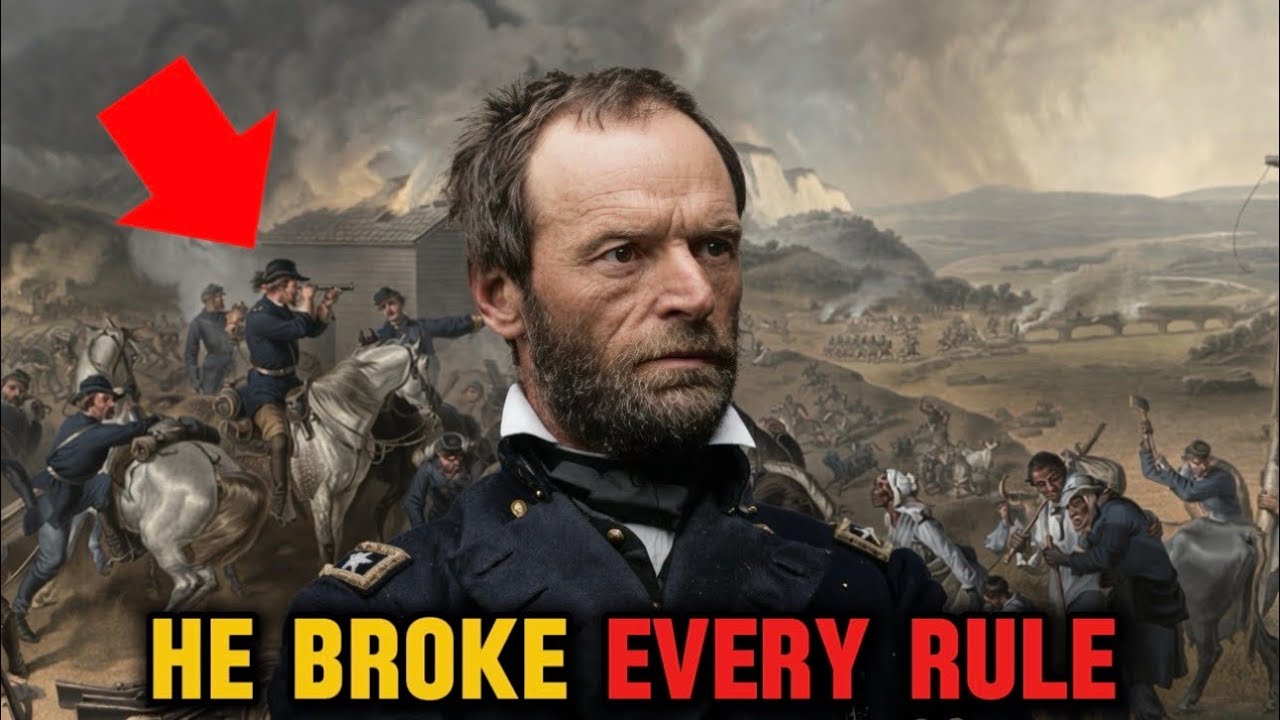
But Sherman was not gambling. He had reached a conclusion most generals on either side had not yet grasped: you do not win a war by defeating armies. You win by breaking the thing that allows armies to exist in the first place. This is the story of how Sherman rewrote the rules of American warfare, and why it still stirs anger today.
To understand why Sherman went to such extremes, it helps to understand what passed for normal in 1861. Civil War generals like Robert E. Lee, George McClellan, and even Ulysses Grant in his early career followed the European rules of the eighteenth century. Two armies meet.
They form lines. They fight. The one that collapses first loses the battle. You seize the enemy’s capital, and eventually one side surrenders.
It was orderly. It was honorable. It was also painfully slow. By 1864, that approach was failing.
Lee kept outmaneuvering Union armies that outnumbered him. The Confederacy kept losing battles and refusing to surrender, because losing a battle did not touch what actually ran the war machine: the southern farms, the railroads, the factories, and the will of southern civilians to keep sending their sons to fight. Sherman looked at three years of slaughter at Antietam, Gettysburg, and Chickamauga, at hundreds of thousands of casualties, and asked an unwelcome question. What if fighting the army was the wrong target entirely?
Sherman was not a cold-blooded theorist. By most accounts, he was a man of intense, troubled brilliance, prone to depressive episodes so severe that newspapers reported early in the war that he had gone insane. He nearly lost his command in 1861 because of it. But that restless mind gave him something most generals lacked.
He understood systems, not just battlefields. Before the war he had run a bank in California, a military academy in Louisiana, and worked as a lawyer. He understood logistics, finance, and how institutions actually function, not just how armies marched. He had also seen the South up close.
During his time running that Louisiana academy he lived among southerners, understood their pride, their economy, and their dependence on cotton and enslaved labor. He knew better than any other Union general exactly what the Confederacy needed to keep fighting: food, railroads, factories, and morale. When Grant, now commanding general of the army, gave Sherman an army and essentially told him to do what needed to be done, Sherman had already decided what that meant. This is where people misunderstand him, and it is worth pausing on.
Sherman did not order the mass killing of civilians. He was not running death squads. What he did was something more specific, and frankly more chilling in a different way. He decided that the South’s infrastructure was now a legitimate military target, not just its armies.
After burning the military and industrial facilities of Atlanta in September 1864, Sherman made a decision that broke every convention of war. He cut his ties to his supply lines completely and marched his army 285 miles toward Savannah, living off the land. Military planners of the time considered the idea close to madness for an army of that size. Along the way, his men tore up railroad tracks and bent the rails around trees in what soldiers called “Sherman’s neckties,” twisted iron rendered useless.
They burned cotton gins, storehouses, and mills. They seized cattle and food for the army. Homes were generally spared. Barns, depots, and railroads were not.
The logic was brutal but consistent. Sherman wrote to the mayor of Atlanta that war is cruelty, and you cannot refine it, and that the crueler it is, the sooner it ends. That was the entire philosophy in one sentence. Make war so physically unbearable that the South’s ability to fight simply ceases to exist.
Not because you killed every soldier, but because you burned the railroads that fed them, the cotton that funded them, and broke the confidence of civilians who believed the Confederate government could still protect them. He did not need to defeat Lee’s army in Virginia. He needed to prove the Confederacy was hollow. Here the story becomes genuinely uncomfortable, and honestly, it should be.
Sherman’s march worked because it was psychological as much as physical. An army that could disappear from contact for a month, live entirely off enemy land, and then emerge after 285 miles leaving a trail of destruction behind it was not just a supply strategy. It was proof that the government could not protect its people. And that the war was already lost, whether the armies technically met in battle or not.
Confederate General Joseph Johnston is remembered as saying that Sherman’s march was the most decisive campaign of the entire war, not because of the men it killed, but because of what it proved. The Confederacy could no longer defend its own homeland. That is a devastating thing to demonstrate to a civilian population. It is exactly why Sherman remains one of the most controversial figures in American history.
In the South, for generations, his name was spoken with genuine bitterness. Some southern families are said to have refused to name their children William Tecumseh for a hundred years afterward. Was it justified? That argument has never really ended.
But strategically, it worked in a way three years of conventional battles had not. Here is the larger point, and it is why military historians still study this campaign obsessively. Sherman essentially invented, or at least refined, what we now call total war. The idea is that a nation’s ability to fight depends on its entire economy and society, not just its army, and that it is a legitimate strategy to target that whole system.
Before Sherman, war was theoretically fought between armies while civilian economic life continued almost in parallel. After Sherman, that boundary disappeared permanently. Every major war since, from the sieges of World War I to the strategic bombing of factories and cities in World War II to modern economic sanctions, traces its logic back to this idea. You can defeat a nation by breaking its ability to sustain war, not just its soldiers.
Grant understood this too in his own way. His strategy against Lee in 1864 and 1865 was one of attrition and resources, grinding down the Confederacy’s ability to replace men and materiel. But Sherman pushed it further and made it explicit. Infrastructure and economy were now the battlefield.
That was the refusal at the heart of Sherman’s campaign. He refused to fight a nineteenth-century war by eighteenth-century rules. He fought the war the Confederacy could actually lose. After the war, Sherman became commanding general of the entire United States Army.
He is credited with a famous saying, though historians differ on its exact wording, that captures his worldview completely: “War is hell, and those who brought it on deserve all the curses a people can pour upon them. ” He was not celebrating what he had done. He genuinely seemed to believe that making war unbearable was the fastest, and therefore the most merciful, way to end it. A cruel logic, but a logic nonetheless.
Today, military academies still teach the Georgia campaign not as a model of brutality but as the first modern demonstration that logistics, infrastructure, and civilian morale are not separate from war. They are the war itself. Sherman did not refuse to fight. He refused to fight the battle everyone expected.
In doing so, he ended the Civil War faster than any battlefield victory could have. And he opened a door in military strategy that the world has spent the last century and a half walking through. So the next time you hear about a war fought with economic sanctions, blockades, or strategic bombing campaigns, remember that it effectively began with a 285-mile march through Georgia led by a general who decided the rules were the problem. Was Sherman right?
That is still debated in classrooms and living rooms across the country. But without question, he was the general who understood something his peers did not. Sometimes the way to win is not to fight harder.
It is to fight differently.