During World War II, millions of German soldiers surrendered to the Western Allies between 1943 and 1945. The vast majority became prisoners of war and were processed according to the rules of the Geneva Convention: disarmed, searched, interrogated, and transported to temporary camps before being moved to larger POW facilities. But documented cases exist where German soldiers were killed after surrendering. These killings were technically illegal under international law and were never official Allied policy.
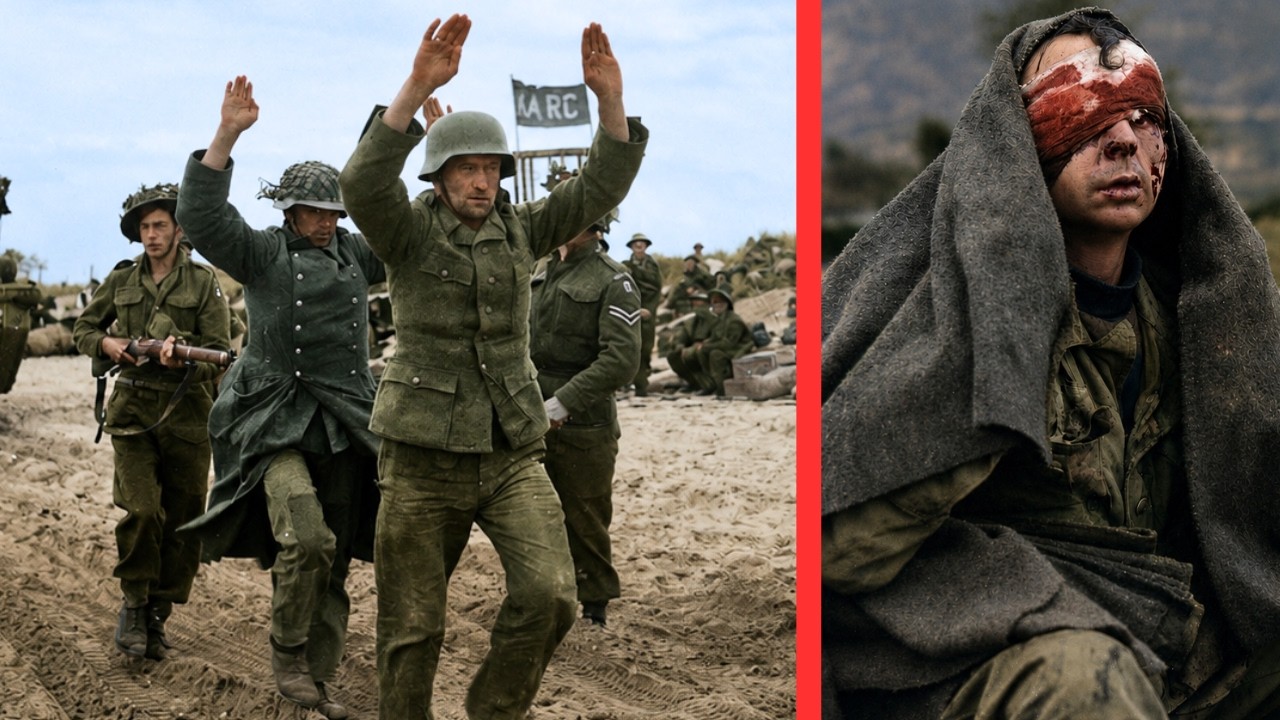
Yet they happened, and understanding why requires looking at the brutal conditions of the final years of the war. As the tide turned against Germany following the Battle of Stalingrad and the D-Day landings in Normandy, many German soldiers chose to surrender to the Western Allies rather than the Soviets. They believed their chances of humane treatment were better in American, British, or Canadian hands. As the Allies advanced through occupied territory and into Germany itself, they uncovered horrifying evidence of Nazi atrocities.
By 1945, Allied soldiers were discovering concentration camps packed with thousands of emaciated survivors and enormous numbers of unburied corpses. Many soldiers had never imagined such conditions existed. Others came across villages where civilians had been massacred or found Allied prisoners who had been killed after capture. These scenes often provoked intense rage.
Soldiers who had spent years fighting suddenly confronted crimes that seemed beyond comprehension. They had not been trained to handle such sights. Although military law still required the protection of prisoners, some soldiers reacted emotionally and took immediate revenge against German individuals they believed were responsible. Spontaneous acts occurred in which captured Germans were led to open areas and shot by Allied troops after hearing stories of their cruelty toward the enemy.
One factor that significantly influenced the brutal disposal of captured German soldiers was the Malmedy massacre, which took place during the Battle of the Bulge, the Ardennes offensive. On December 17, 1944, soldiers from the 1st SS Panzer Division, Leibstandarte SS Adolf Hitler, under the command of Joachim Peiper, killed 84 American prisoners of war near the Belgian town of Malmedy. News of the massacre spread rapidly among American units, convincing them that the Waffen-SS could not be trusted to follow the laws of war. In the days and weeks that followed, historians have documented several incidents during the fighting in the Ardennes where surrendering Waffen-SS soldiers were shot, as well as regular German Army soldiers who were mistakenly captured as SS members, rather than being taken prisoner.
The Malmedy massacre particularly had a profound impact. One of the most notable retaliatory incidents occurred near the village of Chene on January 1, 1945, when members of the 11th Armored Division shot between 60 and 80 German prisoners of war. This happened roughly two weeks after the Malmedy massacre. They were all killed by machine gun fire in a field similar to the one at Malmedy, and revenge was undoubtedly the motive.
One eyewitness to the massacre described what he saw. He said that some soldiers had lined up some prisoners, and he knew they were going to shoot them, which he hated. They led the prisoners up the hill to kill them along with the other prisoners they had captured that morning. As they climbed the hill outside the town, he saw their soldiers lining up German prisoners in the fields on both sides of the road.
There must have been between 25 and 30 German soldiers in each group. Machine guns were being set up. These soldiers were to be shot and killed. He acknowledged they were committing the same crimes they now accused the Japanese and Germans of.
When he returned to the town, he looked at the fields where the German soldiers had been shot. Their bodies lay lifeless and dark on the snow. But not every shooting of surrendering German soldiers was an act of revenge. Battles were often chaotic, especially in cities, forests, and villages.
When visibility was poor, German soldiers sometimes pretended to surrender, then suddenly opened fire with hidden weapons or threw grenades. German military leadership did not encourage surrender; they wanted their troops to fight to the death. Other soldiers concealed pistols under their uniforms or attempted to flee as soon as Allied forces approached. After encountering such deceptive tactics, Allied soldiers became extremely cautious.
As a result, some Germans who genuinely intended to surrender were shot because the soldiers believed they were about to attack. Allied soldiers also had little inclination to take prisoners when time was critical. On D-Day, for example, as Allied forces stormed the beaches and advanced toward the hills, they cleared bunkers one by one and dug trenches. The primary objective was to maintain a foothold and secure the beaches to ensure more soldiers and equipment could land.
Capturing prisoners was not a priority. If a German soldier surrendered, he was often shot, especially after soldiers had witnessed the horrific scenes on beaches like Omaha. In the small Normandy village of Andouville-la-Hubiere, 30 German soldiers were killed near the village in retaliation for the heavy losses suffered by American paratroopers during the Normandy campaign. There were also famous allegations against Ronald Spears, popularized by the television series Band of Brothers, that he shot six German prisoners of war with his Thompson submachine gun.
However, the battalion command ignored these claims. The Waffen-SS faced a much greater danger than regular German Army soldiers and Wehrmacht personnel. By 1945, the Waffen-SS had gained a notorious reputation among the Allies for its involvement in massacres, executions of prisoners of war, and other war crimes. This reputation caused many Allied soldiers to view captured Waffen-SS members entirely differently from ordinary German infantrymen.
Nevertheless, most Waffen-SS soldiers who surrendered were successfully captured and survived the war. Only a small number fell victim to revenge. The situation on the Eastern Front was entirely different. The war between Nazi Germany and the Soviet Union had been exceptionally brutal since the start of Operation Barbarossa.
Both sides committed terrible war crimes, and Soviet forces sometimes executed captured German soldiers, particularly after discovering villages destroyed by German occupation forces or after witnessing evidence of atrocities committed by the SS and other units such as the Einsatzgruppen. At the same time, the Soviets captured millions of German Army soldiers alive and sent them to labor camps. Inside those camps, many died from disease, starvation, exposure, and forced labor, especially during the early years of their captivity. Still, Soviet executions of German prisoners were more frequent than those carried out by the Western Allied armies.
British and Canadian forces generally maintained a good reputation for not executing prisoners of war. Captured Germans were disarmed, searched, and evacuated to POW camps, many of which were in Britain, where the men worked in agriculture and food production. Scattered claims and documented incidents of illegally killing prisoners of war existed, particularly during the intense fighting in Normandy and after the discovery of atrocities committed by the SS against Canadian forces in those areas. But these incidents were rare, and commanders did not necessarily encourage them.
When killings occurred after capture, they were mostly the result of individual decisions made in moments of extreme anger, fear, or confusion, not on the orders of Allied governments or senior commanders. It is known that captured German soldiers were sometimes executed after surrendering to Allied forces during World War II. These actions are documented and should not be ignored. At the same time, they were rare compared to the millions of Germans who were safely transported into Allied captivity.
The majority of German prisoners reached detention camps and survived the war. Their chances of survival were greater if captured by the Western Allies rather than the Red Army. Still, the execution of captured German soldiers was an illegal act committed mostly by individuals and small groups acting on their own.