In a conference room at Nintendo’s headquarters in Kyoto, during the early 1990s, a small team from Waltham, Massachusetts, set a prototype on the table and began the most important pitch of their lives. Across from them sat Hiroshi Yamauchi, the president who had transformed a playing card company into the most feared name in video games. The prototype contained a single vertical column of red LEDs, one light wide, and a tiny mirror that swept that line back and forth so quickly the eye saw a whole picture hanging in the dark. Partway through the demo, by the account of sales chief Steve Liff, Yamauchi’s head sank onto his hand, then onto the table, and he fell sound asleep.
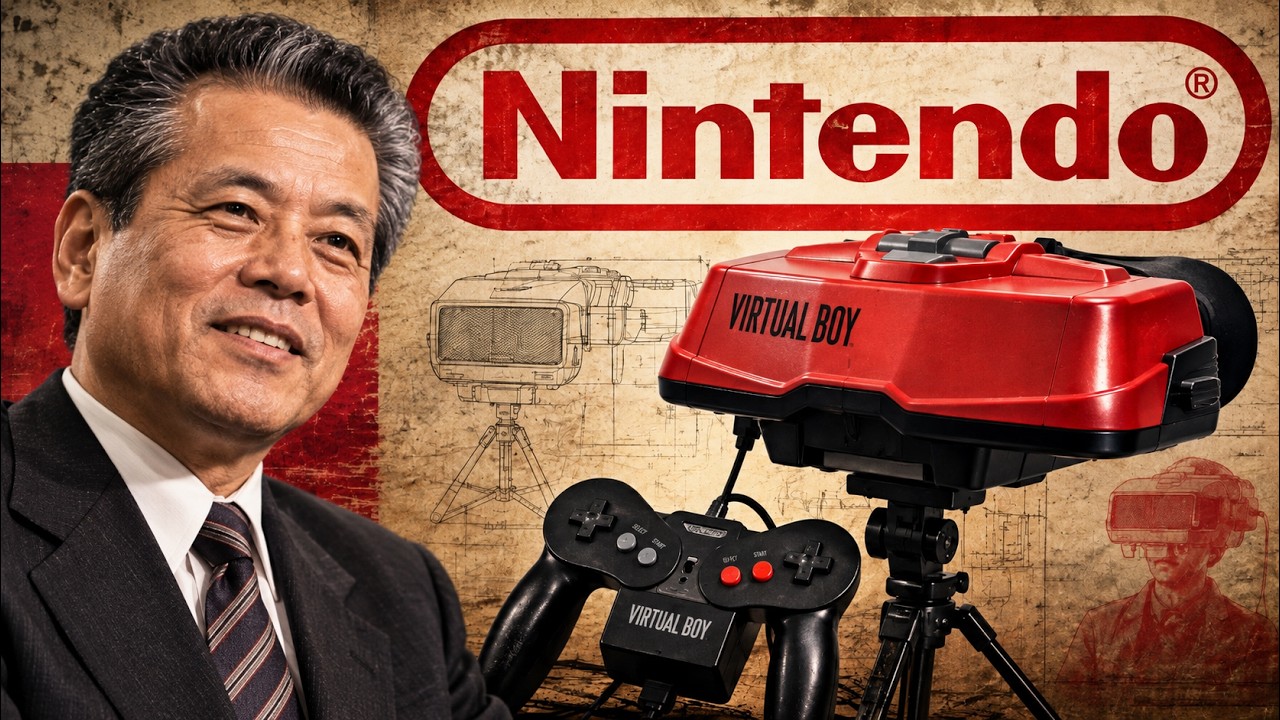
The visitors assumed the meeting was over. Their liaison in Japan, Jack Plimpton, read it the opposite way. In Japanese business, he later explained, the senior man was sending a message, and the message was that the project was a go. That nap became the Virtual Boy.
Nintendo sold it in America for $179. 95 and stopped selling it in Japan on December 22, 1995, five months after launch. American stores carried it for about a year. Worldwide, it sold 770,000 units, the lowest total of any console Nintendo has ever made.
The most successful game company on Earth had taken a line of red light, its best engineer, and an American invention it had paid millions for, and turned all three into its worst-selling machine. To understand the Virtual Boy, you have to start with the man Nintendo trusted to build it. Gunpei Yokoi was born in Kyoto on September 10, 1941. He studied electronics at Doshisha University, and in 1965 he took a job maintaining the machines that produced Hanafuda, traditional Japanese flower cards, at a company that at the time mostly made playing cards.
Nobody hired him to invent anything, but he invented anyway. In his own time, he built an extending lattice arm with a grabber on the end, a gadget made for his own amusement. Yamauchi saw it and ordered it into production. Released as the Ultra Hand in 1966, it sold about 1.
2 million units, and Nintendo’s toy business grew out of a maintenance engineer’s spare hours. Over the next two decades, Yokoi turned that first success into a philosophy. He called it lateral thinking with withered technology. The idea was simple and stubborn.
Don’t chase the newest, most expensive component. Take a part that is old, cheap, well understood, and mass-produced by the millions, and find a use for it that nobody has thought of. A calculator-style liquid crystal display became the Game & Watch in 1980. A cheap monochrome screen would one day become the Game Boy.
Toys and games, as his philosophy is usually summarized, do not need cutting-edge technology because a new way to play matters more. For Yokoi, the fun lived in the idea, never in the silicon. On the other side of the Pacific, an engineer in Massachusetts was chasing nearly the opposite dream. In 1985, Alan Becker found himself in an airline seat, wishing he had a real computer screen he could carry, something that didn’t need a desk, a wall socket, or a picture tube the size of a microwave oven.
Becker wasn’t thinking about games at all. He was thinking about a screen you could wear. His answer was strange and elegant. Instead of building a whole grid of pixels, he would build just one line of them, a single vertical column of light.
Then he would set a mirror in front of that column and make it vibrate, sweeping the line across the eye so fast that the brain stitched the slices together into a complete image. He called it the scanned linear array, and within a year he would bet a company on it. Reflection Technology was founded in 1986 by Becker, Neil Golden, Benjamin Wells, and Nate Goldlag. Their first home was the basement of a former bakery in Cambridge, Massachusetts.
The hard problem was the light itself. Becker’s design needed a dense, fast, reliable row of tiny light sources, and the most mature ones on the market were red LED arrays made by AEG Telefunken, designed for printers. Red was the color because red was what existed, what was cheap, and what was already rolling off production lines. That small purchasing decision would follow the technology all the way to the toy aisle.
The result was the Private Eye, a column of 280 red LEDs in a box about three inches long that weighed two and a half ounces and drew half a watt of power. A resonant mirror swept the column across your field of view, painting an image 720 by 280 pixels, sharp red text on pure black. Strap it to a headband in front of one eye, and you saw what looked like a full computer monitor floating about eighteen inches from your face. It went on sale in 1989 for $795.
At MIT, Carnegie Mellon, and Columbia, researchers inventing what we now call wearable computing built their experiments around it. At MIT, Thad Starner wore a Private Eye rig every day starting in 1993. Because it covered only one eye, the brain blended the red image with the real world seen through the other, a kind of accidental augmented reality decades before anyone sold glasses with a screen inside. What the company lacked was a market large enough to pay for mass production.
The founders went looking for a partner who knew how to sell millions of something. Reflection Technology knocked on nearly every door in the toy and game industry. Mattel held long discussions and nothing came of them. Hasbro showed real interest and then the deal fell through.
Sega was the most painful rejection. Tom Kalinske, then running Sega in America, later remembered the trouble without softening it. A big issue, he said, was that kids got sick, threw up, or fell over. He had another complaint.
The display was just one color. So the company kept pitching and kept paying rent and kept shrinking its list of possible partners. Then Plimpton managed to open a door in Kyoto, and behind it stood the one engineer whose instincts ran against every American executive who had already said no. By the time Reflection Technology reached him, Gunpei Yokoi was general manager of Nintendo’s Research and Development 1 division, and his record had no equal in the industry.
He had made the Game & Watch. He had produced Metroid and Kid Icarus in 1986. He is credited with the cross-shaped directional pad that nearly every game controller since has borrowed. And in 1989, he had shipped the Game Boy.
Yokoi looked into the demo and saw something the Americans themselves had underrated. It wasn’t the red. It wasn’t even the 3D. It was the black.
Because the image came from a single line of light sweeping across darkness, every pixel that wasn’t lit stayed completely black, with no glowing backlight, no gray border, no visible edge. A player looking in would be inside a void where only the game existed. He fell in love with the technology, and pushing it meant taking it to Yamauchi. That is how a team from a Massachusetts startup came to watch the man who ran Nintendo fall asleep across the table.
If Yokoi wanted this, the meeting was a formality. The terms were generous. According to people involved in the deal, Nintendo paid Reflection Technology a reported $10 million in advance royalties and took a minority stake in the company, securing exclusive worldwide rights to the display within the video game market. Exclusivity cut both ways.
From that day on, Reflection Technology could not sell its display to any other game company. When Nintendo announced the investment publicly at the start of 1995, it described it as its first ever equity investment in an American company. What Yokoi pictured first was not a box on a table. It was a headset worn like goggles, tracking the player’s head the way the tank demo had.
Over the next four years, that vision would be cut down piece by piece, and almost none of the cuts came from inside his lab. In the early 1990s, virtual reality was the most talked about idea in consumer technology. To an industry reading magazine covers about goggles and digital worlds, the middle of the decade looked like the moment someone would bring 3D into the home. At the same time, the console war was shifting under Nintendo’s feet.
Sony and Sega were moving to 32-bit machines with compact discs and polygon graphics, and Nintendo’s answer, the console then called the Ultra 64, was taking longer than anyone wanted. Shigeru Miyamoto, the designer behind Mario and Zelda, was consumed by it. He had almost no involvement with the Virtual Boy. Then came the safety questions.
Nintendo asked Dr. Eli Peli of the Schepens Eye Research Institute to study whether staring into twin displays could harm children’s eyes. His conclusion was that the device was generally safe, but that very young children, roughly under five to seven, could risk developing a lazy eye if the two images were even slightly misaligned. The fix was a rigid plastic body with a precision steel frame inside, locking both displays in alignment, and a warning that the system was not for children under seven.
A rigid steel frame does not sit comfortably on a head. Head tracking went next, dropped over worries about radio frequency emissions so close to the skull. The goggle design was abandoned over safety and liability. A shoulder-mounted stand was considered and rejected because a player wearing it might fall.
Japan’s new product liability act took effect on July 1, 1995, widening manufacturers’ exposure to claims. The Virtual Boy would reach Japanese stores three weeks later. What survived all of this was a red and black machine on a two-legged stand sitting on a table that the player had to lean into. Nintendo announced it on November 14, 1994, priced at 19,800 yen.
The forecasts were enormous. Nintendo projected three million consoles and fourteen million games in Japan in roughly the first year. One analyst told reporters he believed that when it reached the market, it would be the winning one. His reasoning was Nintendo’s own playbook.
Sell the hardware cheap, then make the real money on software. To see why so many smart people believed him, you had to look at what Yokoi had already done with the Game Boy. On paper, it lost to almost everything around it. Its screen was monochrome, 160 by 144 pixels, showing four shades of greenish gray.
Rival handhelds were already promising backlit color, but the modest screen sipped power, so the Game Boy ran for up to thirty hours on four AA batteries. Tetris went on to ship more than thirty-five million copies with the machine. The monochrome models alone sold 59. 89 million units by the autumn of 1997.
Counting the Game Boy Color that followed, the family reached 118. 69 million. That was the track record walking into every Virtual Boy meeting. When Yokoi said a strange display could become a hit, nobody at Nintendo had any reason to doubt him.
Now open a Virtual Boy and look at what he built. At its heart was an NEC V810, a 32-bit processor running at 20 megahertz, in a year when Nintendo’s living room flagship was still a 16-bit machine. Behind each eyepiece sat a single column of 224 red LEDs. A mirror in front of each column oscillated back and forth, sweeping the line across your vision about fifty times a second and building an image of 384 by 224 pixels for each eye.
Because each eye received a slightly different image, the brain fused the two into true stereoscopic depth. You could hear it working. The oscillating mirrors gave off a faint mechanical hum, the sound of a machine physically drawing its picture for you. It ran on six AA batteries or a wall adapter.
The games were built around that darkness. Yokoi’s advice to developers was revealing. “We’re working with the Virtual Boy here,” he told them. “Just draw the edges.
The black would do the rest. ” But two quiet decisions sat underneath all of this engineering. When reporters asked why the images were only red, a Nintendo spokesman gave a one-word reason. A full-color 3D system, he said, was unaffordable.
And when Yokoi’s team wanted the machine to carry the kind of big Nintendo games that sell hardware, the answer came back from above. “I was told not to release that kind of stuff,” Yokoi said later. Nobody in Kyoto treated either sentence as a warning at the time. The first wave of the public met the machine at the Consumer Electronics Show in Las Vegas on January 6, 1995.
Nintendo was openly confident. Yamauchi promised that it would transport players into a virtual utopia with sights and sounds unlike anything they had ever experienced. The crowds were cooler. People leaned into the eyepieces, played for a few minutes, and stepped back unsure what they had seen.
The launch slipped from the planned April to July 21, 1995, and before it arrived, Nintendo cut the Japanese price from 19,800 yen to 15,000. The launch lineup was Mario’s Tennis, Red Alarm, Teleroboxer, and Galactic Pinball. Japanese players bought roughly 140,000 units. Magazines ran stories about dizziness, nausea, and headaches, and some speculated without evidence about permanent damage to young eyes and brains.
The Virtual Boy was a toy priced like a console. It was too awkward to be a handheld and too isolating to be a living room machine. Its best design talent was held back for the Nintendo 64, and its color was limited by a cost decision made years earlier. Every one of those calls looked sensible in its own room.
Holding Mario back protected the bigger launch. Using red kept costs down. Mounting it on a table answered the eye doctors and the lawyers. Put them together and you had a product nobody had designed as a whole.
The Virtual Boy reached American stores in the middle of August 1995 with Mario’s Tennis packed in the box. $179. 95 in 1995 is roughly $380 in today’s money. Europe never saw it at all.
Nintendo of America expected to sell more than 1. 5 million consoles and 2. 5 million games by the end of the year. The company spent about $25 million promoting it.
Blockbuster rented the system out so families could try it at home before buying. Then the price started falling. On October 18, 1995, it dropped to $159. 95.
By May of 1996, it was $99. By late that year, clearance bins at Toys R Us were selling brand new units for around $30. The last official American release, 3D Tetris, arrived on March 22, 1996. By August, the machine was gone.
Here is the ledger. Nineteen games in Japan, fourteen in North America, twenty-two in total. A forecast of three million consoles in Japan against 140,000 sold there. An American forecast of 1.
5 million by the end of 1995 against 770,000 worldwide across its entire life. For comparison, the Wii U, the next weakest console Nintendo has ever released, sold 13. 6 million. Those numbers do not describe a slow decline.
They describe a machine that never found its audience at all. Yokoi had a theory about what went wrong, and it was mostly about money. “Give me 1 billion yen to market it,” he said, “and I will launch the Virtual Boy into the stratosphere. ” In the middle of August 1996, after 31 years at Nintendo, Gunpei Yokoi resigned.
Nintendo said publicly that his departure was absolutely coincidental to the hardware’s performance. Yokoi’s collaborator, Takafumi Makino, said Yokoi had made up his mind to leave the company well before the Virtual Boy failed, and Benjamin Wells remembered him planning retirement before the project even started. Before he went, Yokoi’s team delivered the Game Boy Pocket, a slimmer, sharper Game Boy that was well received in 1996. In September 1996, he founded Koto Laboratory and began work with Bandai on a new handheld that would become the WonderSwan.
Monochrome, cheap, and able to run on a single AA battery. Withered technology one more time. On October 4, 1997, Yokoi was riding in a car on the Hokuriku Expressway near Komatsu when it struck the back of a truck. He got out to look at the damage, and a passing car hit him.
He was 56 years old. He had spent 31 years inside Nintendo and barely 14 months outside it. Reflection Technology went down more slowly. “We were all shocked when it tanked,” Wells said.
The company had tied its future to a single customer, and that customer had moved on. Fax View finally reached production in late 1995 and went nowhere. A full-color version of the Private Eye ran out of funding before it was finished. By 1997, the company was effectively gone.
Becker moved on to water purification technology for developing countries. He died at home on October 14, 2001. He was 53. Neither man lived to see what became of the machine they had built together.
The machine, however, refused to stay buried. In 2011, as Nintendo prepared to launch the 3DS, a handheld with 3D that needed no glasses, Satoru Iwata sat down with Shigeru Miyamoto and admitted the obvious. Virtual Boy was, he said, a commercial failure. Miyamoto’s answer was more generous.
He had thought of the Virtual Boy as a fun toy. When you think of it as a gaming platform, he added, it becomes a failure. The Virtual Boy, he said, had two big tasks to accomplish and went out into the world without satisfying either one. It wasn’t that the machine itself was wrong as a product, but that we were wrong in how we portrayed it.
Then on February 17, 2026, Nintendo did something that would have been unthinkable in 1996. It brought the Virtual Boy back to its Nintendo Classics service on the Switch and Switch 2, sold alongside a plastic replica headset for $99. 99 and a cardboard version for $24. 99.
Thirty years after Nintendo pulled the machine from shelves, people paid $100 to look into a red and black void again. The first wave included Virtual Boy Wario Land, Red Alarm, Teleroboxer, and The Mansion of Inmouth, a horror game that had only ever been sold in Japan. That summer, Nintendo even released Zero Racers and De Hopper, two games it had cancelled thirty years earlier. In August 2026, Nintendo added an option that lets players switch the Virtual Boy’s line of light from red to other colors, a choice the company once called unaffordable, arriving long after Gunpei Yokoi and Alan Becker could see it.
The Virtual Boy was never a failed console. It was a brilliant toy that Nintendo sold as one.