On August 29, 1986, a horse-drawn glass carriage carrying a $6,000 bronze coffin rolled through the streets of East Oakland. The coffin was topped with flowers arranged in the shape of a dollar sign, and behind it stretched a procession of 14 white Rolls-Royce limousines so long witnesses could not see where it ended. Around 8,000 people lined the streets as ushers in tuxedos directed the crowd and television cameras broadcast the scene internationally. Black Panther co-founder Huey P.
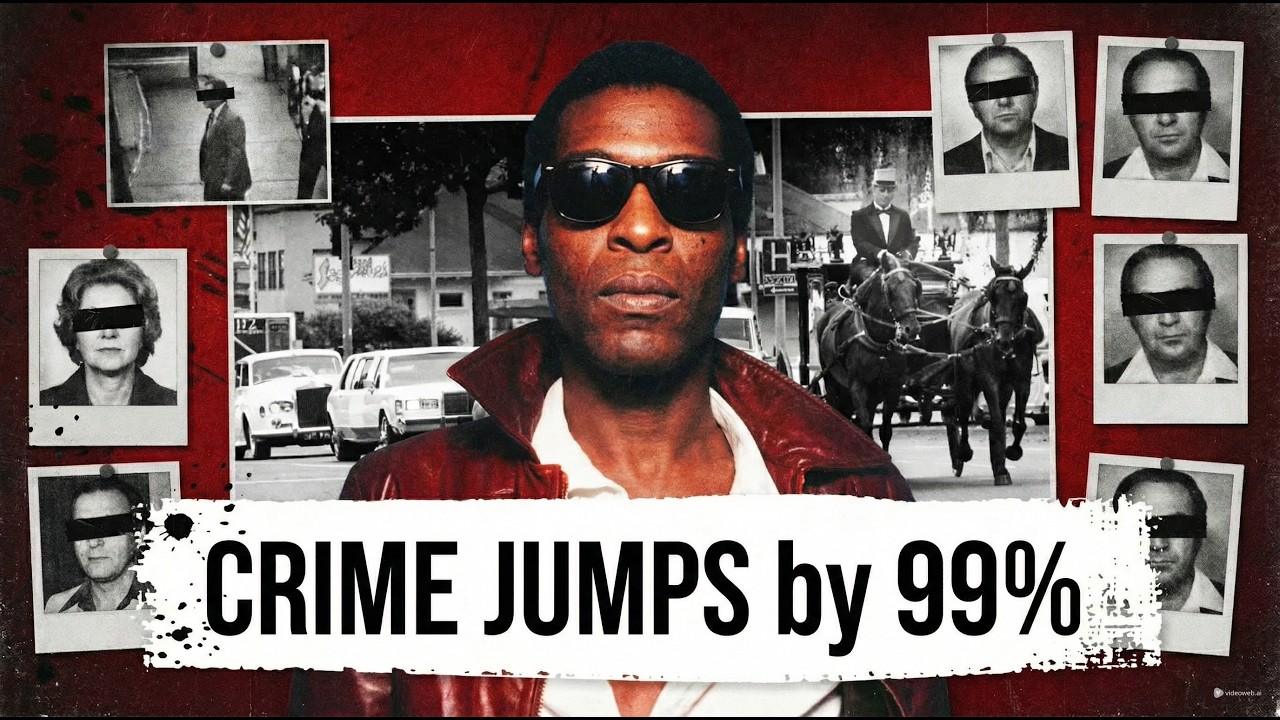
Newton was among the mourners. Bay Area radio host Jimmy Guy later said watching the procession felt like the death of Martin Luther King Jr. The funeral was for Felix Mitchell, a 31-year-old heroin dealer from the housing projects, and civic leaders were furious—but proper permits had been filed, so there was nothing anyone could do. Felix Wayne Mitchell Jr.
was born on August 23, 1954, in Oakland. He grew up in the 69th Avenue San Antonio Village housing projects, known to residents as 69 Ville, a cluster of low-rise buildings in East Oakland where buildings crumbled and jobs did not exist. The city invested in downtown and the hills while the flats got nothing, and Felix dropped out of high school with no diploma and no prospects. As a teenager, he began organizing the boys he had grown up with, calling the group “My Other Brother”—or MOB.
Through a Los Angeles kingpin named Tootie Reese, Felix built supply lines connecting the Bay Area to Los Angeles and Detroit. Criminologists would later credit him with creating the country’s first large-scale gang-controlled drug operation, predating the Crips, the Bloods, and the Gangster Disciples. The 69 Mob ran heroin through East Oakland like a corporation, with structure, hierarchy, and territory mapped block by block. The product was stamped with branding so customers knew they were getting 69 Mob heroin.
He also used children as young as 12 as delivery agents and lookouts, because they could not be prosecuted as adults. A BET documentary later described how his armed lieutenants and child lookouts helped make Oakland an outlaw culture. Yet Felix also gave candy and toys to neighborhood kids, donated to charities, sponsored youth athletic programs, opened swimming pools in poor neighborhoods, took busloads of children to Marine World, and distributed turkeys at Thanksgiving. He went to church.
He was destroying the community with one hand and building it with the other, and the community loved him for it because nobody else was doing anything at all. By the late 1970s, Felix was untouchable. On Saturday nights, processions of European sports cars rolled through the neglected streets around 69 Ville. At the center rode Felix in full-length fur coats, diamonds catching the street light, surrounded by lieutenants openly carrying assault rifles.
Nobody called the police. In 69 Ville, Felix Mitchell was the authority. Rapper Too Short later said, “Felix Mitchell was like Oakland’s leader, not its drug dealer, its leader. ” Estimates of his earnings ranged from $400,000 to $800,000 a week, but everyone agreed he had more money than anyone in Oakland, and he did not hide it.
He drove a different luxury car every day and threw lavish parties, understanding that fear keeps people in line but loyalty keeps them quiet. Felix’s nephew, Darryl Reed, was drawn to his uncle’s glamour—the jewelry, the clothes, the diamond-encrusted glasses frames. Felix treated him like a son, buying him expensive clothes and showing him what power looked like. Reed had once dreamed of being a baseball player, but that dream did not stand a chance growing up watching his uncle’s empire.
Felix’s dominance faced challenges from two main rivals: Harvey Whisenton, who ran a gang called Funktown USA, and Milton Moore, known as Mickey Mo, a former R&B singer who led a crew called The Family. For years the three organizations circled one another, with tensions simmering and territory shifting. In the first week of August 1980, three people connected to Moore’s Family gang were murdered: Vendisha Davis, Terry Hatter, and Charles Dorsey. On August 6, 1980, Ricky “the Rocket” Walker, his 18-year-old brother Roger, and their sister-in-law Sandy Adamson disappeared.
The next morning, a jogger found the three on a grassy slope near Skyline Boulevard. Roger Walker and Sandy Adamson had plastic bags pulled over their heads and died of asphyxiation. Ricky Walker had two bullet wounds to the back of his skull, execution-style. Six gangland murders in one week led police to call it Bloody August.
Federal witnesses later testified that members of Felix’s inner circle bragged about their involvement in the Walker and Adamson murders. Felix himself told an associate he had been on a trip to Los Angeles during the first week of August 1980—a convenient alibi that kept his hands clean. Felix also popularized the drive-by shooting, turning gangland murder into something done fast and impersonally from a moving car. The tactic spread from Oakland to cities across America.
Mickey Moore and the Family were eventually brought down in 1985, the same year Felix was arrested. Moore, the R&B singer who went to war with Oakland’s drug king, is now a preacher. By 1985, the FBI, the DEA, and the Oakland Police Department had spent years building a case with wiretaps, informants, and surveillance. Felix was arrested, tried, and convicted, and the judge sentenced him to life in prison at Leavenworth Federal Penitentiary.
Law enforcement celebrated, believing they had cut the head off the snake and that the heroin trade would collapse. They were catastrophically wrong. When police removed Felix Mitchell from Oakland, crime got worse—not a little worse, but catastrophically worse. The volume of drugs on the streets surged, heroin became cheaper and more accessible, more people got addicted, more people died, and violence exploded.
Without Felix controlling the market, smaller gangs rushed to fill the vacuum. They lacked his discipline and structure, but they had guns and ambition. Price wars broke out, followed by shooting wars. Criminologists gave this phenomenon a name: the Felix Mitchell Paradox.
The idea is that Felix had such monopoly power over Oakland’s drug market that he actually controlled the violence. He set stable prices, so there were no price wars. He policed smaller gangs, so there were no turf wars. He was the ceiling and the floor.
Remove him, and 20 small-time dealers flooded the same corners, undercutting one another. Cheaper heroin meant more customers, more addicts, more desperation, and more crime. Without Felix keeping smaller gangs in check, every block became contested and every corner became a battlefield. The police thought they were performing surgery to remove a tumor; instead, they performed an amputation with no plan for what came after.
The same principle has been documented in cities across America: take out the kingpin and the kingdom does not fall—it fractures into a hundred pieces. Felix did not live to see what happened to his city. On August 21, 1986, a little more than a year into his life sentence at Leavenworth, another inmate stabbed him to death. He was 31 years old, two days before his 32nd birthday.
The man who created the country’s first large-scale gang-controlled drug operation died violently, suddenly, with no warning and no escape—the same way many of his own victims had died. Eight days later came the funeral. The horse-drawn carriage, the 14 Rolls-Royces, the dollar sign flowers, 8,000 mourners, Huey P. Newton in the crowd, and international television coverage.
In 1987, Felix Mitchell’s criminal convictions were overturned by a federal judge on technicalities. It didn’t matter. He was already dead. His story continued through his nephew.
Darryl “Lil D” Reed had grown up watching his uncle’s cars, jewelry, and power. By the time Felix died, Reed was still in high school but already moving thousands of dollars of crack cocaine a day. By age 20, he had become the most powerful drug dealer in the Bay Area. He cleared $15,000 a day and bought exotic cars with paper bags full of cash.
In December 1988, he threw himself a $30,000 20th birthday party at the Golden Gate Fields Turf Club, attended by 3,000 guests, where MC Hammer performed and Reed danced with him on stage. Less than two weeks later, the DEA kicked in his door. Agents raided his Adams Point apartment and seized 30 pounds of crack cocaine and 16 pounds of powder cocaine, with a street value of $3 million—one of the largest drug seizures in Bay Area history. An undercover officer had been holed up in the apartment directly above Reed’s, listening to him cook cocaine.
Reed was sentenced to 35 years in federal prison on his first offense. When Reed went away, a second Oakland drug war erupted. Two of his former lieutenants, Timothy “Timmy Black” Luett and Anthony “The Ant” Flowers, turned on each other. Sixteen murders followed in less than three years.
Felix Mitchell’s empire had created a cycle that kept repeating: build, control, get arrested, power vacuum, war, bodies. In 2016, President Barack Obama commuted Darryl Reed’s sentence. The former crack king of Oakland walked free after 28 years and now runs a foundation in his name, mentoring at-risk youth and telling his story as a warning. Reed wrote from prison, “To anybody who thinks that I lived a great life, it was not worth decades of my freedom.
”
Felix Mitchell is immortalized in rap lyrics by Too Short and Yukmouth, profiled on BET’s American Gangster, and loosely inspired the movie New Jack City. His name still echoes through Oakland decades after his death. What separates his story from every other gangster tale is the paradox: every other gangster story ends with police catching the bad guy and the city being saved. Felix Mitchell’s story proves that sometimes the system is so broken that removing the villain doesn’t fix anything—it makes everything worse.
The problem wasn’t Felix Mitchell. The problem was a city so devastated by poverty, neglect, and institutional abandonment that a heroin dealer from the housing projects became its most important leader. His funeral procession wasn’t just a drug dealer’s send-off.
It was Oakland screaming: look at us, look at what we’ve been reduced to.