On July 4, 1946, an estimated crowd of more than 100,000 people gathered on Biskupia Górka hill overlooking Gdańsk, Poland, to witness the public executions of former guards from the Stutthof concentration camp, including several young women whose names have become synonymous with the brutality of the Nazi camp system.
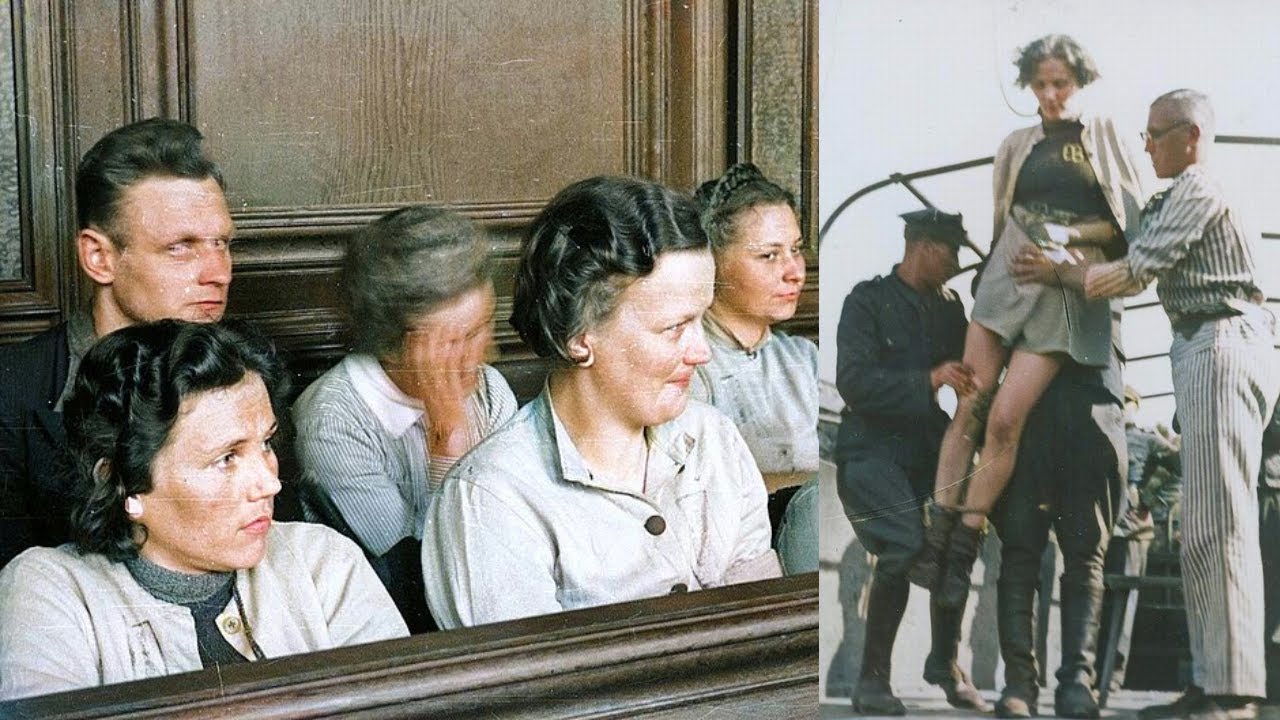
The condemned were hanged on massive wooden gallows constructed specifically for the occasion, their deaths marking the culmination of the first Stutthof trial, one of Poland’s most significant postwar reckonings with the crimes committed at the camp located near the Baltic coast.
Among those executed were women barely into their twenties, former guards who had been found guilty of crimes against humanity for their roles in the torture, starvation, and systematic murder of tens of thousands of prisoners.
Their names—Eva Paradies, Elizabeth Becker, Jenny Wanda Barkmann, Gerda Steinhoff, and Wanda Klaff—stand as a stark reminder that the machinery of genocide was not operated by men alone.
The Stutthof camp, established immediately after the German invasion of Poland in 1939, evolved from a holding site for Polish prisoners into a full concentration camp with gas chambers and crematoria by 1942.
Over its operation, approximately 65,000 people perished within its barbed-wire fences, victims of starvation, disease, forced labor, and deliberate extermination.
In 1944, as the war turned against Germany, the camp received massive transports of Jewish prisoners from Auschwitz and other sites, swelling its population to over 110,000 inmates.
To manage this influx, the SS recruited local German women from the Danzig region, offering them positions as overseers with authority over female prisoners.
Many of these women embraced their roles with enthusiasm, becoming notorious for their cruelty and sadism.
Eva Paradies, born in December 1920, arrived at Stutthof in August 1944 for training as an overseer.
Witnesses testified that she beat prisoners with whips and other weapons, and in one documented incident, she ordered a group of women to undress in freezing winter conditions before dousing them with ice-cold water and beating them when they moved.
She fled during a death march in early 1945 but was captured and brought to trial, where she was condemned to death at the age of 25.
Elizabeth Becker, born in July 1923, was indoctrinated through the League of German Girls, the compulsory Nazi youth organization for young women that boasted over 4.5 million members at its height.
She joined the camp staff in 1944 and became known for her participation in selections, the process by which the weakest prisoners were chosen for the gas chambers.

At her trial, Becker confessed to selecting at least 30 women to be killed, though she later appealed to the Polish president for clemency.
Her appeal was rejected, and she was executed at just 22 years old.
Jenny Wanda Barkmann, born in Hamburg in May 1922, had dreamed of becoming an actress or fashion model before answering an SS advertisement seeking camp guards in early 1944.
Assigned to Stutthof, she quickly earned the nickname “Mad Jenny” and “the Beautiful Specter” for her violent beatings and participation in selections.
She was arrested in May 1945 while attempting to board a train in Gdańsk and was sentenced to death after dozens of survivors testified against her.
At her trial, Barkmann showed no remorse, reportedly flirting with guards and concerning herself more with her appearance than the proceedings.
Her final recorded words were chilling: “Life is really a great pleasure, and pleasure as a rule does not last long.”
Gerda Steinhoff, born in January 1922 in Danzig, worked as a tram conductor before answering the SS call for guards in 1944.
She trained at Stutthof and became a block leader, eventually rising to the rank of senior overseer.
Despite serving for only about a year, she was implicated in selections and brutal beatings, earning a reputation as a sadist who assaulted prisoners on an hourly basis.
She was executed on the same gallows as Johann Pauls, the former commandant of Stutthof.
Wanda Klaff, born in March 1922 near Danzig, worked in a jam factory before marrying and becoming a streetcar operator.
 She answered the SS recruitment call in 1944 and was assigned to Stutthof’s subcamps, where she beat and whipped female prisoners.
At her trial, Klaff admitted her crimes with disturbing pride, stating: “I am very intelligent and very devoted to my work in the camps. I struck at least two prisoners each day.”
She was sentenced to death at the age of 24.
The executions on Biskupia Górka were carried out using the short-drop method, in which the condemned were made to stand on stools on the backs of trucks with nooses around their necks.
When the trucks drove away, the prisoners were left hanging, slowly strangling to death over several minutes.
The crowds, which included many survivors of the camp, watched in silence as the former guards were executed one by one.
Some reports indicate that as many as 200,000 people may have witnessed the proceedings, though more conservative estimates place the crowd at around 100,000.
The Stutthof trial itself was one of 16 trials held in Poland after the war to prosecute those responsible for atrocities at the camp.
In total, 11 former guards and staff members were executed on that July day in 1946, including both men and women.
The case of the female guards raises uncomfortable questions about how ordinary young women, many of them in their early twenties, became capable of such extreme cruelty.
Most had been members of the League of German Girls, where they were indoctrinated with Nazi ideology and trained for their roles in the Reich.
The organization emphasized loyalty to Hitler above family, encouraged physical training, and prepared girls for lives as wives and mothers in service of the Nazi state.
Some historians argue that these women were products of a system that systematically dehumanized both its victims and its perpetrators.

Others note that many of the guards came from working-class backgrounds and were drawn by the promise of steady employment, career advancement, and power over others.
Whatever their motivations, the courts that tried them found that they had made choices—choices to beat, to torture, to select, and to 𝓀𝒾𝓁𝓁.
The executions on Biskupia Górka served as a public reckoning, a visible demonstration that the perpetrators of genocide would be held accountable.
Yet the memory of these women and their crimes continues to disturb, a reminder that the Holocaust was not perpetrated by monsters alone but by ordinary people who chose to embrace evil.
Today, Biskupia Górka is a quiet hill overlooking the modern city of Gdańsk, with little to indicate the horrors that unfolded there.
But for the survivors who watched the executions, and for the families of the victims, the events of July 4, 1946, remain a dark chapter in a history that must never be forgotten.
The Stutthof camp itself was evacuated in early 1945 as Soviet forces advanced, with approximately 50,000 prisoners forced on death marches toward the sea.
Many were shot by SS guards as they entered the water, and an estimated 25,000 died during the evacuations.
The camp was liberated by Soviet forces on May 9, 1945, but for the tens of thousands who had already perished, liberation came too late.
The trials that followed sought to bring some measure of justice, but they could never undo the suffering inflicted within the camp’s barbed-wire fences.
The executions of the female guards of Stutthof remain one of the most striking examples of postwar justice, a moment when the young women who had embraced brutality faced the consequences of their actions.
Their deaths, witnessed by thousands, sent a clear message: those who participate in crimes against humanity will be held accountable, regardless of their age or gender.
As the world continues to grapple with the legacy of the Holocaust, the story of Stutthof and its guards serves as a solemn warning about the capacity for cruelty that exists within ordinary people and the importance of confronting that capacity wherever it emerges.