In the spring of 1945, the mark that had been meant to save a soldier's life became the thing that could destroy him. It was a small tattoo, the size of a fingernail, on the underside of the left arm near the armpit. It showed a blood group, applied so that a medic pulling an unconscious man from a burning vehicle would know what to pump into him.
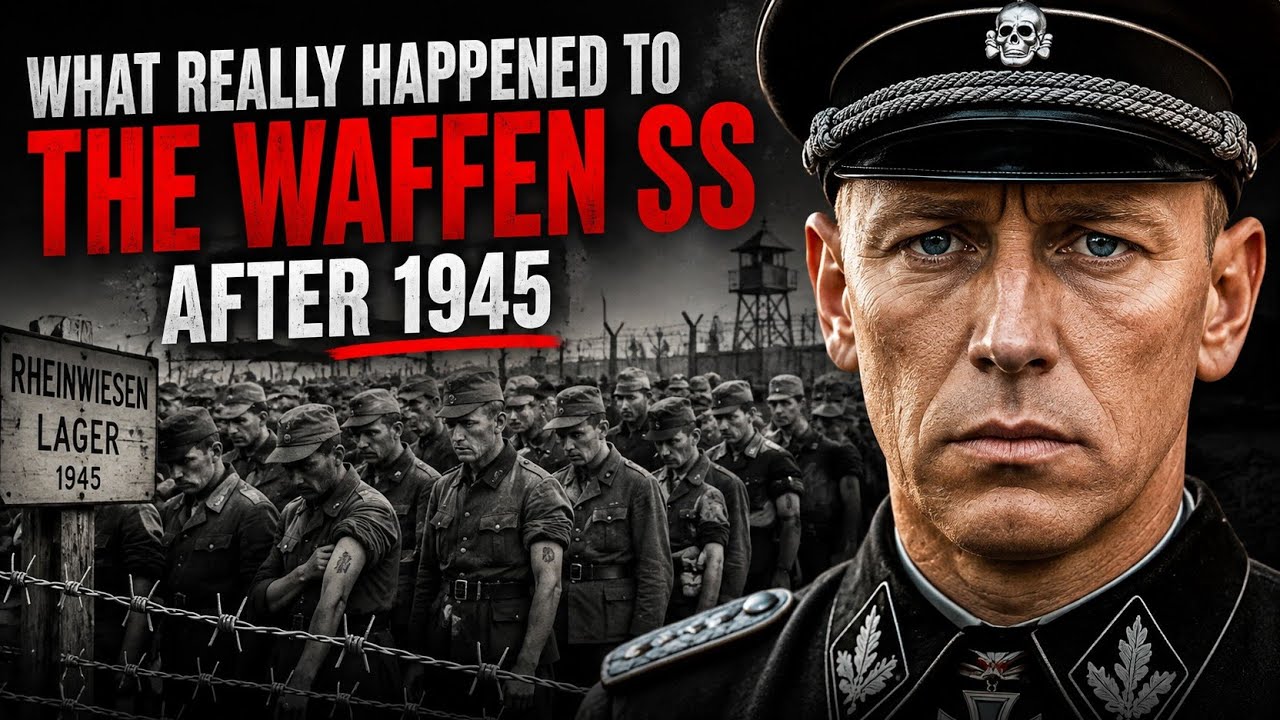
By the time Germany surrendered, Allied screening officers knew about it. The procedure became routine at collection points from Bavaria to the Baltic coast. Prisoners were lined up, arms raised, and anyone with ink under the arm was pulled into a separate pen.
Men tried to get rid of it. Some burned it off with cigarettes. Some cut it out with bayonets or razor blades and let the wound go septic in the heat. Some pressed a lit match to the skin and told interrogators it was shrapnel. There are accounts of men shooting themselves through the upper arm, gambling that a bullet wound would look more innocent than a scar shaped like a rectangle.
That is what the collapse of the Waffen SS actually looked like in May 1945. Not a last stand, but hundreds of thousands of exhausted men trying to become invisible.
At its peak, the organization had counted somewhere in the region of 900,000 men who passed through its ranks across the war. Volunteers, conscripts, teenagers, Germans, Dutchmen, Latvians, Frenchmen, Ukrainians, Bosnians, Norwegians. By the last winter of the war, it was less an elite than a bloated emergency reserve filled out with transferred Luftwaffe ground crew and boys born in 1927 who had never volunteered for anything.
Then Germany surrendered, and every one of them woke up as a member of an organization that was about to be put on trial as a whole.
The honest answer to what happened to them is that almost nothing people assume happened actually happened. There was no mass execution. There was no great vanishing into South America, whatever the paperback thrillers suggest. Most of them did not flee anywhere.
Most went home, found work, married, had children, drew pensions, voted, and died in bed in a country that had rebuilt itself around them and mostly agreed not to ask. But a small number did run. A smaller number were hanged. Some fought for decades to have their reputations restored and got further than you might expect. And the argument they started did not die with them.
The surrender itself was not one event. It was a scramble. By late April 1945, the surviving Waffen SS formations were spread across a shrinking map. The 6th SS Panzer Army was falling back through Austria. Elements of the Nordland Division were fighting inside Berlin alongside French volunteers of the Charlemagne Division who had nowhere left to go. Units in Courland were trapped against the Baltic. Others sat in Bohemia, in Hungary, in northern Italy.
Every one of their commanders understood the same thing. The direction you surrendered in mattered more than anything else you would decide in your life. Surrender to the Americans or the British and you would be hungry, humiliated, and processed. Surrender to the Soviets and you might not come back for a decade, if you came back at all.
So the last operational decision of many SS units was not tactical. It was a westward foot race. Sepp Dietrich, who had commanded Hitler's own bodyguard formation and by 1945 was running the 6th SS Panzer Army, drove his men west across Austria to hand himself to the Americans. Waffen SS troops in Bohemia tried to cross the demarcation line ahead of the Red Army. Some made it. Thousands did not and were handed straight over to the Soviets by American units with no interest in sheltering them.
The men who reached the western zones were funneled into a system that had never been designed for numbers like this. Along the Rhine, the Americans set up a chain of enclosures known as the Rheinwiesenlager, the Rhine meadow camps. There was very little in them. Wire, guards, mud, and an enormous number of human beings.
Prisoners dug holes in the ground to sleep in. Rations were thin and sometimes absent. Dysentery moved through the fields. Rain turned the whole thing into a swamp. Those camps have since become a favorite subject for people with an agenda who inflate the death toll into the hundreds of thousands to manufacture a moral equivalence. The serious research does not support that. But conditions were genuinely bad and men did die there. The experience left an entire generation of prisoners with a grievance they would nurse for the rest of their lives.
Screening was the next stage. Interrogators worked through the mass looking for particular categories: concentration camp personnel, security police, officers, anyone connected to units with known massacres attached to their name, and of course anyone with that tattoo.
Here the neatness of the categories started to break down, and it has never really been put back together since. The Waffen SS of 1945 was not the Waffen SS of 1939. In the beginning it had been small and fanatical and entirely voluntary, drawn from men who had to prove Aryan ancestry back through generations and who swore a personal oath to Hitler rather than to Germany.
By 1943, the manpower crisis had shredded all of that. Conscripts were being assigned directly into SS divisions with no choice in the matter. Ethnic Germans from Hungary and Romania were drafted wholesale. Boys of 17 were handed a paybook with the runes on it and told where to stand.
So when an American sergeant pulled a 19-year-old out of the line because of his tattoo, what exactly did the tattoo prove? That he was a believer, or that he had been unlucky about which office processed his call-up papers?
The Allies knew this was a problem. They had to answer it in a courtroom, and the courtroom was in Nuremberg. The International Military Tribunal is remembered for the men in the dock: Göring, Hess, Ribbentrop, Keitel, the surviving leadership of a state that no longer existed. But Nuremberg was doing something else at the same time that had far wider consequences for ordinary Germans, and it is barely remembered at all.
The prosecution asked the tribunal to declare entire organizations criminal. The logic was practical. There were millions of people implicated in the machinery of the Nazi state. You could not try them one at a time in front of an international bench. So instead the tribunal would rule on the organizations themselves, and national courts could then prosecute individuals on the basis of membership alone.
The SS was the most obvious target. The prosecution laid out how the organization ran the concentration camps, staffed the killing squads in the East, carried out reprisal massacres, and ran the machinery of the final solution.
The defense for the Waffen SS was argued by lawyers who had a specific line to sell: that the fighting formations were separate, that the men in the panzer divisions had nothing to do with the camps, that they were soldiers who happened to wear the wrong uniform.
The tribunal did not buy it. The judgment delivered at the end of September 1946 declared the SS a criminal organization and explicitly rejected the attempt to carve out the Waffen SS as innocent. The court pointed to the movement of personnel between camp guard units and field divisions, to atrocities committed by combat formations in France, Italy and the Soviet Union, and to the fact that the fighting units had been recruited and indoctrinated by the same organization that ran everything else. There was no wall between them.
But the tribunal did add limits, and those limits shaped the next 50 years. Criminal liability applied to those who had joined or remained knowing the organization was being used for criminal purposes, or who had personally taken part in crimes. Men who had been conscripted into the Waffen SS by the state and who had committed no offenses themselves were excluded.
That is the doorway hundreds of thousands of men walked through. The tribunal had drawn a line between the volunteer and the conscript, between the believer and the boy who got a letter. It was a reasonable and humane distinction. It was also almost impossible to police at scale, and it handed every defendant in Germany a script: I was drafted. I knew nothing. I was in Normandy, not in Poland. I never chose any of this.
Some of them were telling the truth. Many of them were not. And in the years that followed, the German legal system was in no condition to tell the difference.
What came next was denazification, and that is where the story gets ugly in a way that has nothing to do with the war and everything to do with paperwork. The Allies wanted German society purged of Nazis from the top down. The instrument was a questionnaire. The Americans called it the Fragebogen: 130-odd questions about your memberships, your ranks, your income, your relatives. Millions were filled in.
Then came the tribunals. The German-staffed Spruchkammern sorted people into five categories: major offenders, offenders, lesser offenders, followers, and exonerated. Penalties ran from imprisonment and confiscation of property down to a small fine and nothing else.
On paper it was thorough. In practice it collapsed under its own weight almost immediately. There were simply too many cases. Millions of files, a shortage of trained judges, and a bureaucracy that had to be staffed by Germans, many of whom had their own files.
The tribunals worked through the backlog by starting with the easy cases, which meant the small ones, which meant that low-level members were processed and cleared while the serious cases sat in the queue. By the time the serious cases came up, the political climate had changed and the appetite for punishment had drained away.
And then there was the trade in character references. Germans called them Persilscheine, after a laundry detergent. A Persil ticket. It was a letter from a neighbor, a priest, a former colleague, or ideally somebody the regime had persecuted, testifying that the bearer had really been a decent man all along, that he had protected a Jewish family, that he had complained privately about the party, that he had only joined for his career. They were traded, written in bulk, and in some cases openly sold. A man could arrive at his hearing with a folder of them and walk out classified as a follower.
For former Waffen SS men, outcomes varied enormously depending on rank and on where they had served. A 20-year-old rifleman from a division that had fought mostly on the Eastern Front against the Red Army was usually out within a year or two. An officer from a division with a documented massacre attached to it faced something much worse.
Because alongside denazification, the real trials were happening. Kurt Meyer was 34 years old when he was captured, and he had been the youngest divisional commander in the German Armed Forces. His division, the 12th SS Panzer Division, had been built around teenagers from the Hitler Youth and stiffened with veteran officers. In Normandy in June 1944, it had murdered Canadian prisoners of war at the Abbaye d'Ardenne and elsewhere, shot in the back of the head in a garden in ones and twos over several days.
The Canadians tried him at Aurich at the end of 1945. He was convicted of responsibility for the killings, sentenced to death, and then the sentence was commuted to life. He served part of it in Canada and then in a British prison in Germany, and he was released in 1954, nine years after his capture.
He walked out and immediately became one of the most prominent voices arguing that men like him had been ordinary soldiers wronged by history. He wrote a memoir. He toured veterans meetings. He died in 1961, and thousands attended his funeral. Nine years. That is the number to remember, because it repeats.
The Malmedy case was bigger and messier, and it poisoned everything it touched. In December 1944, during the opening days of the Ardennes Offensive, a battle group from the 1st SS Panzer Division under Joachim Peiper had shot down a group of American prisoners in a field near the Belgian town of Malmedy. Around 80 men died. Survivors played dead in the snow and crawled away, and the story reached the American press within days. It became the single most notorious atrocity committed against American troops in the Western theater.
The trial opened at Dachau in the summer of 1946, in the same complex that had been a concentration camp. Seventy-three defendants sat in the dock wearing numbered placards around their necks. The court convicted all of them. Forty-three were sentenced to death, including Peiper. Twenty-two got life.
None of the death sentences were ever carried out. What happened instead was an argument about how the confessions had been obtained. The American investigators had used mock trials, stool pigeons, hoods, isolation, and threats. Defense lawyers said prisoners had been beaten. A review commission was appointed. Then the US Senate got involved, and a young senator from Wisconsin named Joseph McCarthy seized on the case and turned it into a public spectacle about American misconduct.
By that point almost nobody was talking about the 80 men in the field. The sentences were reviewed, reduced, and reduced again. Peiper's death sentence became life. Sepp Dietrich, convicted in the same proceedings, was out by 1955. Peiper walked out of Landsberg prison in December 1956, 12 years after Malmedy.
He was not a marginal figure. He had been Himmler's personal adjutant before he took a combat command. He had seen how the machine worked from the inside at the very top, and he came out of prison at 41 years old in a country entering its economic boom and got a job.
That is the pattern across the whole period. Landsberg in Bavaria became the holding pen for the men convicted by American courts, and through the late 1940s the pressure to empty it grew steadily. German churches lobbied for clemency. German politicians made it a condition of cooperation.
In early 1951, the American High Commissioner in Germany, John J. McCloy, announced a sweeping review that cut sentences across the board and commuted most of the remaining death sentences. The reason was not that anyone had decided these men were innocent. The reason was the Cold War. Germany had gone from enemy to prize in about three years. The Soviets were in Berlin, the Korean War had started, and Washington wanted West Germany rearmed and inside the Western Alliance. You cannot ask a country to raise an army while you are hanging its soldiers. Something had to give, and what gave was the punishment.
France went through its own version of this, and it produced one of the most bitter episodes in French post-war memory. In June 1944, soldiers of the Das Reich division had entered the village of Oradour-sur-Glane in the Limousin, herded the population together, shot the men, and burned the women and children alive inside the church. 642 people died. France left the ruins standing exactly as they were as a permanent accusation.
The trial opened in Bordeaux in January 1953, and then it detonated because of who was in the dock. Of the 21 defendants, 14 were Alsatians. Alsace had been annexed by Germany in 1940, and its young men conscripted into German uniform, including into the Waffen SS. They called themselves the Malgré-nous, the against our will.
Alsace insisted they were victims who had been forced into a German uniform at gunpoint. Limousin insisted they had burned children alive and their paperwork was irrelevant. The country split along a geographic line. There were demonstrations in Strasbourg and demonstrations in Limoges. The government, terrified of losing Alsace politically, pushed an amnesty law through Parliament within days of the verdicts. The convicted Alsatians went home almost immediately. The people of Oradour were so disgusted that they refused the state's official commemorations for years and turned away government ministers who came to lay wreaths.
Italy had its own long reckoning. Walter Reder, an Austrian SS officer, had commanded troops during the reprisal killings around Marzabotto in the Apennines in the autumn of 1944, where hundreds of civilians were murdered in mountain villages. He was sentenced to life by an Italian military tribunal in 1951 and stayed in a cell in Gaeta for decades, becoming a long-running diplomatic irritant between Rome and Vienna. He was finally released in 1985 and flew home to Austria, where he was met at the airport by the Austrian defense minister. The handshake caused a scandal that helped bring the minister down.
Then there is what Italy did with the rest of the files, which is worse. In the 1990s, an investigator in Rome found a cupboard in a storeroom of the military prosecutor's office. It had been turned to face the wall. Inside were hundreds of dossiers on war crimes committed in Italy that had been opened after the war and then quietly shelved in the 1960s, filed away rather than prosecuted because putting Germans on trial in the middle of the Cold War was politically inconvenient. Journalists called it the cupboard of shame. Most of the suspects in those files were dead by the time anyone opened it.
So that accounts for the men who were caught, tried, and mostly released early. What about the ones who ran?
This is the part everyone thinks they know, and most of what they think they know comes from a novel. The idea of a vast, disciplined SS escape network with a name and a hierarchy moving fugitives out of Europe on a conveyor belt took hold in the public imagination largely because Frederick Forsyth wrote a bestseller about it in 1972. And Hollywood filmed it.

The reality was less organized and in some ways more damning, because the escapes did not need a secret army. They needed a sympathetic priest, a Red Cross travel document, and a government willing to look away.
Rome was the hub. A number of clergymen with strong anti-communist convictions and in some cases open sympathy for the fascist order helped fugitives obtain identity papers under false names. From there the route ran to Genoa, and from Genoa to Buenos Aires. Argentina under Juan Perón was actively recruiting. Perón wanted engineers, aviation designers, technicians, and men with military experience, and he was uninterested in what they had done before they arrived. Argentine officials worked in Europe to identify useful candidates and smooth their entry.
The best known Waffen SS man to take that route was Otto Skorzeny, and his career after 1945 is almost absurd. Skorzeny was the commando officer who had snatched Mussolini off a mountain in 1943 in a glider raid and who had led English-speaking Germans in captured American uniforms behind Allied lines during the Ardennes Offensive.
The Americans tried him at Dachau in 1947 for that operation and he was acquitted, partly because a British officer testified that the Allies had done comparable things. He was then held for denazification proceedings and in 1948 he simply walked out of the internment camp, reportedly with help from former comrades in borrowed military police uniforms.
He surfaced in Spain, where Franco had no intention of extraditing anyone. He set up as a businessman and an engineering consultant. He advised the Egyptian government on military matters. He became a fixer, an arms broker, a man with a network. There is credible reporting published decades later that in the 1960s he even did work for Israeli intelligence, which if true is one of the strangest turns in the whole post-war period. He died in Madrid in 1975 of cancer, having never spent a full year in prison for anything.
Léon Degrelle is the other name worth knowing, because he shows what the runners actually did with their freedom. Degrelle was Belgian, the leader of a fascist political movement before the war, who raised a volunteer unit that ended up incorporated into the Waffen SS, and who fought on the Eastern Front. He escaped in the final days by flying to Spain and crash landing on a beach in San Sebastián.
Belgium sentenced him to death in absentia and asked for him back. Franco said no. Spain said no again for the next 50 years. Degrelle lived openly in Spain until 1994. He gave interviews. He published books denying the Holocaust and praising Hitler in terms that would have been extreme in 1943. He became a kind of living monument for the international far right, receiving visitors and correspondents from admirers around the world. He was never punished for anything.
But it is worth being precise about scale here, because the escape story distorts the picture badly. The number of Waffen SS men who fled Europe was small. A few hundred of real significance set against several hundred thousand who stayed. The interesting question is not what happened to the ones who ran to Argentina. It is what happened to the enormous majority who did not run anywhere.
Soviet captivity was a different universe. Germans taken by the Red Army went into a network of camps that stretched from Ukraine to Kazakhstan to the Arctic. They worked. They rebuilt the cities their army had flattened, mined coal, cut timber, and died of malnutrition and typhus and cold in enormous numbers, particularly in the first two winters.
Waffen SS prisoners were treated worse than Wehrmacht prisoners, which is saying something. Many were tried by Soviet military tribunals and handed sentences of 25 years hard labor, often on the basis of unit membership rather than any specific proven act. Most German prisoners who survived were released in waves through the late 1940s and early 1950s, but several thousand convicted men were still being held in 1955, ten years after the war ended, and their families had no idea whether they were alive.
The breakthrough came in September 1955 when Chancellor Konrad Adenauer flew to Moscow to negotiate diplomatic relations with the Soviet Union. He came home having agreed a deal, and the deal included the release of the remaining prisoners. Around 10,000 men came back over the following months.
The homecoming was filmed, broadcast, and burned into West German memory. Trains arriving at Friedland, thin men in ragged coats, women holding photographs up at the windows asking whether anyone had seen this face. Nobody in those crowds was checking armpits for tattoos. In that moment they were all just German soldiers coming home, and the distinction the Nuremberg court had worked so hard to draw quietly stopped mattering to the public. That is one of the moments where the postwar rehabilitation of the Waffen SS really happened, not in a courtroom, but on a railway platform, in front of weeping families and newsreel cameras.
The foreign volunteers had a completely different set of problems, because they went home to countries that considered them traitors. Roughly half the Waffen SS by 1945 was not German at all. There were Dutch, Flemish, Walloon, Danish, Norwegian, French, Latvian, Estonian, Ukrainian, Hungarian, Croatian, Albanian, and Bosnian formations of wildly varying quality and motivation.
Some were true ideological volunteers. Some were anti-communists who thought Germany was the only army standing between their homeland and Stalin. Some were conscripted by occupation authorities and had no more choice than the Alsatians.
For the Western Europeans, punishment was often much harsher than anything a German faced. The Netherlands stripped tens of thousands of collaborators of citizenship and property and put them through mass trials. Norway prosecuted a huge proportion of its population for collaboration, including everyone who had served in German uniform. Belgium sentenced thousands and executed some. In France, the volunteers of the Charlemagne division, captured at the end of the war, received short shrift. A group of them, taken prisoner in Bavaria, were shot by Free French forces on the spot without trial. Being a Dutchman in an SS uniform in 1945 was, in practical terms, more dangerous than being a German in one.
But the Eastern European volunteers were a different case entirely, and their story is the one that has come back to haunt the present. Latvia and Estonia had been occupied by the Soviet Union in 1940, then by Germany in 1941, and the first Soviet year had involved mass deportations that left deep and lasting hatred. When Germany began raising legions in the Baltic states, it drew on that hatred and it also used straightforward conscription. Tens of thousands of Latvians and Estonians ended up in Waffen SS formations fighting the Red Army.
In 1945, those men could not go home. Home was Soviet again, and returning meant a camp in Siberia at best. So they stayed in Western Europe, in displaced persons camps in Germany, in a legal limbo with no country willing to claim them.
Then the Cold War rearranged everyone's priorities. In 1950, the American commission responsible for displaced persons ruled that the Baltic legions were to be considered separate in purpose and membership from the German SS and were therefore not hostile to the United States. That ruling opened the door. Baltic veterans emigrated in large numbers to the United States, Canada, Britain, Australia, and Sweden, where they built communities, founded veterans associations, and raised children who grew up hearing that their fathers had fought for national independence against Soviet occupation.
Something similar happened with the Ukrainians of the 14th Waffen Grenadier Division, the Galicia Division. Around 8,000 of them surrendered in Austria and ended up interned at Rimini in Italy. Poland wanted them for atrocities committed against Polish civilians. The Soviets wanted them as traitors. Britain took them instead, moved them to camps in England and Scotland in 1947, and most eventually settled in Britain or Canada.
Canada looked at the question again in the 1980s. A Royal Commission examined allegations that war criminals had been let into the country and concluded that membership of the Galicia Division alone was not grounds for prosecution and that the allegations against the unit as a whole had not been substantiated to a legal standard. Critics have been arguing about that finding ever since.
That brings us to a moment in September 2023 that made every one of these unresolved questions explode at once. The Canadian House of Commons was hosting President Zelensky of Ukraine. The Speaker of the House introduced a 98-year-old Ukrainian-Canadian constituent in the gallery as a veteran who had fought the Russians during the Second World War. The chamber stood and applauded twice.
Within 24 hours it emerged that the man, Yaroslav Hunka, had served in the Galicia Division, which is to say, in the Waffen SS. The Speaker resigned. The Prime Minister apologized. Poland raised extradition. Russian state media ran the footage on a loop for weeks because it handed them exactly the propaganda they wanted.
Almost 80 years after the surrender, a parliament in North America gave a Waffen SS veteran a standing ovation because nobody in the room had thought to check. And because the category "fought the Russians" and the category "fought in the SS" had been allowed to sit unexamined in the same sentence for three generations. That did not come out of nowhere. It came out of decisions made in the 1950s, and most of those decisions were made in West Germany.
Because the men who stayed did not stay quiet. By 1949 the Federal Republic existed, Adenauer was Chancellor, and the country had a problem it could not avoid. There were millions of former soldiers in it. They needed jobs, pensions, and above all they needed to be told that their lives had not been a crime. And there were enough of them to decide elections.

Then in 1950 the Korean War started, and Washington began seriously pushing for West German rearmament. That autumn, Adenauer convened a small group of former Wehrmacht officers at Himmerod Abbey in the Eifel to work out what a new German army would look like and what it would require. Their memorandum came back with military detail and one political demand that was not negotiable. Before Germans would put on a uniform again, the honor of the German soldier had to be publicly restored and the men still in Allied prisons had to be released.
They got most of what they asked for. In January 1951, the American General Dwight Eisenhower, about to take command of NATO, made a public statement drawing a distinction between Hitler and his criminal group on one side and the ordinary German soldier on the other. In December 1952, Adenauer told the Bundestag that the honor of those who had fought decently was not in question.
Both statements were carefully worded to cover the Wehrmacht. Neither covered the Waffen SS, and that gap is exactly where the most effective lobbying organization in post-war Germany went to work.
In 1951, former Waffen SS generals founded a mutual aid association for veterans of the organization. The name was deliberately dull: a mutual assistance society for former members. Everyone called it HIAG. Its founders were not cranks. Paul Hausser had commanded an army group. Felix Steiner had commanded a corps. Otto Kumm had led a division. These were articulate, well-connected men who understood German politics and understood the media, and they set out to do one thing above all others: erase the Nuremberg judgment in the public mind.
Their argument was compact and easy to repeat. The Waffen SS had been a fighting force. It had fought at the front against armed enemies like any other army. The camps were run by different people wearing similar insignia. The crimes belonged to Himmler's police apparatus, not to the Panzer divisions. "We were soldiers like any others." Hausser wrote that line into a book title, and it stuck. It is still the single most quoted sentence in the entire post-war defense of the organization, and it has been repeated by people who have no idea where it came from.
It was untrue in almost every particular. The field divisions had been folded into the same organization, the same personnel system, and the same ideological training as the camp guards. Men moved between the two. The Totenkopf division was literally built from concentration camp staff. Waffen SS units had carried out massacres of civilians in Poland, Ukraine, Belarus, Italy, and France, and had helped suppress the Warsaw Ghetto Uprising.
But the argument did not need to be true. It needed to be useful, and it was enormously useful to a great many people who wanted a version of the past they could live in.
HIAG built local branches across West Germany. It ran a publishing operation and a monthly magazine for members filled with unit histories, reunion notices, and articles rewriting the war as a purely military affair. It organized divisional reunions that drew thousands. It lobbied hard on the specific practical grievance that motivated its membership: pensions.
The West German war victims legislation of 1950 provided support for disabled veterans and war widows. Whether Waffen SS men were entitled to it was politically explosive, and the compromises worked out in the early 1950s were messy, with exclusions aimed at concentration camp personnel and at those convicted of crimes. But the general direction of travel through the decade was towards inclusion. Former Waffen SS men who had not been individually convicted increasingly drew the same state support as any other veteran.
At the same time, the new army was standing up. The Bundeswehr was founded in 1955 and it needed experienced men badly. Former Waffen SS officers applied. Vetting committees examined them. Senior ranks were largely refused and Allied advisers pushed back against anything that looked like continuity with the old organization. A minority got in, mostly at junior and middle levels, and mostly on the understanding that they would never mention it.
And below all this political activity, the ordinary reintegration just happened quietly, the way these things always do. Men went back to farms and factories. They joined the police and the fire service. They ran shops and construction firms. They used their old networks to find work, because a comrade with a business will hire a comrade. The economic miracle absorbed them because it needed hands and did not ask many questions.
Joachim Peiper went to work for Porsche after his release and later for Volkswagen. He was pushed out when his past became public and the unions objected. He tried other jobs and hit the same wall each time. Eventually he moved to a village in eastern France called Traves, translated military books for a living, and kept to himself. In 1976, a French communist newspaper identified him. There were leaflets. There were threats. On the night of the 14th of July, Bastille Day, his house burned down with him inside it. The killers were never identified.
Peiper was responsible for atrocities and had escaped meaningful punishment for them, and he was also burned alive in his home by people who appointed themselves as judges. Both things are true. That is roughly the shape of this entire subject.
HIAG's decline took longer than it should have. Through the 1960s it was still being courted by mainstream politicians who wanted veteran votes. The turn came with the generation that grew up in the 1960s and started demanding answers from their parents. Investigative journalists went after the organization's political connections. Historians dismantled the clean soldier claim with archival evidence. Domestic intelligence services began listing it as a right-wing extremist body. Its tax privileges were withdrawn. Politicians who had once addressed its rallies stopped returning calls.
The national organization dissolved in 1992. Local circles and the magazine outlived it, kept alive by aging men and by younger admirers who were not veterans of anything.
But there was one more moment when the old argument won, and it happened in front of the entire world. In May 1985, for the 40th anniversary of the end of the war, Chancellor Helmut Kohl invited President Ronald Reagan to a gesture of reconciliation: the two leaders laying a wreath together at a German military cemetery at Bitburg.
Then someone checked the graves. Among the roughly 2,000 burials were around 49 Waffen SS men, some of them from the division that had committed the Malmedy killings. The reaction in the United States was ferocious. Veterans organizations objected. Congress objected. Elie Wiesel, receiving a medal from Reagan at the White House days before the trip, told him to his face that the cemetery was not his place, that his place was with the victims.
Reagan went anyway because canceling would have humiliated Kohl. He added a visit to the Bergen-Belsen campsite to balance it. He stayed at Bitburg for about eight minutes. Eight minutes, 40 years after the war. And the argument that HIAG had been making since 1951 was standing there in the photographs. These are just soldiers' graves, and a soldier is a soldier.
After 1989, the ground shifted again. Soviet and East German archives opened. Researchers could finally trace unit movements, order chains, and personnel transfers in detail. And what they found demolished whatever remained of the clean hands story. Historians documented how thoroughly the fighting divisions had been integrated into the wider apparatus of occupation and mass murder. A traveling exhibition in the mid-1990s about crimes committed by the regular German army caused enormous public rows in Germany, precisely because it removed the last comfortable partition people had been using.
Then in 2006 came the revelation that landed hardest of all. Günter Grass was the moral conscience of post-war German literature, a Nobel laureate who had spent decades telling his countrymen to face their history honestly. That summer, promoting his memoir, he disclosed that at 17 he had served in the Waffen SS in a Panzer division in the last months of the war. He had never said so publicly in 60 years.
The reaction split between fury at the hypocrisy and something more uncomfortable, because Grass was the perfect illustration of the problem. A boy drafted late who did nothing criminal, who carried the mark for the rest of his life, and could not bring himself to speak about it even while lecturing everyone else about honesty. If that was true of him, it was true of tens of thousands of others.
The Waffen SS did not disappear in 1945. It dissolved into ordinary life, which is a different thing entirely. Its members went into factories and offices and pension queues. A few went to Spain and Argentina. Several thousand died in Soviet camps. A handful were hanged, and a great many more were sentenced to death and then quietly released within a decade.
Their veterans built an organization that argued for 40 years that the verdict at Nuremberg had been a mistake, and although that organization is gone, its central slogan is still in circulation, still being repeated by people who could not name a single division.
Every 16th March, a march winds through Riga to honor the Latvian legionaries, and every year it produces protests and diplomatic complaints and a genuinely difficult argument about occupation, coercion and national memory that nobody has ever settled. In 2023, a parliament in Ottawa applauded a Waffen SS veteran on its feet because the vocabulary had never been sorted out.
The last of them are gone now, or almost. The youngest conscripts of 1945 would be approaching a hundred. What outlived them is the argument, and the argument turned out to be the durable part. They lost the war in a few months. The fight over what the war had meant and what they had been took another 50 years, and some of it is still open.
A regime can be defeated completely, its cities flattened, its leaders hanged, its records seized, and the story it told about itself can still survive, because stories do not need an army. They only need people who would rather believe them.