A woman of the Tudor era was executed by a method so rare and so brutal that it has survived in historical memory as one of the most horrifying judicial killings ever carried out on English soil. She was pressed to death beneath the weight of her own door, a punishment reserved for those who refused to enter a plea before the court. The case has reemerged in public attention after a widely circulated video transcript referenced the execution, drawing fresh scrutiny to a practice that legal historians describe as state-sanctioned torture by design.
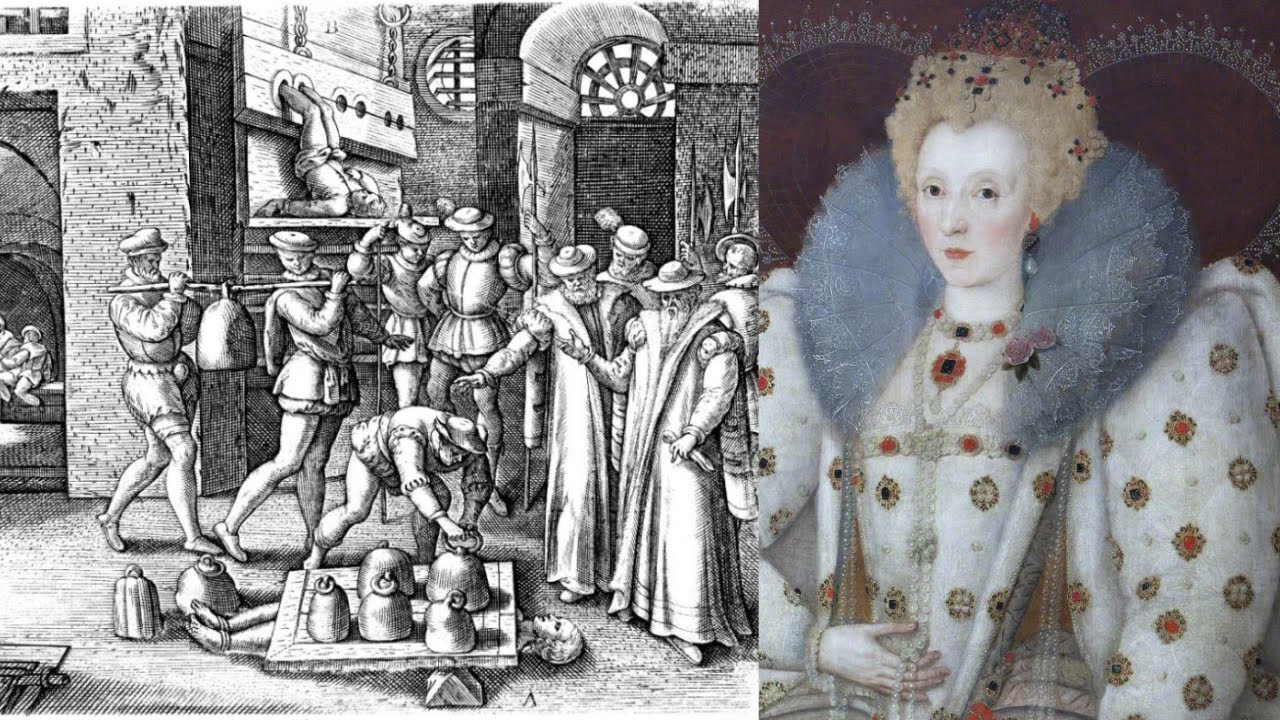
The victim, identified in surviving records as a woman of modest standing who became entangled in the machinery of Tudor justice, was subjected to the ancient penalty known as peine forte et dure. The procedure required that the accused be laid upon the ground, often naked or near-naked, with a board or door placed across the body. Stones or iron weights were then piled upon the board, one after another, until the prisoner either agreed to plead or died under the crushing load.
What distinguishes this case is the detail that has seized the imagination of researchers and the public alike: the door itself. According to accounts preserved in local tradition and referenced in the transcript, the woman was pinned beneath the very door of her own home, a domestic object transformed into an instrument of death. Historians say the choice was not accidental.
Doors were readily available, heavy, and symbolically potent, representing the threshold between the private world of the household and the public authority of the law.
The Tudor period, spanning roughly from 1485 to 1603, was an era of extraordinary political and religious upheaval. Monarchs including Henry VIII, Edward VI, Mary I, and Elizabeth I used the courts as instruments of control, and the legal system reflected the harshness of the age. Treason, heresy, and rebellion were prosecuted with severity, and executions were public spectacles intended to deter dissent.
Yet even within this landscape of routine capital punishment, the practice of pressing stood apart for its slow, deliberate cruelty.
Legal scholars explain that peine forte et dure was not technically a sentence but a mechanism for compelling a defendant to enter a plea. Under medieval and early modern English law, a person who refused to plead could not be tried, and without a trial, the crown could not seize the accused’s property. For some prisoners, refusing to plead was a calculated act of defiance, a way to protect their families from forfeiture of land and goods.
The penalty was the state’s answer: if you will not speak, you will be made to speak, or you will die in silence.
The woman at the center of this case is said to have endured the weight for an extended period before succumbing. Accounts differ on the exact duration, with some sources suggesting she remained conscious for hours as additional stones were placed upon the door. Witnesses, according to the transcript, described her cries and the gradual compression of her body.
The executioners were reportedly instructed to increase the load gradually, a detail that underscores the punitive intent behind the procedure.

Contemporary observers of Tudor justice often recorded such events in letters, diaries, and court rolls. These documents, many of which survive in archives across England, provide fragmentary but vivid glimpses into the final moments of those condemned under peine forte et dure. The woman’s name appears in some records but is rendered inconsistently, a common problem for historians working with early modern manuscripts where spelling was not standardized and the poor were often identified only by parish or occupation.
What is clear from the available evidence is that she was not a figure of noble birth. She was, by most accounts, an ordinary woman whose life intersected with the law in a way that sealed her fate. Whether she was accused of theft, witchcraft, or another offense remains a matter of debate among researchers.
Some interpretations suggest she may have been involved in a dispute over property, while others point to the religious tensions of the era as a possible context for her prosecution.
The use of a door as the pressing board has drawn particular interest from historians of material culture. In Tudor England, doors were substantial objects, often made of heavy oak and reinforced with iron. They were also deeply symbolic, marking the boundary of the home and the family.
To be crushed beneath one’s own door was, in the view of some scholars, a deliberate inversion of domestic order, a message that the state could penetrate even the most private spaces.
The video transcript that brought renewed attention to the case is chaotic and heavily garbled, mixing references to modern brands, online platforms, and unrelated topics with fragments about the execution. Despite the noise, the core narrative of a Tudor woman pressed by her own door has resonated with audiences, sparking discussions on social media about the history of capital punishment and the treatment of women in the legal system.
Experts caution against treating the transcript as a reliable historical source. It appears to be an automated or poorly transcribed recording, with words and phrases jumbled together in ways that obscure meaning. Nevertheless, the underlying story aligns with documented practices of the Tudor era, and the detail of the door has been corroborated by at least some local traditions and antiquarian writings.
The broader history of peine forte et dure is well established. It was used in England from the medieval period until the eighteenth century, when it was gradually replaced by other procedures. One of the most famous cases involved Giles Corey, an accused witch in colonial Massachusetts, who was pressed to death in 1692 after refusing to plead.
 Corey’s defiance became a symbol of resistance against unjust authority, and his last words, reportedly “more weight,” have echoed through American history.
In England, the practice was formally abolished by the Parliament of England in 1772, though it had fallen into disuse before then. The reform was part of a broader movement toward more humane legal procedures, influenced by Enlightenment thinkers who criticized torture and arbitrary punishment. By the nineteenth century, pressing had become a relic of a darker age, remembered mainly in legal textbooks and popular histories.
For the Tudor woman whose life ended beneath her own door, the historical record offers little comfort. Her death was not recorded in the grand chronicles of the age, and her name is not among those celebrated in monuments or memorials. She exists instead in the margins of court documents and in the collective memory of a period known for its brutality as much as its cultural achievements.
Historians who study gender and justice in early modern England note that women were particularly vulnerable to harsh punishments. Accusations of witchcraft, infanticide, and moral offenses often fell disproportionately on women, especially those who were poor, widowed, or otherwise outside the protection of male relatives. The woman pressed by her own door may have been targeted for reasons that had as much to do with her social position as with any alleged crime.
The transcript’s references to modern culture, including mentions of social media, fashion, and online platforms, create a jarring contrast with the historical subject matter. This juxtaposition has led some commentators to question whether the story is being exploited for entertainment rather than understood as a serious historical event. Others argue that any attention to the past, however imperfect, can spark curiosity and learning.
Museums and heritage sites in England have increasingly sought to address the darker aspects of Tudor history, including executions and torture. Exhibits at places such as the Tower of London and various local museums now include information about peine forte et dure and other forms of judicial violence. Curators say the goal is not to sensationalize but to help visitors understand the realities of a legal system that we would now consider barbaric.

Legal historians also point out that the principle behind peine forte et dure, the idea that the state can compel a person to speak or suffer the consequences, has echoes in modern debates about interrogation, detention, and the rights of the accused. While pressing has long been abolished, questions about coercion and due process remain central to contemporary discussions of justice.
The woman’s story, as fragmented as it is, serves as a reminder that history is not only made by kings and queens but also by ordinary people caught in extraordinary circumstances. Her death beneath a door, a household object turned instrument of state power, is a stark illustration of how the law can reach into the most intimate corners of life.
Researchers continue to examine archival records for more details about her case. Some hope to identify her name, her parish, and the specific charges she faced. Others are focused on the broader context of Tudor justice, including the role of local officials, the influence of religious authorities, and the ways in which communities responded to executions in their midst.
For now, the image of the Tudor woman pressed by her own door endures as a powerful and disturbing symbol. It speaks to the fragility of life in an age of arbitrary power, and to the capacity of human beings to inflict suffering in the name of order. As the transcript circulates and new audiences encounter the story, historians urge a careful and compassionate approach, one that honors the memory of a woman whose voice was silenced centuries ago.
The case also highlights the importance of accurate historical communication. In an era of rapid information sharing, stories can be distorted, stripped of context, or reduced to shock value. Scholars emphasize the need to ground such narratives in evidence and to treat the victims of past violence with dignity, not as curiosities.
Ultimately, the execution of the Tudor woman pressed by her own door is a chapter in a larger story about power, resistance, and the human cost of justice. It is a story that continues to be told, retold, and debated, reminding us that the past is never truly past and that the lessons of history remain urgently relevant.