Millicent Veronica Wilson was born on July 16, 1882, in New York City. Her father, George Wilson, was a vaudeville performer of moderate success. Her mother was Hannah Murray Wilson.
There was no fortune behind the name and no social position waiting to be claimed. Millicent and her sister Anita performed on stage as teenagers, working as dancers and chorus girls in Broadway productions.
It was honest work, and it was public work. Polite New York regarded the commercial stage with a mixture of fascination and condescension.
William Randolph Hearst first saw her in 1896. He was 33 years old, already wealthy, and already a major newspaper publisher. She was 16.
The age gap told one story. The class gap told another. He was the son of a senator and a philanthropist, educated at St. Paul's before being expelled from Harvard. She was the daughter of a vaudevillian, earning her living in the chorus line of a New York show.
The seven-year courtship that followed, from 1896 to 1903, suggested the negotiation was at least as complex as the feeling. The principal obstacle was his mother, Phoebe Apperson Hearst.
Phoebe had spent three decades converting mining money into cultural respectability. She looked at Millicent Wilson and saw the undoing of her life's work. A chorus girl did not fit the design of a dynasty in which Hearst women dignified Hearst money.
William married her anyway, on April 28, 1903, in New York. He was 40. She was 20 or 21.
The children came quickly. George Randolph Hearst was born in 1904. William Randolph Hearst Jr. followed in 1908. John Randolph Hearst arrived after that. Then in 1915 came the twins, Randolph Apperson Hearst and David Whitmire Hearst.
Five sons in 11 years. A dynasty needs heirs, and Millicent had provided them. Phoebe's resistance dissolved inside the arrival of grandchildren.
From the moment those boys existed, Millicent's value to the Hearst structure became non-negotiable. She was not merely a wife. She was the mother of continuity.
That fact — that her security was rooted not in love but in succession — would prove to be the most consequential reality of her entire life. It was the reason she could never be fully discarded even after she was no longer desired.
The Hearst fortune began underground. George Hearst, William's father, was a Missouri-born prospector who made his wealth in western mining. He held stakes in the Homestake Mine in South Dakota, the Ophir in Nevada, and the Anaconda in Montana.
He served as a United States senator and acquired ranch land across California and into Mexico. When he died in 1891, he left behind an estate valued at roughly 18 to 19 million dollars.
His widow directed it with extraordinary care. Phoebe Apperson Hearst was 20 years younger than her husband, a schoolteacher from Missouri who had married him at 19. She traveled Europe with her son, collected art and antiquities, endowed buildings at the University of California, and funded kindergartens, libraries, and archaeological expeditions.
Her real legacy was atmospheric. She established the principle that would govern the Hearst dynasty for generations: men made the money, women made it mean something.
William Randolph Hearst was born on April 29, 1863, in San Francisco. His mother showed him Europe at the age of 10. His father gave him something different — scale, and the conviction that if something existed, it could be acquired.
He was expelled from Harvard in 1885 for a prank involving chamber pots personalized with his professors' names. Two years later, at 23, he talked his father into giving him the San Francisco Examiner, a failing newspaper George had acquired as a political instrument.
William turned it profitable within two years through a formula of sensation, illustration, crusading headlines, and a willingness to spend money to make stories rather than merely report them. By 1895, he had bought the New York Morning Journal. By the turn of the century, he owned papers in New York, San Francisco, Chicago, and beyond.
By 1902, he was in Congress. By 1906, he was running for governor of New York and losing. The loss did not slow him. He simply bought more.
At his peak, by his own organization's accounting, nearly one in four Americans received the news from a Hearst publication. Twenty-eight newspapers, 13 magazines, a wire service, radio stations, a film studio, and a real estate portfolio that stretched from Manhattan to a million-acre ranch in Mexico.
This was not wealth in the conventional sense. This was narrative power — the ability to decide what the country saw, what it feared, what it celebrated, and what it chose to ignore.
But the stage was always more expensive than the receipts could cover. Winston Churchill, visiting San Simeon in the autumn of 1929, noted in his private letters not only the grandeur of the estate but the harassed figure of a finance man perpetually scrambling to find money to cover the next wave of purchases and building projects.
William collected art compulsively, without limit and often without immediate means of payment. He bought a castle in Wales. He imported monastery ceilings from Spain. He filled warehouses with tapestries and sculptures and crated antiquities that sat unpacked for years because there was no room left to display them.
By 1938, Time reported that he was liquidating at least two-thirds of an art collection valued at 15 million dollars, a disposal driven by the need to settle debts and reduce the inheritance tax burden that would one day fall on his sons.
The dynasty's operating principle was magnificence. Its operating condition was strain.
In the early years of the marriage, the Hearst household in New York was a hub of influence. Editors, politicians, society figures, and foreign correspondents understood that access to William Randolph Hearst was access to the machinery of American public opinion.
Millicent presided over that world with a competence that surprised people who remembered her origins. She studied the world she had married into and learned its codes faster than that world expected.
The family also spent time at the San Simeon Ranch before the castle existed, camping on Camp Hill and riding the land George Hearst had first purchased in 1865 — nearly 100,000 acres of California coastal range. Millicent was present for the earliest conversations about what to build on that hilltop.
When construction began in earnest after Phoebe's death in 1919, she contributed design suggestions that William relayed to his architect, Julia Morgan. She was not decorative in those years. She was participatory.
Morgan was one of the first women to be licensed as an architect in California. William enlisted her in 1919 to turn his boyhood hilltop into something permanent. Their collaboration would run for 28 years.
Morgan designed Casa Grande, the three guest houses, the Neptune Pool, the Roman Pool, the gardens and terraces, and the carefully engineered approaches to the hilltop. She was the professional witness to the family's transformation — the woman building a monument to one man's desire while the wife who had helped conceive it was gradually disappearing from its rooms.
Millicent's own visibility grew alongside the empire. She chaired the mayor's committee of women on national defense under Mayor John Hylan in New York. She raised funds for France, for French orphans, and for wartime relief organizations.
She was recognized not as Mrs. Hearst, the society wife, but as Mrs. Hearst, the public servant. In 1921, she established the Free Milk Fund for Babies, a charitable organization that would become her most enduring public cause and eventually her most durable shield.
During the Depression, she worked alongside Eleanor Roosevelt at charitable events in New York, distributing milk and coal and relief to families who could not feed their children. She was operating in the orbit of the first lady, not in the shadow of her husband's mistress.
The Free Milk Fund was not vanity charity. It was structure — the kind of institutional work that survives personal crisis because it has its own momentum, its own board, its own public meaning.
She was learning to convert a name into authority, to perform usefulness so consistently and so publicly that the world would continue to take her seriously regardless of what happened inside her marriage.
That education was happening just in time. By the late 1910s, William Randolph Hearst had already begun constructing another world, one that had no room for Millicent in it.
Marion Cecilia Douras was born in Brooklyn on January 3, 1897. Like Millicent, she came from a family without social standing. Like Millicent, she was performing on stage as a young woman. And like Millicent, she was seen by William Randolph Hearst while she stood in front of an audience.
Hearst saw Marion in the Ziegfeld Follies around 1917. She was 20. He was 54. The age gap was almost identical to the one that had separated him from Millicent two decades earlier.
By 1918, he was financing her film career through Cosmopolitan Productions, the studio he had created to produce motion pictures. Initially based in New York, Marion appeared in costume dramas and period pieces, many of them lavish, many promoted aggressively through Hearst's own newspapers.
By the early 1920s, the operation had moved west to California, and Marion with it. She was not a passing infatuation. She was a project, a companion, a household, and eventually the emotional and social center of San Simeon itself.
She was, by every account, a gifted comedian and a genuinely warm human being. People who knew her described a woman of quick wit, personal generosity, and a kind of unfussy charm that put even intimidated guests at ease.
She was also an investor shrewd enough to avoid the debt that consumed Hearst himself, and loyal enough to hand him one million dollars of her own money in the late 1930s, when his empire teetered on the edge of collapse.
As Julia Morgan continued to build, and the hilltop complex grew into the most famous private residence in America, Marion was becoming the presiding feminine presence of that world. She greeted the guests. She organized the evenings. She sat beside Hearst at the long dining table while Hollywood actors, politicians, visiting dignitaries, and European writers passed through for weekends that felt like appearances at a private court.
The guest lists told the scale of the thing: Charlie Chaplin, Greta Garbo, Winston Churchill, Calvin Coolidge, Charles Lindbergh, George Bernard Shaw. People who came because Hearst was powerful and who stayed because Marion made it pleasurable.
Millicent, 3,000 miles away in New York, was watching the arrangement harden into something that could no longer be described as an affair. It was becoming an institution — a second household with its own rules, its own guest lists, its own architecture of intimacy and obligation.
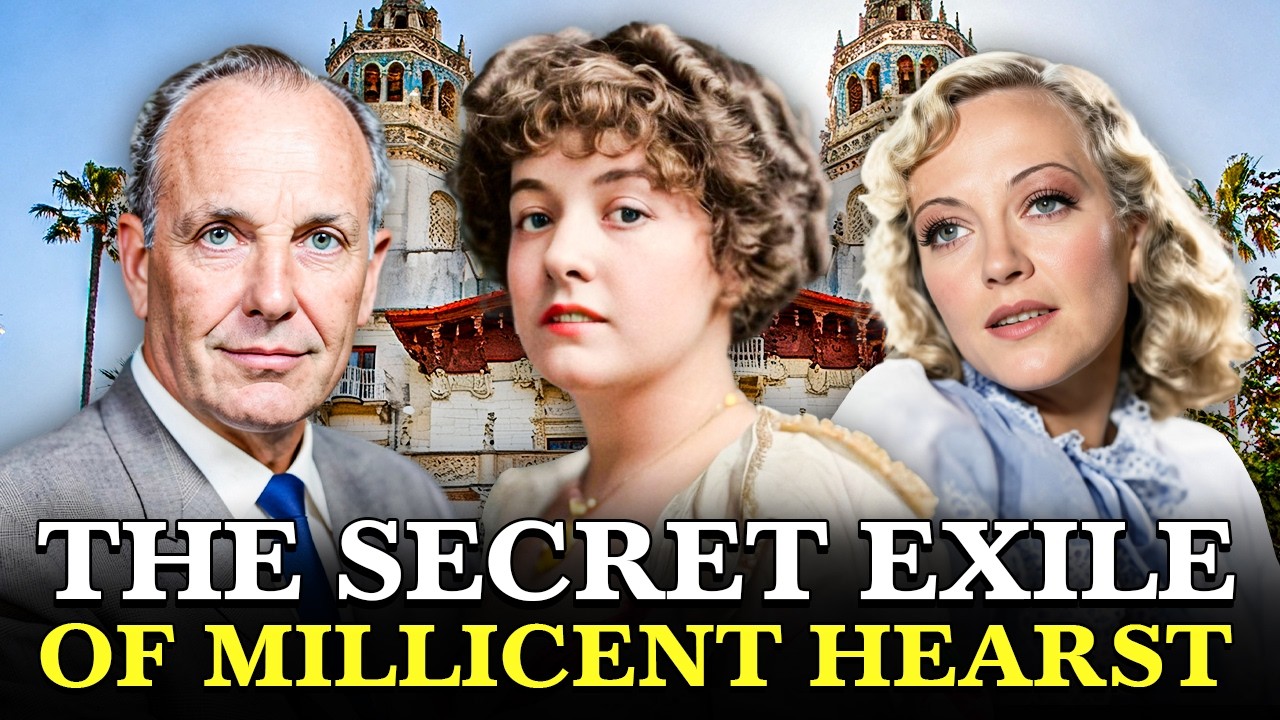
The estrangement came in 1926. That is the date given by Hearst Castle's own institutional history, and it is described with a single devastating word: intolerable. The increasingly open liaison with Marion Davies had become intolerable.
Millicent had known about Marion for years. She had watched the films promoted, the houses established, the California weekends proliferate. What changed in 1926 was not the information. What changed was the conclusion she drew from it.
She did not file for divorce. She did not stage a public confrontation. She did not sell her story to a rival newspaper, though any editor in the country would have paid for it.
What she did was quieter and in its way more devastating. She established a separate residence in New York. She drew a geographical line. She remained Mrs. William Randolph Hearst in law, in public address, in social standing, and in every directory and committee listing that mattered.
The marriage became a title maintained by mutual agreement for reasons that had nothing to do with affection and everything to do with structure.
That decision to separate without divorcing was not weakness. It was strategy. A divorce in 1926 would have produced a settlement, but it would also have produced a scandal of national proportions.
The sons, ranging in age from 11 to 22, would have been forced into public positions of loyalty. The business empire, which depended in part on the family's image of stability, would have absorbed a blow from which public confidence might not have recovered.
And Millicent herself would have lost the one asset that no settlement could replace: the name. As long as she was Mrs. William Randolph Hearst, she was the dynasty's official representative in New York. As a divorcée, she would have been a former wife — sympathized with, perhaps, but no longer sovereign.
She chose sovereignty. William could live with Marion. He could host the world at San Simeon. He could build his California kingdom of film and fantasy and imported antiquity. But he could not erase Millicent from the official record. He could not remarry. He could not present Marion as anything other than what the world already understood her to be.
The legal wife held the east. The companion held the west. And the empire, which had always depended on the fiction that one man could command everything, now had to operate across a divided map.
There was no formal announcement. There were no court proceedings. The marriage simply reorganized itself around absence. Holidays were negotiated. Visits were arranged. The sons moved between residences like diplomats, shuttling between capitals, carrying affection in one direction and obligation in the other.
By several accounts, all five sons sided with their mother emotionally. They understood what had been done to her. And yet their livelihoods were indexed to their father.
George, the eldest, was already inside the Hearst business by the late 1920s. He was 22 when the estrangement formalized, old enough to understand its full dimensions. He could not denounce his father without imperiling his career. He could not abandon his mother without betraying the woman who had raised him. He stayed, he worked, he said little.
William Jr., 18 in 1926, was developing his own voice as a journalist. Before all of that, he was a young man watching his family split in two and learning that some truths are acknowledged by everyone and spoken about by no one.
John, the quietest of the brothers, was navigating his own path into adulthood with less public visibility. The twins, Randolph and David, were 11 years old in 1926. They did not choose sides because children do not choose sides. They simply lived inside the world their parents created.
What all five shared was the experience of operating across the family's two kingdoms. They visited their mother in New York. They visited their father in California. That oscillation was not merely geographical. It was moral.
In New York, Millicent's circle understood and respected her position. She was not pitied. She was admired in the particular way that women of her era admired other women who absorbed injury without visible collapse.
Her philanthropic work intensified after the separation. The Free Milk Fund grew. Her committee work expanded. She became, in the language of New York civic life, indispensable.
If San Simeon was the kingdom of spectacle, then Millicent's New York was the kingdom of respectability. Her world was committees and fundraisers, Catholic charities and civic boards — the sober architecture of a city that valued usefulness over enchantment.
In California, Marion Davies was not regarded as a homewrecker by the Hollywood world that orbited San Simeon. She was regarded as a hostess, a companion, a woman whose relationship with Hearst was understood by everyone present and judged by almost no one, at least not to her face.
The most revealing witness to the arrangement appeared in September 1929, when Winston Churchill visited San Simeon during an American tour. He was not yet prime minister. He was between offices, traveling with his son Randolph.
He made the long drive up the coast. He saw the exotic animals grazing on the hillsides as the road climbed — zebras, deer, Barbary sheep. He arrived at the white hilltop complex with its towers and terraces and the Neptune Pool gleaming in the California light.
What Churchill saw was a man living inside a fantasy so complete and so expensive that it had consumed all the oxygen around it. The art was magnificent and the scale was absurd. The finance man perpetually in attendance was perpetually anxious.
The letter he wrote to Clementine afterward captured the situation with a precision that no insider account could match. He described Hearst as a man of immense income, perpetually overspent, surrounded by magnificence and attended by anxiety. He noted the arrangement with what amounted to dry amusement: Hearst appeared to have two charming wives and a complete indifference to public opinion about the fact.
The 1930s brought a different kind of pressure. The Depression hit the Hearst empire with a force that no amount of editorial belligerence could deflect. Advertising revenue collapsed. Newspapers that had been profitable in the boom years became liabilities.
The art collection, always more extensive than any responsible financial adviser would have tolerated, now sat in warehouses and galleries as a monument to overextension. The building at San Simeon continued intermittently, but the mood had shifted from creation to survival.
For Millicent, the Depression had a paradoxical effect. It strengthened her position. Her philanthropic work became more valuable, not less, in an era when millions of Americans could not feed their children.
She was photographed distributing milk. She was named on relief committees. She stood beside Eleanor Roosevelt at charity events that carried genuine social weight. The wife who had been sidelined by scandal was now, in the public eye, the Hearst who was doing something useful.
William was building castles and buying art. Millicent was feeding babies. The moral optics were not subtle, and Millicent, who had spent two decades learning how public perception worked, understood them perfectly.
According to widely repeated secondary accounts, Millicent explored the possibility of divorce in 1937. The negotiations reportedly collapsed when her financial demands — said to involve ownership of Cosmopolitan magazine or its equivalent value — exceeded what Hearst was willing or able to concede.
The precise terms are not as firmly documented as the core chronology of the marriage. But the underlying truth it reveals is sound: by the late 1930s, the marriage remained legally intact because dissolution would have cost more than maintenance.
The money answered back in 1937. The Hearst Corporation was overextended. Advertising revenue, which had cratered during the worst of the Depression and never fully recovered, could no longer sustain the combination of newspapers, magazines, radio stations, film operations, real estate, art collecting, and the continuous construction of a castle on a California hilltop.
A conservation committee was established to restructure the empire's finances, and its recommendations were not suggestions. Newspapers were sold or consolidated. Radio stations were disposed of. Real estate was liquidated.
Saint Donat's Castle in Wales, which Hearst had purchased in 1925 and filled with art and armor, would eventually be sold. The Babícora Ranch in Mexico, a million-acre remnant of George Hearst's frontier ambitions, was disposed of. The geography of the empire was contracting.
The art collection became the most visible casualty. By 1938, Time reported that Hearst was disposing of at least two-thirds of a collection valued at 15 million dollars. Much of it had never been displayed. Some of it had never been uncrated.
It was in this context that Marion Davies did something that complicated every easy version of her story. She gave Hearst a check for one million dollars.
When the empire was at its most precarious, when the advisers were circling and the creditors were pressing and the art was being sold, Marion reached into her own resources and handed the man she loved a sum of money that represented not merely generosity, but a reversal of the relationship's founding dynamic.
He had made her career. He had built her houses. And now she was the one writing the check. The kept woman was keeping the keeper.
That detail matters enormously because it disrupts the moral simplicity the story might be tempted to impose. Marion was not merely the cause of scandal. She was materially loyal in a way that went beyond what most people in any relationship are ever called upon to demonstrate.
Millicent was not merely the injured wife. She was the guardian of a respectability that the family needed in order to survive the financial crisis with its public standing intact. And Hearst himself was not merely a villain or a fool. He was a patriarch whose system had grown too large to sustain itself without the devotion of both women.
The triangle at this point in the story was not a romance. It was a load-bearing structure. Remove any one element and the whole thing collapsed.
The late 1930s gave way to the 1940s, and the 1940s brought a different kind of attrition. The Second World War reshaped American life in ways that touched even the insulated world of the Hearst dynasty.
William's newspapers, which had spent much of the 1930s publishing editorial positions sympathetic to isolationism, were now compelled to pivot toward the patriotic consensus that the war demanded. His political influence, which had been declining since the financial crisis, diminished further.

Marion retired from films. Her last picture had been released in 1937, and by the early 1940s she had ceased to be a working actress in any meaningful sense. The Cosmopolitan Productions operation had been shut down. She settled into the role that would define the rest of her life with Hearst: not actress, not star, but companion — the woman who stayed.
Then in 1941, the family's private arrangements were translated into the most famous film in American cinema. Citizen Kane, directed by and starring Orson Welles, told the story of a media tycoon whose life of accumulation ends in loneliness and the whispered mystery of a word: Rosebud.
The parallels to Hearst were unmistakable and were understood as intentional. Hearst, who understood the power of narrative better than almost anyone alive, banned any mention of the film from his newspapers. He attempted through intermediaries to prevent its distribution.
The damage the film inflicted was not evenly distributed. It landed hardest on Marion. Welles's version of the second wife, Susan Alexander Kane — an untalented singer whose career is manufactured by the tycoon's money — was a distortion of Marion's actual gifts and actual character.
Marion was not Susan Alexander. She was a talented comedian who had been miscast by Hearst's promotion into prestige roles that did not suit her, and who had been far more capable and independent than Welles's portrait allowed. But the film's version proved more durable than the truth.
For Millicent, Citizen Kane was something else entirely. She barely appeared in the film's imagination. The legal wife was a peripheral figure, a woman who existed only to be abandoned, not to be understood.
That erasure, which might have stung another person, was in some ways the final proof of Millicent's strategy. She had made herself so thoroughly the woman of public duty that the dramatists and mythmakers who came to tell the Hearst story could not find a narrative hook to hang on her. She had dignity, and dignity in the economy of storytelling is almost invisible.
In 1947, the arrangement met its physical limit. Hearst's health had deteriorated across the preceding years, his heart weakening, his stamina diminishing. The castle sat on a hilltop accessible only by a long winding road through the ranch. The nearest major hospital was hours away.
The doctors were clear. And so, in a departure that carried the emotional weight of an abdication, William Randolph Hearst left San Simeon for the last time. He was 84 years old.
He did not go alone. Marion went with him. They moved to a house on Beverly Drive in Beverly Hills — comfortable, well-appointed, medically convenient, and utterly lacking in the theatrical grandeur that had defined their life together for a quarter of a century.
The hilltop kingdom was over. The imported ceilings, the Roman Pool with its mosaic tiles, the guest houses where Chaplin and Garbo and Churchill had slept — all of it was left behind, maintained by a skeleton staff, visited by almost no one.
Millicent, in New York, did not visit. She had not needed the castle for decades, and she did not need the Beverly Hills house now. She had built her own architecture — civic, philanthropic, maternal, structural — and it did not require California hilltops or imported marble.
She was 65 years old. She had been Mrs. William Randolph Hearst for 44 years. She had been effectively separated for 21 of them, and she was still standing.
The last four years of William Randolph Hearst's life were lived in a key entirely different from the decades that preceded them. The Beverly Hills house was spacious, but it was not San Simeon. There was a wealthy old man in declining health and the woman who had loved him for more than 30 years, living together in the particular quiet that descends on a household when the dominant personality in it can no longer dominate.
Marion was his constant presence. She managed the household. She attended to his needs. She absorbed the daily reality of a man whose body was betraying the will that had once bent an entire country's media landscape to his preferences.
Hearst, for his part, had not surrendered his sense of command. He continued to issue editorial directives to his newspapers. He continued to involve himself in the corporation's affairs, though his involvement was increasingly filtered through advisers and family members.
The sons visited. George, William Jr., John, Randolph, and David moved between their own lives, their careers inside the Hearst Corporation, their marriages, their children, and the Beverly Hills house where their father was slowly dying.
The visits were dutiful, affectionate, and loaded with the unspoken complexity that had defined the family's emotional life for a quarter of a century. They loved their father. They resented what he had done to their mother. They depended on the business he had built.
In 1950, with his health visibly failing, Hearst signed a voting trust agreement that would govern the future control of the Hearst Corporation. The agreement designated Marion Davies as the sole voting trustee of the corporation.
If enforced, that provision would have placed the woman who had been Hearst's companion for three decades in a position of formal authority over the business that bore his name, the business that employed his sons, the business that represented the entirety of the Hearst family's financial future.
The sons and the estate's legal advisers understood immediately what the voting trust implied. If Marion controlled the corporation's votes, she controlled the corporation. The legal wife's sons would answer to the mistress.
That prospect was intolerable to the family in the same way that Marion's ascendancy had been intolerable to Millicent in 1926. Not because of personal animosity, but because of structural impossibility.
The Hearst Corporation was not merely a business. It was the family's identity, the family's income, the family's legacy, and the family's claim to continuity. To hand its control to a woman who existed outside the family's legal and biological architecture was to repudiate everything that Millicent's decades of endurance had been designed to protect.
William Randolph Hearst died on August 14, 1951, a Tuesday, in Beverly Hills. He was 88 years old. Marion was present. The doctors were present. The staff was present.
There was no dramatic last utterance. There was no Rosebud. There was an old man dying in a comfortable house in Beverly Hills with the woman he had loved for 34 years beside him, and a legal wife 3,000 miles away in New York who had not shared his daily life in a quarter of a century, but who remained in every legal and official sense his widow.
The funeral was held at Grace Cathedral in San Francisco, the city where William Randolph Hearst had been born 88 years earlier. Millicent attended as the widow. She was 69 years old, dressed in black, flanked by her sons.
Marion was not there. The woman who had sat beside Hearst at 10,000 dinners, who had hosted the world on his hilltop, who had given him a million dollars when his empire was failing, who had nursed him through the last four years of his life — that woman was absent from the ceremony that marked the end of his life.
Her absence was not an oversight. It was a decision, and the decision was made by the family that Millicent had held together through a quarter century of managed separation.
The estate itself was a labyrinth. The true value of Hearst's holdings was impossible to determine immediately because of the complexity of the corporate structure, the interlocking ownership of newspapers, magazines, radio stations, and real estate, the debts and encumbrances that had accumulated over decades of overextension, and the legal instruments, including the voting trust.
The voting trust arrangement became the immediate flashpoint. Randolph Apperson Hearst, the fourth son, was identified in Time's reporting as one of the principal figures in the counterattack against Marion's potential corporate authority.
The family's position was clear. Whatever William's wishes may have been, the corporation belonged to the family. The family was defined by blood and law, and Marion was outside both.
Marion did not fight. She surrendered the voting trust claim. A legal battle against the entire Hearst family, against five sons, an army of corporate lawyers, and the institutional momentum of one of America's largest media companies would have been expensive, exhausting, and almost certainly futile.
She could have won a legal battle and still lost the war. She could have become, in the eyes of the press and the public, the woman who fought the grieving widow and the fatherless sons for control of a dead man's empire. The optics were impossible. The emotional cost was unbearable. She let it go.
That surrender was the final act of the triangle. Marion had the love. Millicent had the name. And when the man who had tried to hold both expired, the name won.
It won not because it was morally superior, or because it represented a truer version of Hearst's life. It won because it was legal, because it was institutional, because it had sons and lawyers and a corporate structure behind it, and because the woman who had maintained it, Millicent Veronica Wilson Hearst, had spent 25 years making sure that when the moment of reckoning came, the official version of the family would be the one that endured.
Within 11 weeks of Hearst's death, Marion would marry Horace Brown, a sea captain. The speed of that remarriage has been interpreted variously as loneliness, as defiance, as the act of a woman who understood that without Hearst she had no structural position and needed to build a new life quickly. The marriage lasted until her death.
Millicent was 69 years old. She had not seen her husband in years. She had not lived with him in 25 years. And yet she was the widow. She was the official mourner. She was the woman whose name appeared in the obituaries, whose sons would inherit the corporation, whose version of the family story had prevailed.
The strategy she had set in motion in 1926 — when she established a separate residence and chose sovereignty over divorce — had been vindicated by the one event that validated all long-term strategies: the passage of time.
She had outlasted the romance. She had outlasted the fantasy. She had outlasted the castle, the parties, the Hollywood guests, the million-dollar checks, and the private kingdom on the hilltop. She was still Mrs. William Randolph Hearst. She would remain Mrs. William Randolph Hearst until she died.
In the weeks after Hearst's death, the family consolidated its hold on the corporation with the efficiency of people who had been preparing for this moment, consciously or not, for decades. The voting trust was neutralized. Marion's claim was relinquished. The board was reorganized around the sons and the professional managers.
The Hearst Corporation would survive as something fundamentally different from what William Randolph Hearst had built. Not a man's personal instrument, but a family trust governed by committees, managed by professionals, and owned through a structure designed to prevent any single individual from ever again exercising the kind of unchecked personal control that had nearly destroyed it.
That transformation was Millicent's legacy as much as anyone's. The structure that survived — the family trust, the sons as stewards, the corporate governance designed for continuity rather than spectacle — was the institutional expression of the principle she had embodied for 25 years: that names endure through structure, not through desire.
William had built the empire on appetite. Millicent's line of succession would maintain it through discipline.
Marion Davies lived another 10 years. She married Horace Brown 11 weeks after Hearst's death, and the marriage endured until her own death on September 22, 1961, in Los Angeles. She was 64 years old.
The years between Hearst's death and her own were quieter than anything that had preceded them. She lived comfortably on the wealth she had accumulated independently — the real estate, the savings, the investments managed with a shrewdness that Hearst himself had never demonstrated.

She did not reenter the Hearst orbit. She did not attempt to reclaim the position that the voting trust surrender had cost her. She lived privately, out of the headlines, in a manner that would have been unrecognizable to the woman who had hosted Charlie Chaplin and Winston Churchill on a California hilltop.
She deserved better from history. She did not get it.
George Randolph Hearst, the eldest, continued as a vice president of the corporation. He died in 1972 at 68, having served the organization for decades without the public visibility of his brother William Jr. or the later notoriety that would attach to his brother Randolph's family.
William Randolph Hearst Jr. became, in the years after his father's death, the most publicly distinguished of the brothers. He assumed the role of editor-in-chief of Hearst newspapers and brought to the position a journalistic seriousness that his father, for all his influence, had never fully possessed.
His interview with Nikita Khrushchev and his subsequent commentary earned him a Pulitzer Prize — an achievement that belonged to him and not to the family name, even though the name had given him the platform from which to earn it. He died in 1993 at 85.
John Randolph Hearst, the third son, died on February 13, 1958, at 49. He was the first of the brothers to go, and his early death carried the particular weight of a life that the public record had never fully illuminated.
David Whitmire Hearst, one of the twins, served as a vice president of the Hearst Corporation. He died on May 24, 1986, at 70. His contribution was institutional rather than individual. He helped keep the machinery running.
Randolph Apperson Hearst, the other twin, lived the longest of the five brothers and carried the family name the furthest into the late 20th century. He became a major newspaper executive, serving as chairman of the board of the Hearst Corporation. Forbes later estimated his personal wealth at 1.8 billion dollars. He died on December 18, 2000.
Taken together, the five sons of William and Millicent Hearst represented something more complex than a simple line of succession. They were the generation that absorbed the cost of the dynasty's central contradiction — the generation that grew up inside a family where the public image was power and the private reality was fracture.
None of them rebelled. None of them left. They served the system. They maintained the silence. And they passed the inheritance, both financial and emotional, to the next generation.
Millicent herself, through all of these years, continued to live the life she had built. The decades between William's death in 1951 and her own in 1974 were, in many ways, the fullest expression of the identity she had constructed.
She remained in New York. She remained on her committees. She remained at her charities. She continued to be addressed as Mrs. William Randolph Hearst, and the title, far from being an anachronism in the years after her husband's death, became, if anything, more settled, more complete, more definitively hers.
There was no longer a competitor for the name. There was no longer a parallel household. There was no longer a castle on a hill presided over by another woman. There was only Millicent — the widow, the mother of the heirs, the philanthropist, the last living link to the marriage that had created the dynasty.
But Randolph's name had already become attached to a different chapter of the Hearst story. On February 4, 1974, Randolph's 19-year-old daughter, Patricia, was kidnapped from her apartment in Berkeley, California, by a group calling itself the Symbionese Liberation Army.
What followed was one of the most bizarre and widely covered episodes in American criminal history. Patricia's captivity, her apparent radicalization, the photograph of her holding a rifle inside a bank during a robbery, her eventual arrest, trial, and imprisonment — the Patty Hearst case consumed the nation's attention for months.
The irony was savage and multi-layered. The family that had built its fortune on sensational headlines was now the subject of them. The dynasty that had controlled the machinery of public narrative was now helpless before it.
Millicent did not live to see the worst of the Patty Hearst crisis, nor its resolution. She died on December 5, 1974, in New York, 10 months after the kidnapping. She was 92 years old.
She had outlived her husband by 23 years. She had outlived Marion Davies by 13 years. She had outlived her son John by 16 years. She had spent more than half a century as Mrs. William Randolph Hearst. And she died with the title intact — the title that had been her weapon, her shield, her instrument of public authority, and the only part of the marriage that had survived as dissolution.
She was buried with the same quiet determination that had characterized her life since 1926. There was no spectacle. There was no hilltop ceremony. There was a woman who had entered the Hearst dynasty as the daughter of a vaudevillian and who left it as the matriarch of one of the wealthiest families in America, having secured — not through romance or beauty or inherited privilege, but through the disciplined, decades-long performance of public duty — the one thing that mattered most: the continuity of the name.
The world that remembered William Randolph Hearst remembered spectacle — appetite, San Simeon, Marion, Citizen Kane, the newspapers, the castles, the art. The world that remembered Millicent — a smaller world, quieter, grounded in New York civic life and the institutional memory of the charity she had built — remembered something different. It remembered a woman who had been injured and had refused to be defined by the injury.
The cultural afterlife of the Hearst story has been dense and ongoing, but it has belonged almost entirely to William and Marion rather than to Millicent. Citizen Kane remains the dominant fictional image — the film that reduced a life of extraordinary complexity to a single word in a sled and that in doing so created a mythology more powerful than the history it distorted.
Later works have attempted to complicate that mythology. The Battle Over Citizen Kane, a documentary first broadcast in 1996, reframed the Welles-Hearst conflict as a collision between two outsized American egos. The Cat's Meow, released in 2001, dramatized the Thomas Ince yacht death folklore that had swirled around the Hearst circle since the 1920s. David Fincher's 2020 film about the writing of Citizen Kane went further in rehabilitating Marion Davies, portraying her with a warmth and intelligence that Welles's original had denied her.
None of these works center Millicent. They treat the lawful wife as background architecture — present in the chronology, absent from the drama. She is mentioned in passing, referenced as a fact, and then the narrative moves on to the more cinematically compelling figures.
The woman who held the dynasty together across five decades of managed fracture has been rendered invisible by the very storytelling traditions that her husband helped create. The man who built the machinery of public narrative ensured, inadvertently, that the woman who survived his narrative would not appear in anyone else's.
In 1958, seven years after Hearst's death, the hilltop complex at San Simeon was donated to the state of California by the Hearst Corporation, and public tours opened the same year. The castle that had been built as a private monument to one man's appetite became a public museum.
The rooms where Marion had presided over the most exclusive social gatherings in American life were now toured by families on holiday, by school groups, by tourists who paused before the Neptune Pool and tried to imagine what it must have been like to live there. Dynastic privacy became ticketed memory.
In 2005, the Hearst Corporation and conservation partners finalized a major conservation agreement covering roughly 82,000 acres and 18 miles of Big Sur coastline. Hearst Ranch operations continue on conserved land to this day.
The family no longer rules from the hilltop, but the hilltop still teaches the public how to imagine the family that built it. And inevitably it teaches the version of the story that centers William and Marion, not Millicent. The castle is their monument.
The counter-kingdom that Millicent built — the charities, the committees, the civic work, the disciplined performance of respectability that sustained the Hearst name through decades of scandal — left no architectural trace. It was never meant to. That was its nature. Structure does not photograph well. Duty does not make a good museum exhibit. But it endures.
The Hearst Corporation recorded 13.5 billion dollars in revenue in 2025 and remains one of the largest privately held media companies in the United States — a fact that would have astonished the financial advisers who were selling off William's art collection in the 1930s.
The family trust, governed by a 13-trustee structure that disperses authority across the family and prevents any single individual from dominating the enterprise, continues to own the company. The governance is precisely what Millicent's principle of structure over spectacle would have demanded. No patriarch, no personal empire, no unchecked will. A board, a process, a system designed to endure.
William Randolph Hearst III, a grandson of William and Millicent, serves as chairman of the board. George Randolph Hearst III, another grandson, remains a director and publisher of the Times Union in Albany, New York — a working newspaperman, still connected to the medium his grandfather used to build the original fortune.
The corporation's portfolio has evolved far beyond the newspapers and magazines that built it. It now encompasses television stations, digital media properties, business information services, and a substantial commercial real estate portfolio alongside its legacy brands: Cosmopolitan, Esquire, Harper's Bazaar, Good Housekeeping.
The transition from personal empire to institutional conglomerate, which began in the financial crisis of the 1930s and accelerated after William's death, is now complete. The Hearst Corporation operates as a 21st-century media and business company, managed by professionals, overseen by family trustees, and connected to its founder principally through the name on the building and the trust structure that channels the wealth.
Patricia Hearst, whose kidnapping in 1974 briefly made the family name synonymous with a different kind of American crisis, was eventually released from prison, received a presidential pardon from Bill Clinton in 2001, and has lived a private life in the decades since.
The family absorbed that crisis as it had absorbed every crisis before it — through endurance, through institutional continuity, and through the refusal to let any single catastrophe define the name permanently.
The name endures. The business endures. The family endures. And the structure that made that endurance possible — the marriage that held in law while it shattered in feeling, the five sons who bridged the divide, the trust that channeled the fortune, the corporate governance that replaced the patriarch — traces its origin to a decision made by a former chorus girl in 1926.
She chose not to divorce the most powerful publisher in America, but to hold a title that his name conferred and use it to build something of her own.
Millicent's line held. Her sons inherited the empire. Her grandsons manage it. Her great-grandchildren carry the name into a new century.
She could not have imagined the structure she preserved through a quarter century of managed separation — through the humiliation of San Simeon and the financial crisis of the 1930s and the legal shock of the voting trust and the long aftermath of a patriarch's death. That structure proved more durable than the romance, more resilient than the fantasy, and more permanent than the castle on the hill.
The chorus girl from a vaudeville family became the matriarch of one of the richest families in America. And she did it not through love or luck or inheritance, but through a disciplined, relentless, half-century-long performance of a single unwavering principle: she would not surrender the name. She would not leave the stage. She would outlast whatever was built to replace her.
And she did.
There is no neat moral to this story. Millicent Hearst did not defeat scandal by exposing it. She did not heal humiliation by escaping it. She survived by reorganizing it.
William built a world in which he believed wealth could hold contradiction forever — a wife in New York, a companion in California, sons in the middle, the castle on the hill, a press empire large enough to blur the edges of any inconvenient truth. It worked for a very long time.
But what lasts in the end is not the fantasy of total possession. It is the colder, stranger endurance of the woman who understood that names and children and public usefulness can outlive romance — and that sometimes dignity is not happiness, but structure.