Soviet soldiers found Friedrich Paulus in the basement of a department store, gaunt and unshaven, surrounded by his staff. He had just been promoted to field marshal by Hitler, a signal that he was expected to take his own life rather than surrender. He refused. The Battle of Stalingrad had already consumed the German 6th Army.
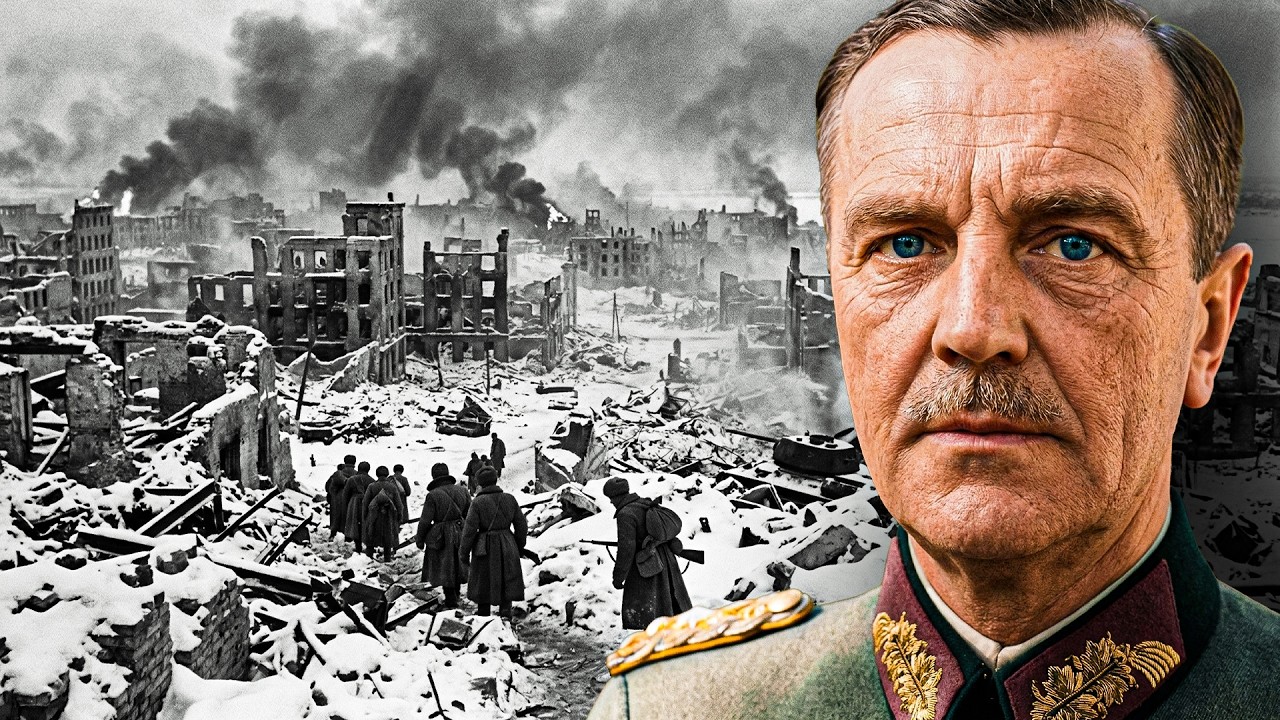
Transport aircraft could not deliver enough food, fuel, or ammunition to sustain the more than 200,000 men trapped in the city. Field Marshal Erich von Manstein’s relief attempt, Operation Winter Storm, had stalled in December, just 30 miles short of the encirclement. Wounded men filled every cellar, and ammunition dwindled by the day. On January 31, 1943, Paulus surrendered.
Two days later, on February 2, General Karl Strecker capitulated with the last northern pocket near the Barrikady factory. The remaining soldiers, roughly 91,000 men, began the long march to prisoner of war camps scattered across the Soviet Union. Weakened by months of starvation and cold, most of the Stalingrad prisoners did not survive the first months of captivity. Of those captured at Stalingrad, only around 6,000 would ever return home.
Major Anatoly Soldatov, among the first Soviet officers to enter the city, described the conditions inside as filthy beyond belief. But the Soviets saw value in their captives. Soviet intelligence had identified these men not just as prisoners, but as potential tools for a larger propaganda strategy. The camp that housed Paulus was designed for a specific purpose.
Its real function was producing propaganda aimed at undermining Wehrmacht morale. Two months later, in September 1943, a more targeted body emerged: the League of German Officers, known by its German acronym BDO. Under Soviet supervision, the BDO produced radio broadcasts, leaflets, and written appeals urging German soldiers to desert. Paulus, however, initially refused all cooperation.
The turning point came after July 20, 1944, when the assassination attempt on Hitler by Colonel Claus von Stauffenberg failed. The plot had been supported by many German officers, and the failure hardened Hitler’s suspicion of the entire officer corps. It also changed Paulus’s mind. He agreed to make public statements against the regime.
His testimony contributed to the conviction of Nazi leaders at Nuremberg. Defense attorneys had dismissed Paulus’s earlier written testimony as fabricated under Soviet pressure. They demanded he appear in person, confident the Soviets would never produce him. When presiding judge Geoffrey Lawrence asked Soviet chief prosecutor Roman Rudenko how long it would take to bring the witness to Nuremberg, Rudenko replied calmly, “About 30 minutes.
” The Soviets had smuggled Paulus across occupied Germany in a decoy convoy, using a double in a second car to deter any assassination attempt. Paulus testified that planning for the invasion of the Soviet Union had begun as early as September 1940, while he served as deputy chief of the General Staff. On the stand, he made his position clear: “Germany must renounce Hitler. ”
The Nazi government responded by placing his wife, Elena, and his daughter under Sippenhaft, the doctrine of kin liability.
The field marshal who had once obeyed every order from Berlin had now turned against the regime entirely. Other generals faced similar fates. General Ernst Walter Heitz, who had ordered his men to fight to the last bullet, died in Soviet captivity on February 9, 1944, barely a year after being taken prisoner. Otto Korfes, who had commanded the 295th Infantry Division at Stalingrad and was among the first senior officers to join the committee, took charge of military archives at the East German Interior Ministry after his release in 1948.
Arno von Lenski, who had also been captured at Stalingrad, followed a different path into Soviet service, but others returned to a West Germany that wanted nothing to do with men who had broadcast Soviet appeals. Collaboration versus loyalty would follow those generals for the rest of their lives, splitting families and former comrades along Cold War lines. In 1953, two years before the last ordinary prisoners returned, Paulus was released from Soviet custody and allowed to move to Dresden in East Germany. He took a position as a civilian chief of the East German Military History Research Institute, a quiet role that kept him close to the regime but out of public view.
Others were not so fortunate. One general, whose sentence of death was commuted within hours to 25 years of imprisonment, served five of those years before a diplomatic breakthrough changed his fate. In September 1955, Chancellor Konrad Adenauer traveled to Moscow and negotiated the release of the last approximately 10,000 German prisoners of war still held in the Soviet Union. The event became known in history as the Heimkehr der Zehntausend, the return of the 10,000.
On October 7, 1955, the first 600 former prisoners arrived at the Friedland transit camp near Göttingen. Some men arrived home to find their wives had remarried and their children had grown up without them. The stigma of surrender followed many of them for decades. Arno von Lenski, who had been sentenced to death by the Nazis in absentia for joining the Soviet cause, survived the war and lived until 1972.
Karl Rodenburg, who had commanded the 76th Infantry Division, outlived them all. But none of them ever fully escaped the shadow of Stalingrad. Paulus died in Dresden on February 1, 1957, exactly 14 years after his surrender at Stalingrad. Of the roughly 91,000 men who had surrendered with Paulus, only some 6,000 ever made the journey home.
Twenty-two generals walked out of a frozen city and into captivity that lasted longer than the war itself. Their fates were shaped by the same forces that defined post-war Europe: ideology, survival, and the long shadow of choices made under impossible pressure.