She spent 67 years in the royal household, a figure of absolute discretion who began as a nursery maid and became the one person who could tell the queen what to do. Margaret Macdonald, known always as Bobo, lived a life of total, silent service that the public never saw, and her story reveals a form of authority built entirely on trust. Bobo Macdonald was born into a railway worker’s family in the Scottish Highlands, and she entered royal service at the very bottom, with no special advantages. She was a small girl when she was assigned to look after the young Princess Elizabeth in the nursery, and the bond between them began in play.
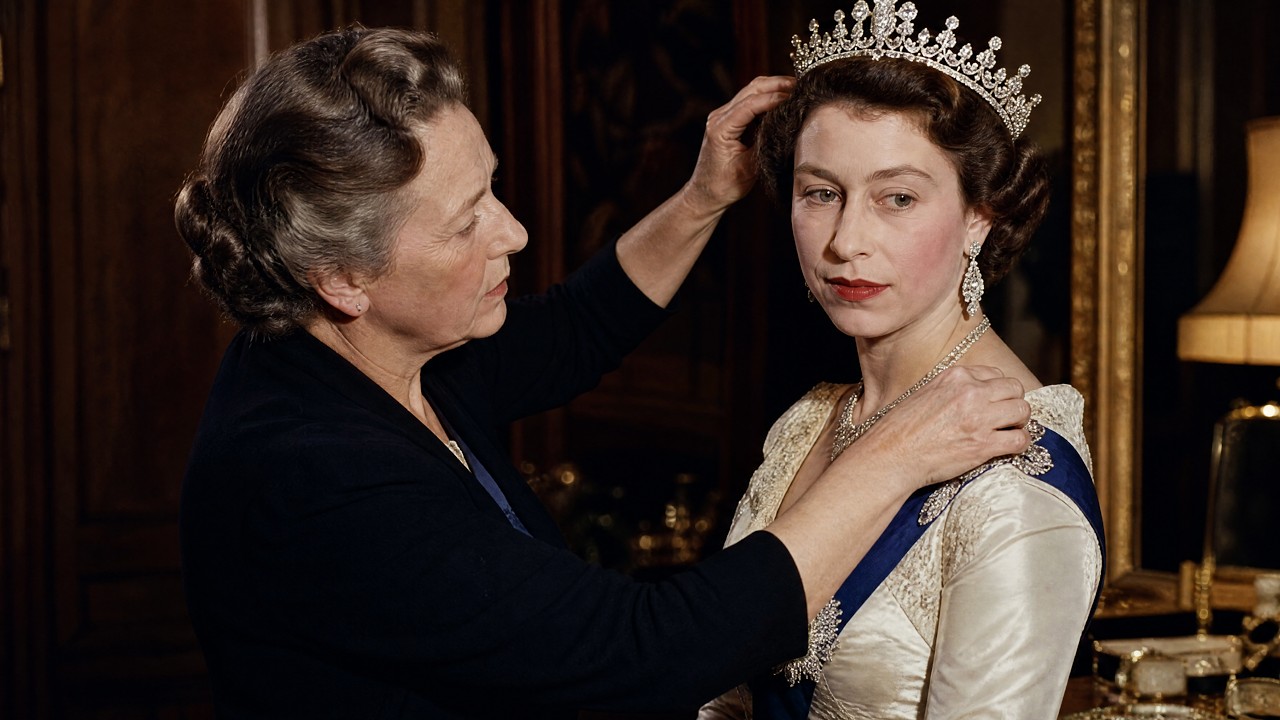
It was so deep that the princess, unable to pronounce “Margaret,” gave her the name “Bobo,” a childhood shortening that followed the servant for the rest of her life. For Bobo, there was never a competing path. The service came first, before any other ambition could form, and she set aside the ordinary things most people build their lives around, a husband, a family, a house, to devote herself entirely to one person. This was not a friendship between equals, and Bobo would have been the first to reject any such notion, but when two people have shared a life in the same rooms for that long, the labels of employer and servant stop describing what has actually formed between them.
Her role was unique. Her authority did not come from the ordinary ranks of the palace but from a private nearness that predated the crown itself. The deeper significance of her position was captured in a single remembered sentence from within the palace: “Do not upset Miss Macdonald. ” At the private point where the queen was dressed each morning, the ordinary lines of power ran backward, and a railway’s daughter could tell a monarch what to do.
The strange paradox of Bobo’s life is that she possessed the most valuable store of royal knowledge any servant has ever held, yet she never used it. She appeared in no official photographs by design, gave no interviews, and occupied no public role. The desire for recognition that drives most human ambition was absent in her, and her silence was not a rule imposed from above but simply part of what she was. She carried this silence so completely that the thinness of her historical record is not a gap to be filled, but the very form of her achievement.
The reverse of her silence was the tenderness she shared with the queen. It was expressed not in words but in the small grammar of service, given and received. The most telling image came in later life when the queen, seeing an old woman grown too old to serve, found a way to keep her close. Bobo had become a fixture of the palace, no longer a working dresser, but simply Bobo, kept near because the queen would not have her anywhere else.
In her final years, the queen sent her a small jar of honey with a note that read “For Bobo,” a gesture that said more plainly than any honor that the relationship had passed entirely beyond the bounds of employment. It was a long life, and it ended quietly. The transfer of the queen’s speech to a small private service in Scotland, where Bobo lay in the form of a lifelong service that had ended.
The story ends with a quiet dignity, a recognition that something real was lost when she died, and that it will not come again.