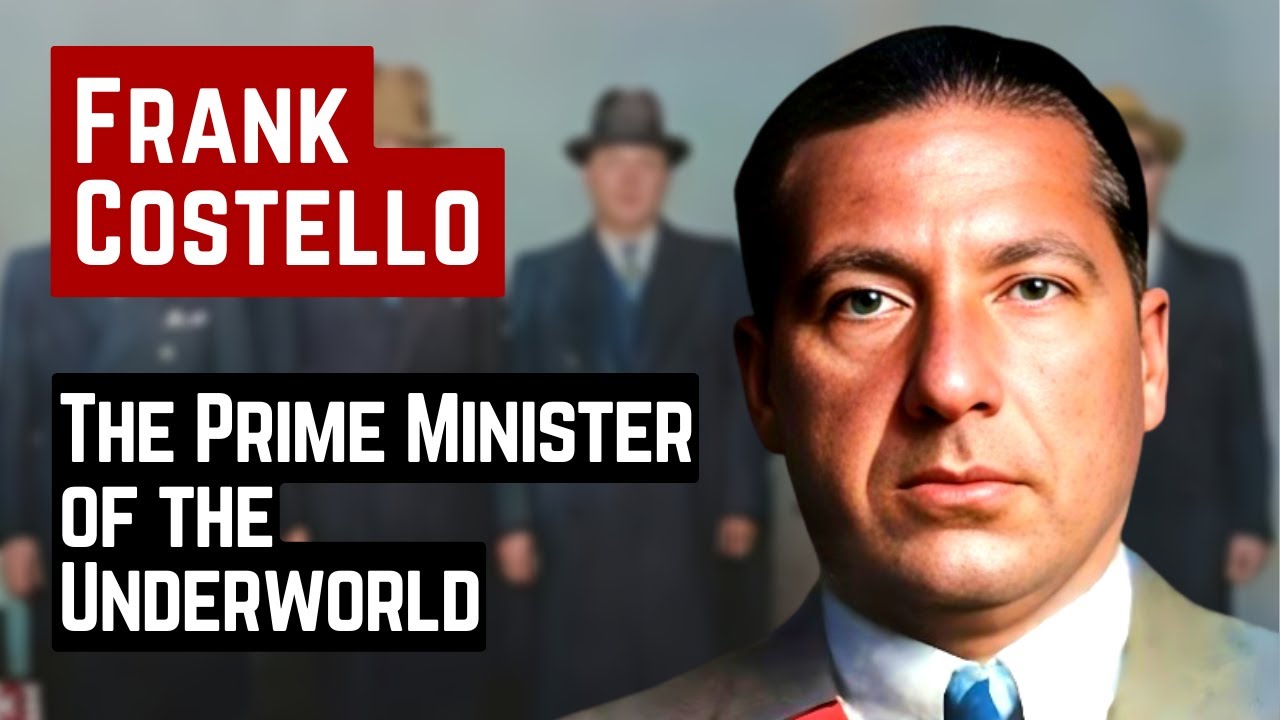
Frank Costello, one of the most influential mobsters of the 20th century, rose to the top of the American underworld not with a gun, but with his mind. Unlike his peers, Costello famously never carried a weapon, which set him apart from other crime bosses of his era. Born on January 26, 1891, in Calabria, Italy, he spent just 10 months in prison early on for carrying a concealed weapon, and after his release, he vowed to abandon violence and use his intellect to make money, a decision that would only increase his influence. Costello eventually went to work for the Morillo gang in Harlem, where he met Charles “Lucky” Luciano, a Sicilian boss of a Lower East Side gang in Manhattan.
The two Italians teamed up immediately and became close friends, working alongside other emerging figures like Benjamin “Bugsy” Siegel. When Prohibition was enacted in 1920, the alliance between Luciano, Costello, and Lansky flourished even more. With backing from criminal financier Arnold “The Brain” Rothstein, the young Italians dove into bootlegging, conducting business with notorious Jewish and Irish criminals of the time, including Dutch Schultz, Owney “The Killer” Madden, and William “Big Bill” Dwyer. By 1924, Costello had become a prominent figure in the Italian underworld, and through his work in Hell’s Kitchen with Dwyer and Madden, he became a close associate of these Irish crime lords, getting involved in their rum-running schemes.
Costello’s power grew steadily, and by 1928, he had formed a critical alliance with Luciano, Lansky, Siegel, and Chicago’s Johnny Torrio. In May 1929, Luciano, Lansky, and Costello met in Atlantic City, where Torrio pitched a plan to establish a national body to prevent gang turf wars like those erupting in Chicago and New York. The plan was well received, and the national crime syndicate, known as the Commission, was formed as a result. However, a power struggle for control of the Italian-American Mafia soon erupted in 1930 between the dictatorial Joe Masseria and fellow Sicilian leader Salvatore Maranzano.
This conflict, later dubbed the “Castellammarese War,” saw Costello and Luciano playing both sides. In a secret deal with Maranzano, Luciano agreed to engineer the death of his own boss, Masseria, in exchange for taking over Masseria’s rackets and becoming Maranzano’s second-in-command. Maranzano’s faction won the war and divided New York’s crime families into the Five Families, but Maranzano unilaterally named himself “Boss of All Bosses” by September 1931. Realizing Luciano was a threat, Maranzano hired Vincent “Mad Dog” Coll to kill him.
However, Tommy Lucchese alerted Luciano that he was marked for death. On September 10, 1931, when Maranzano summoned Luciano, Genovese, and Costello to a meeting at his office, they knew he planned to kill them. As a direct result, Maranzano was murdered by four Jewish hitmen on Luciano’s orders. Luciano then established a power-sharing arrangement called the Commission, a group of mafia families of equal stature intended to prevent such wars in the future.
Following the power shift, Costello’s next challenge came in 1934 when his assets were seized by Mayor Fiorello LaGuardia, loaded onto a barge, and dumped into the river. Costello then agreed to Louisiana Governor Huey Long’s proposal to install slot machines across the state in exchange for a 10 percent cut of the profits from slot machines and bookmaking. Meanwhile, Luciano’s own legal troubles were mounting. In 1936, he was found guilty of running a prostitution ring with the aid of Costello and Lansky and received a sentence of 30 to 50 years in state prison.
Luciano tried to run the crime family from behind bars but found it too challenging. Vito Genovese took over as the Luciano crime family’s interim leader after Luciano was imprisoned, but Genovese soon fled to Italy to avoid prosecution for a 1934 murder charge. With Genovese gone, Luciano appointed Costello as acting boss, with Costello’s cousin Willie Moretti as underboss. During this period, the U.
S. Senate launched the extensive organized crime investigation known as the Kefauver Hearings, which ran from May 1950 to May 1951 under the direction of Tennessee Senator Estes Kefauver. Costello received an 18-month prison term after being found guilty of contempt of the Senate. Senator Kefauver concluded that politician Carmen DeSapio was aiding Costello’s activities and that Costello had gained influence over Tammany Hall decisions.
Despite acknowledging several meetings with Costello, DeSapio insisted that politics was never discussed. In 1952, the government began proceedings to revoke Costello’s citizenship, and he was charged with evading $73,417 in income taxes between 1946 and 1949. He received a five-year prison term and a $20,000 fine. Costello appealed the conviction and was released on a $50,000 bail.
From 1952 to 1962, Costello was in and out of half a dozen federal and local prisons and jails. Meanwhile, Genovese had been tried for the 1934 murder in June 1945 after arriving in New York by ship. The charges against him were dropped in 1946 after both witnesses were discovered dead after being freed from custody. Genovese was able to reunite with the Luciano family in New York, but neither Costello nor Frank Moretti were eager to give him back control of the family.
Luciano, who had never trusted Genovese—unlike Costello—met privately with Genovese in Luciano’s hotel suite on December 20 during a gathering of major crime families in Havana. Genovese attempted to persuade Luciano to become a titular “boss of bosses” and give him control over everything. But Luciano politely rejected the idea. Genovese became the capo of his former Greenwich Village crew.
However, on October 4, 1951, Moretti was murdered on the orders of the Mafia Commission. They disapproved of his testimony at the Kefauver Hearings and feared that, with syphilis now affecting his brain, he might start speaking to the media. Costello was then chosen by Luciano to serve as his new underboss. Genovese was dissatisfied but waited.
In 1956, Joe Adonis, a powerful Costello ally, chose deportation to Italy over a lengthy prison term. Costello was left vulnerable by Adonis’s departure. Genovese still had to defeat Albert Anastasia, another strong Costello ally, before he could make his move. Anastasia had gained control of the Mangano crime family after crime boss Vincent Mangano vanished and his brother Philip was killed on April 14, 1951.
Genovese decided to pursue Costello in early 1957 and gave Vincent Gigante the order to kill him. Costello was wounded by Gigante’s gunshot on May 2, 1957, outside his apartment complex. As a result of the altercation, Costello was persuaded to cede control to Genovese and retire. Gigante was identified as the shooter by a doorman, but Costello testified in 1958 that he was unable to identify his attacker, and Gigante was cleared of attempted murder.
Anastasia was killed on October 25, 1957, eliminating the last major obstacle. Genovese finally took control, while a retired Costello continued to be referred to as the “Prime Minister of the Underworld,” remaining active in the New York Mafia even after stepping down from direct leadership.