On the evening of October 14, 1950, the corner of 125th Street and Seventh Avenue in Harlem carried its usual Saturday night rhythm. The Hotel Theresa rose thirteen stories above the avenue, its brick facade lit by a sign that had replaced a whites-only policy just a decade earlier with one that welcomed Black guests as its primary clientele. Inside, the lobby smelled of cigar smoke and polished wood, with a small band playing softly through the wall from the adjoining ballroom. Ellsworth “Bumpy” Johnson arrived a few minutes after eight, wearing a precisely tailored dark gray suit, a white shirt, and a gray fedora set level on his head.
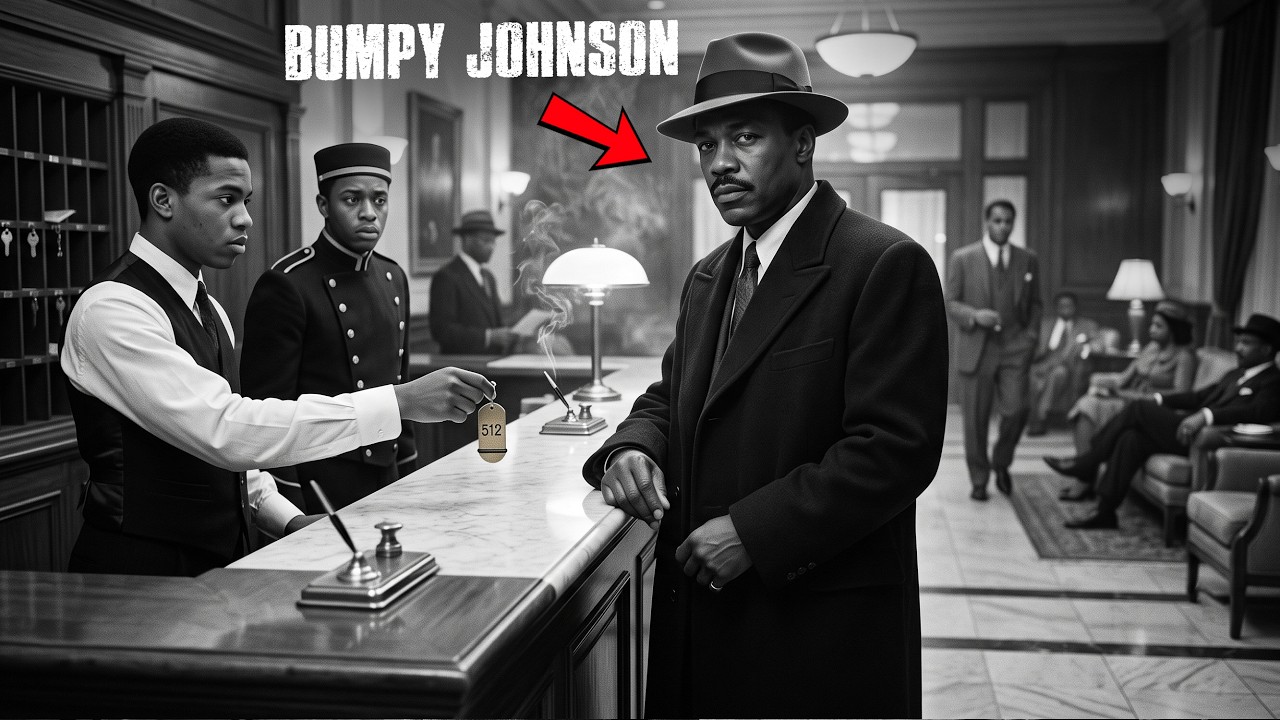
He was a familiar figure at the Theresa, not because he flaunted his presence, but because his presence was simply a fact of Harlem life. He crossed the lobby without urgency, exchanged a brief nod with the elevator operator, and approached the front desk to collect the key to the room he kept permanently for meetings requiring privacy. The clerk behind the desk that night was not regular staff. He was a young man recently transferred from the hotel’s downtown management office, sent to observe operations for what staff had been vaguely told was a routine administrative review.
The clerk looked at the reservation card, looked at Johnson, and reached toward a key on the board without matching it to the card in his hand. He placed it on the counter with a small, deliberate movement. “Room 512,” he said, though the card before him clearly indicated a different number. Curtis, a bellhop who had worked the evening shift at the Theresa for three years, noticed the error immediately and opened his mouth to correct it.
But the clerk gave him a brief look that ended the matter before it began. Johnson took the key without comment. He had seen enough transfers from downtown offices to recognize the nature of this gesture. It was not an administrative mistake, but a small display of power delivered before dozens of witnesses in the lobby, reminding a well-known and respected man that someone else still held the paper that mattered.
Two men seated near the front window, both known to Johnson from years of working together in the neighborhood, watched the exchange without appearing to do so, the way people in Harlem had learned to observe closely while looking elsewhere. One was Percy Alvarado, a funeral director whose parlor on 129th Street handled services for half the neighborhood’s prominent families. The other was a bandleader who worked the Theresa ballroom on weekends and depended on the hotel’s continued goodwill for his bookings. Neither said anything to Johnson as he crossed toward the elevator, but both would later remember the particular stillness with which he accepted the key, and the deliberate slowness with which the clerk had placed it on the counter, as if the movement were designed for exactly the people who noticed it.
Johnson rode up to the fifth floor in silence. When he turned the key in the lock of Room 512, the door opened onto a room that was already occupied. A man in shirtsleeves sat at the small writing desk with an open ledger, a glass of whiskey beside him, and two suitcases stacked near the window that had not been there the last time Johnson used the room. The man looked up, unconcerned, perhaps even amused, as if he had been told to expect an interruption and had decided in advance not to react to it.
He was a liquor distributor named Walter Kettering, representing the kind of downtown supplier who had been placed inside major Harlem hotels and clubs in recent months by an investment group that had purchased a controlling stake in the Theresa’s ownership structure the previous spring. His ledger sat open to a page tracking deliveries to three separate Harlem establishments, a detail Johnson noted without comment, understanding at once that the man’s presence in this particular room on this particular night was no coincidence but an arrangement designed to coincide with his own booking. Kettering did not rise from his seat. He said only that he had been told the room was available for his use during his stay, and that if there was any confusion at the front desk, it was not his to resolve.
Johnson stood at the doorway for a moment, taking in the ledger, the suitcases, the man’s relaxed posture behind the desk, and the fact that none of it was accidental. He did not raise his voice. He did not take another step into the room. He said only that there seemed to be a mistake, and that he would speak to the desk clerk about it.
Then he closed the door quietly, heard the lock click, and walked back toward the elevator. Curtis, the bellhop, was waiting near the elevators, clearly expecting a reaction, an instruction, or some signal of what should happen next. Johnson gave him none of that. He asked only that his coat be sent up when his usual room was ready, and that no fuss be made about the matter that night.
He returned to the lobby and sat near the window, ordering coffee from a waiter who knew him and who seemed unsure whether to mention what had happened at the front desk. Johnson did not raise the subject. He sat with his coffee, watching the room slowly fill with the evening crowd, watching the desk clerk complete two other transactions without incident, and watching, more carefully than anyone in the lobby might have noticed, which staff members avoided looking in his direction and which did not. He stayed for nearly an hour, saying little, drawing no attention to himself, allowing the small insult of the wrong key and the occupied room to settle into a kind of calm that looked to others like nothing at all.
The withdrawal that followed was not sulking and it was not defeat. It was a particular kind of quiet that Johnson had developed over decades of working in a city that offered men like him no institutional protection and little patience for complaints. He left the Theresa shortly after ten, walked two blocks to a restaurant that stayed open late, and ate a simple meal alone, turning the evening’s events over in his mind without any change in his expression. He discussed the incident with no one that night.
He sent no message to the bellhop or the desk clerk. He did not return to the hotel to demand an explanation. The next morning, he kept to his usual routine: a walk up Seventh Avenue, a stop at the newsstand, small talk with a barber, an afternoon in a back office above a tailor shop reviewing figures with an accountant who managed several small businesses under his oversight. To any observer, nothing had changed.
He answered his accountant’s questions with the same attention he always gave, and sat through a long conversation with a numbers runner about a territorial dispute near 145th Street without mentioning the hotel once. This reticence was not indifference. It was discipline Johnson had built over years of working in a city where a man in his position could not afford to let a personal insult dictate the timing or nature of his response. He had learned long before that October evening that the men who survived in Harlem’s business world were rarely those who responded quickly to offense, but those who could live with an insult long enough to understand exactly what it was meant to accomplish before deciding what, if anything, to do about it.
But Johnson had already begun to see the truth of what had happened to him, and he was no longer thinking about the clerk, or even about Kettering, but about the system that had placed both men where they were. This conviction had not come in a single moment. It formed gradually over the following days, the way understanding always comes to a man who has learned patience with his own conclusions. Johnson had heard in general terms that the Theresa’s ownership had changed the previous spring, when a downtown investment group purchased controlling shares from the family that had run the hotel since its conversion to Black ownership in the 1940s.
He had also heard that similar purchases had been made quietly at two other Harlem hotels and one of the largest supper clubs on Lenox Avenue. What he had not fully understood until the night of the wrong key was the purpose of these purchases. They were not merely real estate investments. They were an attempt to impose downtown supply chains, from liquor and linens to food and entertainment bookings, onto businesses that had kept those contracts within Harlem for decades, employing its own distributors and musicians.
The room assignment was not a personal insult aimed at Johnson alone. It was a display of power staged in the lobby of the neighborhood’s most prominent hotel to prove that the new owners could place their men wherever they wanted, regardless of who had built the Theresa’s reputation or who had filled its rooms and ballrooms with paying guests for years. It was a test of whether Harlem’s established men would accept without resistance a slow transfer of control over the very commerce that sustained the neighborhood’s economic life. Johnson recognized the nature of this test because he had seen earlier forms of it on a smaller scale in different corners of Harlem’s business world, and because he had learned, through years of watching money move through the neighborhood, that the men who controlled supply contracts often held more real influence over the community’s daily life than those who controlled its politics.
A downtown liquor combine would offer a club owner a better price on inventory, on condition of dropping the usual Harlem distributor. A laundry service from Long Island City would bid slightly lower than a Harlem laundry, just enough to justify the switch, and within a year the local laundry would disappear, the new price rising to what it had been at the start. Each of these steps, viewed alone, looked like ordinary commercial competition. But viewed together across the years, they amounted to a quiet rerouting of money that had circulated within Harlem toward owners and suppliers with no stake in the neighborhood’s stability.
Johnson had watched this pattern take hold so gradually that most residents never connected the individual cases. A tailor lost a formalwear contract to a hotel supplier. A cigarette distribution route was reassigned to a company based in Yonkers. A jukebox franchise in a Lenox Avenue club was quietly transferred to an operator with no ties to Harlem.
None of these events alone seemed worth organizing a response to, and so none produced one. What made the incident at the Theresa different was not its scale but its clarity. It happened in the hotel lobby, before important witnesses, to a man of established standing in the community, and it gave Johnson a signal clear enough, and delivered publicly enough, to finally address the pattern for what it was: not a series of unconnected coincidences but a coordinated effort. In this context, the wrong key and the occupied room were not merely an error to be corrected but a message to be answered, and Johnson understood that answering it with anger, or with a private word to the night manager, would change nothing about the arrangements underneath.
He also understood that answering it with violence, the easiest tool available to a man in his position, would accomplish nothing at all. The ownership group would treat violence against a distributor or an employee as an additional cost of doing business, and it would give them a pretext to bring in more of their own men under the cover of security, without affecting the contracts and ownership stakes that had caused the insult in the first place. What was required was not a response to the man in Room 512. What was required was a response to the structure that had put him there.
Over the following two weeks, Johnson began assembling a small group of people whose interests, though different from his own, aligned with his general direction. He held no meeting and announced no campaign. He visited people individually in the context of ordinary business and raised the matter in conversation rather than confrontation. The first person he spoke to was Harold Bishop, a Harlem lawyer who handled licensing matters and contract disputes for a number of the neighborhood’s smaller hotels and restaurants.
Bishop was a precise, deliberate man who had spent years reading the fine print of leases and health department regulations that most business owners never examined closely. His importance lay in his detailed knowledge of the regulatory requirements that a hotel like the Theresa depended on to keep operating without interruption: liquor licenses, fire safety certificates, health inspections, the annual renewal of the ballroom’s entertainment permit. He also knew better than anyone in Harlem how easily an ownership group that had recently taken over a property could overlook some of the paperwork during the transition, simply because new owners rarely knew every obligation their predecessors had quietly maintained. The second person Johnson contacted was Odessa Vance, who ran the Palmetto Laundry on 132nd Street, one of the last remaining Black-owned commercial businesses in Harlem still operating at a scale large enough to serve hotels and restaurants.
Vance’s importance lay in the fact that her business had been one of the accounts quietly shifted to an outside supplier when the Theresa changed hands, part of the same pattern Johnson had begun to notice. She had absorbed the loss without complaint, as Harlem small business owners often did, assuming there was nothing to be done about a decision made in a downtown office. Vance had built Palmetto from a single pressing machine in her family’s basement into an operation employing eleven people and serving accounts in three neighborhoods, at a time when banks rarely extended credit to a Black woman running a commercial laundry, regardless of how sound her books were. The third person was Thaddeus Okafor, who supplied produce and dry goods to a dozen Harlem restaurants and clubs from a warehouse near the Harlem River docks, and who had relationships with two smaller Harlem hotels that Johnson knew were eager for the kind of conference and banquet business that went regularly to the Theresa.
Okafor mattered because he understood hospitality supply logistics in a way that made him useful not only as a vendor but as a source of information: which hotels were overextended on credit, which were current on their bills, and which owners were quietly worried about cash flow. The fourth was the Reverend Alton Price, pastor of a Baptist congregation on 138th Street whose membership included dozens of working professionals in Harlem, and whose word carried moral weight in a community where church attendance and business reputation were closely linked. Price’s importance lay in his ability, without issuing any public accusation, to encourage his congregation to consider where their patronage went, and in the fact that his presence at any gathering lent the effort the character of community concern rather than personal grievance. The fifth was Delia Marsh, a columnist for a Harlem weekly newspaper whose readership included nearly every business owner and public figure north of 110th Street, and who had an established habit of writing measured, factual articles about changes in Harlem’s commercial landscape without naming sources that could not be verified.
Marsh mattered because careful disclosure without exaggeration could accomplish what threats could not: it could make the absentee ownership group aware that its practices were visible to the very community it depended on for revenue, without giving that group a pretext to claim harassment or defamation. The sixth and final person was Nathaniel Cobb, who ran a small credit union used by Black-owned businesses in Harlem for short-term financing when downtown banks refused their applications, as they usually did, regardless of the actual condition of the business. Cobb mattered because any strategy built on shifting contracts away from outside suppliers would require the businesses benefiting from it, like Vance’s laundry and Okafor’s supply house and the small hotels hoping to gain banquet business, to have the working capital to expand quickly enough to take on new accounts without stumbling. Johnson brought these six people together not in a single dramatic meeting but through a series of quiet conversations, some in Bishop’s office, some over meals at ordinary restaurants, some in the back room of Okafor’s warehouse.
He laid out what he understood clearly, without dramatizing it. The new owners of the Theresa had shifted supply contracts outside the neighborhood, had begun placing their own men inside the building in important positions, and had demonstrated, whether deliberately or by careless assumption, that they viewed Harlem’s leaders as guests to be managed rather than partners to be respected. He proposed no confrontation and no public accusation. He proposed a strategy built in layers, each designed to reach the ownership group through channels they could not simply override with their own orders.
The first layer was economic. Vance would quietly approach two of the Theresa’s smaller sister establishments, a restaurant and a barbershop recently acquired by the same ownership group in the neighborhood, and offer laundry service at a slightly lower price than the outside supplier was charging. Okafor would do the same with fresh produce and dry goods for the hotel kitchen, using his existing relationships with two Theresa kitchen staff members who had no loyalty to the new owners and who had noticed, as kitchen staff always notice first, that the quality of ingredients had declined since the outside supplier took over. Neither Vance nor Okafor asked for the Theresa’s business directly.
They simply made it easy for hotel staff to raise questions internally about whether the current suppliers were really serving the property well. The second layer was social, and this was where Price’s role mattered most. Price organized no boycott and was careful never to use that word. He simply began, in ordinary conversation with his congregation and with other ministers he knew around Harlem, to mention that a number of neighborhood business owners had noticed changes at the Theresa since the change of ownership: slower service, higher prices in the lobby, suppliers no one recognized delivering goods through the back entrance.
He suggested, without issuing any directive, that members might consider holding their family gatherings and church banquets at hotels and halls that had kept their original Harlem ownership. This kind of suggestion spread slowly, the way news moves through a community that trusts its institutions more than its advertisements, but it spread steadily. Price mentioned it once at a deacons’ meeting, and one deacon, who also served on the planning committee for a fraternal organization’s annual dinner, quietly moved that year’s booking to a hall on Convent Avenue instead. A church member who was a schoolteacher organizing her union’s holiday gathering made a similar decision after a brief conversation with her pastor.
None of these decisions were framed as a stance against the Theresa. Each was presented sincerely as a preference for supporting neighborhood institutions whose ownership had never changed. Within a month, the Theresa’s banquet calendar showed three cancellations that hotel staff found difficult to explain to the owners’ downtown office. The third layer was legal, and here Bishop’s careful reading of the hotel’s paperwork proved decisive.
Through a routine review of public licensing records that any lawyer was entitled to inspect, Bishop discovered that the Theresa’s ballroom entertainment license came up for renewal in ten weeks, and that the most recent fire department inspection report, filed the previous year under the old ownership, had noted two minor violations in the service stairwell that had never been formally closed out during the transition to new management. None of this was criminal. None of it was even unusual for a large building changing ownership. But it meant that the new ownership group, perhaps unaware of the outstanding items, was operating on paper records that could raise questions from any diligent lawyer at the moment of license renewal.
Bishop filed no threats and issued no reports. He simply made a routine formal inquiry to the fire department on behalf of a local civic association, the kind of inquiry any concerned citizen was entitled to make, asking whether the previous violations had been resolved. The inquiry itself, entirely proper and entirely public, was enough to prompt the fire department to schedule a new inspection, which the hotel management would now have to prepare for on short notice. The fourth layer was competitive and moved more slowly than the others because it depended on the willingness of other Harlem hotels to accept business that might come their way.
Through his contacts among the smaller hotels near Sugar Hill, Okafor arranged for two of them to quietly improve their banquet offerings, advertising through the same word-of-mouth channels Price was using that they were eager to host the kind of civic dinners and social gatherings traditionally held at the Theresa. One of these hotels hired a second banquet coordinator specifically to handle the additional inquiries it expected, and began offering a modest discount to any organization booking its hall for the first time, a gesture that cost the hotel little but made switching easier for groups that might otherwise have hesitated out of habit or loyalty to the Theresa’s name. This was not framed as competition against the Theresa specifically. It was framed simply as improvement of Black-owned Harlem institutions’ own offerings, which was genuine and required no confrontation with anyone.
None of these four layers moved quickly, and Johnson did not expect them to. Over the following six weeks, the effects accumulated in small, barely noticeable increments. Vance’s laundry picked up the restaurant and barbershop accounts within the first ten days at prices that made the outside suppliers’ contracts with those smaller properties look badly negotiated by comparison. The hotel kitchen staff, encouraged by Okafor’s contacts, began requesting substitutes for produce items that only Okafor’s warehouse could reliably deliver on short notice.
By the fourth week, the head chef had quietly replaced two of his standing orders without asking permission from the management office, simply because it was easier than explaining another late delivery. The banquet cancellations prompted by Price’s conversations grew from three to seven over the following month, each citing scheduling conflicts or family preferences, reasons that were true in the narrow sense and incomplete in the broader one. The fire department inspection arrived in the sixth week, and the hotel management, insufficiently prepared, was cited for the same unresolved emergency stairwell violation plus a new finding about an obstructed exit on the mezzanine level that no one downtown had known to check. During the middle of this period, effects moved in ways no single participant could have arranged alone, but which the gathering of the six made nearly inevitable.
The head chef, a precise man named Otis Ferrell who had worked at the Theresa since before the change of ownership and owed the new owners no loyalty beyond his salary, found himself increasingly willing to sign for Okafor’s shipments without consulting management first, simply because Okafor’s produce arrived fresh and on time while the outside supplier’s trucks became less reliable as that supplier expanded into wider areas of the city. By the time anyone in management thought to ask why the monthly kitchen invoices showed two suppliers instead of one, Ferrell had already come to depend on Okafor’s shipments for the most important items on his menu, and reversing the arrangement would mean disrupting a kitchen that was, by every measure the ownership group tracked, operating better than it had in months. By the seventh week, Gerald Ashford, the ownership group’s New York representative overseeing the Theresa along with two other properties, began his own inquiries, trying to understand why the hotel’s operating numbers were declining steadily across several unconnected categories at once. Ashford had managed hotels for nearly fifteen years, always in buildings where the owners held clear, uncontested leverage over every supplier and every staff member, and he had never encountered a situation where pressure applied at one point produced no visible effect anywhere else in the system.
He called his department heads to a meeting and asked precise questions about the laundry account, the produce supply, the banquet schedule, and received answers that made sense individually but were deeply frustrating when taken together. The laundry price was simply better. The produce was simply fresher. The banquet cancellations simply cited family reasons.
He did not immediately recognize that he was facing a coordinated response, because nothing about it resembled a coordinated response as he understood the term. There were no picket lines, no public statements, no complaint letters. There was only a series of reasonable business decisions made by reasonable people that happened to all point in the same direction at the same time. Ashford’s first instinct, once he began to suspect something deliberate, was to apply pressure of his own.
He instructed the hotel manager to inform Vance’s laundry that the smaller establishments would return their business to the outside supplier unless Vance agreed to take on the main hotel account at a lower price than she had offered. It was an offer designed to test whether she could be pressured into accepting an unprofitable arrangement out of fear of losing what she had gained. Vance, backed by Cobb’s credit union, which had already provided the capital to expand her plant capacity in anticipation of just such a test, declined the lower price and said the owners could take back the smaller accounts if that was truly their wish. Ashford did not carry out his threat, because losing the restaurant and barbershop business over a laundry contract made no financial sense once the numbers were examined, and the threat quietly dissolved.
Ashford tried a second approach shortly afterward, instructing the hotel’s lawyer to send a letter to Bishop’s contact at the civic association, suggesting that continued inquiries about the fire inspection might be construed as harassment of a legitimate business. Bishop replied in writing with a calm, thorough summary of the association’s legal right to request public safety information about a licensed public facility, adding a polite note that the fire department’s own citations, not the association’s questions, were the source of any difficulties the hotel was currently experiencing. The exchange produced nothing useful for Ashford because there was nothing wrong with what Bishop’s clients had done, and continuing the matter would only draw more attention to the very violations at issue. By the ninth week, the banquet cancellations, the produce substitutions, the laundry contract, and the renewed scrutiny from the fire department had combined to put real pressure on the Theresa’s quarterly numbers.
When investors in the downtown ownership group began asking questions about the property’s performance under new management, one of them, reviewing the quarterly figures at a routine meeting, asked directly why a hotel that had shown stable occupancy rates and banquet revenue under its previous management was declining in both areas within a year of the ownership change. Ashford found himself unable to give a convincing answer, because none of the individual explanations he had gathered from his department heads added up to a story he could tell his superiors with confidence. Ashford gradually realized, after spending two months trying to identify a single point of resistance he could press or remove, that no such point existed. There was a laundry owner backed by capital, a lawyer asking questions he was legally entitled to ask, a minister mentioning banquet halls in ordinary conversation, a produce supplier filling orders kitchen staff wanted filled, and two competing hotels quietly improving their service.
None of these people had committed any legal violation, issued any threat, or spoken a single harsh word about the Theresa publicly. There was nothing to sue over, nothing to report, and no single person whose withdrawal under pressure would make the problem disappear. At this point, in the tenth week, Ashford requested a meeting, not with Johnson directly, since no record linked Johnson to any of the individual decisions that had accumulated against the hotel, but with Bishop, whose name appeared prominently in the fire department correspondence and who struck the ownership group as the person most likely to know why several unrelated business relationships had turned at once. Bishop agreed to the meeting and asked Johnson whether he wished to attend.
Johnson declined to appear personally, preferring that the meeting remain a dialogue between a lawyer representing community business interests and a representative of the hotel’s owners, with his name never entering the discussion. This was itself part of the strategy. The resolution should look like a correction of an oversight in ordinary business relations, not like a negotiated surrender to one man’s grievance, because surrender to one man might breed resentment and eventually be reversed, while a correction in ordinary business practices tended to hold. The meeting took place in Bishop’s office on a Tuesday afternoon in early December.
Ashford arrived without the confidence he might have had two months earlier. He acknowledged, in careful language, that the hotel’s change of ownership had led to some supplier decisions that had not taken into account the neighborhood’s long-standing relationships. He asked what arrangement might resolve the difficulties the hotel was facing in its supply contracts, banquet bookings, and license review. Ashford had arrived expecting some kind of accusation and had prepared a defense of the ownership group’s business decisions as ordinary cost management.
Instead he found a conversation conducted entirely in the context of ordinary business planning, with no reference to the night of the wrong key, no mention of Kettering, and no hint that anyone had been personally wronged. This, more than anything Bishop said directly, unsettled him, because it left him with no grievance to contest and no injured party to appease. He was instead being offered a set of terms that made sense on their own commercial merits, and he realized by the end of the meeting that refusing them would only prolong the difficulties that had already cost the hotel more in lost revenue than the proposed arrangements would cost in adjusted supplier prices. Bishop, without emotion and without reciting grievances, put forward a direct and clear proposal.
The hotel’s laundry and produce contracts would return to Harlem suppliers at fair market prices, reviewed annually by an independent accountant rather than imposed unilaterally by the owners’ office. The hotel would establish a small advisory arrangement, meeting quarterly with representatives of the neighborhood’s business and civic community to consult on decisions affecting local suppliers and employees, a body that in its first year would include Price, Okafor, and a representative chosen by the hotel’s kitchen and housekeeping staff. And the front desk would adopt a written policy, posted for staff training purposes, stating that room assignments for regular guests must follow booking records precisely, with any changes requiring the guest’s own approval rather than unilateral reassignment by staff. Ashford, weighing the cost of continued friction against the modest cost of the proposal, agreed to all three points within a week.
The agreement was written down, signed by the hotel’s general manager, and filed with the same civic association whose earlier inquiry had led to the fire safety inspection in the first place. The victory, when it came, was not noisy and was not announced. It appeared in the form of a Palmetto Laundry truck making the morning delivery to the Theresa’s loading dock in January, where the outside supplier’s truck had made the same delivery for eight months before. It appeared in a produce order placed with Okafor’s warehouse for a civic banquet held in the Theresa ballroom that same month, the first such banquet the hotel had hosted in ten weeks.
It appeared in a small procedural change in the front desk training manual, a document no guest would ever see, stating that room keys would not be issued except in exact match with the guest’s confirmed reservation number, with no exceptions except with the guest’s personal approval. And it appeared most clearly on a Saturday evening in February, when Johnson returned to the Theresa for a meeting, approached the front desk, and was handed the key to his reserved room by a clerk who matched the number against the card without hesitation, exactly as should have happened four months earlier. He said nothing about the difference. He simply took the key, thanked the clerk in the same calm tone he used for every transaction of that kind, and went up to his room.
The change extended beyond the Theresa’s internal policies. Over the following year, the pattern of supplier relationships that Johnson, Vance, Okafor, Bishop, Price, Marsh, and Cobb had established in response to a single insult became something close to established practice among Harlem hotel owners and service institutions, who had watched the Theresa’s difficulties closely without ever learning the full story behind them. Two of the neighborhood’s other hotels, fearing that their own out-of-town investors might attempt similar cost-cutting through outside suppliers, began reviewing their supply contracts on their own initiative, preferring local vendors and their products even when the price difference was slight, on the reasoning that a business closely tied to the neighborhood’s commerce was less likely to face the kind of disruption the Theresa had experienced. Cobb’s credit union, having successfully financed Vance’s expansion, began receiving a steadier flow of applications from other small Harlem businesses hoping to position themselves for similar opportunities, and its lending capacity grew accordingly, attracting new depositors who had previously kept their savings in downtown institutions out of habit rather than preference.
Vance herself expanded Palmetto Laundry for the second time in two years, adding a delivery route reaching into Sugar Hill, and in later conversations with other business owners often credited the Theresa contract as the moment her operation shifted from serving a neighborhood to resembling a small industrial enterprise. Bishop’s practice gained a number of new clients among Harlem’s smaller hotel and restaurant owners, who had learned from the Theresa’s example that questions about licensing and inspection records were not merely defensive tools but a form of business due diligence any owner could use to protect a fair position. Johnson himself made no public statement about any of it, then or afterward. He did not take credit for changing the Theresa’s supplier policy, and when an acquaintance who had heard part of the story asked whether he had played a role in what happened at the hotel that winter, he answered only that businesses in the neighborhood had their way of finding their balance over time, and left it at that.
He continued to keep his usual room at the Theresa, continued to drink his coffee in the lobby on Saturday evenings, and continued to conduct his affairs in the quiet, unremarkable manner he had always used, without any outward sign that the change in the hotel’s practices had been his doing. Curtis, the bellhop who had noticed the error at the front desk that October night and whose objection had been silenced before he could correct it, remained at the Theresa for many years afterward, eventually rising to assistant manager under a later ownership group that valued his long memory of how the hotel had nearly lost its standing in the neighborhood it depended on. He would tell the story in later years only to new staff during training, presenting it not as a complaint against any individual but as an illustration of why the front desk policy on room assignments existed, and why it should never under any circumstances be treated as a formality. The clerk who had handed over the wrong key that October evening left the Theresa within a year, moving to another property downtown, and the incident itself was never discussed by anyone present except in the quiet, indirect way Harlem stories had been passed down for years, as an example of how patience and organization could accomplish what confrontation could not.
In the years that followed, the arrangement born of that single night at the Theresa became something like an unwritten model for how Harlem’s established business figures handled the steady flow of outside capital into the neighborhood’s hotels, clubs, and commercial buildings. It was understood, without formal instruction, that a public insult from an absentee ownership group rarely deserved a response in kind, and that the more lasting response was to identify the suppliers, professionals, clergy, and press who together held real leverage over any business that depended on Harlem’s money to survive, and to apply that leverage patiently and in stages until the business in question found correcting its practices easier than continuing to resist them. The Theresa itself remained a center of Harlem social life for another decade. Its ballroom hosted formal dinners, political gatherings, and visiting dignitaries, always part of its identity and its ownership.
Whatever downtown office held its ownership papers in any given year had learned to treat the neighborhood’s institutions as partners whose cooperation had to be earned rather than assumed. Price, in a sermon delivered years later on patience as a form of strength rather than weakness, referred indirectly to a period when the neighborhood had learned that its institutions, working together without any single leader announcing the effort, could correct an imbalance that no individual complaint would have changed. He did not name the hotel and did not name the man whose evening had begun the correction. But those in the congregation who had lived through that winter understood exactly what he meant, and understood also why the story did not need to be told any louder than that.
What began as a wrong key handed across a hotel front desk, and a stranger’s suitcases left in a room that was not his own, became, through the quiet accumulation of a single winter, a permanent adjustment in how power moved through one corner of Harlem. It was accomplished without a single raised voice, and it was remembered by the few who understood its full dimensions as proof that intelligence and patience, carefully applied, could hold their own against any display of power founded on nothing but the assumption that no one would notice, no one would organize, and no one would wait long enough to see the correction through.