Toyotomi Hideyoshi is remembered as Japan’s Second Great Unifier, and his rise from nameless peasant to the most powerful man in the country remains one of the most extraordinary stories in Japanese history. Born into a society defined by rigid class structures and endless war, he climbed through sheer intelligence, cunning, and ambition—first as a servant, then a general, and finally as the de facto ruler of Japan. Very little is reliably known about Hideyoshi’s early life before 1570, when he first appears in surviving documents. His autobiography, which begins in 1577, reveals almost nothing about his childhood.
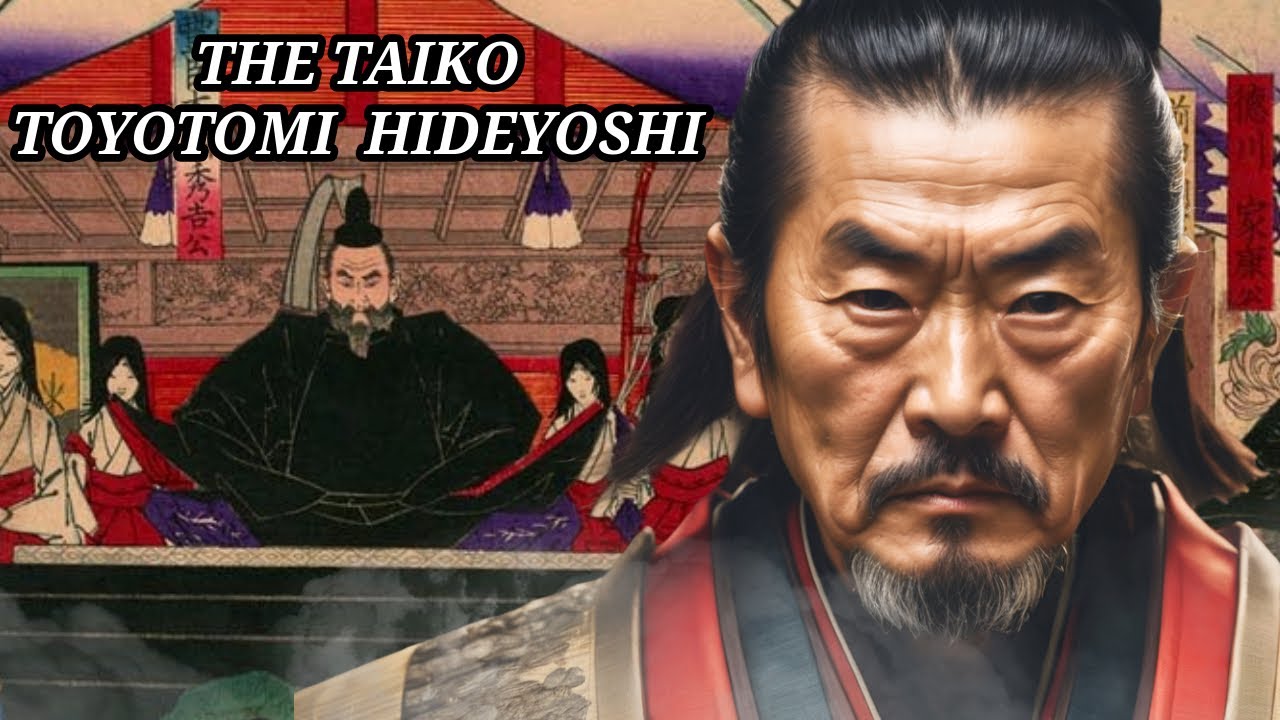
Tradition holds that he was born in Owari Province in 1536 to a peasant foot soldier named Yaemon. With no samurai lineage, he had no surname. His father died when Hideyoshi was just seven years old. Legends suggest he was sent to a temple to study but soon rejected monastic life in favor of adventure.
As a young man, he traveled to Totomi Province and became a page to a local daimyo under the name Kinoshita Tokichiro. He later served the Imagawa clan before reportedly absconding with money entrusted to him and becoming implicated in a robbery affair. In 1558, following in his father’s footsteps, he joined the Oda clan as a foot soldier under the young Oda Nobunaga. Hideyoshi reportedly fought at the Battle of Okehazama, where Nobunaga’s outnumbered forces famously defeated Imagawa Yoshimoto’s army of roughly 25,000.
The victory made Nobunaga a formidable player in the struggle for control of Japan, and it was during this period that Hideyoshi’s military prowess began to attract notice. Many tales of Hideyoshi’s rise are folk legends. One well-known story claims he became Nobunaga’s sandal bearer after warming his lord’s straw sandals against his chest on a cold day. Nobunaga, an early riser and hardworking administrator, was reportedly impressed by Hideyoshi’s work ethic, whom he nicknamed “Saru” (Monkey), supposedly due to his skinny body and ugly face.
Other samurai used the name as an insult, but Hideyoshi reportedly dreamed that the lords he served would one day serve him. Nobunaga was known for unconventional methods and valued good ideas regardless of the rank of the man who proposed them. Hideyoshi was promoted to diplomat and sent to bribe warlords in Mino Province to turn against the Saito clan. In 1566, he proposed building a castle near the Saito stronghold, Inabayama Castle, as a staging point for war.
He completed the construction quickly, offering prizes to the fastest workers, giving rise to the legend that the castle was built in a single night. When Nobunaga planned to besiege the seemingly impregnable Inabayama Castle, Hideyoshi proposed a bolder plan: infiltrating the fortress with a small team. Learning of a little-known path up the mountain’s northern slope from a local resident, he scaled the mountain at night with his men, set fire to the castle storehouse, and opened the front gates. Nobunaga’s forces stormed in, and the castle fell.
Hideyoshi’s role as the mastermind was recognized, and he was made lord of three districts in northern Mino Province. He had gone from peasant to lord—something unprecedented at the time. After the siege, Nobunaga marched into Kyoto and installed Ashikaga Yoshiaki as Shogun, but the two soon fell out. Yoshiaki allied with Nobunaga’s enemies, and Nobunaga responded by marching on Kyoto again, putting the Shogun to flight and ending the Ashikaga line.
By 1570, Nobunaga had such faith in Hideyoshi that he made him a general and assigned him to lead Oda troops in battle for the first time. During the campaign against the Asakura clan, Nobunaga found himself surrounded by the combined forces of Asakura and his brother-in-law Azai Nagamasa, who had betrayed him. Hideyoshi commanded the rear guard during the retreat, allowing Nobunaga to escape with a large portion of his forces. This became one of Hideyoshi’s most celebrated accomplishments.
He later served as acting general in several battles, including the destruction of both the Asakura and Azai clans. In 1573, Nobunaga appointed Hideyoshi daimyo of three districts in northern Omi Province. He also took control of the Kunimoto firearms factory, whose output increased dramatically under his administration. Born a peasant himself, Hideyoshi had a unique ability to connect with workers, speaking to them as equals and inspiring efficient work.
Hideyoshi served as a senior general in many campaigns, fighting at the Battle of Nagashino and in the long Ishiyama Honganji War against the Ikkō-ikki warrior monks. In 1578, he was sent to conquer Harima Province and took the region without bloodshed through diplomacy. However, one lord, Bessho Nagaharu, revolted, refusing to submit to someone of peasant birth. Hideyoshi launched several sieges to cut off the Bessho supply lines.
In 1580, with no hope of reinforcements, Nagaharu committed suicide in exchange for the lives of his troops. At the siege of Tottori, Hideyoshi was sent to subdue the powerful Mōri clan. He cut off the castle’s supplies, drove local villagers into the fortress, and built watchtowers around its perimeter. He also bought all the rice in the province at high prices to break the garrison’s resolve.
The defenders ran out of food, consuming their horses and then grass, and were rumored to be nearing cannibalism. After 200 days, the castle’s lord surrendered and agreed to commit suicide. Many garrison members died from overeating after being released into Hideyoshi’s care. In 1582, Hideyoshi besieged Takamatsu Castle, which was thought impregnable due to its natural marsh moat.
With about 30,000 men against a reinforced enemy force of roughly 45,000, Hideyoshi requested support from Nobunaga. Following the advice of Kuroda Yoshitaka, one of Nobunaga’s generals, Hideyoshi diverted a nearby river to flood the castle, creating an artificial lake. He built towers on barges from which his gunmen could fire continuously. With the castle flooded and food running out, its commander, Shimizu Muneharu, refused to submit.
While Hideyoshi overlooked the flooded castle, news reached him that his lord Oda Nobunaga had been killed by his own general, Akechi Mitsuhide, at the Honnō-ji incident. Hideyoshi moved quickly to end the siege, making peace with the Mōri clan on the condition that Muneharu commit seppuku. The commander rowed into the middle of the artificial lake and took his own life in full view of both armies. Mitsuhide had murdered Nobunaga and his eldest son, Nobutada, and was moving to Kyoto to establish himself as Shogun.
Hideyoshi sought vengeance, allied with Nobunaga’s sons and generals, and marched rapidly on Kyoto. The night before the Battle of Yamazaki, he sent ninja into Mitsuhide’s camp to set fires and cause confusion, robbing the enemy of sleep. Mitsuhide’s forces fled when panic set in, and Mitsuhide himself was later murdered by bandits. With Nobunaga dead, a succession crisis gripped the Oda clan.
Nobunaga’s second and third sons, Oda Nobukatsu and Oda Nobutaka, quarreled over succession. Hideyoshi summoned a council that declared Nobunaga’s three-year-old grandson, Oda Hidenobu, the rightful heir. Having defeated Mitsuhide and with the heir being an infant, Hideyoshi was in a strong position to unofficially succeed Nobunaga himself. However, Shibata Katsuie, another of Nobunaga’s trusted generals, challenged him by supporting Nobutaka’s claim.
The conflict culminated in the Battle of Shizugatake. Hideyoshi’s forces overwhelmed Katsuie, who retreated to his fortress at Kitanosho Castle. His men seized the castle after three days, but not before Katsuie killed himself along with his wife, Nobunaga’s sister. Nobutaka then surrendered and, under pressure from Hideyoshi and his older brother Nobukatsu, committed suicide, composing a vengeful death poem that read: “You had killed the one you had served.
May the gods strike you down. ”
Hideyoshi had now consolidated his position and controlled most of the Oda clan’s former generals. He soon abandoned the pretense of supporting Hidenobu and moved to take power for himself. This led Nobukatsu to align with Tokugawa Ieyasu, another of Nobunaga’s former generals, resulting in the Battle of Komaki and Nagakute.
The campaigns proved fruitless and ended in a stalemate, followed by peace. In 1585, the Imperial Court granted Hideyoshi the clan name Toyotomi. He built Osaka Castle as his main stronghold and was appointed Chancellor of the Realm, essentially becoming the de facto ruler of Japan. From foot soldier to sandal bearer to daimyo to Chancellor, Hideyoshi had climbed higher than anyone of his birth could have dreamed.
Hideyoshi inherited many of Nobunaga’s enemies, including the troublesome Ikkō-ikki religious zealots. At the siege of Ota Castle, he again used flood tactics, and the castle soon surrendered. He ordered the execution of all samurai families and set the complex ablaze, cutting down monks as they fled. Peasants, however, were disarmed and sent back to work in their fields.
Hideyoshi turned his attention to the rest of Japan. Chōsokabe Motochika had unified Shikoku and refused to submit to Nobunaga. Hideyoshi invaded the island with a massive force of 113,000 men, and Chōsokabe eventually submitted and became his retainer. In 1586, Hideyoshi turned to Kyushu, where the Shimazu family had become the dominant power.
Many of Kyushu’s lords allied with the Toyotomi cause, isolating the Shimazu, who had few firearms and were overwhelmed. Shimazu Yoshihisa sued for peace. The only major clan that still opposed Hideyoshi was the Hōjō clan. Hōjō Ujimasa refused to attend an Imperial visit to Hideyoshi’s residence in Kyoto, prompting the Odawara Campaign.
Hideyoshi’s massive army surrounded Odawara Castle in what has been called the most unconventional siege in samurai history. His troops enjoyed entertainment from concubines, prostitutes, musicians, acrobats, fire eaters, and jugglers. Hideyoshi also ordered the construction of Ishigakiyama Castle on a hill overlooking Odawara’s defenses. Built in secret in a wooded area over 80 days, the woodland was cut down in one night, and when the Hōjō defenders awoke, they saw a fully built castle that appeared to have sprung up overnight.
Demoralized, the Hōjō clan surrendered nine days later, and Ujimasa was forced to commit seppuku. This victory marked the end of the Sengoku period, as Hideyoshi had unified all Japan. But Hideyoshi was not content. He soon used his power to attempt the conquest of Korea and China.
Several theories explain why. One suggests he could not assume the title of Shogun because he was not of Minamoto descent, so he sought military power to legitimize his rule. Another insists he wanted to fulfill Nobunaga’s dream of conquering China. Others suggest he sought to mitigate the threat of civil disorder posed by the large number of now-idle samurai.
In 1592, Hideyoshi marshaled a formidable army of 225,000 soldiers for a spring invasion of Korea. The Korean king requested aid from the Chinese Ming Emperor, who sent an army under General Li to block the planned invasion of China and recapture the peninsula. The Japanese forces had a hard fight, with Japan’s entire navy being destroyed. By 1594, the Ming Emperor threatened Hideyoshi with an attack by 400,000 soldiers, and a ceasefire was imposed.
During the war, Hideyoshi’s 11-year-old son Tsurumatsu died, leaving him without an heir. Depressed, he gave his nephew, Toyotomi Hidetsugu, the title of Imperial Regent, assuming Hidetsugu would inherit his lands and titles. Hideyoshi himself took the title Taikō, meaning retired Imperial Regent, though he retained all power. In 1593, the political climate changed when Hideyoshi’s concubine Yodo-dono gave birth to a new heir named Hideyori.
This strained the relationship between Hidetsugu and Hideyoshi. In 1595, Hidetsugu was accused of plotting a coup and ordered to commit ritual suicide. Hideyoshi also ordered the execution of Hidetsugu’s entire family, including children, wives, and mistresses. The execution of 39 women and children shocked Japanese society and alienated many daimyo from Toyotomi rule.
Earlier, in 1591, Sen no Rikyū, a tea master and one of Hideyoshi’s closest confidants, was also sentenced to death. He had given Hideyoshi sound advice but told him his true opinions, leading to his ritual suicide. The same year, Hideyoshi’s half-brother Toyotomi Hidenaga, known as Hideyoshi’s brain and right arm, died. Many scholars believe that with Rikyū and Hidenaga gone, Hideyoshi became even more intoxicated with power, as there was now no one who could tell him the truth.
Hideyoshi’s growing paranoia and uncontrolled fits of rage became the norm, even for his close servants. His behavior in later life has led some theories to suggest he contracted syphilis, which may have contributed to his anger and apparent madness. After years of stalled negotiations with Korea and China, Hideyoshi launched a renewed invasion of Korea in 1597. The conflict resulted in staggering loss of life, with reportedly over 100,000 Japanese soldiers perishing, alongside over one million Korean soldiers and civilians and approximately 20,000 Chinese soldiers.
Hideyoshi’s health deteriorated after he fell ill in late 1598. Realizing he needed to ensure his son’s succession, he created the Council of Five Elders to act as regents until Hideyori came of age, as the boy was only five. His last words to the Council were reportedly: “I depend upon you for everything. I have no other thoughts to leave behind.
It is sad to part from you. ”
The Council ordered Japanese forces in Korea to withdraw, ending Hideyoshi’s dream of conquering China. Hideyoshi died soon after. The man once called “Monkey” by the lords of Japan had risen from peasant to become one of the most influential figures in Japanese history.
But his paranoia in later life caused the downfall of his own clan, as he murdered most of his family members, including his nephew Hidetsugu, his only adult successor. From his meteoric rise from the gutter, the impact of Hideyoshi’s cruelty on his own blood resulted in the eventual destruction of the Toyotomi clan.