BERLIN — As the Soviet Red Army tightened its stranglehold on the crumbling capital of the Third Reich in the spring of 1945, a wave of atrocities swept through the ruined streets that would leave scars on the city for generations. Behind the iconic images of soldiers raising the hammer and sickle over the Reichstag lies a darker history that historians and survivors have documented for decades: the mass assault and brutalization of German women, a campaign of retribution that unfolded as Nazi Germany collapsed into defeat.
The Battle of Berlin, which raged from late April until the city’s surrender in early May 1945, was among the bloodiest engagements of the European theater. Soviet forces lost roughly 80,000 soldiers, while German military losses reached approximately 100,000. Around 22,000 civilians were killed in the fighting, and nearly half a million people were taken captive.
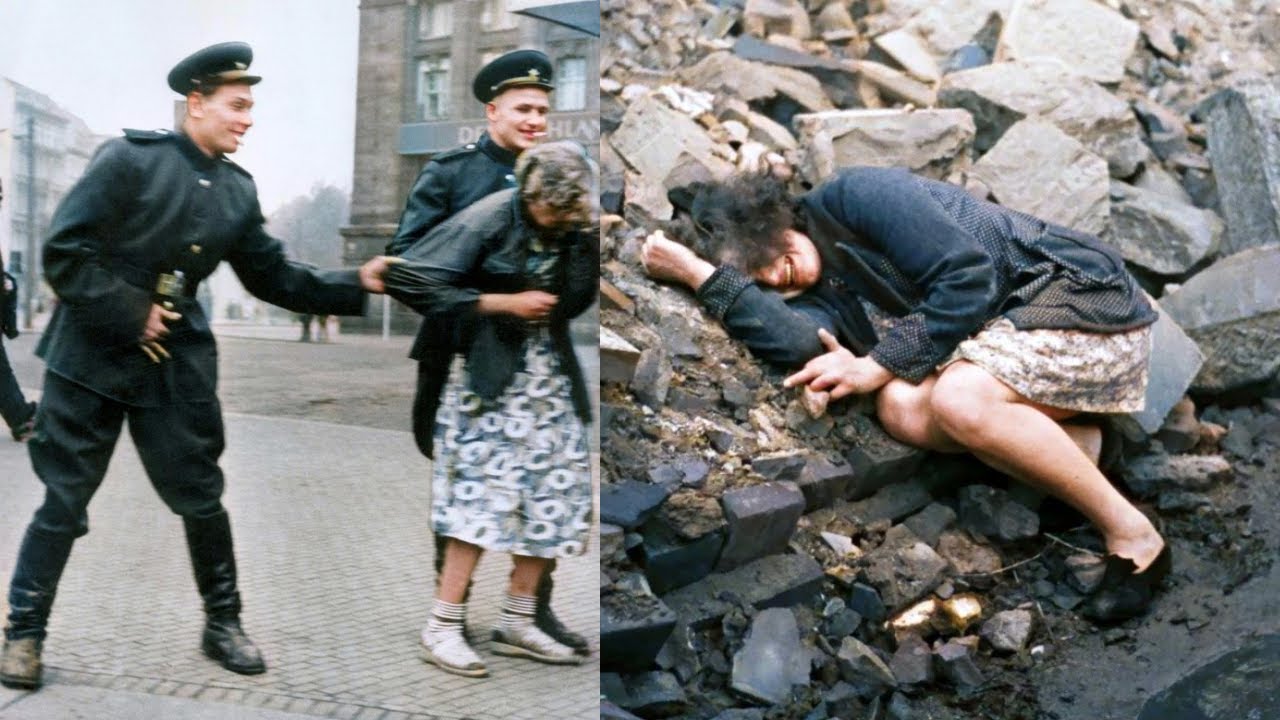 Adolf Hitler, holed up in his underground bunker as artillery pounded the city above him, took his own life on April 30, 1945, but for the women of Berlin, the end of the battle did not bring an end to the terror.
The assault on Berlin’s women was not an isolated phenomenon but the culmination of violence that had followed the Red Army’s westward advance across Eastern Europe. Reports reaching Moscow as early as 1945 described widespread attacks on German women in East Prussia, Pomerania, and Silesia. Soviet order number 006, issued in an attempt to redirect soldiers’ hatred toward combatants rather than civilians, had little effect.
Discipline within the ranks collapsed, and a culture of vengeance — fueled by memories of German atrocities during Operation Barbarossa and by heavy consumption of alcohol — took hold.
Survivors and contemporary accounts describe a city in which no woman was safe. Soviet soldiers assaulted females ranging from young girls to elderly women, often in full view of others. One widely cited account from the period stated that Russian soldiers were attacking every German female “from eight to eighty.”
Women who attempted to resist or who were defended by husbands, fathers, or sons frequently watched those men shot dead or executed on the spot.
The violence was systematic in its cruelty. Soviet troops combed air raid shelters, flashing torches into the faces of terrified women before dragging them out for assault. In one documented incident, officers from the first wave of troops visited a maternity clinic and orphanage, behaved with restraint, and warned the nuns and mothers of what the second wave would do.
Their warning proved accurate. When the second echelon arrived, nuns, young women, elderly women, pregnant women, and mothers who had just given birth were subjected to horrific ordeals.
 Margarete Dörr, a 24-year-old actress at the time, was dragged from a cupboard where she had hidden. A soldier from Central Asia discovered her, and she offered to become his girlfriend in exchange for protection from other soldiers. Instead, he boasted to his comrades, and she was assaulted en masse.
Her story is one of thousands. Women learned to disappear during what they called the “hunting hours,” when Soviet soldiers roamed the streets searching for victims, and to emerge only during the safer early-morning hours when their attackers lay hungover and asleep.
Mothers often gave themselves up to soldiers in desperate attempts to spare their daughters. Women smeared their faces with cold dust and covered their heads with rags, trying to make themselves as unattractive as possible. One survivor recalled huddling with other women in the central part of a basement, shaking with fear, while some peeked through low windows at the Soviet-controlled streets outside.
“We felt paralyzed by the sight of those husky Mongolians looking wild and frightening at the ruin across the street from us,” she remembered.
The scale of the crimes remains difficult to comprehend fully. One Berlin doctor estimated that approximately 100,000 women were assaulted in the city, and that roughly 10,000 died from their injuries or took their own lives afterward. Across Germany as a whole, historians believe at least two million women were attacked by Red Army soldiers.
An estimated two million children were born to German women who had been subjected to these ordeals, many of whom faced social stigma and hardship in the postwar years.
 Not all Soviet soldiers participated, and some accounts distinguish between frontline combat troops and the second echelon that followed. One Berlin woman noted that the frontline Russian troops “who did the fighting” generally left women alone, though they shot every man they saw, including old men and young boys. “It was the ones who came afterwards, the second echelon, who were the worst,” she said.
“They did all the assaulting and plundering. They stripped homes of every single possession right down to the toilet.”
Soviet women serving in the Red Army reportedly watched as their male comrades assaulted and killed German women, and in some cases, the violence was treated as amusement. A Soviet general recounted how a group of 35 provisional lieutenants and their battalion commander entered a women’s dormitory and carried out horrific crimes. Another Soviet soldier, upon encountering captured German women fighters who declared they were avenging their dead husbands, wrote that his comrades suggested stabbing them, though he preferred execution.
The justification offered by many Soviet soldiers was retribution. German forces had committed widespread atrocities against Soviet women during the invasion of the Soviet Union, and many Red Army soldiers believed this gave them license to do as they pleased inside Germany. “Our soldiers’ behavior towards Germans, particularly German women, is absolutely correct,” one soldier claimed, reflecting a mindset in which conquest entitled them to take women as plunder.
In the eyes of many troops, Berlin’s women were spoils of war.
The ordeal did not end with the cessation of hostilities. In the desperate postwar environment, with food scarce and the city in ruins, many Berlin women resorted to selling themselves for food, cigarettes, and other necessities. Cigarettes became a form of currency in the devastated city, and women who had already endured assault found themselves forced into further exploitation simply to survive.
 Men who attempted to defend women against Soviet attackers were shot dead or executed in brutal ways. The violence created a climate of terror in which women had no recourse and no protection. Hospitals across Berlin struggled to cope with the influx of victims, and medical personnel documented injuries consistent with assault and torture.
For many women, the psychological wounds proved as devastating as the physical ones.
The legacy of these crimes has been difficult for both Germany and Russia to confront. During the Cold War, discussion of the atrocities was largely suppressed in East Germany, where Soviet forces remained stationed, and in the Soviet Union itself. Only after the fall of the Berlin Wall and the collapse of the Soviet Union did historians and survivors begin to speak more openly about what had happened.
Today, many elderly women in Berlin still recall the horror of those nights, and the screams that echoed through broken windows during the battle.
Historians continue to debate the exact numbers, but the consensus is that the mass assault of German women during the Battle of Berlin represents one of the largest and most horrific war crimes of the Second World War. It was a campaign of violence that targeted civilians on the basis of gender, carried out in the chaos of a collapsing regime and justified by a desire for revenge. The women of Berlin paid a terrible price for the crimes of their government, and their suffering remains a somber reminder of the human cost of war long after the guns fall silent.