Before sunrise on a spring morning in 1788, on a small branch of Tick Creek in what is now Shelby County, Kentucky, a young man stepped out of a cabin door to gather firewood.
His name was Benjamin Ballard, and he was in his late teens. He did not know that fifteen men had been lying all night in the wet grass and brush surrounding his family's cabin.
He did not know that one of them had been watching the door for hours, waiting for this exact moment — a body in the doorway, a target in the dim light of dawn.
Benjamin bent toward the woodpile. The first shot rang out across the clearing.
You are now inside that morning. Inside a cabin where a father is about to brace the door with his shoulder, where a stepmother is about to run for a back door she will not reach in time, and where a young girl is about to be struck on the head with a tomahawk and left among her family's bodies — and who will, somehow, impossibly, survive.
Two hundred yards away, inside a wooden stockade called Tyler's Station, more than a dozen armed men were about to hear those shots. Almost none of them moved.
In less than an hour, on a patch of ground a person could walk across in three minutes, five members of one family would be killed, and six or seven attackers would die beside them. And a 28-year-old man would begin his transformation into a legend.
But there are two things about that morning that the polished telling of the story has never explained.
The first is the men in the fort. Every account of the Tick Creek massacre says the same strange thing: of all the settlers safe behind that fence, only one went out. One. Not a squad, not a rescue party. A single man, running across 200 yards of open ground toward the sound of his family being killed.
What happened to the rest that morning? Why did they not move?
The second is the child — the little sister the attackers left for dead in the corner of that cabin, her skull opened by a tomahawk. Nothing about what she had seen should have allowed her to survive. But she did.
Now, go back to Tick Creek, spring of 1788.
The Ballard family had come to this creek looking for a beginning, not an end. Bland Ballard Sr. was in his early fifties, from Virginia, from Spotsylvania County — the kind of man who had watched the Tidewater fill up with older sons and wealthier men and decided, in the mid-1780s, that Kentucky was the answer.
He brought his wife, his children, and everything a farming family owned in a wagon, and settled on a small branch of Tick Creek a few miles east of Shelbyville.
His son, Bland William Ballard, was 28 years old, married, and living close enough to his father's cabin to hear a rifle shot from it. He was not yet the Major Bland W. Ballard that Kentucky history books would later enshrine. He was not yet the scout who would campaign against Tecumseh. That morning, he was simply a son.
The family first settled inside or beside Tyler's Station, one of the small fortified stations scattered along the Kentucky frontier — a cluster of cabins surrounded by sharpened logs, garrisoned by perhaps a dozen armed settlers.
But at some point in early 1788, Bland Sr. did something the great Kentucky historian Lewis Collins described in a single cutting phrase. He moved a short distance away from the fort to be closer to his sugar camp.
Two hundred yards. That was the distance between a gate barred with wooden rails and his cabin door. Two hundred yards to turn late-winter sap into sugar. Two hundred yards so a family could turn maple trees into money.
This was not negligence. It was frontier arithmetic, the kind every settler ran in his head — one column labeled danger, the other labeled survival. Bland Ballard Sr. added up his numbers and walked outside the wall.
On the other side of a wide wooded country, in villages along the Scioto and Miami rivers, and to the north, there were men running their own calculations. Warriors of the Delaware and Shawnee, who had watched their families displaced from Pennsylvania and New Jersey, pushed west and west again by the same wave of settlers now building cabins on Kentucky creeks.
Many of them were young, fifteen or twenty years old, riding under experienced war leaders. They had lost mothers and sisters and children too. The frontier arithmetic ran on both sides of every clearing.
Tyler's Station was not a fort in any sense you might imagine from a film. There were no cannons, no stone walls. It was a rectangle of vertical logs sharpened at the top, enclosing perhaps a handful of cabins, a well, and one or two blockhouses with gun ports.
On a good day it might hold ten families. On this day in the spring of 1788, it held enough armed men to make a difference. As it turned out, it did not hold enough men willing to use their weapons outside its walls.
The Ballard cabin itself stood 200 yards from that fence. Two hundred yards is nothing. It is the length of two football fields laid end to end. An adult man can walk it in three minutes at an easy pace. He can run it in under a minute if he is young and afraid.
From the cabin door, anyone standing outside could see the top of the station's stockade. From the stockade, sentries could see smoke rising from the Ballard chimney every morning.
Two hundred yards. Remember that number, because within seven minutes of this account, every person in this story will have his courage tested against those 200 yards. Some will cross it. Most will fail. And one man at the end of that distance will discover he was faster than he thought — and yet, somehow, too slow.
The group that came out of the woods at dawn numbered about fifteen men. Most sources describe them as Delaware, though that identification reaches us through settler tradition rather than any contemporary militia report. They could easily have been a mixed party of Shawnee and Delaware warriors. The frontier did not always classify its enemies precisely.
They carried trade rifles, some muskets, iron- or steel-headed tomahawks on wooden handles, and long knives. They traveled light and fast, as raiding parties always do, relying on dried meat and whatever they could take from the country as they moved.
They knew what they were doing. They were not children playing at war. They were men experienced in military campaigns, capable of lying still in wet spring grass for hours, capable of choosing firing positions the night before, capable of hitting a man's chest at fifty yards in dim light.
The open ground was small — a few dozen yards of cleared land around the cabin, bordered by mixed hardwood forest. The sugar camp was close by: a stand of maple trees, crude wooden troughs collecting sap, perhaps a black kettle smoking over a low fire, because it was late winter or early spring and the sap was still running.
A branch of Tick Creek whispered somewhere among the trees. The ground was wet. A light mist may have hung over the creek at dawn. Every tree within a hundred yards of the cabin door was a place a man could hide. Every tree was a place a man already had.
We need to stop here, because the most important moment in this entire story does not happen inside the cabin. It happens inside a fortified wall 200 yards away, in the mind of a 28-year-old man.
Picture the scene. The first shot has just cracked across the clearing, then the second, then the third. The Ballard cabin is under fire.
Inside Tyler's Station, men woke, seized their rifles, moved to the gun ports, and peered through the narrow slits at the threads of smoke rising from the trees around the Ballard home.
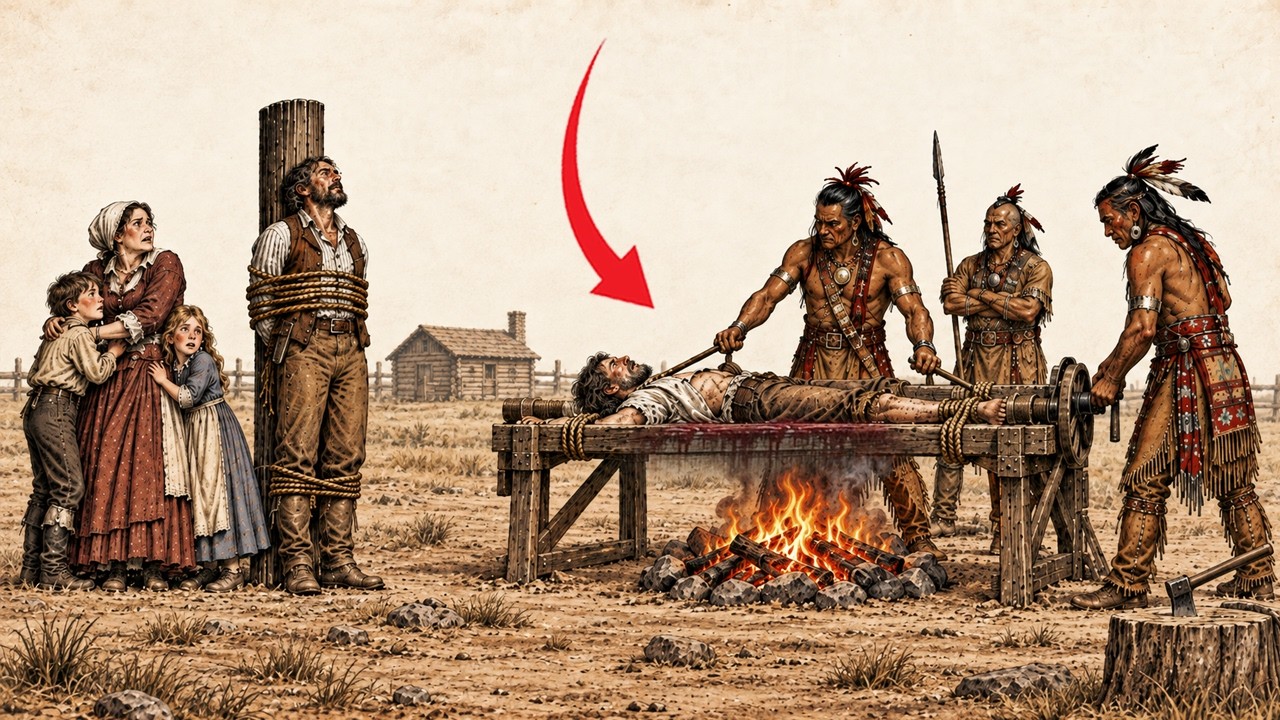
Every one of those men understood what he was seeing. Every one of them knew what was happening to the family in that cabin. Every one of them held a rifle, and every one of them, in that first minute, ran the same terrible calculation Bland Sr. had run when he chose the sugar camp.
If I go, I may not come back. If I stay, they die.
Only one man solved that equation in reverse.
Bland W. Ballard, 28 years old, married, with a son, took his rifle, his powder horn, and his shot pouch, and walked toward the stockade gate.
We do not know whether he said anything to the men around him. No one wrote down what he said. The only detail every account preserved is this: an older man in the fort said he was willing to go with him. But when the moment came, only Bland passed through the gate.
It is not recorded whether he covered the 200 yards in one sprint or in short bounds from tree to tree, from cover to cover. What is recorded is that he crossed it alone while his brother lay dead at the doorway and his father was still alive inside.
Before we follow Bland across that ground, we have to return one last time to the moment everything began.
Benjamin Ballard was probably eighteen or nineteen. No one recorded his exact birth year. He was the sort of young man who did the household work that needed doing that morning. The fire had died down overnight. The cabin was cold, and someone had to bring in wood before breakfast.
So Benjamin opened the door, stepped out into the pale gray light, and walked toward the woodpile at the side of the house.
There were men fifty yards away who had been watching that door all night. The shot that killed Benjamin came from cover, probably from behind a tree at the edge of the clearing, and struck him before he reached the woods.
He fell in sight of the door, in sight of the cabin window, within earshot of his family inside.
This is what life on the frontier actually looked like. Not the pageantry of Fort Ticonderoga, not the drums of Yorktown — a boy stepping out to bring in firewood for the breakfast fire, dying in wet grass before the water boiled. This is how most of the 800 settlers killed in Kentucky in the 1780s died: one at a time, in the middle of ordinary chores.
Inside the cabin, the shot changed everything in an instant. Bland Sr., the only grown man inside, understood immediately what it meant. By every account, he was a stubborn man and a fighter in tight places.
He braced the heavy log door with his shoulder, dropped the bar into place, and moved to a port in the wall with his rifle in his hands. His wife, the stepmother of some of the children, was gathering the girls. The youngest was too small to understand what was happening. Somewhere inside that cabin, someone was already crying.
The sound of the gunfire carried 200 yards to Tyler's Station like a hammer striking a bell. Men inside the wall came awake. They grabbed their rifles, ran to the ports, and looked out. What they saw was smoke, movement in the trees, and the shape of the cabin surrounded by an enemy they could not clearly identify.
And here, in the 1840s, Lewis Collins — drawing on the memories of survivors and their children — wrote his most damning sentence about the settlers of Tyler's Station. He wrote, and this is the exact wording preserved in his "Historical Sketches of Kentucky," that no man in the fort, except the subject of this sketch and one old man, dared to go out to his assistance.
Read that sentence again. No man in the fort, except one. And the old man who said he would go apparently did not go.
There is Bland W. Ballard, and then there is a wall of silence — a wall of armed men who chose the stockade over the cabin.
Do not judge them too quickly. Every man behind that wall had a wife inside the fort. Every man had children. Every man ran the same arithmetic as Bland Sr. and chose the safer answer. The wall was the reason they were alive. Leaving it, for most of them, was madness.
Bland W. Ballard was about to prove that madness was exactly what the morning required.
The gate opened. Bland W. slipped through.
The 200 yards between Tyler's Station and his father's cabin was not open ground. Part of it was clear pasture. Part of it was the edge of woods. There may have been fence posts, scattered logs, a rise in the ground.
He did not run in a straight line. He moved in broken steps, the way any frontier man moves when he wants to stay alive under fire — running to a tree, kneeling on one knee, reloading his rifle, listening, then running again.
The cabin was still holding when he came within range — fifty yards, maybe seventy-five. Close enough for his long rifle to be deadly. Far enough that the attackers surrounding the house would have to search the trees to find him.
He chose his first target and fired.
The frontier long rifle, in the hands of an experienced man, was one of the most accurate small arms in the world in 1788. Its ball, driven by a good charge of powder, could kill at 200 yards in the open. At fifty yards, it did not miss.
Bland's first shot echoed across the clearing, and one of the men surrounding his father's cabin went down.
Now the attackers had a problem. The house was still holding out in front of them, and now, somewhere behind them, there was a rifle killing them one by one.
But inside the cabin, the situation was becoming unbearable. Fifteen attackers is a large number, and even after two were killed — one by Bland Sr.'s rifle, one by Bland W.'s — twelve men were still working around the walls. Some fired at the ports while others attacked the door with tomahawks.
Log by log, blow by blow, the cabin's defenses began to fail.
Inside, the air was thick with black powder smoke. Bland Sr. fired, reloaded, fired again. He swabbed the barrel, measured powder with shaking hands, primed the pan, squeezed the trigger. His eyes burned. His ears rang.
His wife pressed against the back wall with the children. His full sister and his half sister were somewhere in the small room. The youngest, very small, may have been in her stepmother's arms or hidden under something.
You have to understand what an untreated log cabin is. A rifle ball will bury itself in seasoned oak. A tomahawk will not. And a determined man with a tomahawk, given three or four minutes, can turn a barred door into splinters.
The Ballard family did not have enough time.

The door broke. We do not know exactly how. Was it a final blow that split the bar, a tomahawk through a hinge, a frame collapsing from the top down? What all accounts agree on is that the attackers got in. And once they were in, the fight became something Kentucky log walls were never built to withstand.
Bland Ballard Sr. did not go down easily. The frontier history of Shelby County, based on the memory of old settlers, is precise: he killed one or two of the attackers inside the cabin before he himself fell.
Picture the place — no more than fifteen or twenty feet long, a low ceiling, black powder smoke thick enough to sting, women and children pressed against the walls, a fire pit somewhere in the middle. And through the broken door, men coming in with tomahawks and knives.
Bland Sr. would have fired his rifle at the first man, then swung it like a club at the second. There was no time to reload. In a room that small, surrounded by hands on every side, a rifle was more a piece of hardwood than a firearm.
One attacker came at him, maybe two, and then someone struck him with a tomahawk. Or a rifle ball, or both. He fell.
Somewhere outside, Bland W. Ballard was reloading behind a tree fifty yards away, and he did not yet know his father was dead. He did not yet know his brother was dead. He was firing shot after shot, trying to reduce the attackers from fifteen to fourteen, to thirteen, to twelve. He had no idea that the number that mattered was inside the cabin.
And that number was already falling.
The full sister died in the cabin. So did the half sister. The two young women fell in the same small room where their father had just fallen, in a scene of violence so compressed that survivors could not separate seconds from minutes.
And while the cabin was being overrun, one man at the edge of the clearing was becoming the story Kentucky would preserve.
"Frontier Shelby County" tells the story plainly: "Bland W. Ballard approached his father's house, where he used his rifle with great skill, killing one or two Indians." That is the sober historical account.
The family account, told by Bland himself for decades afterward and passed down through his descendants and Collins, goes further. In total, Bland W. is credited with killing six or seven men over the course of the entire fight. Six or seven out of fifteen — nearly half the attackers. With one rifle, by one man.
Imagine the rate of fire. A frontier marksman experienced in combat can fire two shots a minute if he is fast, if his powder is dry, if his hands are not shaking. Bland W. was fast, but his hands were shaking. He was shooting at the men who had just killed his brother at the doorway of a house. Every shot he fired in that clearing was a shot he would remember for the rest of his life.
He moved from cover to cover — a tree, then another tree, then a rise in the ground. He reloaded on one knee. He fired again. Every shot was aimed. Every shot, at fifty yards in morning light, was probably a hit. And every hit meant a warrior falling in the grass around his father's cabin — sometimes right at the walls of the house he was trying to save.
The attackers now knew there was a marksman in the woods behind them. They did not yet know it was one man.
Inside the cabin, the stepmother made a decision any mother might make in her position. She ran for the back door.
She had, judging by the number of attackers still inside the house at that moment, perhaps a slim chance of survival. The main attackers were pressing from the front and the walls. If she could reach the back and get into the woods, she might live. She might reach the fort. She might find somewhere to hide.
She got the back door open. She stepped outside — and a warrior, one of the attackers ringing the house, was behind her within seconds. He raised his tomahawk to strike her from behind as she ran.
Outside, among the trees, Bland W. Ballard saw what happened.
This account is preserved in one of the most affecting sentences in Kentucky frontier history. The story says his stepmother was being chased by an Indian whom his stepson shot as he raised his tomahawk to strike her. The Indian was not killed in time to prevent the fatal blow.
Read that again. The Indian was not killed in time to prevent the fatal blow.
Bland W. hit his target. His rifle ball killed the warrior who was raising his tomahawk over his mother's head. But the tomahawk had already begun to fall. The dead man's arm completed its swing. The blade struck her — her skull or her shoulder, we do not know precisely — and she fell beside her attacker in the dirt outside her own back door.
Two men died in that instant. One by rifle ball, one by an iron head on a wooden handle. And the man who fired the rifle spent the rest of his long life knowing that he had been fast — the fastest man on the Kentucky frontier that morning — and yet half a second too slow.
That kind of memory makes a certain kind of man. That kind of memory makes a song for Major Bland W. Ballard.
Inside the cabin, one child remained. She was small, apparently under ten years old. She had watched her father fall and her sisters fall. She had watched her stepmother reach the back door and disappear toward what she hoped was safety. She was alone in a room full of her family's bodies and living raiders.
The warriors were not taking captives at that moment. It was a raid, and close-range raids ended in overwhelming violence. One of the attackers came at her with a tomahawk and struck her on the head.
She fell among her family members, and the attackers left her for dead — believing, as any reasonable person would, that a child struck that way, in that place, with that weapon, could not survive.
But she did not die.
The record of American frontier violence is full of miraculous survivals, and most of them, on close inspection, turn out to be exaggerations. This story is different. Two separate nineteenth-century sources, drawing on independent family testimony, confirm the same fact. The youngest Ballard sister was struck with a tomahawk in that cabin, left for dead, and recovered.
She grew up. She lived. And she carried the scar of that morning on her body for the rest of her life. Every relative who looked at her forehead was looking at a piece of American history that no monument commemorates.
Outside, Bland W. Ballard was still firing.
Six or seven of the attackers were down. The rest of the party — perhaps eight or nine men still standing — realized they had lost too much. The house was theirs. The family inside it was dead, as far as they knew. But that rifle was still in the woods, Tyler's Station was still 200 yards away, and daylight was rising.
They withdrew.
We do not know exactly at what moment the attackers decided the fight was over. There is no clock in the account, no marker for the second the last warrior turned from the cabin toward the trees. But at some point that morning, probably only an hour after Benjamin Ballard bent toward the woodpile, the survivors of the attacking party gathered what they could carry and what they could move of their wounded, and vanished back into the Kentucky forest with the same speed and silence with which they had come.
Bland W. Ballard came out from among the trees.

Picture him crossing the clearing to his father's cabin, his rifle in one hand, empty now, his hands and face streaked with powder. The yard around the cabin was full of the bodies of raiders he had killed himself, and the body of his brother beside the woodpile. As he stepped through what remained of the front door, he saw the bodies of his father and his sisters. When he went out the back door, he saw the body of his stepmother beside the man who had killed her.
And then, because he checked the place, because every survivor in a room like that checks, he found his youngest sister breathing.
There are moments in history that are recorded and remembered because a great man gave a great speech. And there are other moments, most of them in fact, that are recorded only because a family remembered them — because someone survived to tell it to someone else, because the child in the corner lived.
The Tick Creek massacre exists in the historical record for one reason: the man who witnessed it survived, and he never stopped telling the story.
Somewhere outside the cabin, in the next few minutes, the men of Tyler's Station finally began to come out. The old man who had promised to go, and others, walked across the 200 yards they had refused to run.
The place they reached was silent. The sugar camp was silent. Even the branch of Tick Creek running quietly through the woods was silent. The only sounds, according to the way this story has been told for 236 years, were a man kneeling beside his father's body and a child's uneven breathing.
When you count what happened inside and around the Ballard cabin on that spring morning in 1788, the numbers are small — the kind of small that gets lost in the narratives of great campaigns and famous battles. But every one of them belonged to someone.
Five dead from the Ballard family, six or seven dead raiders, one child struck with a tomahawk, one soldier covered in powder, and a fort full of men who watched from behind a wooden wall and would spend the rest of their lives, or the lives of their neighbors, trying not to talk about what they did not do.
Lewis Collins wrote, decades later, that the account of events was clear and deliberately tragic. He wrote that the Indians also killed a full sister, a half sister, and the stepmother, and struck the youngest sister, a child who survived, with a tomahawk.
That is the complete list in a single sentence: a full sister, a half sister, a stepmother, and a child. Add to that list the father, killed inside the cabin defending the door. Add Benjamin, killed outside at the woodpile before the fight even began.
Five members of one family, in one morning, in one clearing — and nine dead in total, if the attackers are counted, in the same wet spring ground.
The child survived. She survived a blow that was meant to be fatal, delivered by an experienced warrior with a weapon designed for exactly that purpose. She was cared for until she recovered in the weeks and months that followed. She grew into a young woman and probably lived a life about which we know almost nothing, because frontier history was written about the men who fired the shots. The girl who miraculously survived was mentioned only as a footnote in someone else's biography.
And here we return to the men in the fort — to the armed wall of silence behind the stockade.
What happened to them? History does not record their names. And that, in a way, is its answer. Bland W. Ballard's name is preserved on memorial plaques, in county histories, and in state records. The men who stayed inside are anonymous, absorbed into the population of Tyler's Station.
We do not know whether they made peace with what they did, or justified it to themselves in private, or whether their children later wished the story had gone differently. History gave them exactly what they chose that morning. It gave them the stockade. And it kept them behind it.
Even Bland W. Ballard himself walked out of that clearing a different man from the one who had entered it. He was 28 years old. He killed six or seven men with a rifle in under an hour. And he watched his family destroyed at close range while he did it.
What that does to a person is not documented in his file. What we can say is what happened afterward. He became one of the most respected scouts on the Kentucky frontier. He fought in campaigns against Native forces in the Ohio Valley. He served in the War of 1812. He took part in operations that pursued Tecumseh.
Every biography of Major Bland W. Ballard describes him as an experienced Indian fighter, and every one of them is correct. But no biography I have found states the obvious truth. He was not born experienced. He was forged on a specific morning on a small branch of Tick Creek, when he was 28 years old and could not run 200 yards fast enough.
Every campaign he fought for the rest of his life was, in a sense, a campaign against that morning.
He lived a long life. Genealogical records indicate he died in 1853 in Shelby County, Kentucky, 65 years after the attack, on ground no more than a day's walk from the cabin where his father died. He was in his nineties.
He outlived by decades everyone who had been present in that clearing that morning, everyone who survived the attack, every man behind the stockade — even the little sister who survived the tomahawk. He was the last living witness to the Tick Creek massacre, and then he was gone.
News of the attack spread the way frontier news always spread — slowly, by word of mouth, from Tyler's Station to Shelbyville, from Shelbyville to Louisville, from Louisville to Virginia. There was no newspaper report, no official militia dispatch, nothing to set beside the records of America's great battles. There were only stories told beside fires in other cabins, at other stations, along other creeks — stories that helped shape the course of the wider frontier war.
The Ballard family's dead were buried near the station the way frontier dead were buried: quickly, in shallow ground, without carved stones. The exact location of their graves was lost. The cabin disappeared. The sugar camp disappeared. The stockade of Tyler's Station disappeared. Even the branch of Tick Creek runs through land so changed by roads and farms that a visitor today could stand on the exact ground where Benjamin Ballard died and see no sign of it.
But the story remained. It remained because Bland W. Ballard survived and told it — to his wife, his children, and the neighbors who came to sit with him in his old age. It remained because Lewis Collins wrote it down in the 1840s in his history of Kentucky. It remained because twentieth-century genealogists searched for it and found it in the archives of the Filson Club and in local county histories. And it remained because someone retells it now and then.
Over time, the Tick Creek massacre became one of those Kentucky stories that appears in county histories and family books but never in the national narrative. By the standards of American history, it is a small event. Five people, one morning, one small clearing.
But that is exactly what most of American frontier history actually was. Not Yorktown, not Saratoga. A father and a son on opposite sides of a 200-yard clearing, the son running, the father dying, and the ground between them filling up, year after year, with more clearings, more cabins, more mornings.
Here is something the short version of the story does not tell you. What Kentucky memory calls the Ballard massacre is not a single event at all. A Kentucky Historical Society marker in the area points to an October date that other sources contradict. The account you have just heard is dated by some genealogists to March 1788, by others to an unspecified spring, by others to an entirely different month. In fact, more than one incident involving the Ballard family occurred on this frontier, and county memory quietly blurred them together.
Even the identification of the attackers as Delaware, repeated as fact in most modern retellings, comes from later tradition rather than any contemporary militia report. The historical record is thinner than the story makes it sound.
There is another silence in this account worth noting. The attackers. The six or seven who died beside the Ballard cabin have no names in the historical record. They had names. They had families. They had mothers somewhere along the Scioto or the Miami who never learned exactly how their sons died — only that a party of warriors went south and not all of them came back.
The Ballard family remembered every one of its dead in precise detail. The attackers' dead were counted in settler accounts only as numbers: six or seven. They suffered a loss. That is what the frontier did to memory. It gave one side names and left the other side as arithmetic.
Major Bland W. Ballard is often described in Kentucky history as an Indian fighter, as though his career began the way a man's career begins in law or farming. It did not. His career began on the morning his brother died at the woodpile, his father died inside a barred door, and his stepmother died steps from safety. His famous career was, at its core, a personal wound stretched across 65 years of frontier wars. Every history that describes him as hardened is describing the shape of a scar. And every history that omits the child hiding in the corner is describing the shape of what we choose not to see.
Go back to where we started — to a boy stepping out of a cabin door before sunrise in the spring of 1788, to the fifteen men in the wet grass, to the 200 yards between a wooden stockade and a cabin, and to the one man in the fort who ran it.
You now know what he found at the end of that run. You know what happened to the child hiding in the corner. You know what the men behind the stockade did and did not do. And you know that the man who covered those 200 yards spent the rest of his life covering them again and again in every campaign he fought, until he died at about 94 in the same county where his brother fell.
Some battles are remembered because they changed the map. Others are remembered because someone survived to tell what happened on that small patch of ground. This was one of them.