On July 24, 1933, a woman knelt in the wet grass of an abandoned Iowa amusement park with her husband's head in her lap. She could barely see him. Glass had gone into her eyes five days earlier, and her left eye was already lost for good.
Her name was Blanch Barrow. She was 22 years old. Behind her, two people she knew well were running for the river. They were not coming back.
For more than 90 years, the story has been that Bonnie and Clyde left her behind. Blanch told a different story. She wrote it down in pencil in a prison cell, and nobody read a word of it for 71 years.
She was born Benny Iva Caldwell in early January 1911 in Garvin, Oklahoma. Her parents split up when she was small, and her father raised her alone. He cut timber, farmed, and by some accounts preached on Sundays.
At 17, her mother arranged a marriage for her to a man who was much older and had money. There was something in the arrangement for her mother. It went bad fast. He was violent with her, and the injuries were serious enough that she would never be able to have children. She got out, and the divorce came through in 1931.
Before that, on November 11, 1929, she was in Dallas County hiding from the man she had run from when she met Marvin Barrow. Everyone called him Buck. He was eight years older, twice divorced, and had three children.
A few weeks after they met, Buck was shot and taken by police after a burglary in Denton, Texas. He went into the Texas prison system. On March 8, 1930, he walked out of the Ferguson prison farm near Midway, took a guard's car, and drove to West Dallas where Blanch was living.
This is where the record splits in two. For most of her life, Blanch's account was that she had no idea what he was, and that she found out afterward. That is the version she gave the men in Missouri who had the power to shorten her sentence. It is the version that ran in the newspapers, and the version most people carry to this day.
Late in her life, she sat down with a historian named John Neal Phillips, the man who would eventually edit her memoir, and told him something else. She told him she knew. She told him she hid with Buck while the state was looking for him, and that she went out on the robberies with him.
Two accounts, decades apart, from the same woman. One was given to men who could take years off a sentence. The other was given to a historian at a point in her life when there was nothing left to take off.
They married on July 3, 1931, in Oklahoma. Then Blanch did something that does not sit comfortably in either version. Two days after Christmas that year, she put her husband in a car and drove him to the front gate of the penitentiary at Huntsville, Texas.
Buck walked up to the officials and told them he had escaped almost two years earlier and would like to come back in and finish his sentence. They were surprised. Then they took him.
A little over a year later, in March 1933, he walked out with a pardon in his pocket, signed under Governor Ma Ferguson's plan to thin out the Texas prison rolls. The conviction was wiped clean from his record.
Whichever version of those four years you take, they end at the same place. She married him. She drove him back to a prison gate herself. She waited out the sentence. And in March 1933, at 22 years old, Blanch finally had a husband with nothing outstanding against him.
Three weeks later, she was sitting in a garage apartment in Missouri when two carloads of officers pulled into the driveway.
It started with a visit. Clyde came to see his brother. There was drinking, and a conversation out in a parked car that Blanch was not part of. When Buck came back inside, he had made his brother a promise. He was going to Joplin.
Blanch said no. She said it more than once. She got in the car only after Buck told her he was going without her.
In late March 1933, the group settled into a garage apartment on a quiet street in Joplin, Missouri, two floors over a double garage. The neighbors noticed things. The shades stayed down in the daytime. Cars went in and out of the garage at hours when working people are asleep. A lot of beer bottles went into the trash for two couples who never seemed to leave the house.
Somebody made a phone call.
On April 13, two carloads of local officers rolled up the driveway. They believed they were dealing with bootleggers. Two of those officers did not go home that night.
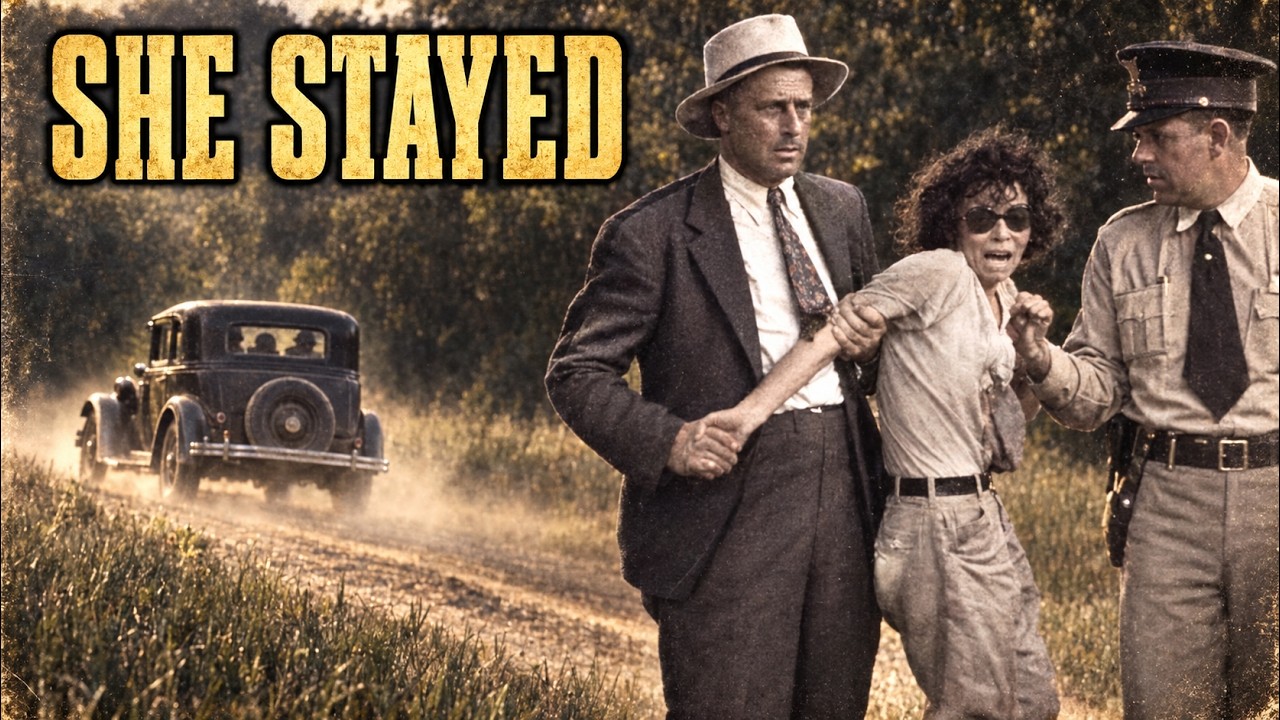
Blanch was out in the street when it started. She had gone after her dog. Somebody caught her by the arm and pulled her into a car that was already rolling. By the time she got the door shut, everything she had built since Huntsville was behind her on that street.
She wrote about that moment years later, describing how she watched her whole life come apart around her while the car pulled away. She did not fire a weapon that day. She did not fire a weapon at any point in this story.
But that is not what the country was about to learn about Blanch Barrow, because of what they left behind in that apartment. They left a marriage license with two names on it, hers and Buck's, and they left a roll of undeveloped film.
The police developed it. What came out of that dark room were photographs of a young woman with a cigar clenched in her teeth, leaning back against the bumper of a Ford, and a young man in a suit holding a shotgun. Both of them clowning for the camera like a couple on vacation.
Up to that point, most people in America could not have told you what any of these people looked like. After Joplin, everybody knew.
Those pictures went out over the wire services. Within a week, they were in papers from Texas to New York, run across four columns with captions underneath. Editors printed them again every time anything happened for the next 13 months, until the two people in the most famous of them were dead.
The Barrow Gang stopped being a regional police problem and turned into something the whole country followed, like a serial in the Sunday edition. Blanch Barrow's name was in every one of those papers. So was her picture. So was the marriage license, photographed and reprinted with her signature at the bottom.
She was 22 years old, and she could not go home.
Three months later, in a motor court in Missouri, it would not be the bullets that got her. It would be the windows.
In June 1933, somewhere outside Wellington, Texas, Clyde came up on a road-closed sign in the dark and did not see it. The car went off the end of a bridge, down into a ravine, and caught fire. Bonnie was pinned underneath it. By the time they got her out, her leg was burned so badly she could not stand without somebody holding her up. For weeks afterward, she had to be carried in and out of buildings.
That is the reason all five of them had to stop moving.
On July 18, 1933, they pulled into the Red Crown Tourist Court just south of Platte City, Missouri. Two brick cabins joined together by a pair of single-car garages. It sat at a highway junction, which is exactly why Clyde picked it. Roads ran in four directions.
They were there two nights. Bonnie could not walk. Clyde spent the daylight hours in that garage with the hood of the Ford up. On the second night, Buck and Blanch sat and talked about going north to Canada and living as trappers, which left Blanch as the one who had to walk outside and be a normal person in front of strangers.
In two nights, this is what the people at the Red Crown noticed. Five dinners going out to the cabins every evening, wrapped in paper, with nobody ever coming in to eat. A woman paying for those dinners in silver coins instead of bills. A trip into town for bandages and rubbing alcohol. And that woman in riding britches, which nobody around Platte City wore, never once coming inside and never once standing where the light from the tavern door could reach her face.
Somebody made a phone call about that, too.
The night of the 19th, running past midnight, a posse came up the highway with an armored car and pulled it broadside across the garage doors. What happened next lasted a few minutes. There were automatic weapons going off on both sides of those cabin walls.
Buck was hit in the forehead. The bullet went straight through the front of his skull.
They got the Ford out. Clyde put it through the gap and onto the highway, and as it went, a burst of fire raked straight across the rear window. The glass did not break into pieces. It came apart into powder and slivers, and all of it went forward into the car.
Blanch was in the back seat. It went into both of her eyes. A fragment cut her scalp right at the hairline. She lost the sight in her left eye that night, and she never got it back.
This next part matters, because almost every version of this story you will ever hear gets it wrong. Most retellings put that injury in Iowa. Markers say it. Articles say it. Books have said it. It did not happen in Iowa. It happened in Missouri, five days earlier, at a motor court off a highway junction.

By the time Blanch Barrow reached that field in Iowa, she had already been effectively blind for five days.
They drove north through the dark with the windows shot out of the car. At some point, they stopped and somebody held a flashlight while somebody else went into her eye with a pair of tweezers, trying to get hold of a piece of glass. The tweezers kept sliding off it. They gave up. She rode the rest of that night with both hands over her face.
Buck was worse. Three and four times a day, they poured drugstore hydrogen peroxide into the wound in his forehead and let it foam. Nobody in that car had one hour of medical training.
The sheriff who caught up around outside those cabins was named Holt Coffey. In September, he would drive Blanch Barrow to prison himself.
They ran north through the rest of that night and most of the next day and stopped outside a town called Dexter, Iowa. The place they picked was an abandoned amusement park. Dexfield Park had been a going concern before the crash. There had been a swimming pool and a dance pavilion, with concession stands along a path that ran through the trees. By 1933, the pool was empty, the pavilion was shut, and the whole thing was just woods with a river running along the bottom of the slope.
They set up a camp: blankets on the ground, a fire ring. Five people, every one of them hurt, living outdoors in the middle of an Iowa July. They washed bandages in the river and hung them on branches to dry.
Buck could not sit up on his own. Blanch fed him and changed the dressing on his head, working mostly by feel because she could not see well enough to do it any other way.
They stayed four or five days. One morning, a troop of Girl Scouts camping in that same park went out on a hike, came up the path past the camp, and waved. According to the local historical record in Dallas County, the girls found out later who it was they had waved at.
Then somebody found bloody bandages in a ditch. Word got around Dexter fast. People in that town worked out who was camped in the old park, and they started making telephone calls.
Bonnie and Clyde kept driving into town for meals anyway. On the 23rd, they picked up hot dogs to cook for breakfast.
The next morning, around 5:00 a.m. on July 24, roughly 50 men closed in on the park. They blocked the bridge. They blocked the road out. A twig snapped. Clyde heard it and shouted, and the whole posse opened up on that stand of trees at once.
The first car hit a stump before it made 20 feet. The second car would not start. The posse had already put rounds through the engine.
Buck went down. He was hit six times in the back, on top of the head wound he had been carrying for five days. Clyde, Bonnie, and W.D. Jones went down the slope toward the water. Every one of them was hit.
Blanch was the only person in that clearing who was not wounded that morning. She could barely see. She was also the only one of the five who could have made it to the river.
She did not go.
The version that ran in the papers that week, and the version most people still carry, is that Bonnie and Clyde abandoned her in that park. The account Blanch gave first to the men who arrested her, and later in her own handwriting, is that she was not left behind. She stayed. She would not leave Buck lying on the ground.
Both versions are on the record. Neither one has ever been settled. What is not in dispute is where she was standing when the shooting stopped. They took her with her hands over her face, still on her knees in the grass.
A mile away, Clyde came up on a farmhouse belonging to a family named Feller, out of ammunition, and demanded a car. The son, Marvel Feller, told the story for the rest of his life. Clyde got behind the wheel of the family car and could not work it. A farm boy in Dallas County, Iowa, had to lean in through the window and show Clyde Barrow how to shift the gears. That is the last thing Iowa kept of him.
They brought Buck to King's Daughters Hospital in Perry, Iowa, under guard, because there was real fear that Clyde would come back for his brother. They brought Blanch in with him. There were reporters in that hallway within hours. Photographers had already gotten their picture that morning out at the park: 22 years old, hair in her face, being walked out of the trees. It ran in papers across the country.
The doctors got a look at the head wound and could not get over it. A bullet had gone through the front of this man's skull five days earlier in another state and had been treated in the back of a moving car by people with no training and a bottle from a drugstore counter. And it was clean. They put it in the report because they did not believe it.
That peroxide was the one thing anybody had done right. It kept him going for 10 days.
Buck was awake. He talked to them. He ate. He told the doctors the aspirin was handling the pain in his head just fine. The pain that was bothering him was the one in his back. He talked to the officers guarding the door. He admitted to things nobody had charged him with, and they wrote all of it down.
They went in after the bullet. It had come in through his back, glanced off a rib, and lodged against his chest wall. The doctors expected that surgery to give him pneumonia. They did it anyway. Then his temperature went to 105 and would not come down. His limbs stopped working. Pneumonia set in.
On July 29, 1933, Marvin Barrow died in that hospital in Perry, Iowa. He was 30 years old. He had been out of Huntsville, pardoned and legally clean, for four months and one week. Blanch was in the room.
Missouri wanted her. She was extradited and charged with assault with intent to kill. The victim named on that charge was Sheriff Holt Coffey of Platte County. She had not fired a weapon at Platte City or anywhere else. In 1933, that was not a defense the courts had much use for.
In September, Coffey drove her to the penitentiary himself. Federal agents came to see her. She was the only member of that gang in custody anywhere, and Bonnie and Clyde were still out there. She gave the agents nothing.
In May 1934, she read about a road outside Gibsland, Louisiana, same as everybody else.
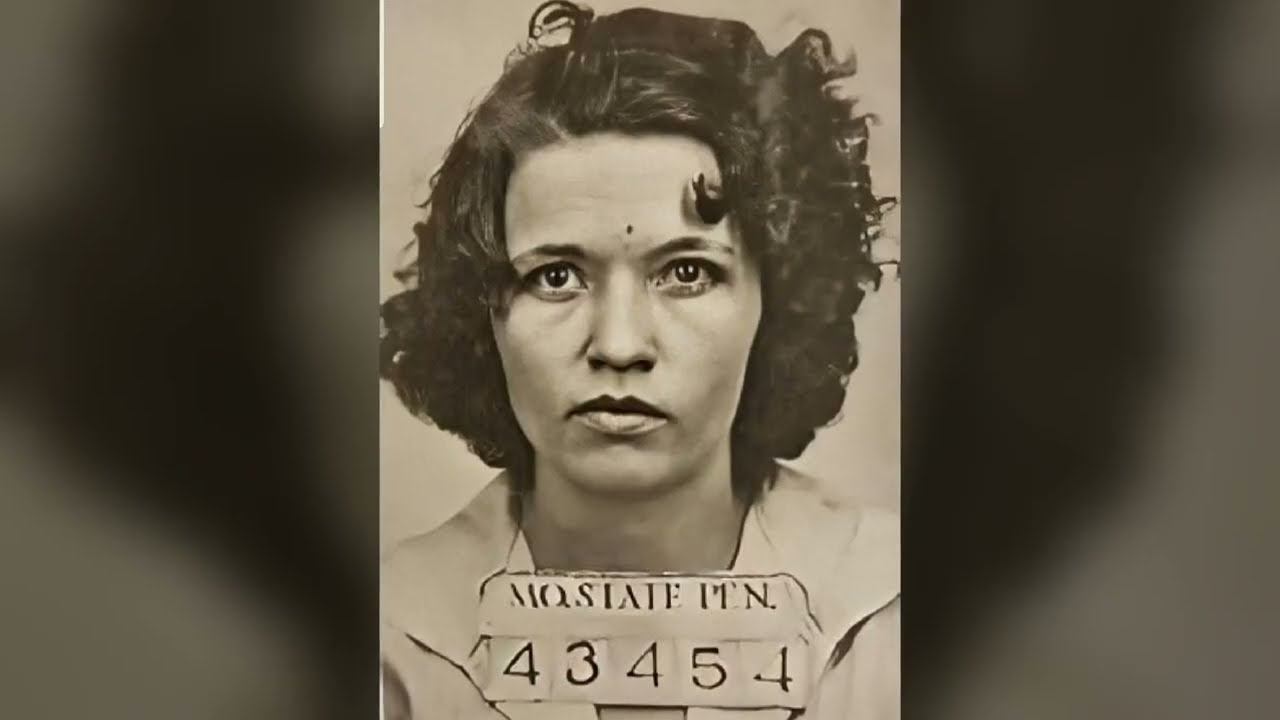
Somewhere in those six years, in a cell in Jefferson City, Blanch Barrow picked up a pencil and started writing down what had happened in those four months. It grew into a full manuscript. She never showed it to anybody.
On March 22, 1939, the governor of Missouri, Lloyd Stark, signed a conditional commutation. Ten years came down to six. Three days later, she walked out on a paper that sent her to her father in Garvin, Oklahoma, put her on two more years of probation, and ordered her out of Cole County for good.
Then there is a letter dated April 16, 1940, from Robert Edson, director of probation and parole for the state of Missouri. Blanch Barrow had applied to the state for permission to get married. Edson wrote back that after a thorough investigation, permission was granted, and that he hoped it helped her settle.
She married a carpenter named Eddie Frasier, finished her probation, and stayed married to him until he died in 1969.
In the middle of the 1960s, Warren Beatty knocked on her door. He wanted the rights to her name. Here is the part that separates her from everybody else ever put in a movie: she did not sell blind. She read the script. She approved it. She signed.
Then the script changed.
On August 13, 1967, the picture opened. It had been made for about $2.5 million and took in more than $70 million worldwide. Blanch went to a theater and watched it. What she found on that screen was a shrieking hysteric whose whole job is to panic and wail and make Bonnie Parker look capable by standing next to her. Blanch said the performance made her look like a screaming horse's ass.
On April 10, 1968, at the Santa Monica Civic Auditorium, two days later than scheduled because Dr. King had been killed on the 4th, that picture went in with 10 nominations. It won two. One of them went to Estelle Parsons, best supporting actress, for playing Blanch Barrow.
Blanch was 57 that spring, in a house in Dallas. The only member of that gang who lived long enough to correct the record was the one whose record got rewritten in front of her, with her signature on the paperwork that allowed it.
That film put Bonnie and Clyde into American memory permanently, and the version of Blanch Barrow that went in alongside them is one she said was invented. She and Beatty stayed on good terms for the rest of her life.
She died of cancer in Dallas on December 24, 1988. She was 77. Ronald Reagan was still in the White House.
Buck Barrow is buried at Western Heights Cemetery in Dallas. Clyde was put in beside him 10 months after Iowa. Blanch is a few miles away at Grove Hill Memorial Park. The name on her stone is Blanch B. Frasier, not Barrow.
She spent 55 years getting out from under that name, and she is buried under a different one, in a different cemetery from the man she would not leave lying in the grass.
Sixteen years after she died, the University of Oklahoma Press published the pencil manuscript, edited by John Neal Phillips, under the title she gave it. Every serious account of the Barrow Gang written since leans on that book. It is the fullest account anybody left from inside that car.
The most reliable witness to the most famous crime spree in American history spent 55 years being contradicted by people who were never there, and by a version of herself she gave a parole board in 1933. The myth got into theaters in 1967. The witness got into print in 2004.
That gap is the whole story.