The spring of 1945 was not a season of triumphant parades for American soldiers in Europe. It was a descent into horror that shattered the psychological foundation of the men who marched into the collapsing heart of the Third Reich.
To understand the confrontation that followed between the U.S. military's highest ranks and its own legal apparatus, one must first picture the American infantryman in those final weeks of the war. These GIs were not fresh recruits. They were traumatized, exhausted veterans who had survived Anzio, the Battle of the Bulge, and the brutal urban fighting of the push across the Rhine.
Their reality had been reduced to the mechanics of survival. The violent death of close friends was a daily occurrence. They believed they had already seen the worst that human beings could do to one another. They were mistaken.
As Allied forces pushed into southern Germany and approached the town of Dachau, these battle-hardened soldiers crossed a threshold from conventional warfare into industrialized, systematic evil. When the men of the U.S. 45th Infantry Division, known as the Thunderbirds, breached the outer perimeter of the Dachau camp complex in late April, they were not met by enemy fire.
Before reaching the main gates, the advancing troops came upon a line of 39 railway boxcars sitting on a rusted siding. Inside the open, weather-beaten cars were the emaciated remains of thousands of human beings. The victims had been packed into the freezing, windowless cars days or weeks earlier and left to die of starvation, dehydration, exposure, and disease.
The American soldiers, accustomed to the sight of fallen comrades and enemy dead, could not process the scale of this mass murder. The stench of rotting flesh and human waste hung so heavily in the damp spring air that combat veterans dropped their weapons, fell to their knees in the mud, and vomited. They stared into the faces of murdered children, women, and the elderly.
In that moment, the traditional rules of engagement evaporated. A raw, primal rage pulsed through the American troops. It was within this crucible of trauma that the heavily armed GIs finally advanced on the SS guards who had operated the camp.
As the Americans swarmed the compound, the German SS personnel did something that severed the last thread of American restraint. The guards, the architects of the starvation and the mountain of corpses on the death train, stepped forward in immaculate, pressed uniforms. Their boots were polished to a shine. They raised their hands and offered a formal military surrender, citing the Geneva Convention.
They expected to be treated as honorable prisoners of war. They expected hot meals, warm beds, and the protections of international humanitarian law. They looked at the traumatized, filthy, sobbing American soldiers and demanded their legal rights.
That was the moment the human mind could not tolerate the paradox. The Americans looked at the pristine uniforms of the murderers, then back at the skeletal remains of the victims. It was not a coordinated military maneuver. It was an eruption of pure vengeance.
Heavy .30 caliber machine guns were set up. M1 Garand rifles were raised. The roar of American firepower echoed through the concrete yards of the camp. Within moments, dozens of SS guards were gunned down where they stood. The liberators had temporarily become executioners, dispensing an unauthorized form of immediate justice in the shadows of the crematoriums.
In the aftermath, a heavy silence fell over the grounds. The soldiers did not celebrate. They stared at the bodies of the SS guards, their weapons smoking, their minds trying to reconcile what they had just done.
While the front-line troops processed the nightmare they had uncovered, a different war was mobilizing far behind the lines. Within hours, rumors of the unauthorized executions at Dachau and other liberated camps filtered back to rear echelon command posts. They eventually reached the desks of the Judge Advocate General Corps, the military lawyers tasked with enforcing the letter of military law.
These were men in clean, pressed uniforms who worked in warm, well-lit offices. Their understanding of the war was dictated by typewritten reports, legal precedents, and the rigid articles of the Geneva Convention. To these prosecutors, the situation was black and white.
American troops had engaged in the extrajudicial killing of unarmed, surrendered enemy combatants. It was a clear violation of international law, they concluded, and a stain on the honor of the U.S. military. They began drafting investigative files and preparing court-martial proceedings that carried the threat of life imprisonment or death by hanging.
The investigative apparatus moved with cold efficiency. Military police and legal officers were dispatched to the front lines to interrogate the traumatized GIs, treating the liberators of Europe as common murderers. The American soldiers were stunned and felt deeply betrayed by their own government.
They had marched through a frozen hell, witnessed the lowest depths of human depravity, and eliminated the monsters responsible for genocide, only to be threatened with a hangman's noose by lawyers who had never heard a shot fired in anger. Morale in front-line units plummeted as the threat of courts-martial loomed.
The legal officers, brandishing briefcases and law books, demanded accountability and strict adherence to the rules of civilized warfare. They refused to acknowledge the psychological reality of the camps, insisting the law must be applied regardless of the emotional circumstances. They were preparing to drag battle-weary GIs into military tribunals, a move that would have created a public relations nightmare for the Allied forces.
It was at this critical juncture that the commanding shadow of General George S. Patton, Jr. fell across the legal proceedings. Patton, the legendary and deeply controversial commander of the U.S. Third Army, operated on a different philosophical plane than the lawyers pushing for courts-martial.
He was a fiercely aggressive warrior who despised the rear echelon bureaucracy and possessed a fierce, almost tribal loyalty to the combat infantrymen who fought and bled under his command. More importantly, Patton was not a man who read about the horrors of the Holocaust in a clean report.

He had physically walked through the gates of the Ohrdruf concentration camp weeks earlier. He had smelled the rotting flesh. He had seen the charred human remains stacked on the railroad tracks. He had famously vomited behind a shed, overwhelmed by the evil of the Nazi regime.
Patton understood on a visceral level that the men of the SS were not traditional soldiers engaged in honorable combat. They were the architects of a mechanized slaughterhouse operating outside the boundaries of human morality.
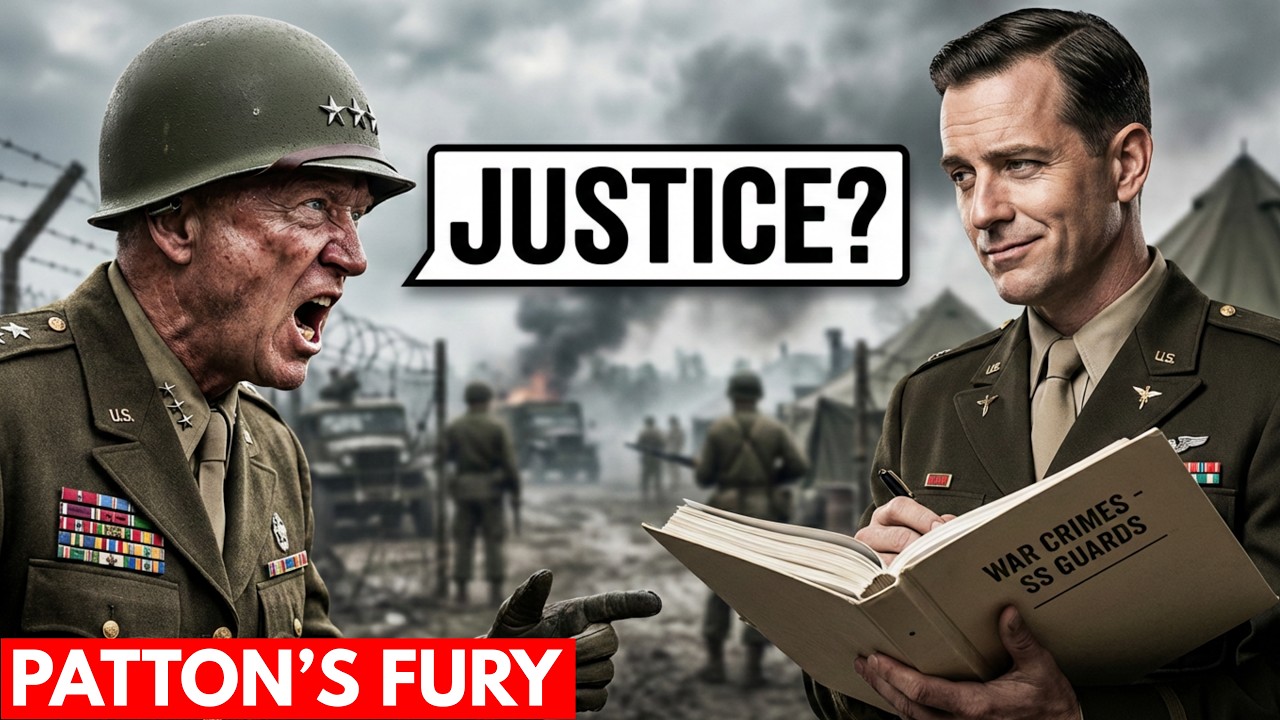
When the JAG officers brought the issue of the SS executions to the highest command levels and confronted Patton, they expected compliance and a shared dedication to military discipline. They expected the legendary general to uphold the letter of the law. They could not have been more wrong.
The confrontation that occurred between the battle-hardened general and the military lawyers remains one of the most intense moments in the history of modern warfare. As the lawyers laid out their case, pointing to the Geneva Convention and demanding severe repercussions for the GIs, Patton listened with a cold fury building behind his eyes.
He looked at the neatly typed pages detailing the execution of the SS guards, then at the men demanding justice for the monsters who had orchestrated the death trains. Patton did not engage in a polite legal debate. He did not cite precedents or argue the finer points of international humanitarian law.
According to the enduring historical lore surrounding his reaction, his response was a violent, uncompromising rejection of the entire bureaucratic premise. He questioned the sanity of a system that would demand justice and legal protection for the architects of a genocide.
How, he demanded, could any rational human being sit in a comfortable office and draft murder charges against an exhausted, traumatized American boy for putting a bullet into the brain of a monster who had just finished feeding innocent children into a crematorium oven?
Patton viewed the SS not as legitimate prisoners of war entitled to Geneva Convention protections, but as a rabid, incurable sickness that needed to be eradicated from the face of the earth. He recognized that the laws of civilized warfare, drafted in peaceful rooms, failed to account for the industrialized evil of the Holocaust.
To apply the Geneva Convention to the operators of Dachau and Buchenwald was, in Patton's eyes, an insult to the millions of innocent victims who had been slaughtered without a shred of legal protection. He made it unambiguously clear that he would not allow the brave, traumatized men who had fought across a burning continent to be crucified by a rear echelon legal apparatus for the crime of eliminating pure evil.
In a move of ultimate defiance, Patton essentially ordered the investigations shut down and buried. He is widely reported to have taken the physical files containing the charges, the evidence, and the witness statements and torn them to shreds, tossing them into the trash bin of history.
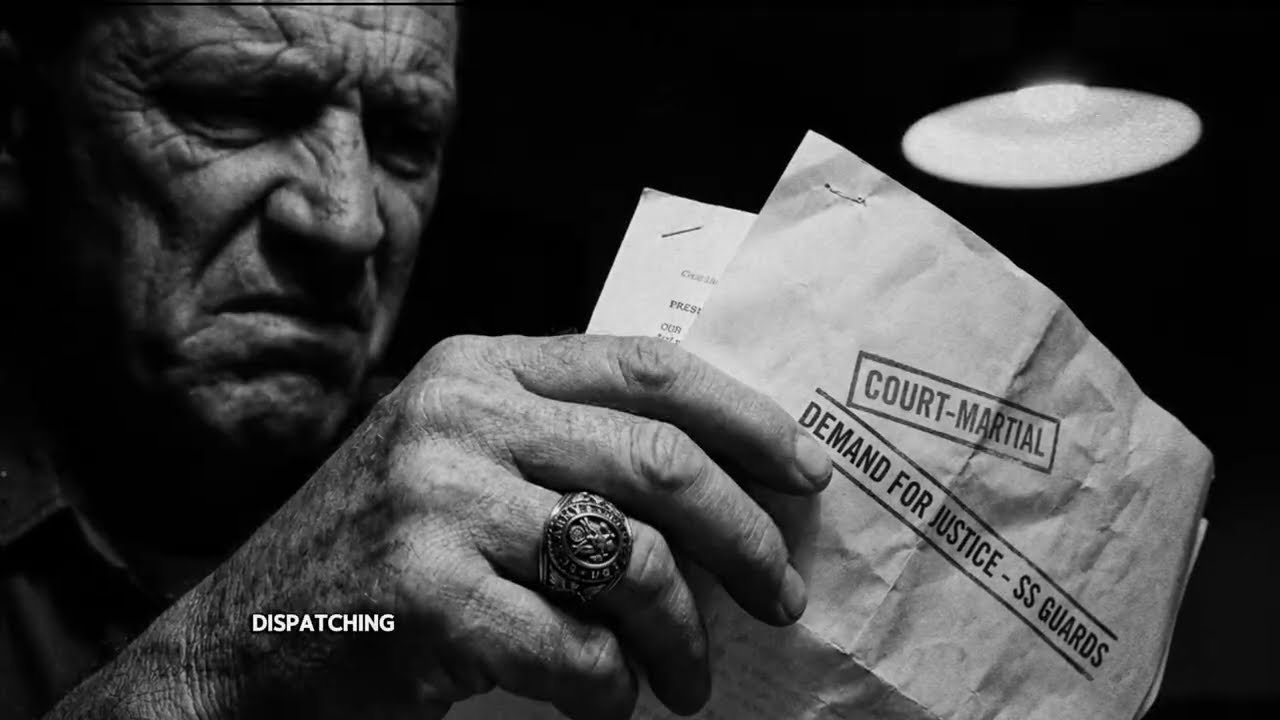
He told the lawyers that if they wanted to prosecute the American GIs for killing the SS, they would have to go through him first. He dared the bureaucracy to challenge his authority, knowing no military lawyer possessed the courage to publicly battle the most famous victorious general in the U.S. Army over the lives of Nazi concentration camp guards.
This decision did far more than save a few dozen American soldiers from the hangman's noose. It fundamentally redefined the concept of moral justice in the blood-soaked aftermath of the Second World War. By killing the investigation, Patton acknowledged a terrifying truth that polite society often ignores.
There are moments in human history when the rigid application of the law fails to deliver actual justice. There are moments when the magnitude of evil is so profound that the only appropriate response is raw, unyielding violence. The lawyers were obsessed with the technical legality of the executions, focusing on the fact that the SS guards had raised their hands in surrender. Patton focused on the mountain of corpses.
He understood that a man who operates a gas chamber does not suddenly regain his humanity or his right to legal protection simply because he drops his weapon when the enemy arrives. The American GIs who pulled the triggers at Dachau were not cold-blooded murderers. They were ordinary young men shoved into a psychological abyss, and their actions were the raw consequence of witnessing the darkest depths of human depravity.
Patton shielded them because he knew they had absorbed a trauma that would haunt them for the rest of their lives. To punish them for lashing out at the architects of that trauma would have been an unforgivable betrayal of the American soldier.
The quiet burial of the Dachau investigation remains one of the most debated ethical dilemmas in military history. It serves as a permanent reminder of the morally ambiguous reality of war. The American soldiers who survived the liberations eventually returned home, packing away their uniforms and attempting to build normal lives in a country that could never truly understand what they had seen.
They carried the secret of the executions with them, burdened by the ghosts of the death camps, but they never faced a military tribunal. They were allowed to fade into history as heroes, protected by the uncompromising shield of a general who valued the sanity and honor of his combat troops over the theoretical demands of military lawyers.
Today, from the comfort and safety of the modern world, it is easy to judge the actions of those young men. It is easy to argue that the law must be absolute, that the soldiers lost their moral high ground the moment they pulled the trigger on surrendered men. But theoretical morality is a luxury of the peaceful and the protected.
When standing ankle deep in the blood and ashes of thousands of murdered innocents, the rules of civilized society tend to disintegrate, leaving only the primal reality of vengeance and survival. History is rarely composed of perfectly clean heroic narratives. It is built upon complex, brutal, and deeply uncomfortable decisions made in the darkest moments of human existence.
General George S. Patton's furious, unapologetic defense of his men stands as a testament to his understanding of the true nature of combat. He was a flawed, controversial, and often problematic leader. But in that specific moment, staring down the legal apparatus of his own military, he served as the ultimate protector of the American infantryman.
He understood that you cannot ask young men to march through hell, to stare directly into the eyes of industrialized evil, and then expect them to behave perfectly according to a rule book written by men who have never smelled the stench of a crematorium.