In 1927, aboard a train crossing Canada, the man who knew the heir to the British throne better than anyone told the prime minister that the young prince would be better off dead. Tommy Lascelles, assistant private secretary to the Prince of Wales, confessed that whenever he waited to hear whether the prince had broken his neck in a country race, he could not help thinking a broken neck would be the best thing for both the man and the country. Prime Minister Stanley Baldwin replied, “God forgive me, I have said the same thing often. ”
Lascelles was not a radical or an enemy of the monarchy.
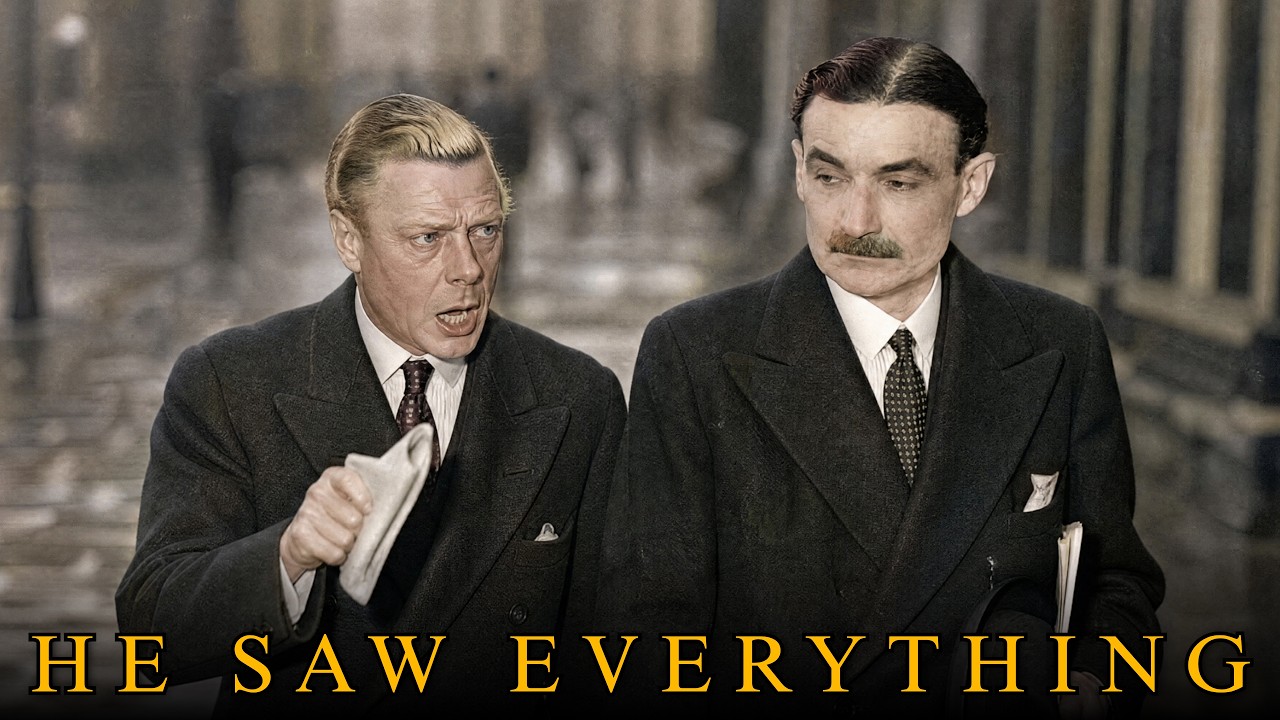
He was one of its most devoted servants, a man who would spend more than three decades at the very center of the crown. The wish on the train was not treason in his mind. It was loyalty to the institution pushed to its darkest edge, a desperate hope that the disaster he saw coming might be averted by the heir never reaching the throne at all. Born in 1887 in Dorset, Lascelles came from a family close to the throne without ever sitting on it.
His grandfather was the fourth Earl of Harewood, making him a cousin to the man who would one day marry the Princess Royal. He was educated at Marlborough College and Trinity College, Oxford, where he took a second-class degree in classics in 1908. Those who knew him described the same qualities throughout his life: a cool manner, a cutting wit, and a moral seriousness that never relaxed. The First World War changed him profoundly.
He served in France with the Bedfordshire Yeomanry and returned as a captain with the Military Cross, having watched friends die on a scale that no sermon about duty could justify. The experience left him with a permanent impatience for anyone who treated life, position, or privilege as something to be idled away. It was a lesson that would shape the harshest judgment of his career. His marriage to Joan Thesiger in 1920 tied him still tighter to the imperial governing class.
She was the daughter of Lord Chelmsford, then Viceroy of India. After a brief spell working in India and failed attempts at journalism and stockbroking, Lascelles found the calling that would define him: service to the crown in the strangest and most invisible office in the kingdom. The private secretary to a member of the royal family is not a typist or a butler. He is the hinge on which the monarchy turns, deciding who reaches the royal person, drafting the words spoken in public, negotiating with governments, and absorbing private disasters so the public sees only the smooth surface of the crown.
The role carries almost no formal power and almost unlimited real power, and Lascelles filled it with more authority and more coldness than anyone of his age. One rule governed his entire career. He served the crown, not the man who wore it. He did not love kings.
He loved the institution, and he judged every monarch by whether they strengthened or weakened that idea. A sovereign who understood duty earned his complete loyalty. A sovereign who treated the throne as a personal possession earned something colder than disapproval: outright opposition. In 1920, Lascelles entered the household of the most adored young man in the world.
Edward, Prince of Wales, was then in his mid-20s, slight and fair and restless, with a boyish charm that reached through newspapers and newsreels to touch people who would never meet him. The whole world seemed to be in love with him. At first, Lascelles shared the enthusiasm without reserve and once described him as the most attractive man he had ever met. The prince had arrived at exactly the moment the monarchy needed reinventing.
His tours of the empire made him a global figure on a scale no royal had ever reached. He shook thousands of hands and left behind a trail of goodwill worth more to the crown than any speech from a throne. Lascelles moved into the machinery of that household and made himself essential, the careful mind behind the glamorous surface. But a private secretary sees his master as no one else does, early in the morning and late at night, tired, bored, drunk, in love, and afraid.
Slowly across the early 1920s, Lascelles began to see things in the gap between the public idol and the private man that troubled him. The charm was real, but behind it lay a restlessness that curdled into petulance, a boredom with duty that no coaching seemed to cure. The drinking and gambling might have been forgiven as the vices of a young man of his age. What could not be forgiven was the attitude beneath them.
The prince did not seem to feel the weight of what he would one day carry. He treated the throne as an inconvenience rather than a trust. To a man who had watched friends die in France for far less than a crown, that carelessness was close to blasphemy. The women troubled him too.
The prince moved through a series of affairs, and the one that mattered most in those years was with Freda Dudley Ward, a married woman. Lascelles was no prude about private lives, but what scandalized him was the way the prince let a woman govern his moods and movements, cancelling duties and arranging his whole life around a private passion while the public work of the monarchy waited. By the middle of the decade, Lascelles could no longer dismiss the flaws as exceptions. He had begun to see the prince not as a gifted young man who needed guidance, but as a fixed and finished character who frightened him.
What he saw was an absence: every gift a man could be given except the one that mattered for the job, a sense of duty deep enough to master his own wants. The prince himself seemed dimly aware of it, once admitting that he was, in his own words, “quite the wrong sort of person to be Prince of Wales. ” Lascelles thought the admission exactly correct and more damning for being made so lightly, as though it were an observation about the weather rather than a confession about a throne. The prince’s own father had reached a similar verdict.
King George V reportedly said of his son, “After I am dead, the boy will ruin himself within 12 months. ” A father’s despair spoken in private matched almost exactly the fear forming in the mind of the father’s most trusted servant. In 1927, on the train crossing Canada with the prince on an official tour, Lascelles let his guard drop and told Baldwin what he had come to think. The image he used was drawn from life.
The prince loved to ride in point-to-point races, and he rode them hard and dangerously. Lascelles confessed that in those long anxious waits, the terrible thought had come to him that a fatal fall might be, for all its horror, the cleanest solution. A broken neck would remove an unfit heir without scandal, without abdication, without the slow damage he feared was otherwise coming. Baldwin’s reply revealed that the alarm reached further than one watchful secretary.
If the prime minister had privately thought the same, then the doubt about the prince ran through the quiet upper reaches of the state. The public still adored him without reserve. The handful of people responsible for the machinery of the crown were quietly frightened of him. A year later, in 1928, Lascelles was in East Africa with the prince on safari when news arrived that King George V had fallen gravely ill.
The heir should have raced home to his father’s side, and if the worst came, to take the throne. The prince reacted with an indifference that Lascelles found almost impossible to believe. He did not want to cut short his pleasures, and he treated the telegram as an interruption rather than a summons. The old king recovered and reigned for another seven years, but something in Lascelles did not recover.
He had wished the prince gone on the train in the abstract. Now he had watched the indifference in the flesh. He decided to resign, and before he left, he decided to tell the prince to his face exactly what he thought. In 1929, Lascelles asked to see the prince alone.
He told him that his whole way of life was a betrayal of what the coming crown demanded, laying out the neglect, the selfishness, and the waste of great gifts. Then he delivered the sentence at the end of it, telling the prince to his face that he was going the way that would cost him the throne of England. The prince’s response was the most chilling part. He did not rage or dismiss the impertinent secretary.
He took the devastating verdict with a mild and almost cheerful good humor, as though it were a small matter. To Lascelles, that reaction was more damning than fury would have been. Anger would have meant the words had reached him. The mildness meant nothing reached him at all.
For two years, Lascelles drifted without a court. In 1931, he was appointed secretary to the governor general of Canada, and he served in Ottawa until 1935. The years in Canada proved that walking out had not destroyed him. He was too able to be wasted, and as King George V weakened, the palace found it needed its ablest men close at hand.
Lascelles was called home in late 1935 as assistant private secretary to King George V, arriving for the final months of the old king’s life. When the king died in January 1936, the thing Lascelles had dreaded for nearly a decade came to pass. The Prince of Wales, the man he had wished dead and told he would lose the throne, became King Edward VIII. The new king held the old courtiers at arm’s length and surrounded himself with a smaller circle, chief among them a woman the establishment was already learning to dread.
Her name was Wallis Simpson, and within months of the accession, she turned Lascelles’ decade of quiet dread into the greatest constitutional crisis Britain had seen in centuries. Edward VIII had inherited the crown in January 1936, and by the autumn it was clear to everyone inside the palace that he meant to marry Simpson, an American woman with two living former husbands. For a king who was also head of the Church of England, which did not then permit the remarriage of divorced people while a former spouse lived, the marriage was impossible. He could have the throne or he could have her.
Faced with the choice, he chose the woman. Lascelles watched it unfold from close range, and his private judgment of Wallis Simpson was as cold as anything he ever wrote. He described her as “a shop-soiled American with two living husbands and a voice like a rusty saw. ” To him, she was simply the instrument of the disaster he had predicted, the final proof that the king would put his own wants above the crown.
What made the crisis so grave was the completeness of the king’s attachment. He was not merely fond of Simpson. He was enthralled to her, dependent on her, unwilling to imagine a life or a reign without her at its center. To those watching, it looked less like a romance than a kind of possession.
The British press held a remarkable silence for months while the king’s relationship filled newspapers in America and Europe. It bought the establishment time to reason with a king who would not be moved. When the silence finally broke, the country woke to the knowledge that its new king intended to marry a twice-divorced American. The government told him plainly that the marriage and the throne could not go together.
On December 11, 1936, after a reign of less than a year, Edward VIII abdicated. Lascelles had been proved right, utterly and publicly. But he felt no triumph. On the night the abdication was settled, he walked alone round and round St.
James’s Park in the dark, thinking of King James II, the last British king to lose his throne. He called the episode “a real tragedy” in his life. He described Edward as being like a child in the fairy stories who had been given every gift except a soul. The fallen king knew exactly who had never believed in him.
In his long exile as the Duke of Windsor, Edward referred to Lascelles with a single venomous word: “That snake. ”
The brother who took the throne was everything the elder had refused to be. George VI was shy, dutiful, and solid, a man who had never wanted the crown and carried a stammer that made public speaking an ordeal. Lascelles found at last a king he could serve with his whole heart.
He gave him 16 years of unbroken loyalty, deepened by the memory of what had come before. The relationship became the great counter-melody of Lascelles’ life. He was knighted in 1939 on the edge of the war that would test them all. As assistant private secretary and, from 1943, as private secretary, he sat at one of the best-informed desks in Britain, seeing the most secret papers of the state, including, by his own record, knowledge of the existence of the atomic bomb months before it was dropped on Hiroshima.
His power lay at the meeting point of two strong forces: the cautious king and the headstrong prime minister, Winston Churchill. Lascelles managed the friction between them, ensuring the monarch and his first minister pulled together through the crisis. Buckingham Palace was struck by German bombs while the king and queen were in residence, and the monarchy turned the fact into a symbol of shared endurance. The war exacted a terrible price from the king, and Lascelles watched it drain him year by year.
George VI drove himself through the conflict with a stubborn diligence that aged him and shortened his life. The elder brother had thrown the throne away and lived on for decades in exile. The younger had taken it up out of duty and let it kill him slowly. The same certainty that made Lascelles a great servant had a harder side.
In 1943, the office of private secretary was occupied by another man, Sir Alec Hardinge, who had grown unpopular with ministers. Lascelles, believing with his usual cold confidence that he could do the job better, was instrumental in easing his predecessor out. It was politics of the sharpest kind, and he played it well. From that height, he did something even more remarkable.
In 1950, he wrote a letter to a national newspaper under the Latin pen name “Senex,” setting out the exact conditions under which a constitutional monarch might properly refuse a prime minister’s request to dissolve parliament. The conditions became known as the Lascelles Principles, and they are still cited today across Britain and the Commonwealth. When King George VI died in February 1952, Lascelles carried his loyalty forward to the daughter. Elizabeth learned in a single moment that she was queen, a young woman of 25 suddenly made sovereign.
Lascelles, by now the grand old man of the palace, guided her through the vast machinery of the accession and toward the coronation set for June 1953. It was the perfect note on which to end a career. But the new reign carried within it the seeds of one more crisis. The young queen had a younger sister, Princess Margaret, spirited and beautiful and 22 years old.
She had fallen in love with Group Captain Peter Townsend, a decorated wartime pilot and a member of the royal household who was entirely unsuitable because he was divorced. On the day of the coronation, Princess Margaret was seen to reach up and pick a piece of lint from Townsend’s tunic, a small and tender gesture that the watching press caught at once. The story that the queen’s sister loved a divorced man began to move through the world. To Lascelles, the matter was a constitutional problem and nothing softer.
There was the Royal Marriages Act of 1772, requiring the sovereign’s consent for the marriage of a royal family member under 25. There was the church’s bar on remarriage, and there was the weight of the dominions. Set against all of that was a young woman’s happiness, and to a man of Lascelles’ creed, the happiness was simply not the heaviest thing on the scale. When Townsend spoke to him of the relationship, Lascelles delivered the line that has followed his name ever since.
“You must be either mad or bad,” he told the war hero, “mad or bad to imagine that such a marriage could be allowed. ” Townsend was posted abroad as air attaché to the British embassy in Brussels, arranged so the two could be kept safely apart. The separation did its slow and grinding work. In October 1955, Princess Margaret announced that she would not marry Peter Townsend, mindful of the church’s teaching and of her duty to the Commonwealth.
She chose the crown over the man. It was the exact reverse of the choice her uncle had made 20 years before. Lascelles did not break Margaret out of cruelty. He had in fact retired before the affair reached its unhappy end.
But the machinery was merciless, and the human cost was real. Margaret reportedly later looked at him and said, “There goes the man who ruined my life,” and refused to speak to him again. The words rest on report rather than on any record in her own hand, but the feeling behind them was real enough. Lascelles retired on the last day of 1953 at the age of 66 after more than 30 years at the center of the monarchy.
He was made a Knight Grand Cross of the Order of the Bath, and Winston Churchill offered him a hereditary peerage. He turned it down, twice. He held with serene certainty that the honor he already had rated higher than a peerage. In retirement, he moved into a grace-and-favor residence at Kensington Palace.
There was a bitter irony in the address, because Kensington Palace was also home to Princess Margaret. The man who had helped to end her great romance and the woman whose romance he had helped to end lived out their later years within the same palace grounds in a silence that was never broken. Lascelles died at Kensington Palace in August 1981 at the age of 94. The world knew him dimly as a distinguished and rather forbidding old courtier of a vanished school.
Almost no one guessed at the drama he had lived through. The secret keeper had kept his own story best of all. But Lascelles had never stopped recording everything he saw. Night after night, in a hand of exceptional clarity, he had written down the conversations, the judgments, the contempt, and sometimes the fear.
After his death, his friend Duff Hart-Davis took up the vast private record and edited it for publication in three volumes: 1986, 1989, and, most explosively, 2006. What those volumes contained was the truth behind the palace walls. The wish on the Canada train was in there, printed at last for anyone to read. The verdicts on Edward were in there, and the contempt for Wallis Simpson.
The man whose entire creed had been discretion became, through his own pen, one of the great witnesses against the masters he had served. In 2016, a television drama about the modern monarchy brought Tommy Lascelles back to life for an audience of millions who had never heard of a private secretary, fixing him in the popular mind as the very image of the cold establishment. The man who had built a career on being unseen became in the end one of the most recognizable courtiers in history. The confession on the Canada train is the key to the whole question.
A man who wishes the heir to the throne dead is either a traitor to the crown or its most desperate defender. Lascelles was no traitor. He was a believer, loyal to the institution above any single person who wore it, willing to be the villain in someone else’s story because he thought the story larger than the people caught inside it. He kept the throne steady.
He also kept the receipts.