At 4:10 a.m. on January 31, 1945, in the walled garden of a small French chateau outside the village of Sainte-Marie-aux-Mines in the Vosges Mountains of eastern France, twelve American soldiers of the 109th Infantry Regiment raised their Springfield rifles and fired one volley into the chest of a 24-year-old private from Detroit, Michigan.
His name was Edward Donald Slovik. He died within seconds.
Four of the twelve bullets struck what an army physician later described as immediately fatal targets. The others wounded him. He was tied to a wooden post, wearing a woolen olive drab uniform with the buttons and insignia cut off. Snow had fallen the night before.
He was the first American soldier since the Civil War to be executed by the United States government for desertion. He remains the only American soldier of the Second World War to receive that punishment.
Twenty-one thousand other American soldiers were convicted of desertion in that war. Forty-nine were sentenced to death. Forty-eight of those sentences were reduced to prison terms. Only Slovik's was carried out.
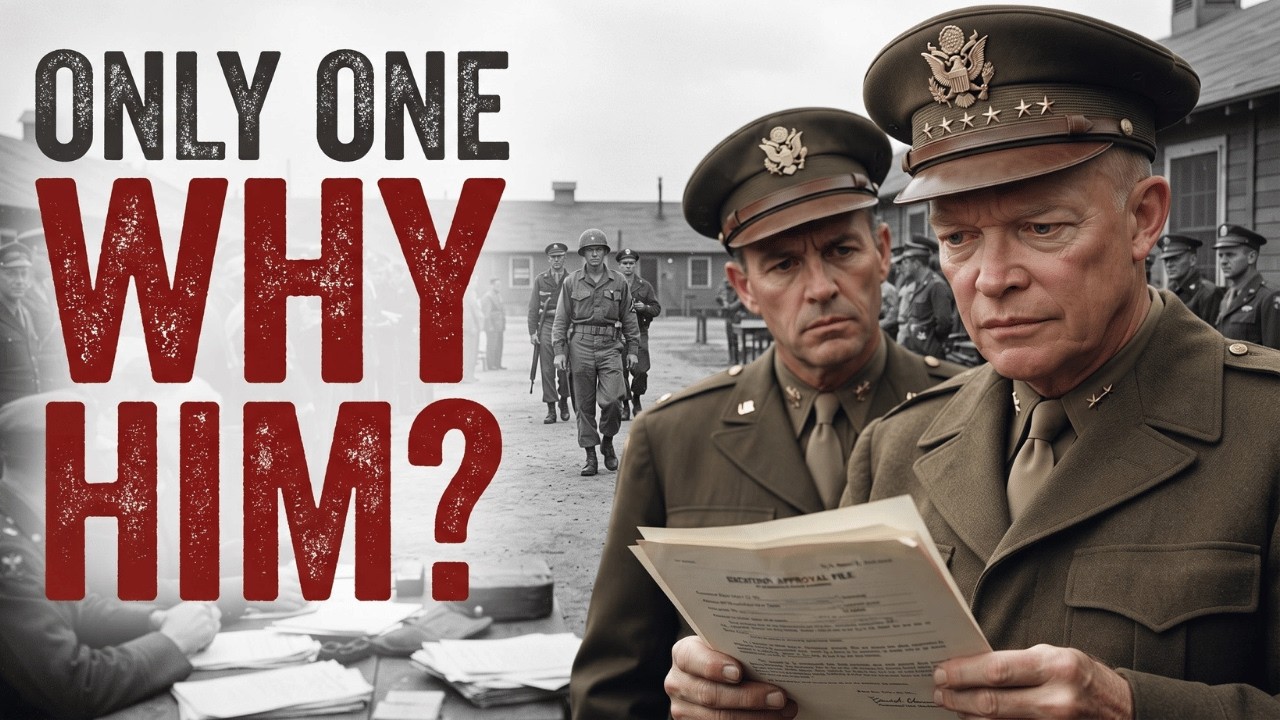
The execution order had been personally confirmed five weeks and one day earlier, on December 23, 1944, by the Supreme Allied Commander of the American Expeditionary Force in Europe. His name was Dwight David Eisenhower. Eight years later, Eisenhower was elected the 34th president of the United States.
This is the story of how a poor Detroit boy who spent much of his adolescence in juvenile reformatories for stealing bread and chewing gum ended up in that walled garden — and of the wife who spent the next 34 years of her life trying to bring his body home.
Edward Donald Slovik was born on February 18, 1920, in Detroit, Michigan, into a devout Catholic Polish American family on the poor east side of the city. His father was Joseph Slovikowski, an alcoholic bricklayer who had immigrated from the Podolia region of what was then part of the Russian Empire. His mother was Anna, whose maiden name was Lutski, from a similar Polish immigrant background.
The family name had been anglicized from Slovikowski to Slovik sometime in the 1920s, in the way so many Polish immigrant families in Detroit, Chicago, and Pittsburgh shortened and simplified their names to fit more easily into their new country.
Eddie was one of several children in a household that struggled every year of his childhood to hold itself together. Joseph drank and could not hold a steady job. The family moved five times in Eddie's first 15 years, always one step ahead of the landlord, always another block deeper into the poor Polish quarter of East Detroit.
For one stretch of 18 months in the winter of 1927 and 1928, they lived in a single room above a coal shed on Chene Street. Eddie's mother cooked on a small kerosene burner. His younger sister slept in the same bed as Eddie under a shared blanket.
Then in 1929, when Eddie was nine years old, the Great Depression hit the United States. Detroit collapsed. The auto plants at Ford River Rouge and Chrysler cut their workforces by more than 60 percent. The unemployment rate in the city reached over 50 percent at its worst. Bread lines formed on Woodward Avenue. Soup kitchens ran three shifts.
Joseph Slovik lost what little construction work he had. The family fell into the kind of poverty that made a boy learn to steal.
Eddie learned at the age of 12. In the fall of 1932, he was arrested for the first time. He had gone into a small neighborhood grocery store on the east side and put a loaf of bread and a nickel packet of chewing gum into his coat pocket. The grocer saw him and called the police. Eddie was taken to the Detroit Juvenile Court, charged, and placed on juvenile probation.
Over the next five years, from 1932 to 1937, Eddie was arrested several more times. The thefts were all small: bread, candy, a pair of shoes, coal from a coalyard fence, 15 cents from an open cash register. He was never arrested for anything violent. He never assaulted anyone. He never carried a weapon.
He dropped out of school after the seventh grade and never went back. His formal education ended permanently at the age of 13 in the spring of 1933. For the rest of his short life, in letters to his mother and later to his wife, he used the awkward simplified spelling of a boy who had never been taught to write above the third-grade level.
In October 1937, at the age of 17, Eddie Slovik was sentenced to prison. His juvenile sentences had run out, and he was now legally an adult. He was sent to the Michigan Reformatory at Ionia, a facility in central Michigan that held young male offenders between the ages of 17 and 25, doing hard labor and receiving a basic mechanical education. He was paroled in September 1938, having served about eleven months.
He returned to Detroit and tried for a few months to go straight. He got a job at a small warehouse, lived at home with his mother, and attended Sunday mass at the local Polish parish. Then in January 1939, he went out drinking one night with a group of neighborhood boys, and the group decided on impulse to steal a car and go for a joyride. Eddie had been drinking and went along. The car was reported stolen, and the Detroit police stopped them within an hour.
Eddie was charged with grand theft auto and sent back to Ionia, this time for a longer term. He served from the beginning of 1939 until April 1942 — three years and three months. He was 19 when he entered Ionia the second time and 22 when he was paroled.
By the time he was released in the spring of 1942, Eddie Slovik had spent more than four years of his adolescence and young adulthood inside Michigan reformatories. He had no high school diploma. He had never held a job for more than a few months. His arrest record showed seven convictions, all for property crimes, with no violent offenses, no drugs, and no weapons.
He was, in the formal language of the American criminal justice system of 1942, a repeat nonviolent property offender with a poor prognosis for rehabilitation. He was also a 22-year-old man who had just been released from prison into a country at war — and he was about to meet the woman he would love for the rest of his life.
Her name was Antoinette Wanda Wisniewski. She had been born on May 13, 1915, in Detroit, five years before Eddie, to Polish immigrant parents named John Wisniewski and Marcela Pogonski. She was 27 years old when Eddie met her in the spring of 1942.
Antoinette had been born with two significant medical conditions that would shape her entire life. The first was epilepsy, which she had inherited from her mother's side of the family and which required her to take medication daily and to avoid stress and physical exertion. The second, acquired in infancy, was a mild form of what her doctors of the 1920s had called infantile paralysis — a polio-like inflammation of the spine that left her right leg three inches shorter than her left. She walked with a permanent limp, using a corrective shoe with a raised heel.
By every account of those who knew her, she was a kind and intelligent woman. She had finished high school, which Eddie had not, and had learned bookkeeping. In the spring of 1942 she was working as the bookkeeper at Montella Plumbing and Heating Company on Michigan Avenue in Dearborn, an industrial suburb adjacent to the Ford Rouge plant.
She lived with her parents and two younger sisters in a small apartment on Junction Avenue in the Polish Catholic quarter of southwest Detroit. Her mother and two different Detroit priests had told her over the previous ten years that no man was ever going to marry her. Her disabilities made her, in the blunt judgment of the Polish immigrant community of that generation, an unsuitable candidate for marriage.
She had accepted this. She had made her peace with the idea that she would live with her parents for the rest of her life, keeping their books, going to weekday mass, tending their small garden, growing older in the quiet way that unmarriageable women of her generation grew older.
She was completely unprepared for what happened when Eddie Slovik walked into Montella Plumbing and Heating in May 1942 looking for work as a laborer. Sitting at the front desk with the company ledger open in front of her, she looked up when the bell over the door rang. She saw a small, thin, dark-haired young man in a cheap suit, holding his hat in both hands in front of him.
She said, in the local Detroit Polish accent they had both grown up speaking, "Can I help you?" Eddie said, "I'm looking for a job." He was hired that afternoon.
Over the next five months, in shared coffee breaks, small conversations at the front counter, and walks to the bus stop after work, Eddie and Antoinette fell in love. He was 22. She was 27. He was a Polish American ex-convict with a seventh-grade education. She was a Polish American epileptic with a permanent limp and a mother who had already told her more than once that no man was ever going to marry her.
They married on November 7, 1942, in a small Polish Catholic church in southwest Detroit. Antoinette's parents attended. Eddie's mother attended. The reception was held in the church basement. Antoinette wore a plain white dress she had made herself on a rented sewing machine. Eddie wore a cheap gray suit that James Montella had given him as a wedding gift.
They moved into a small duplex on Bewick Avenue in Detroit, sharing the rent with Antoinette's parents. Eddie got a better-paying job at the old Dodge plant, working on the assembly line making transmission parts for wartime military vehicles. They bought a used bedroom set on credit and saved $12 a week toward a house of their own.
For the next 14 months, from November 1942 to January 1944, Eddie Slovik and Antoinette Wisniewski Slovik were happier than either of them had ever been in their lives. They went to mass together on Sunday mornings at St. Peter and Paul on East Jefferson. They went to the movies on Saturday nights at the Fox Theater downtown. They walked in the summer of 1943 along the Detroit River at Belle Isle, holding hands.
Antoinette taught Eddie to read at a level higher than the third grade. She sat with him at the kitchen table in the evenings and worked through the newspapers with him, one sentence at a time, until his reading comprehension had improved to something closer to the sixth-grade level. He wrote her small notes in his still awkward handwriting and left them under her breakfast plate. The notes said things like, "I love you, Tony, and you are the best thing, and nobody ever loved anybody like me and you."
Antoinette kept those notes in a small tin box that had originally held Christmas candy. She would keep them for the rest of her life.
Then came the draft notice. The United States had entered the Second World War on December 8, 1941, the day after the Japanese attack on Pearl Harbor. By the summer of 1942, the American armed forces had grown from a peacetime strength of about 1.5 million men to a wartime target of over 8 million. By 1943, the target was rising to 12 million.
Eddie Slovik in 1942 was disqualified. His criminal record placed him in classification 4-F, meaning he was considered morally unfit for military service. Antoinette wept with relief when the classification came through. She wrote to her mother-in-law that week, "Eddie's safe. They won't take him. We can build a life."
But the war did not stop growing. The invasion of North Africa in November 1942, the Sicily campaign in the summer of 1943, the Italian campaign that ground on through the fall of 1943, and the buildup for the coming invasion of France all required more men faster than the Selective Service was producing under its existing rules.
In October 1943, the War Department instructed the Selective Service System to relax its moral character requirements. Ex-convicts with nonviolent property offenses were now eligible. Eddie Slovik was reclassified from 4-F to 1-A on a date in October 1943 that he and Antoinette would remember for the rest of their lives.
The draft notice arrived at the Bewick Avenue duplex in early January 1944, and Antoinette read it first. She was sitting at the kitchen table when Eddie came home from the Dodge plant that afternoon. She had not moved for over an hour. When Eddie walked in, she looked up at him and said only, "It came."
Eddie reported to the Detroit Induction Center on January 24, 1944. He was officially inducted as Private Edward Donald Slovik, service number 36,896,415, United States Army. He was sent by rail to Camp Wolters in Mineral Wells, Texas, for 17 weeks of basic infantry training.
He was trained as a rifleman, the assignment he was least suited for. He had never fired a rifle. He hated guns. He was small and thin and had bad eyesight. But the American army in 1944 needed riflemen replacements for the coming invasion of France more than it needed anything else, and every draftee who did not qualify for a specialized branch went into the infantry.
He wrote to Antoinette almost every day. Of the 376 letters between them that survived, most were preserved after the war in a small metal file box that Antoinette kept beside her bed for the remaining 34 years of her life.
In one letter from Camp Wolters dated April 7, 1944, Eddie wrote in his awkward handwriting: "Tony, I don't think I could kill anyone. I really don't. When they teach us to fire the rifle at the paper targets, I do it because they tell me to. But I keep thinking that paper is a man. A man like me. Maybe a man with a wife like you. I don't want to shoot anyone. I don't want anyone to shoot me. I want to come home. That is all I want in the world, Tony. Just to come home."
Antoinette wrote back every day too. She wrote about the small things: the garden behind the duplex, the neighbor's cat, rationed sugar, and substitute coffee. In one letter dated May 2, 1944, she wrote: "Eddie, I miss you every hour. I know you are scared. I am scared, too. But we made a promise to each other in the church. We promised we would be together. That promise does not stop because the army says so. When you come home, we will pick up where we left off. Just come home to me."
He completed basic training. On May 21, 1944, he was granted a two-week leave and went home to Detroit. He saw Antoinette for what would be the last time in his life. They spent 14 days together in the small upstairs bedroom on Bewick Avenue. They walked to the small Polish grocery store on the corner. They went to mass together on Sunday. They talked about the future they would have when the war ended.
On the last night of that leave, June 6, 1944, they lay together in the small upstairs bedroom and listened through the open window to the neighbors' radios up and down the street playing news reports from the coast of Normandy, where the first waves of American soldiers were landing at a beach called Omaha under German machine gun fire from the bluffs above.
Eddie held Antoinette in his arms in the dark. Neither of them said anything. They both knew that within a few weeks Eddie would be going where those men were going. At approximately 3 a.m., Antoinette said in the darkness, "Eddie, promise me you will come back." Eddie said, "I promise, Tony. I promise." Neither of them believed him, but they said it anyway.
Eddie shipped out to England via New York and the Queen Elizabeth at the beginning of August 1944. He arrived in the port of Liverpool on August 12. He was assigned as a replacement to Company G, First Battalion, 109th Infantry Regiment of the 28th United States Infantry Division.
He was flown across the English Channel on August 20, 1944, and reported to his division at a forward assembly area in the small town of Elbeuf in Normandy on August 25, 1944. He was 24 years old. He had five months and six days to live.
The 28th Infantry Division into which Private Eddie Slovik was placed as a replacement rifleman was one of the most heavily engaged and heavily bloodied American divisions in the entire European theater. It was a National Guard division, federalized on February 17, 1941. Its officers and senior enlisted men were disproportionately career National Guardsmen from Pennsylvania.
Its shoulder patch was a red keystone, the state symbol of Pennsylvania, on a black background. In combat, the red keystone had a way of looking to the men who wore it like an inverted bucket of blood, and so the division had come to be known among itself and other American units in Europe as the Bloody Bucket Division.
Its commander in August 1944 was a 50-year-old major general named Norman Daniel Cota, one of the most decorated American infantry commanders of the war. Born in Chelsea, Massachusetts, in 1893, he had graduated from West Point in 1917 and served in the American occupation of the Rhineland after the First World War. He had taught tactics at the Infantry School at Fort Benning throughout the 1920s and 1930s.
On June 6, 1944, Cota landed with the second wave on Omaha Beach as assistant division commander of the 29th Infantry Division. He walked upright along the Omaha seawall in full view of German machine gun fire, rallying pinned-down riflemen. Standing on the wet sand that morning, he said a phrase that entered American military folklore: "Rangers lead the way."
Six weeks after D-Day, on July 23, 1944, Cota was promoted to major general and given command of the 28th Division. He would command it through the terrible remaining months of the war in Europe and would lose more men over those months than any other American major general commanding an infantry division in the western theater.
The 28th Division landed at Utah Beach on July 22, 1944. It fought through the hedgerow country of Normandy and broke out with Patton's Third Army in Operation Cobra in early August. On August 29, 1944, it marched down the Champs-Élysées in the great victory parade of the liberation of Paris.
Eddie Slovik was not in that parade. He had arrived at Elbeuf in the division's replacement pool four days before the parade took place and was in the process of being moved forward to join the line units when it occurred.
The 28th Division fought through the German border in September 1944 and broke into the Siegfried Line in October. In November 1944, the division was ordered into what would become the worst division-level defeat of the American army in the entire European theater: the Hürtgen Forest campaign.
The Hürtgen Forest was a dense, dark region of pine and beech forest along the German-Belgian border immediately east of Aachen. It was heavily fortified with German pillboxes, barbed wire, and prepared artillery positions. The forest floor was so dense with underbrush that visibility at ground level was often less than 20 meters.
The 28th Division entered the Hürtgen Forest on November 2, 1944, and was pulled out on November 16 — over 14 days of continuous combat. The division suffered 6,184 casualties, of which approximately 1,500 were killed in action. It was effectively destroyed as a coherent fighting formation and was sent to a rest area in the Ardennes forest of Belgium to rebuild.
Eddie Slovik, however, was not in the Hürtgen Forest. He had never fought in the Hürtgen Forest. He had never fought in the Battle of the Bulge. He had never fought at all.
To understand how Eddie Slovik ended up in a stockade instead of with his division, and how he then ended up in the walled garden at Sainte-Marie-aux-Mines with twelve rifles pointed at his chest, you have to understand what happened to him in the small French farming country around Elbeuf in late August 1944.
The town of Elbeuf sits on the Seine River 20 miles south of Rouen in upper Normandy. In August 1944 it was a small industrial town of about 15,000 people, most employed in local textile mills. It had been under German occupation since the summer of 1940 and was liberated by advanced elements of the Canadian Second Army on August 24, 1944.
Eddie Slovik and his replacement group, including a young private from Ohio named John Tankey, arrived at the 28th Division forward assembly area outside Elbeuf on August 25, the day after the town's liberation. They were assigned to Company G, First Battalion, 109th Infantry Regiment, and told to prepare to move forward that same night to join the company at farmhouse positions two miles east of town.
That evening, as Eddie and Tankey moved forward with the replacement column, German artillery began falling on the road they were walking on. It was Eddie's first exposure to enemy fire. The shells came from a battery of 88mm guns positioned in the woods to the east. Two men in Slovik's replacement group were killed in the first ten minutes. Three more were wounded.
The sound of a German 88mm shell in flight, according to every American infantryman who heard one and lived, was a sound the human nervous system was not equipped to process. It was a screaming, tearing, whistling sound that seemed to come from directly overhead and to be directed personally at the man hearing it.
Eddie Slovik, 24 years old and three weeks out of a suburban Detroit duplex bedroom with his wife Antoinette, had never in his life been in combat. He was terrified. He and John Tankey rolled off the road into a shallow drainage ditch and lay flat with their faces pressed against the mud. The rest of the replacement column moved on in the confusion and noise without noticing that two men had rolled into the ditch.
Eddie and Tankey stayed in the ditch for the rest of the night. When dawn came, they did not know where their unit was, how far forward the front line was, or how to find their way back to the assembly area. They were, in the technical language of American Army administrative practice, replacements who had become separated from their unit before ever reporting to it.
This was an extremely common experience in the summer of 1944. Thousands of American replacement soldiers were becoming lost in the chaos of the fast-moving Allied advance through France. The standard army disposition was to give the replacement 48 to 72 hours to make his way to any American unit and reintegrate. Getting lost in that particular week of the war was not a court-martial offense.
Eddie and Tankey did not find their way back to an American unit within 72 hours. They wandered south across the Seine into an area Canadian forces had advanced through two days earlier. On the morning of August 27, they walked into a Canadian military police detachment in the village of Saint-Aubin-Épinay, six miles south of Elbeuf.
The Canadian noncommissioned officer who processed them was a bilingual French Canadian sergeant major from Quebec whose name has not survived in the American records of the case. He understood immediately what he was looking at: two frightened American replacement infantrymen who had been separated from their unit during their first exposure to combat and could not figure out how to get back.
The sergeant major fed them and gave them a place to sleep in the Canadian detachment's requisitioned schoolhouse. He offered to send word to the American liaison officer at Canadian corps headquarters that two American replacements needed to be returned to the 28th Division. Eddie and Tankey asked quietly whether the message could perhaps wait a day or two.
The sergeant major looked at them. He saw two boys who were, in the frank language of the military, badly shaken by their first exposure to shellfire and who needed time behind the lines to recover before being sent forward again. He decided to wait a day or two.
The day or two became six weeks. Eddie and Tankey stayed with the Canadian detachment through the whole of September and into the beginning of October 1944. They cleaned the kitchen, ran messages, and helped the detachment's cooks prepare meals. They slept in the schoolhouse. They were, in every meaningful sense, guests of the Canadian Army, tolerated because the sergeant major was a kind man who understood exactly what was going on.
This was, in the historical terminology of Second World War American Army administration, absence without leave. It was not strictly speaking desertion. Slovik had not renounced his allegiance to the United States. He had not fled to the enemy. He had simply allowed himself to be sheltered by an allied unit for six weeks while he tried to work up the nerve to return to his own division.
During those six weeks, Eddie wrote three letters to Antoinette, addressing them via the Canadian Army Postal System rather than the American, which delayed their delivery by about three weeks but did not prevent it. The letters, all of which survived, described the Canadian unit, the food, the small French village where he was billeted, and the kindness of the men he was with.
He did not tell Antoinette that he was in fact absent without leave from his own division. He told her only that he had been temporarily attached to a Canadian unit for administrative reasons and would be rejoining the 28th Division shortly. He did not want to frighten her.
On October 5, 1944, the Canadian detachment was reassigned to another sector. Before his departure, the sergeant major transferred Eddie Slovik and John Tankey to the custody of the American military police unit stationed in Rouen. The MPs drove them that afternoon in the back of a jeep to the 28th Division's current position at Elsenborn, Belgium.
Eddie Slovik and John Tankey rejoined the division to which they had been assigned. No charges were brought against either of them. Replacement infantry getting lost in the chaos of the August pursuit was so common that the army had effectively stopped prosecuting it. The Canadian paperwork listed them as detached in error and returned to their unit. The 28th Division's personnel records made a note of the six weeks and moved on.
Eddie Slovik was, on the morning of October 6, 1944, a soldier in good standing with his unit. He had done nothing that would ever have led to a court-martial. His record, if he had simply picked up his rifle and gone forward with his company, would have looked no different from the records of thousands of other American replacement infantrymen that fall.
But on that morning, Eddie Slovik was thinking about the German artillery he had heard at Elbeuf. He was thinking about the six weeks with the Canadians and the safety of that schoolhouse. He was thinking about the coldness of the front line, the wife he had left in Detroit, and the promise he had made her that he would come home. He was thinking about how not to die.
In that thinking, in the fatal miscalculation that would follow, he was about to make the worst decision of his short life.
Eddie Slovik reported on the morning of October 9, 1944, to the temporary field headquarters of Company G, 109th Infantry Regiment, in a farmhouse outside Rott, Belgium. The company commander was a 29-year-old captain named Ralph Grot from Illinois. Grot had been in continuous combat since Normandy and had lost 42 of his original 180 riflemen over the previous ten weeks.
Eddie walked into the farmhouse in his olive drab uniform, holding his helmet under his arm. He walked to Captain Grot's field table, stood at approximate attention, and said in the flat Detroit Polish accent he had never lost: "Captain, I need to talk to you. I'm too scared and too nervous to be a rifleman. If you make me go up on that line, I will run away."
Grot looked up from the paperwork on his field table. He was holding a pen in his hand. He put the pen down and said, "Private, take your rifle. Take your ammunition. Report to your platoon. You are not the first man to be scared. You will not be the last. Nothing more will be said about this. Go."
Eddie said, "Captain, I cannot go. I will run away."
Grot looked at him for a long moment. He said, "Slovik, listen to me. If you go up on that line and if you get through the next month, and if you do your duty, nothing will ever be said about the six weeks in the ditch. Nothing will be said about this conversation. You will come out of the war a soldier in good standing. You will go home to your wife. That is the way. Now take your rifle and go."
Eddie said, "Captain, I cannot go. Please put me under arrest."
Grot made one more attempt, in what would later be the central piece of evidence at Slovik's court-martial. He looked directly at Eddie and said, "Son, if I put you in the stockade, you may not come out. You do not know the army the way I know the army. Go take your rifle. Go."
Eddie Slovik said, "Captain, I want the stockade."
Grot, in the after-action account he gave at the court-martial one month later, said he waited a long moment. Then he ordered a runner to escort Private Slovik to the regimental military police and noted in his morning report that Private Slovik had refused to go forward.
Eddie walked out of the farmhouse under military police escort, in the light rain falling on Rott that morning, toward the temporary 28th Division stockade at a farm about a mile behind the front line. He had a specific plan in mind.
He believed, based on what he had observed of the army's handling of previous deserters during his six weeks at the division depot, that he would receive a jail sentence of anywhere from 10 to 20 years. He believed that sentence would be commuted at the end of the war. He believed he would go home to Antoinette when the war was over. He believed he had traded the risk of dying in the Hürtgen Forest for the certainty of surviving the war.
He was wrong about the last three of those beliefs. He was, in retrospect, catastrophically wrong. But on the morning of October 9, 1944, as he walked toward the stockade with his hands in the pockets of his olive drab wool trousers and his eyes on the muddy road, Eddie Slovik was smiling to himself. He believed he was going to see his wife again.
He did the thing that finished him within 24 hours.
At the stockade the next morning, October 10, 1944, Eddie Slovik was taken before the regimental judge advocate of the 109th Infantry Regiment, a lieutenant colonel whose job was to determine whether Slovik's case warranted a court-martial or whether he could be sent back to his unit under an informal disciplinary arrangement.
The judge advocate offered Slovik the informal arrangement. He said, in language that survives in the court-martial transcript: "Private Slovik, if you go back to your company right now and if you pick up your rifle, this will be considered an unpleasant misunderstanding. There will be no court-martial. There will be no record. You will simply have had a bad morning. Do you understand?"
Eddie said, "I understand, Colonel, but I will not go back."
The lieutenant colonel said, "Are you certain?"
Slovik said, "Yes, sir."
The lieutenant colonel said, "Then I have to ask you for the record to put your refusal in writing."
Slovik said, "I'll do it."
He was given a green regulation-issue army paper and a pencil and left alone in a small room at the stockade for approximately 20 minutes. He wrote, in his own poor handwriting, a single paragraph that would over the course of the next twelve weeks kill him.
"I, Private Eddie D. Slovik, ASN 36,896,415, confessed to the desertion of the United States Army. At the time of my desertion, we were at Elbeuf in France. I had come up as a replacement. They were shelling the town and we were told to dig in for the night. The following morning they were shelling us again. I was so scared, nerves and trembling that at the time the other replacements moved out, I couldn't move. I stayed there in my foxhole till it was quiet and I was able to move. I then walked into town, not seeing any of our troops, so I stayed overnight at a French hospital. The next morning, I turned myself over to the Canadian Provost Corps. After being with them 6 weeks, I was turned over to American MP. They turned me loose. I told my commanding officer my story. I said that if I had to go out there again, I'd run away. He said there was nothing he could do for me, so I ran away again, and I'll run away again if I have to go out there."
He signed it: "Eddie D. Slovik, ASN 36,896,415."
He handed the paper to the judge advocate. The lieutenant colonel read it and then said, "Private, do you understand what this piece of paper says?"
Slovik said, "Yes, sir."
The lieutenant colonel said, "It says in your own handwriting that you deserted twice and that you will desert again if returned to your unit. It says that you will run away every time you are sent to combat. This is a written confession of the crime of desertion in the face of the enemy. That crime is punishable by death under Article of War 58."
Slovik said, "Yes, sir, I know."
The lieutenant colonel said one more time, in what the court-martial transcript records as a slow and deliberate voice: "Private Slovik, tear this piece of paper up right now. Tear it up and go back to your company. Nothing needs to happen from this."
Slovik said, "Colonel, I want the paper on the record. I want the court-martial. I want to go to the stockade."
The judge advocate, in the last words he spoke to Slovik that morning, said, "Then you have done it. God help you, son. You have done it."
The paper was entered into the case file. The court-martial was scheduled. Eddie Slovik was moved from the temporary 28th Division stockade to the general court-martial detention facility at Rott, Germany, 20 miles to the east. He was, at that moment, 24 years old. He had 113 days to live.
The general court-martial of Private Edward Donald Slovik convened at 10 a.m. on November 11, 1944, in a small conference room at the headquarters of the 109th Infantry Regiment in Rott, Germany.
The date is worth pausing over. November 11 had been Armistice Day in the American calendar for 26 years since the end of the First World War in 1918. It would be 29 years after Slovik's court-martial redesignated Veterans Day. On the day of Slovik's trial in 1944, it was the anniversary of the day the American army had celebrated its victory over Imperial Germany. On that same anniversary, an American army was trying an American soldier for desertion in the face of the enemy.
The court-martial panel consisted of nine officers, all combat veterans of the 28th Division. The president of the court was a lieutenant colonel from Pennsylvania. The prosecutor was a captain of the Judge Advocate General's Corps. The defense counsel appointed by the army was Captain Edward P. Woods, a lawyer from Kansas City who had been drafted into the JAG Corps in 1943.
Slovik did not testify in his own defense. This was a decision made on the advice of Captain Woods, who believed that Slovik's continued stubbornness about the stockade would only harden the court against him. Slovik sat in a folding metal chair, silent for the entire 90-minute proceeding.
The prosecution's case consisted of a single piece of evidence: Slovik's written confession in his own handwriting on green regulation paper, dated October 10, 1944. The confession was read into the record. The prosecutor made his closing argument.
Captain Woods, in his defense summation, argued that Slovik had been under extreme psychological stress at the time of the confession and had not fully understood the legal consequences of what he was signing. He argued that a lesser charge, such as absence without leave, would be more appropriate to the facts of the case.
The nine officers retired to a small adjoining room. The entire proceeding, from opening statements through verdict, had lasted less than one hour and 40 minutes. They returned. The president of the court stood and read the verdict in the flat administrative voice of American military procedure.
"Private Edward D. Slovik, this court finds you guilty of desertion to avoid hazardous duty. The court sentences you to be dishonorably discharged from the service, to forfeit all pay and allowances due or to become due, and to be shot to death with musketry."
The phrase "to be shot to death with musketry" was carried over from the Articles of War as first codified in the early 19th century. It had not actually been carried out on an American soldier since the summer of 1864.
Eddie Slovik, according to the court-martial transcript, did not visibly react. Captain Woods leaned over and whispered, "Eddie, do you understand what he just said?" Slovik said, in a voice Woods later described as calm and almost cheerful: "Yes, sir, but it's just talk. Nobody shot a deserter in 80 years. It's just talk. They'll give me 20 years and I'll go home."
That was the last time Eddie Slovik smiled for a very long time.
His case went under standard American military legal procedure up the chain of review. First to the commanding general of the 28th Division, Major General Norman Cota. Then to the commanding general of 12th Army Group, General Omar Bradley. Then to the office of the theater judge advocate at Supreme Headquarters Allied Expeditionary Force in Rheims, France.
At each stage, the review officers had the discretion to reduce the sentence to a prison term. This was the traditional pattern in the 28 previous death sentences for desertion imposed on American soldiers in the European theater from June through October 1944. All 28 had been reduced to prison terms on review. The pattern was so consistent that no American soldier at the ETO stockade expected to be executed.
Norman Cota, when he received the file at 28th Division headquarters in early December 1944, did something that surprised his own staff. He upheld the sentence.
Cota's written endorsement, dated December 4, 1944, read in part: "I have carefully reviewed the record of trial in the case of Private Slovik. I find that the offense was aggravated by the deliberate, considered, and premeditated nature of the accused's refusal to serve. His written confession contains a clear statement of intent to desert again if returned to combat. I am unable in my capacity as the commanding officer of a division that has lost 6,000 men in combat in the past 2 months to justify a lesser sentence for this accused when so many other men have died doing their duty. Sentence approved."
Cota would say in the only interview he ever gave about the case, to William Bradford Huie for Huie's 1954 book: "If I had had to do it over again, I would have done it the same way. I could not have looked in the face of one of my own men who had lost a friend at Vossenack and told him that Slovik was going to sit in a warm cell in England while he was going forward to die. I could not have done it."
Bradley reviewed the case in early December and approved the sentence.
The file reached General Eisenhower's desk at Supreme Headquarters in Rheims on the evening of December 22, 1944. That was a specific and terrible day in the life of Dwight David Eisenhower.
Six days earlier, on December 16, the German army had launched Operation Watch on the Rhine, the counteroffensive the American press would soon rename the Battle of the Bulge. Three German field armies totaling over 400,000 men and 1,400 tanks had attacked through the Ardennes Forest in an attempt to split the American First Army from the British 21st Army Group and seize the port of Antwerp.
In the six days of the offensive so far, the American army had suffered approximately 19,000 casualties and was still in headlong retreat in many sectors. Five days earlier, on December 17, the SS Kampfgruppe Peiper of the 1st SS Panzer Division had murdered 84 American prisoners of war at a crossroads outside the Belgian town of Malmedy. American soldiers all along the front had heard about it and had begun, in documented cases, to execute captured German prisoners in retaliation.
Two days earlier, on December 20, the German advance had encircled the town of Bastogne and the American 101st Airborne Division defending it. The town was completely cut off, the weather was too bad for aerial resupply, and the airborne inside Bastogne was down to its last few days of ammunition.
On the day itself, December 22, at 10 a.m., the German corps commander outside Bastogne sent a formal surrender demand to the acting commander of the encircled American forces, Brigadier General Anthony McAuliffe. McAuliffe's written reply, in a single word, would enter American military legend that afternoon: "Nuts."

Eisenhower had been in briefings all day. He had signed 19,000 casualty telegrams over the previous six days. He was, in the private diary entries of his aide Kay Summersby for that week, a man on the edge of his psychological reserves.
The file of Private Edward Donald Slovik was placed on his desk by his staff aide at approximately 6 p.m. on December 22, 1944. Attached to the file was a written recommendation from Brigadier General Ernst C. McNeel, the assistant judge advocate general of the European theater, dated the previous week.
McNeel's recommendation read: "The specific language that would be the legal ground of Eisenhower's decision to commute this sentence would only accomplish the accused's purpose of securing incarceration and consequent freedom from the dangers which so many members of our armed forces are required to face daily. The imposition of the death sentence in this case and its execution is necessary to maintain the discipline upon which the entire American army in this theater currently depends."
Eisenhower read the recommendation. He read the court-martial transcript. He read Slovik's own written confession. He also read Slovik's letter of appeal, dated December 9, 1944, which had been forwarded to SHAEF the previous week.
Slovik's letter, written in the same seventh-grade handwriting that had produced the confession two months earlier, read in part: "I begged my commanding officer when I came back not to send me on the line. I told him if I had to go, I'd run away. He said there was nothing he could do. I ran away to the Canadians because I was scared and nervous and I didn't want to be shot and killed. General Eisenhower, I am now in the second month here in this stockade. I have never done anything dishonorable. I have never been what I would call a criminal person. Anything I did was wrong, I did in wrong company. I plead with you and I beg of you deeply and sincerely for the sake of my dear wife Antoinette who is in poor health and for the sake of our love for each other to have mercy on me."
Eisenhower held the file, according to Kay Summersby's diary entry for December 22, for approximately 20 minutes without moving. He read the appeal letter three separate times. Then he signed the sentence approval.
His endorsement, dated December 23, 1944, read: "Sentence approved. It is essential to the discipline of the army in the current campaign that this sentence be carried out. The execution will be conducted in the presence of a detachment representative of the accused's own division and will be made known to the soldiers of that division only. General publicity is not authorized."
The order was transmitted to the 28th Division headquarters that evening. Cota was informed. According to the accounts of his own staff, Cota was surprised. He had expected Eisenhower to reduce the sentence. Cota gave the order to schedule the execution.
The date chosen was January 31, 1945, five weeks and one day after Eisenhower's signature.
Eddie Slovik was informed of the date on January 23, 1945, by a chaplain at the Le Havre detention facility in France to which he had by then been transferred. The chaplain was a Catholic army priest, Father Carl Patrick Cummings from Boston. Father Cummings would remain with Slovik, at Slovik's own request, for the eight days remaining before the execution.
When Cummings told him the date, Slovik did not react for a long moment. Then he said, in a voice Cummings would remember for the rest of his life, "They're not going to do this, Father. They can't do this. Nobody's been shot for this since the Civil War. They're not going to shoot me."
Cummings said, "Eddie. They are."
Slovik said, "No, Father. They can't. I'm just a regular guy. I'm not important. I'm nobody. They can't shoot me for this."
According to his own written account, Cummings said nothing more. Then Slovik understood. He wept.
He wrote a final letter to Antoinette dated January 24, which he did not know would never be delivered because the army had classified it as evidence and impounded it. The letter began: "Tony, my dear wife, I do not know how to tell you what they are going to do to me. I do not know how to make it right. I only know that I have loved you every day of the two years we have been married and that I will love you every day of eternity. Whatever happens, remember I always came home to you. I always tried to come home to you."
The letter was released in the declassified army investigative files in 1985, six years after Antoinette's death, in response to Bernard Calka's Freedom of Information Act request. Antoinette never saw it. It is preserved today, along with the rest of Slovik's personal papers, in the Bentley Historical Library at the University of Michigan.
Eddie Slovik was transported from Le Havre to a small unit rear area outside Sainte-Marie-aux-Mines in the Vosges Mountains of Alsace, France, on January 28, 1945. He was placed in a small stone outbuilding on the grounds of a rural French estate that the American army had requisitioned for use as a temporary rear-area billet for elements of the 28th Division resting after the end of the Battle of the Bulge.
The Bulge had officially ended six days earlier, on January 25, 1945. The American army had suffered 89,500 casualties in the 40 days of the battle. The 28th Division, which had been resting at Elsenborn when the German attack began, had been at the center of the initial German breakthrough and had suffered additional heavy losses.
The men of the firing squad were volunteers from the 3rd Battalion of the 109th Infantry Regiment — Slovik's own regiment — in accordance with the traditional practice of American military firing squads going back to the Civil War. There were twelve of them. Eleven of the twelve rifles were loaded with live ammunition, and one was loaded with a blank cartridge. No man in the firing squad knew which of the twelve was holding the blank.
The tradition was intended to allow each member of the firing squad the psychological comfort of believing that his particular rifle had not killed the condemned man. It was not in fact effective for that purpose. All twelve men felt the recoil of the cartridge in the same way regardless of whether it was live or blank. But the tradition persisted anyway.
The commanding officer of the execution detail was a major from the 3rd Battalion whose specific identity has been protected in the surviving official records out of respect for the man and his family. He had never presided over an execution before. No American infantry officer of the current war had.
On the night of January 30, 1945, Father Cummings stayed with Eddie Slovik in the stone outbuilding. According to the meteorological records of the 28th Division, it was a bitterly cold night. There had been heavy snow the previous week, and the temperature that night was approximately 11 degrees Fahrenheit. The stone outbuilding was not heated. Cummings and Slovik shared a single blanket and huddled together against the wall for warmth.
Cummings gave Slovik the sacrament of reconciliation. He heard, in the seal of the confessional, the final confession Eddie Slovik would ever make. What Slovik said in that confession has never been disclosed. Cummings died in 1970 without ever revealing it, in accordance with the Catholic sacramental seal.
But Cummings recorded in the written account he provided to William Bradford Huie in 1953 the conversation he and Slovik had after the sacrament was completed. It was in that conversation that Slovik said the sentences that have become the moral center of the entire story.
Slovik said, according to Cummings's account: "They are not shooting me for deserting the United States Army. Thousands of guys have done that. They just need to make an example out of somebody, and I am it because I am an ex-con. I used to steal things when I was a kid. And that is what they are shooting me for. They are shooting me for the bread and chewing gum I stole when I was 12 years old."
Cummings did not answer. There was, as Cummings would say many years later to Huie, nothing to answer. It was, in the specific terrible sense of the phrase, exactly true.
Slovik and Cummings prayed together briefly before dawn. Slovik slept for approximately two hours. He was awakened at 7 a.m. on January 31, 1945. He was given a small breakfast of coffee, bread, and a boiled egg. He was allowed to smoke two cigarettes.
He asked Cummings, sitting on the small wooden bench in the corner of the stone outbuilding, whether Antoinette would be told, whether she would be told that morning in Detroit at approximately the time it was happening in France, and whether Cummings, who had ministered to soldiers of the 28th Division for two years, knew how the army handled notification of families in cases such as this.
Cummings said, "Honestly, Eddie, I do not know."
Slovik was quiet for a while. Then he said, "Father, she has never been very strong. Her health is not good. When they tell her, please, if you can find her, please tell her that I loved her. Please tell her that I was thinking about her at the end."
Cummings said, "Eddie, I will find a way. I promise."
Cummings would keep that promise, but it would take him three years and eight months, and he would not manage to keep it in the way Eddie had wanted. But he would keep it.
At approximately 9:40 a.m., two American military policemen came into the stone outbuilding. They cut the buttons off Slovik's dress uniform jacket — the traditional ceremony of dishonorable discharge that preceded the execution. They pinned a small white paper heart onto the left breast pocket of the jacket over Slovik's actual heart as a marker for the firing squad. The white paper heart was, according to Cummings, roughly the size of a playing card.
Slovik was walked between the two military policemen, with Cummings walking behind him reading the prayer for the dying aloud in Latin, across the snow-covered lawn of the French estate to the walled garden at the rear of the property.
The garden was approximately 50 feet square, walled on three sides by an old French stone wall about eight feet high, weathered gray-green by two centuries of Vosges mountain rain and snow. In the center was a wooden post about six feet tall that had been placed there the previous day. The post was tied to two other posts at 45-degree angles to prevent it from falling under the impact of the bullets.
The twelve members of the firing squad were already in position, standing in a line facing the post from a distance of approximately twelve paces. The major stood at the right end of the line holding a saber upright in his right hand. Behind the firing squad, in a small semicircle, were about 40 American soldiers, all from the 28th Division, selected as witnesses per Eisenhower's order. Several of these witnesses were later interviewed by William Bradford Huie in 1953. Almost every one of them cried while describing what they had seen.
Slovik was walked to the post and tied to it with heavy hemp ropes at the ankles, knees, waist, and chest. His arms were pinioned behind him. His head was covered with a black hood made from a piece of American army blanket.
Cummings approached him for a final blessing. Cummings said, according to his own written account, "Eddie, God have mercy on you." Slovik, through the hood, said, "Okay, Father, I am ready."
Cummings stepped back to a position beside the firing squad. The major raised his saber and said, in a voice the witnesses later described as very loud and very level: "Attention. Ready. Aim. Fire."
The twelve rifles fired one volley. Eleven of the twelve bullets hit Eddie Slovik. Four of the eleven were, in the subsequent post-mortem analysis by the 28th Division surgeon, immediately fatal. The other seven were serious but survivable wounds.
The paper heart pinned over Slovik's actual heart was, when the post-mortem team examined the body, still recognizably heart-shaped but pierced by three separate bullet holes and partially carbonized around the edges by the powder flash of the rifles.
The division surgeon, an American army physician assigned to the 28th Division medical detachment, walked forward with his stethoscope. He listened to Slovik's chest and looked up at the major. He said, "Sir, he is still alive."
The major, according to the witnesses, went pale. He turned to the firing squad and ordered them to reload for a second volley. But the firing squad members, in the shock of what they had just done, could not open their bolt actions cleanly. There was fumbling. There were dropped clips.
Before the reloading was complete, the physician checked Slovik's pulse a second time. He looked up again and said, "Sir, hold. He is gone."
The reloading was halted. Slovik's body was untied from the post, wrapped in a heavy army blanket, and placed in a wooden coffin that had been prepared the previous day. The time was approximately 10:06 a.m. on January 31, 1945. Two minutes after the volley, Eddie Slovik was buried.
That same afternoon, he was buried in Plot E of the Suresnes American Cemetery near the village of Suresnes, north of Paris. Plot E was a specifically segregated section of the cemetery, hidden from public view by shrubbery and a small wall, designated for the burial of American soldiers executed for military crimes in the European theater.
It contained, by the end of the war, 96 graves. Ninety-five of the men buried there had been executed for rape or murder. Eddie Slovik was the 96th and the only one executed for desertion.
The headstones in Plot E were and remain small flat granite markers that give only a number and no name. Slovik's number was and remains 65. It is row three, grave 65 of Suresnes American Cemetery. The Plot E section is not on the visitor map. There is no signage directing visitors toward it and no interpretive plaque explaining why the section exists. An active low hedge of shrubbery has been maintained by the cemetery staff for 80 years for the specific purpose of concealing Plot E from the ordinary tourist path.
The men buried in Plot E are, in the specific bureaucratic language of the American Battle Monuments Commission, not to be recognized as war dead. They are counted in the standing policy of the commission only as administrative interments.
Antoinette Wisniewski Slovik was 29 years old on the morning of February 12, 1945, when the Western Union messenger boy knocked on the door of the small duplex on Bewick Avenue in Detroit where she had been living with her parents for the 18 months of Eddie's military service.
She limped to the door and opened it. The messenger boy, according to his later interview with William Bradford Huie, was 17 years old and had made 43 casualty deliveries in the Detroit area over the previous two months. He handed her the yellow paper and said the phrase he had been taught by his supervisor to say in these cases: "Ma'am, I am very sorry."
The telegram read: "The Secretary of War desires me to express his deep regret that your husband, Private Edward D. Slovik, died 31 January in European area. Confirming letter follows. J.A. Ulio, The Adjutant General."
Antoinette Slovik sat down in the front hall of her parents' duplex and did not move for the next several hours. She did not know on February 12, 1945, how Eddie had died. She assumed, in the way any woman receiving a Western Union telegram from the War Department in February 1945 would have assumed, that her husband had been killed in action fighting the Germans somewhere on the Western Front. She was aware in a general way that a great battle called the Bulge had recently been fought in Belgium. She assumed Eddie had died in that battle.
The confirming letter followed as the telegram had promised. It arrived four days later, signed by a colonel at the army adjutant general's office in Washington. It stated, in the standard bureaucratic language of the army's next-of-kin correspondence: "Private Slovik died on January 31, 1945, in Sainte-Marie-aux-Mines, France. Cause of death is not disclosed at this time due to security considerations of the ongoing operations in the European theater. Your husband's personal effects will be forwarded to you at the conclusion of hostilities."
The letter did not use the word executed. It did not use the word firing squad. It did not use the word desertion. It allowed Antoinette Slovik to believe, for the next three years and eight months of her life, that her husband had died fighting the enemies of the United States of America.
She filed her application for the standard army life insurance benefit of $10,000 payable to the surviving spouse. It was denied. She filed her application for the standard war widow's pension. It was denied. She filed her application for the standard next-of-kin benefits available under the GI Bill of Rights, signed into law by President Roosevelt in June 1944. It was denied.
Every application was denied without explanation. Antoinette began to write letters asking why. She was told, in a series of increasingly evasive responses over the following 18 months, that the specific circumstances of her husband's death disqualified her from benefits, but that those circumstances could not be disclosed to her by the Department of the Army.
In the fall of 1946, she began to lose weight. Her mother noticed and took her to a Polish-speaking Catholic doctor in the neighborhood, who examined her and said, in the professional judgment of a mid-20th-century American general practitioner, that Antoinette was suffering from acute nervous exhaustion. He prescribed rest, and a diet of milk and eggs and small portions of red meat when the ration book permitted.
He said quietly to Antoinette's mother in the hallway outside the examining room: "Mrs. Wisniewski, your daughter is grieving in a way that is not natural. She thinks something is being kept from her. It is eating her alive. If you know anything that might explain what she is worried about, please tell her. It will kill her not to know."
Antoinette's mother did not know. Nobody in Detroit knew. The army had not told anyone.
In the fall of 1948, three years and eight months after Eddie's death, a New York freelance journalist named William Bradford Huie tracked Antoinette down at the Bewick Avenue duplex. Through his own investigation of the army's classified records, he had learned the truth about the Slovik execution. He told Antoinette he was writing a book about it and wanted to interview her. He wanted to give her, if she was willing to sit for the interview, the confidential information about her husband's death that the army had for three years refused to disclose.
Antoinette sat down at her small kitchen table across from Huie. Huie told her, as gently as he could, that her husband had been executed by an American army firing squad on January 31, 1945, in the walled garden of a French estate in the Vosges Mountains, in front of 40 American witnesses, on the personal written order of General Dwight David Eisenhower.
Antoinette Slovik, according to Huie's own written account of that interview, did not immediately react. She sat holding a cup of instant coffee in her hands and looked past Huie's shoulder at the yellow curtains of her kitchen window. After approximately three minutes of silence, she said, "Mr. Huie, are you certain?"
Huie said, "Ma'am, I am certain."
Antoinette said, "Then all these years, they let me think he died a soldier."
Huie said, "Yes, ma'am, they did."
Antoinette said, "Why?"

Huie said, according to his own account, "Ma'am, I do not know. I do not think anyone in the United States government ever wanted to be the one to tell you."
Antoinette Slovik began, from the date of that conversation with Huie in the fall of 1948, the campaign that would last for the next 31 years of her life, until the day she died.
She wrote to every American president who occupied the White House during her lifetime. She wrote to Harry Truman in 1948, 1949, and 1950. She wrote to Dwight Eisenhower in 1953, 1955, 1957, and 1960, addressing her letters to the man who had personally signed her husband's death warrant. She wrote to John Kennedy in 1961 and 1962. She wrote to Lyndon Johnson in 1964 and 1966. She wrote to Richard Nixon in 1970 and 1972. She wrote to Gerald Ford in 1975. She wrote to Jimmy Carter in 1977 and 1978.
Seven presidents received her letters. Every one of them had it answered by a staff aide in language that was polite and formal and evasive, and denied her request in every case.
She asked for two things. She asked that her husband's body be returned to the United States from Plot E in France so that he could be reinterred in Detroit and she could visit his grave. And she asked that the army posthumously restore his rank and his benefits so that she could receive the widow's pension and the $10,000 life insurance she had been denied. Neither request was ever granted during her lifetime.
The reply from Eisenhower's office in 1955 was the one Antoinette kept for the rest of her life in a small envelope in the tin box with Eddie's letters. It was signed by a staff assistant named Bernard Shanley. It read: "Mrs. Slovik, the president has asked me to acknowledge receipt of your letter of the 14th of March. He regrets that under the circumstances of your husband's death, he cannot direct the Department of the Army to reverse the sentence of the court-martial or the disposition of the remains. He extends his personal sympathy to you for your loss. Very truly yours, Bernard Shanley, Special Assistant to the President."
Antoinette Slovik lived, from the date of the Huie interview in 1948 until her death in 1979, in a series of increasingly small and shabby apartments on the east side of Detroit. She could not remarry. She would say, in the small circle of family and friends who continued to check on her, that she was still married to Eddie and would remain married to him for as long as she lived.
She kept his photograph on the wall of every apartment she occupied. She kept the metal file box with his 376 letters beside her bed. She kept on the mantel a small American flag that had been folded and sent to her by the army in 1945 in place of the honors any other war widow of the Second World War would have received.
She worked as long as her epilepsy and her polio-affected leg permitted, as a bookkeeper for a series of small Detroit businesses. She received Social Security disability payments after 1960. She lived on canned soup and toast. She could not afford to visit her sister in Chicago in 1965.
At the age of 50, using 12 years of accumulated Social Security savings, she purchased a small burial plot at Woodmere Cemetery on the west side of Detroit. The plot cost her $380. It was in a modest section of the cemetery near the fence along West Fort Street.
She specified in the purchase agreement, in language she personally wrote out on the back of the standard cemetery form, that the plot to the immediate right of her own was to remain unoccupied and reserved. She had, she told the cemetery office manager in a written note that has survived in the cemetery archives, a husband who would eventually be coming home. She wanted him to be able to rest beside her when he did.
The cemetery office manager, a man named Michael Hanrahan, was one of the few people in Detroit outside Antoinette's immediate family who by that time knew the story of what had happened to Eddie. He agreed to the reservation. He noted on his own copy of the paperwork, in his own handwriting: "Reserved for husband, indefinite." That paperwork was preserved and would be produced 22 years later, in the summer of 1987, by Michael Hanrahan's successor in support of the reburial arrangement Bernard Calka would organize.
In the fall of 1978, at the age of 63, Antoinette was diagnosed with breast cancer. She was moved over the following winter and spring from her small apartment on the east side to a nursing home operated by the Sisters of St. Casimir in the Polish Catholic quarter of southwest Detroit. She died there of the cancer and a complicating heart condition on September 7, 1979.
She was buried at Woodmere Cemetery on September 10. Her funeral was attended by approximately 15 people. Her sister came from Chicago. A few elderly parishioners from the church she had attended came. Two of the Sisters of St. Casimir who had cared for her in her final year came. Antoinette Wanda Wisniewski Slovik died at the age of 64. The plot to her right was still empty.
Eddie Slovik would come home eight years later. He would come home because of Bernard Calka.
Bernard V. Calka was a Polish American veteran of the Second World War from Warren, Michigan, a working-class Detroit suburb about eight miles north of the Bewick Avenue duplex where Antoinette Slovik had lived. He had served in the American Army during the war. Afterward he returned to civilian life in Macomb County, married, raised a family, and eventually served as an elected Macomb County commissioner for over a decade.
Calka read William Bradford Huie's book, "The Execution of Private Slovik," in 1980, 26 years after its first publication, when a paperback reissue passed through his neighborhood bookstore. He had never heard the story before. He read the book in three evenings, sitting in his small den in Warren. At the end of the third evening, according to his later account, he closed the book and decided that he was going to bring this soldier home.
Calka spent the next seven years of his life fighting the United States government to bring Eddie Slovik's remains from Plot E to Woodmere Cemetery. He filed Freedom of Information Act requests one after another and slowly assembled the complete army file on Slovik's court-martial and execution. He wrote to the Polish American community of Detroit, to veterans organizations, to the American Legion, to the Veterans of Foreign Wars, and to every American Catholic bishop in the state of Michigan. He wrote over five separate years to the offices of presidents Carter and Reagan.
He spent, according to the accounting he provided to Detroit journalists after the reburial, approximately $8,000 of his own money on letters, copies, postage, legal fees, and eventually the transatlantic transport costs of the exhumation itself. He was a working-class Detroit veteran with a modest county pension, and $8,000 was a very substantial personal sacrifice.
When Detroit journalists asked him in 1987 why he had done it, he gave the same answer he had given his family in his den in 1980. He said, "Because it was not right. Because somebody had to."
In the spring of 1987, President Ronald Reagan's Department of Defense, having received Calka's fifth formal petition through the office of Congressman David Bonior of Michigan's 12th District, agreed to release Slovik's remains for repatriation to the United States. It was the first time in the 42 years since the execution that any American administration had reversed the standing army policy on the disposition of Slovik's body.
Slovik's remains were exhumed from row three, grave 65 of Plot E on July 7, 1987. They were transported via military air transport to Detroit Metropolitan Airport, arriving on July 12, 1987.
On July 15, 1987, Private Edward Donald Slovik was reinterred at Woodmere Cemetery in Detroit, in the plot Antoinette had purchased and reserved for him 22 years earlier. The funeral was attended by approximately 200 people.
Bernard Calka was there, standing quietly at the back of the crowd in a dark gray suit he had bought for the occasion. Members of the Polish American Catholic community of Detroit were there. Several dozen Second World War veterans wearing their VFW and American Legion caps were there. A small delegation from the Detroit Catholic Archdiocese was there.
A Detroit Catholic priest of Polish descent celebrated the funeral mass and delivered the eulogy. He said, in a passage that would be quoted in the Detroit newspapers the next day: "Antoinette waited 34 years for Eddie to come home. She did not live to see it, but she prepared for it. She purchased the plot. She left the ground beside her open. She trusted that someone someday would bring him. And someone did. And here they lie side by side as they should have from the beginning."
The two headstones are simple. Antoinette's, on the left, reads: "Antoinette W. Slovik, 1915–1979, Beloved Wife." Eddie's, on the right, reads: "Eddie D. Slovik, 1921–1945, Pvt US Army."
Neither headstone mentions the desertion. Neither mentions the firing squad. Neither tells the story of what happened in the walled garden at Sainte-Marie-aux-Mines on the morning of January 31, 1945.
The graves are in a modest section of Woodmere Cemetery near the fence along West Fort Street. There is often, according to the cemetery's ground staff, a small American flag stuck into the ground between the two headstones. Nobody knows who puts it there, but it is replaced approximately every three months in all four seasons, year after year, by an unknown hand.
Dwight David Eisenhower was elected the 34th president of the United States on November 4, 1952. He served two terms and died on March 28, 1969, at Walter Reed Army Medical Center in Washington, D.C., of congestive heart failure. He was 78 years old.
In the two volumes of memoirs he published during his lifetime, "Crusade in Europe" in 1948 and "Mandate for Change" in 1963, Eisenhower mentioned the Slovik case exactly once. It was in "Crusade in Europe," on page 462, in a single sentence in a chapter about army discipline in the winter of 1944 and 1945. The sentence read: "The only execution of an American soldier for desertion during the war took place at this time. It was necessary."
Six words. It was necessary.
Eisenhower would not discuss the Slovik case with reporters or historians for the remaining 24 years of his life. His press secretary, James Hagerty, was instructed to decline all questions on the subject. His private papers, released after his death and now held at the Eisenhower Presidential Library in Abilene, Kansas, contain no additional written notes on the case beyond the original endorsement of December 23, 1944.
Members of his personal staff during his presidency later suggested in interviews given after his death that the Slovik case had continued to weigh on him privately even during his years in the White House. Whether he ever spoke the words aloud to anyone or only carried them silently is a question his own reticence has left unanswered.
Mamie Eisenhower, who survived her husband by ten years and died in 1979, was asked once in 1971 by a Newsweek reporter whether her husband had ever discussed the Slovik case with her privately. Mamie was, according to the reporter's later account, a woman of her generation who did not readily discuss her husband's professional decisions with strangers. She looked at the reporter for a long moment across the small parlor of her Gettysburg farm and said, in the voice of a widow who had been carrying more than she wanted to carry: "Young man, my husband carried many things. Please do not ask me what they were."
The reporter did not ask again.
Norman Cota returned to civilian life after the war. He retired from the army as a major general in the summer of 1946 and settled with his wife Constance in Wichita Falls, Texas. He worked for several years as an insurance company executive. He gave the single interview to William Bradford Huie in 1953 about the Slovik case and never gave another.
He died on October 4, 1971, in Wichita Falls at the age of 78 of heart failure. He was buried with full military honors and with the Distinguished Service Cross he had earned on Omaha Beach 27 years earlier at Arlington National Cemetery in Virginia. His obituary in the New York Times mentioned Omaha Beach, the Hürtgen Forest, and the Battle of the Bulge. It did not mention Eddie Slovik.
Father Carl Cummings, the chaplain who sat with Eddie Slovik on the night before the execution, heard his final confession, and walked with him across the snow-covered lawn to the walled garden reading the prayer for the dying in Latin, returned to civilian pastoral ministry in the Boston Archdiocese after the war. He served for 25 years as the parish priest of a small Catholic church in the working-class neighborhood of Charlestown.
He never spoke publicly about Slovik after his one written contribution to Huie's 1954 book, out of respect for the seal of the confessional and for the family of the executed man. He died in 1970 at the age of 68 of a stroke. He was buried in the small Catholic cemetery of St. Patrick's Church in Charlestown. Most of his parishioners at the funeral had no idea that their parish priest had once, in the winter of 1945, been the last human being to hear the confession of the only American soldier executed for desertion in the Second World War.
Bernard Calka died in Warren, Michigan, in October 1995, eight years after he had brought Eddie home. He was 73 years old. He had continued in the last decade of his life to work quietly on behalf of American soldiers whose stories had been forgotten.
He had helped in 1990 to organize the successful campaign to have the 95 other American soldiers in Plot E of the Suresnes American Cemetery officially recognized as war dead in the records of the American Battle Monuments Commission, though not their disposition altered. He had appeared in 1992 in a small documentary film about Slovik produced by the Detroit Public Television station.
In the year before his death, he personally paid for the placement of a small plaque at Woodmere Cemetery near the entrance to the section where Eddie and Antoinette were buried. The plaque, small and unadorned and easy to miss, reads simply: "Edward Donald Slovik, 1921–1945. One of ours."
Calka was buried, per his own instructions, in a modest plot in a Polish American Catholic cemetery in Warren. His personal papers, including the $8,000 of receipts he had accumulated over seven years of repatriation work, were donated after his death to the archives of the Polish American Historical Association at Central Connecticut State University in New Britain, Connecticut, where they remain today.
There is no clean moral answer to what happened at Sainte-Marie-aux-Mines on the morning of January 31, 1945. Historians have argued the question for 80 years and will argue it for another 80.
Was Eddie Slovik executed for desertion, or for being an ex-convict without political connections, or because his file arrived on Eisenhower's desk in the specific week that 400,000 German soldiers were killing American soldiers at the rate of 2,000 a day in the Ardennes? Was Eisenhower's decision necessary military discipline in the darkest week of the American war, or was it the scapegoating of the one available man who could be scapegoated without political cost?
Would any other man in Eisenhower's chair on December 23, 1944, with the Malmedy massacre six days old and Bastogne encircled and the American desertion rate at 41 per thousand, have decided differently? Would General Marshall have decided differently? Would General Bradley? Would General Patton? Would Roosevelt himself?
These are questions no one has satisfactorily answered.
What can be said is that Eddie Slovik was not an innocent man. He was not a hero. He was not a martyr. He was a scared, unlucky, criminally recorded, poorly educated 24-year-old draftee from a Detroit slum who had never fired a rifle at another human being in his life, who made a series of catastrophically bad decisions in the specific weeks of October and November 1944, and whose written confession arrived on the desk of the Supreme Allied Commander in the specific week of December 1944 that no plea for mercy could survive.
He should not have been drafted. His criminal record made him legally exempt under the pre-war standards of the American Selective Service System. The army lowered its standards in October 1943 to fill the meat grinder of Normandy and Italy, and Eddie Slovik walked through the reclassification like tens of thousands of other men with felony records who ended up in the American army because the country needed bodies more than it needed the peacetime rules.
He should not have written the confession. Twenty-one thousand of his fellow American soldiers were convicted of the same crime in the same war and survived to see their families again. He wrote his own confession in his own hand, and he refused three separate opportunities from Captain Grot and the regimental judge advocate to withdraw it, and he sealed his own legal fate in the specific words he used.
He should not have been executed. Forty-nine death sentences for desertion were handed down in the European theater. Forty-eight were commuted to prison terms on review. His arrived on Eisenhower's desk during the specific week that 400,000 German soldiers were counterattacking through the Ardennes Forest and killing American infantry at the rate of 2,000 a day. If his file had arrived a month earlier, before the German attack began, or a month later, after the Bulge had ended, he would have gone home after the war to Antoinette.
None of those things happened. He was drafted. He wrote the confession. He was executed.
Antoinette Slovik lived 34 more years after the morning at Sainte-Marie-aux-Mines. She never remarried. She wrote to seven American presidents asking for her husband's remains, and seven American presidents denied her. She died in a Detroit Catholic nursing home in 1979 at the age of 64 of breast cancer, in poverty, with a photograph of Eddie on the wall of her small room and the folder with his 376 letters in a drawer beside her bed. She did not live to see him come home.
Bernard Calka, a Polish American Second World War veteran from a Detroit suburb who had never met either of them, but who read the story in a book one evening in his small den in 1980, spent the next seven years of his own life fighting the United States government to bring Eddie's bones home. He won that fight in 1987, eight years after Antoinette had died, at a personal cost of $8,000 and countless letters and countless drives to countless veterans meetings.
Eddie Slovik was reinterred at Woodmere Cemetery in Detroit in the grave Antoinette had reserved next to her own 22 years earlier. Their two headstones sit side by side now. His gives his name, his dates, and his rank. It does not mention the desertion. It does not mention the firing squad. It says only, "Pvt US Army." A small American flag is placed in the ground between them every three months, in all four seasons, by an unknown hand.
Dwight David Eisenhower carried the decision for 24 years and three months. He mentioned it in his memoirs in a single sentence. He would not discuss it with reporters or historians for the remaining years of his life. His press secretary was instructed to decline all questions on the subject. His widow, 26 years after his death, would not answer a Newsweek reporter who asked whether her husband had discussed it privately with her. She said only, "Young man, my husband carried many things. Please do not ask me what they were." He carried it to his grave in 1969.
Remember Eddie Slovik. Remember Antoinette Slovik. Remember Captain Grot and the regimental judge advocate and Captain Woods, the American officers who tried three separate times to make Eddie tear up the piece of paper before it killed him.
Remember Major General Norman Cota, the D-Day Omaha Beach hero who upheld the death sentence because he could not, in his own conscience, tell one of his own men who had lost a friend at Vossenack that Slovik was going to sit in a warm cell while that man went forward to die.
Remember General Dwight David Eisenhower, who read Slovik's appeal letter three times in his private office at SHAEF headquarters on the evening of December 22, 1944, and who signed the sentence approval the next morning.
Remember Father Carl Cummings, who heard Eddie's last confession and stood beside him at the wall and read the prayer for the dying in Latin in the snow.
Remember Bernard Calka, the Polish American Second World War veteran from Warren, Michigan, who read a book in 1980 and decided that he was going to bring one dead soldier home — and did.
The 96 men buried in Plot E of the Suresnes American Cemetery in France were, in the specific bureaucratic category the American army invented in 1945 to describe them, not war dead. They are, in the current standing policy of the American Battle Monuments Commission, administrative interments. They do not receive the honors due to war dead. Their families were denied benefits. The names of 95 of the 96 are still unknown to the commission's public records.
Only Slovik of the 96 has been repatriated. Only Slovik of the 96 is buried today under a headstone that gives his actual name and his actual dates. The other 95 men, who died mostly for the far more terrible crimes of rape and murder committed against European civilians during the war, remain in Plot E. They will remain there, presumably forever. Their families, if any survive them, do not know where they are buried. The American government has never told them.
Slovik got home because one Polish American Detroit veteran read a book in 1980 and decided to spend the last 15 years of his life on the problem. The other 95 have not so far gotten home.
There is no clean moral answer. There is only what happened.
The war would end in Europe three months and seven days after Slovik's execution. It would end in the Pacific six months and 15 days after. The 16 million American servicemen and women would come home over the following two years, build the post-war American economy, raise the baby boom generation, and populate the American middle class of the 1950s and 1960s.
Eddie Slovik would not come home for 42 years. Antoinette would wait 34 years and not see him come home. Bernard Calka would work seven years to bring him home. They lie together now, side by side at Woodmere Cemetery in Detroit, under two simple granite headstones, with an American flag placed between them by an unknown hand.