In 1984, a Vietnamese family risked everything to reach America, but before they could taste freedom, Thai pirates boarded their refugee boat and tore a 14-year-old girl from her father’s arms. Her final screams still haunt him nearly 40 years later. “Father, save me. ”
Tang Ba Canh, born in Can Tho, worked as an English teacher before 1975 and also assisted the American intelligence agency.
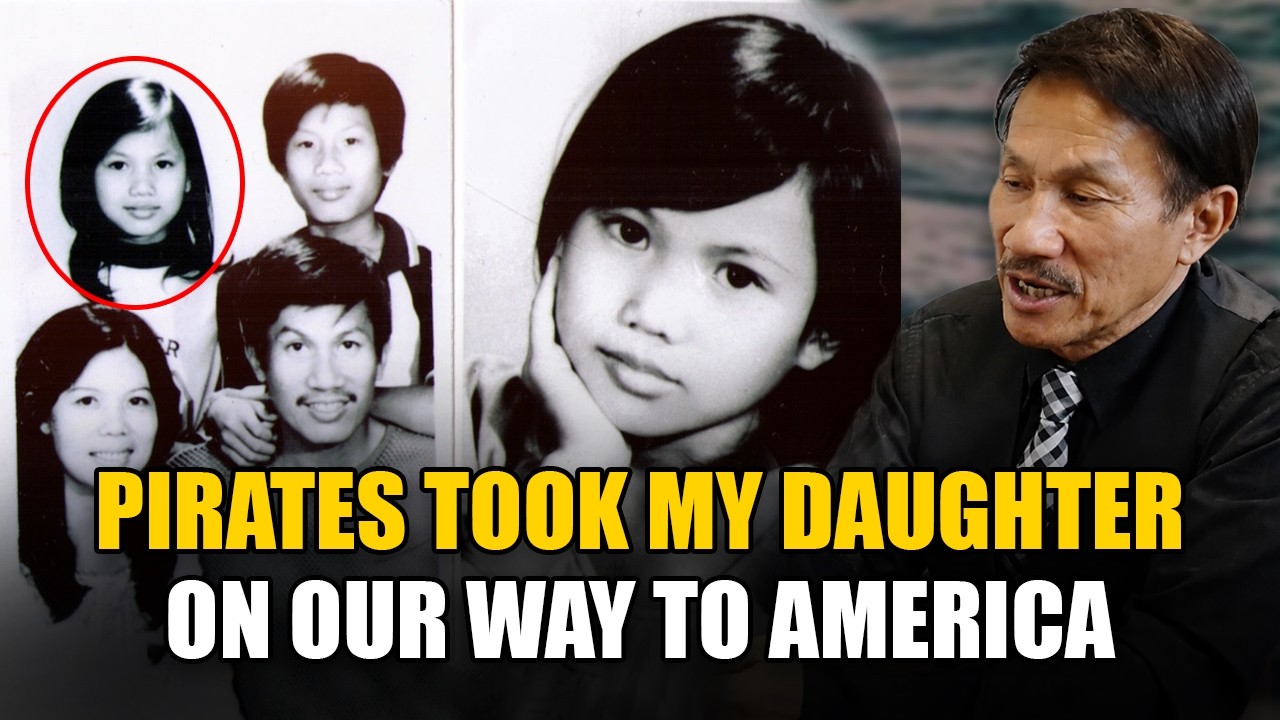
After the war, he was imprisoned for seven years, spending part of that time on death row. Although he eventually regained his freedom, he knew his family had little future if they remained in Vietnam. Two escape attempts failed, but in October 1984, he tried again with his family and roughly 120 other refugees, boarding a small boat from My Tho. Before their departure, a fortune teller quietly warned him that while his own fate seemed favorable, the same could not be said for his daughter.
The prediction troubled him, but after everything his family had endured, he chose to ignore it. Whatever risks lay ahead, they would face them together. On the second day at sea, a large American ship appeared on the horizon. Because he spoke English, Canh swam toward it and pleaded with the crew to rescue everyone on the refugee boat.
Instead, officials determined the vessel was still seaworthy and pointed them toward a safer route, promising to notify another ship. The refugees continued their journey, grateful for the guidance. Years later, Canh often wondered how different their lives might have been had that ship taken them aboard. “If the Americans had rescued all 120 people on my boat that day, perhaps I would not have spent all these decades living with this pain.
”
The next day, pirates attacked. The first group robbed the passengers and left, and just a few hours later another pirate boat appeared to steal what little remained. Shaken but relieved to be alive, many believed the worst was over. They were wrong.
Around noon the following day, a third pirate boat approached. Unlike previous attackers, these men were brutally violent. Armed with knives and machetes, they struck the refugees without hesitation and threw young people who resisted into the sea. After already searching the boat twice, they ordered everyone to strip, convinced valuable items were hidden.
Among the terrified passengers, 14-year-old Dang My Khanh sat on her father’s lap, hoping no one would notice her. Instead, one of the pirates pointed directly at her and ordered her to undress. Shy and terrified, Khanh refused. That single act of defiance changed her family’s life forever.
The pirates wasted no time. The moment Khanh refused to comply, the man grabbed the frightened girl and dragged her toward his boat. Watching his daughter being taken, Canh instinctively resisted, desperately trying to hold on to his child. Later, he recalled only one thought running through his mind.
“I had no weapon. At that moment, life or death no longer mattered. I just wanted to get my daughter back. ”
He lunged at the pirate, struggling desperately to pull Khanh back into his arms.
For a brief moment, father and daughter were entangled as both sides fought for control. Then another pirate rushed from behind and drove a spear into Canh’s back. The blow drained what strength he had left. No matter how desperately he held on, his grip gave way, and the pirates tore Khanh from him.
Inside the cabin, his wife had no idea what was happening. By the time she realized their daughter had been taken, the pirate boat was already pulling away. As they carried her across the water, Khanh turned toward her father one last time. “Father, save me.
”
More than 40 years later, Canh still recalls that moment with painful clarity. What hurts most is not her voice, but the expression in her eyes—filled with fear, trust, and the belief that her father would somehow save her. That evening, four young girls were abducted from the refugee boat. None of them were ever found.
Over the years, Canh has replayed those terrifying minutes countless times. He believes the passengers might have had a chance had they resisted together. The pirates numbered no more than five or six and carried no guns, but after days at sea, repeated robberies, and overwhelming fear, the refugees were simply too exhausted and terrified to unite against them. Not long after the pirates disappeared, a helicopter flew overhead.
The pirates panicked and fled, but before leaving they deliberately rammed the refugee boat, leaving it badly damaged and drifting helplessly at sea. As darkness fell, a violent storm swept across the water. Waves pounded relentlessly against the crippled boat while frightened families held each other and prayed for morning. No one knew whether they would survive the night.
At dawn, the sea finally showed some mercy. The battered refugee boat ended up on an island in Malaysia, concluding a five-day journey that had already taken his most precious possession. Nearly a year later, in September 1985, the family arrived in Southern California to begin a new chapter. They had finally reached the freedom they had longed for above all else.
Yet the joy of survival was overshadowed by the ache of the daughter who should have been with them. Just two days after arriving in America, Canh visited Phat To Ba Gia Da temple with a single question that had consumed him since their separation. He looked at the master and asked in a soft voice, “Master, is my daughter Bech Hong still alive? ” The answer came hesitantly: “Yes, she is.
” Those two words became the foundation for everything that followed. While others might see it as a simple reassurance, Canh clung to it like a promise. As long as there was the slightest chance Hong was alive, he refused to believe their story had ended. After settling in Southern California, he worked to rebuild his family’s life, but every step was overshadowed by one unanswered question: where was Bech Hong?
Finding her became the goal that guided every spare moment over the next four decades. He placed missing-person ads in American newspapers, appeared on local television, and posted notices in Thai newspapers, believing someone might recognize the face of the 14-year-old girl who had been abducted. As the internet expanded, he shared her story online, hoping it would reach someone, somewhere, who knew what had become of his daughter. In the late 1980s, businessman David Chambers, who had worked on President Ronald Reagan’s campaign, helped publicize Hong’s story through the Orange County Register and local television stations.
That effort eventually led to Canh speaking with President Ronald Reagan by phone. His request was remarkably simple. “Mr. President, with the authority you hold, please give me hope that I can find my daughter again.
” The president replied, “Yes, I will do my best. ”
Over the years, many people came forward with potential leads. An American tourist once believed he saw a young Vietnamese woman in a nightclub in Thailand who closely resembled Hong. Canh pursued that lead immediately, only to discover it was someone else.
The American embassy in Thailand later helped publish a missing-person notice for Hong in Thai newspapers, while documentary filmmakers and friends continued sharing her story through television and social media. Each new lead brought renewed hope, but each one ultimately ended in disappointment. “I feel like I have been living in the clouds because of the hope people gave me,” he said. Whenever someone mentioned Hong’s name, his smile returned to the moment she was torn from his arms.
“That was the most terrifying moment of my life—watching my beloved daughter scream for help while I was powerless to do anything. ”
His wife carried the same heartbreak and suffered from depression for years after losing their daughter. Although they built a new life in America, the void in their family never disappeared. Yet Canh refused to give up.
When newspapers, television, and investigators could not provide answers, he sought comfort from Buddhist monks, astrologers, and spiritual teachers. Despite their different backgrounds, they all offered the same reassurance: Bech Hong is still alive. One astrologer believed she had been raised near the sea by an adoptive family and would someday search for her father herself. Another friend carried Hong’s photos to Tibet, where a monk prayed for her and relayed the same message: “She is alive.
Keep praying. ” Those words sustained him through years of uncertainty. Determined to help others facing the same tragedy, Canh later joined families searching for children abducted by Thai pirates. During those efforts, two families were successfully reunited with their lost children, strengthening his belief that miracles remain possible.
He eventually founded the Lost Children of Southeast Asia Foundation, hoping to help families torn apart by piracy and war find each other again. When people asked why he continued to believe after more than 40 years, he answered that his faith had never changed. “The miracle will not come from my daughter alone. It will also come from the nearly 100 families in our organization who have lost their children.
I will continue to work as hard as I can to support this mission. ”
For Tang Ba Canh, hope was not merely a feeling. It became a promise he made to the daughter whose last words still echo in his heart—a promise he intends to keep as long as he lives.