On the morning of August 27, 1979, a 29-foot fishing boat called Shadow V moved through calm water off the coast of County Sligo, Ireland. On board were seven people: three generations of one family and a local teenager earning summer wages.
The oldest passenger was 83. The youngest were 14-year-old twin boys sitting side by side. At the center of the boat stood a 79-year-old man in a flat cap and windbreaker, steering toward the lobster pots he had fished every August for decades.
A castle watched from the headland behind them. The sea was green and quiet. No one on the boat knew that a radio-controlled bomb had been wired into the hull beneath their feet.
At 11:39, it detonated. The boat lifted from the water, broke apart, and collapsed into wreckage. The old man was killed. One of the twins was killed. The teenager was killed. The grandmother died the next day. The mother was pulled from the sea with both legs broken, not yet knowing which of her children had survived.
The man in the flat cap was Lord Mountbatten, great-grandson of Queen Victoria, last viceroy of India, and one of the most carefully protected public figures in 20th-century Britain. For 60 years, his family had managed every scandal, every private complication, and every inconvenient truth through a system of discretion, royal proximity, and institutional deference so effective that the British state itself helped maintain the silence.
This is the story of how that system was built across four generations, two world wars, and the collapse of an empire. It is a story about what the system concealed, who it protected, and what it cost the people inside it.
To understand what happened on that boat, you have to go back further than the war, further than India, and further than the marriage that made the Mountbattens a name the world recognized. You have to go back to a family that was not originally called Mountbatten at all.
The family the 20th century came to know as the Mountbattens began as the Battenbergs, a morganatic branch of the House of Hesse. That word matters because it determined everything that followed.
It meant the marriage that produced the line was one in which a royal husband had wed a woman of lower rank. The children, though legitimate, could not inherit their father's full titles or succession rights.
From the beginning, the Battenbergs existed in a strange middle space: royal by blood, diminished by technicality, close enough to the great European thrones to feel their warmth, but never quite seated upon them. They carried the lineage without the full authority, which meant that what others simply inherited, the Battenbergs had to earn.
That tension between what the bloodline promised and what the world would actually grant ran through every generation that followed, long after the name itself had been discarded.
Dickie Mountbatten's father, Prince Louis of Battenberg, understood this better than anyone. Born in Graz in 1854, he came to England as a boy, entered the Royal Navy at 14, and spent the next four decades building one of the most distinguished naval careers of his era.
He was naturalized British. He married Princess Victoria of Hesse, a granddaughter of Queen Victoria, which placed him firmly inside the royal web, not as an outsider accepted by charity but as a kinsman who had also proved himself through decades of professional excellence.
He rose through command after command in the Mediterranean Fleet and the Atlantic Fleet, until in December 1911 he was appointed First Sea Lord, the professional head of the Royal Navy. A Battenberg born in the Austrian Empire had reached the summit of British naval power through competence, loyalty, and four decades of unbroken service.
That achievement lasted less than three years. When war broke out in August 1914, the fact of Prince Louis's German birth became politically unbearable.
It did not matter that he had served the crown for over 40 years. It did not matter that his sons were serving in the British forces, preparing to fight the very country whose blood ran in their veins. What mattered was his name, his accent, and the place where he had entered the world.
The press turned on him with the particular viciousness that wartime reserves for those who can be made to look like the enemy within. Public feeling curdled. Questions were asked in Parliament.
By October, he had resigned, writing to Winston Churchill that the step was painful but that he felt driven to it by circumstances beyond his control. Churchill replied with genuine regret, but the resignation stood.
The most accomplished foreign-born officer in the history of the Royal Navy was out. The reason was not incompetence or disloyalty, but the simple, immovable fact of where he had been born.
That humiliation did not fade. It settled into the family like damp into stone. Prince Louis retreated into private life. His health declined. He died in 1921, just 67 years old, having watched the institution he had served for a lifetime recoil from his origins.
The lesson his fall delivered was not subtle, and his younger son absorbed every syllable of it. Reputation was fragile. Service alone could not protect you. The public story had to be managed, curated, and defended, or it would be written by people who did not care what was true.
Three years before Prince Louis's death, in 1917, George V asked all members of the royal family with German titles to relinquish them and adopt British surnames. The Battenbergs became the Mountbattens. Prince Louis became the first Marquess of Milford Haven.
The name itself was a translation exercise, Battenberg rendered into English. But the act was something larger and more revealing. It was the family's first public reinvention, carried out under pressure and in full view of a nation at war.
You could not control what the world thought of your origins, but you could change the label, adjust the visible surface, present a new name, and hope that the substance beneath it would be judged on different terms.
That instinct, the belief that survival depended on managing how you were seen, would become the Mountbatten family code. It would serve them for decades. It would protect them through scandals that would have destroyed less skillful families. And it would fail them finally in the one situation where no amount of image management could make any difference at all.
The boy who absorbed all of this was Louis Francis Albert Victor Nicholas Mountbatten, born at Frogmore House on June 25, 1900. Known to everyone for the rest of his life as Dickie, he grew up inside a family that had already been publicly punished for what it was rather than what it had done.
His father had been loyal, capable, and devoted to the British crown, and it had not been enough. The family had been forced to shed its identity, to swap one name for another, to make itself acceptable by making itself less visible.
That is the founding wound of the Mountbatten story. The boy who inherited it would spend the next six decades trying to ensure it never happened again, not through modesty or withdrawal, but through relentless self-advancement, obsessive cultivation of royal favor, and a lifelong insistence on being not merely present at the center of events but remembered as indispensable to them.
But ambition needs fuel, and the position Dickie inherited was long on prestige and desperately short on money. The fortune came from somewhere else entirely.
Edwina Cynthia Annette Ashley was born on November 28, 1901, the elder daughter of Wilfrid Ashley and his wife Maud, who was herself the daughter of Sir Ernest Cassel. Cassel was one of the towering financial figures of the Edwardian age, a German-born Jewish banker who had risen to become personal financial adviser to Edward VII and had accumulated a fortune of almost incomprehensible scale.
When Cassel died in 1921, his estate was valued at roughly 7.3 million pounds gross, with approximately 2.9 million claimed in death duties. Edwina's trust interest from the residue amounted to about 1.6 million, a sum so vast that it is difficult to convey without context.
Dickie Mountbatten's Royal Navy pay as a lieutenant was roughly 310 pounds a year. Edwina's inheritance was not merely large. It was a different order of reality. In the early years of the marriage, the couple reportedly had about 60,000 pounds a year after tax and struggled to spend it.
That imbalance between what he brought and what she brought would define the marriage in ways neither of them could acknowledge publicly. He needed her money to sustain the life his ambitions required. She needed his name to convert her grandfather's wealth into the kind of social position that money alone in the Britain of the 1920s still could not quite purchase.
But money without emotional foundation produces a particular kind of life. Edwina's childhood was not the golden pastoral that the Cassel fortune might suggest. Her mother Maud died when Edwina was 10. Her father remarried.
The emotional geography of her early years was shaped by maternal loss, by displacement, and by the strange distortions of being raised as the granddaughter of one of the richest men in England before she had done anything at all to earn the attention that came with it.
She grew up at Brook House on Park Lane, the Cassel London residence, a place of immense opulence, staffed and polished and built to command admiration. She learned what it meant to be looked at, appraised, and desired. What she did not learn, by most later accounts, was how to be held not socially but emotionally.
That absence would shape everything that came after. It would drive her restlessness, her appetite for experience, her search for connection in places her marriage could not provide, and eventually her transformation from a society ornament into something more complicated, more admirable, and more difficult to contain.
The second great property in the Mountbatten story is Broadlands, near Romsey in Hampshire, which came to Edwina through the Ashley and Mount Temple line. It carried older, deeper associations. Palmerston had lived there. The ground stretched across Hampshire parkland in the way that only centuries of landed ownership could arrange.
Broadlands would become the family seat around which the Mountbatten mythology crystallized. Princess Elizabeth and Philip honeymooned there in 1947. Charles and Diana did the same in 1981.
The house was not merely a home. It was an instrument of proximity to the crown, a stage on which the family's relationship to the monarchy was physically enacted and repeatedly renewed. Even now, Broadlands remains in family hands, open for heritage tours, curated and maintained.
The estate outlasted the empire. The house outlasted the people. That is not an accident. It is the product of a family that understood from the very beginning that property endures in ways that reputation does not, and that the best defense against scandal is a roof that has sheltered kings.
The family developed a code, not written down, not spoken aloud, but legible in everything they did. It was not simple prudery. It was something more elite and more useful than that: a set of operating assumptions about how powerful people survive embarrassment.
The first assumption was that service confers moral credit, that a man who has commanded fleets and governed nations has earned the right to a private life that is not closely examined. The second was that proximity to the monarchy confers a kind of social immunity, that the friend and adviser of kings operates under different rules than ordinary subjects.
The third, and the one that would matter most in the end, was that papers, memoirs, and official memory must be managed. Dickie did not merely keep records. He curated them. He marked files. He sorted, annotated, and arranged his personal archive with the care of a man who understood that history is not what happened, but what survives in writing.
That instinct was not paranoia. It was strategy. And it connected the Mountbattens to a tradition as old as the British establishment itself: the belief that embarrassment does not need to be prevented, only contained, kept within circles that know how to be discreet, filed in archives that know how to stay closed.
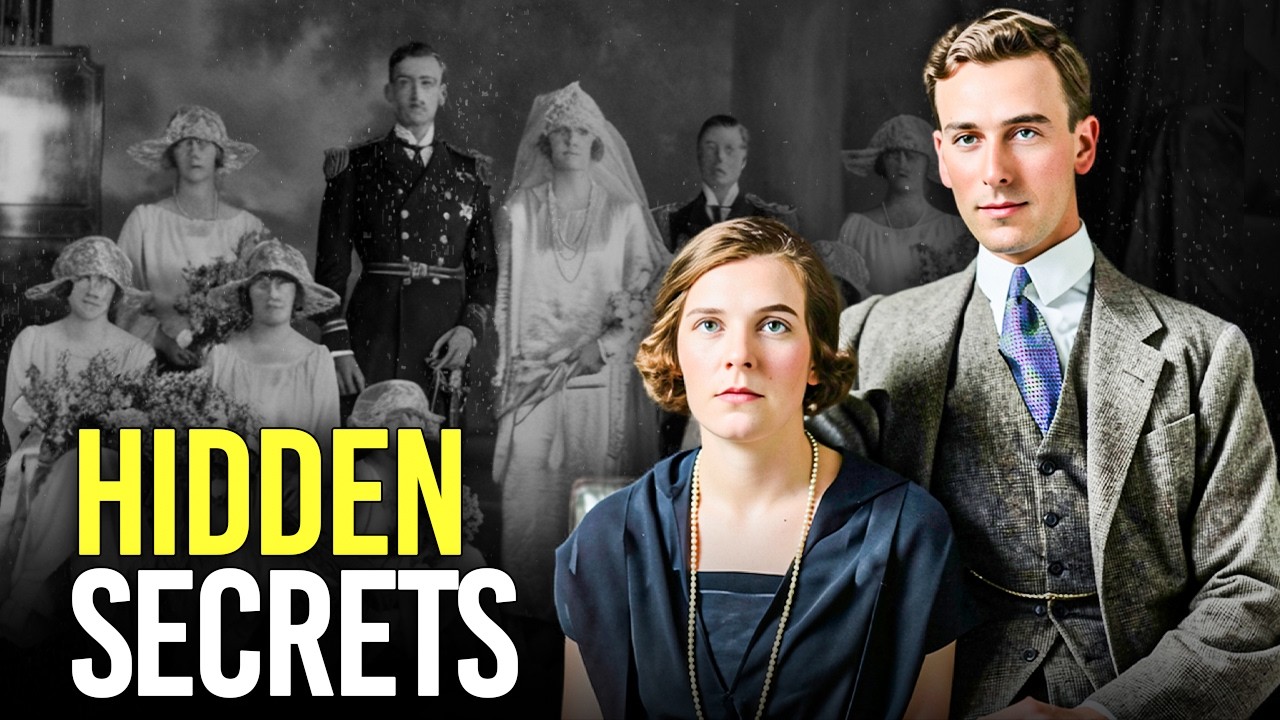
On July 18, 1922, at St. Margaret's, Westminster, with the Prince of Wales serving as best man and enormous crowds pressing against the barriers outside, Louis Mountbatten and Edwina Ashley were married. The newspapers covered it as a fairy tale.
The guest list read like a compression of the British establishment and half the surviving royal houses of Europe. The photographs show a couple who appear to have been designed for one another: he tall and striking in naval dress, she luminous and composed, both projecting the effortless confidence that only money and breeding in careful combination can produce.
What no photograph could capture was the calculation beneath the romance: his need for her fortune, her need for his position, and the unspoken agreement that the combination would create a public identity powerful enough to protect them both from whatever private complications might follow.
Brook House became their London stage, remodeled in sleek, almost naval style, a headquarters for entertaining on a scale that matched the fortune underwriting it. Broadlands became their country retreat.
The household took shape. Patricia arrived in 1924, Pamela in 1929. The family was now complete: a father whose ambition was already visible to anyone paying attention, a mother whose restlessness was already stirring beneath the polish, and two small daughters who would learn before they could articulate it that their parents' world was larger, busier, and more complicated than anything the nursery contained.
Staff raised the girls. Nannies managed the routines. The rhythm of the household was not organized around the children's needs but around the adults' calendar, naval postings, social obligations, and European travel.
Edwina moved through her social and later humanitarian callings with an energy that left little space for the kind of slow daily attentiveness the children absorb as love. She was not cruel. She was elsewhere.
Dickie, for all his vanity and his own relentless schedule, was more present: the parent who appeared, who engaged, who tried to explain the bewildering adult world that swirled around their childhoods. That pattern, his warmth compensating for her distance, would continue for decades.
By the late 1920s and into the 1930s, the marriage had become an arrangement, not in the sense of a cold contract but in the way that many upper-class marriages of the era operated. Both partners understood that emotional and sexual needs would be met outside the household, and both understood that the household itself would continue regardless.
Edwina's affairs were numerous, varied, and within the circles that knew about them, openly acknowledged. She was drawn to men who offered what Dickie could not: emotional intensity, physical novelty, a sense of being wanted for herself rather than for her money or her husband's name.
Dickie's response was complicated and revealing. He was not indifferent. Letters that surfaced later suggest hurt, frustration, and a kind of bewildered pride, the reaction of a man who loved his wife, could not quite hold her, and could not bring himself to make the scenes that might have forced a reckoning.
Neither partner sought divorce. Divorce would have been socially devastating, financially complicated, and incompatible with the public identity they had built together. The Mountbatten brand required two Mountbattens, and so the marriage endured.
The children lived inside this structure and absorbed its lessons. Patricia, the elder, learned discretion. She learned that one did not discuss what one saw at home, that loyalty to the family's public face was more important than honesty about its private one.
Pamela, the younger, learned something slightly different. She learned to watch. She became the family's observer, the daughter who noticed the absences, registered the emotional temperatures, and cataloged the private textures of a household that was magnificent to look at and difficult to live inside.
Then the war came, and the Mountbattens became genuinely important. Dickie's wartime career gave him something his peacetime ambitions could not: legitimate stature of the kind that could not be dismissed as mere social climbing.
He commanded the 5th Destroyer Flotilla. His ship, HMS Kelly, was sunk off Crete in May 1941 in an action that killed over half the crew. He survived by swimming clear of the capsizing vessel while men died around him.
The story of Kelly's loss became, through Noel Coward's film In Which We Serve, one of the iconic narratives of wartime naval gallantry, which suited Dickie perfectly: real courage transformed into mythology, personal survival woven into a national story of sacrifice.
By 1943, he had been appointed Supreme Allied Commander, South East Asia, a position of genuine strategic authority. His performance in that role was debated then and has been debated since, but the appointment itself was beyond dispute. Dickie Mountbatten had arrived at the center of world events.
Edwina's war was different in texture but equally transformative. She could have spent the conflict as a society figure doing voluntary work at a comfortable distance from danger. She did not.
She threw herself into relief operations with the same energy she had once directed at parties: St. John Ambulance, the Red Cross, prisoner-of-war repatriation, hospital inspections in conditions that were genuinely dangerous and physically demanding. The war gave Edwina a sense of usefulness proportional to her capabilities.
In March 1947, Dickie arrived in New Delhi as the last viceroy of India, charged with overseeing the transfer of power from British rule to independence. It was the role of a lifetime, and he occupied it with exactly the combination of energy, charm, and self-belief that had carried him to every previous appointment.
Edwina arrived with him, and Pamela too, the younger daughter, now 17, old enough to witness history at close range and young enough to be permanently shaped by it. The family was placed at the center of one of the 20th century's great political dramas.
Dickie's critics accused him of haste, of accelerating the timetable for withdrawal from June 1948 to August 1947, compressing a process that required years into a matter of months, and of prioritizing a clean British exit over the protection of the millions who would be caught in the violence that followed.
His defenders argued that the situation on the ground was already disintegrating, that delay would have produced not peace but a slower, more protracted bloodbath, and that Dickie's speed, however brutal, prevented an even worse outcome.
What is not in dispute is the family's visibility. The Mountbattens in Delhi were the Mountbattens at their most operatic: the white uniforms, the viceregal receptions, the photographs that showed a couple presiding over the birth of new nations.
It was Edwina who found her truest purpose in India's crisis. While Dickie managed the politics, she threw herself into the human wreckage of partition. She visited refugee camps. She toured hospitals overwhelmed by the injured and the displaced. She organized relief supplies and pressured officials.
The scale of suffering she confronted was staggering: trains arriving in Delhi full of the dead, columns of refugees stretching to the horizon, communal violence that had turned neighbors into killers. She met it with a ferocity that impressed even those who had spent their lives working in disaster relief.
It was in India, amid the violence and the ceremony and the political theater, that the private story developed its most famous chapter. Edwina's bond with Jawaharlal Nehru is one of those relationships that history has never quite resolved.
What is documented is a close, emotionally intense connection that expressed itself in frequent meetings, long correspondence, and a mutual regard that was visible to everyone around them. Letters between them survive in archival collections and confirm a relationship of unusual depth.
Whether it was also sexual has been contested for decades. Pamela Hicks, who was there, insisted throughout her life that it was not, that it was a profound emotional and intellectual attachment but not a physical affair. Others, drawing on the intensity of the letters, have concluded otherwise.
The ambiguity is itself the point. In a family built on the management of appearances, here was a relationship that existed in the space between what could be seen and what could be confirmed: visible enough to generate a lifetime of speculation, contained enough that no definitive proof has ever surfaced.
The family returned from India as legends: the last viceroy and vicereine, the couple who had presided over the birth of two nations. The public image was now armor-plated, burnished by service, by sacrifice, by the moral credit of having been present at one of history's hinge points.
But the private story had not disappeared. It had merely been absorbed into channels that the general public could not access: intelligence files, diplomatic networks, the whisper circuits of the transatlantic elite.
The existence of an FBI file on Louis Mountbatten is not by itself extraordinary. American intelligence agencies maintained files on hundreds of prominent foreign figures during and after the war. What makes the Mountbatten file significant is its content and what that content reveals about the limits of the family's protective machinery.
Secondary reporting on the file, which was opened during his wartime prominence and later released under American Freedom of Information provisions, describes elite informants characterizing the Mountbattens as persons of extremely low morals. The file recorded allegations about Dickie's sexuality and his personal conduct.
The claims were not verified by the FBI. They were simply recorded, filed, and preserved in a system that operated entirely outside the Mountbattens' reach. John Barratt, Mountbatten's long-serving private secretary, later denied the most damaging claims outright, insisting they were malicious gossip elevated to the false authority of intelligence.
But the denial does not erase the file's existence. And the file's existence tells us something more valuable than any single allegation: the Mountbattens believed their private world was contained. It was not. It was merely unprinted.
That distinction is the first real fracture in the family's mythology. Not a public scandal, not a newspaper exposure, but the quieter and more corrosive discovery that the apparatus of concealment had holes in it.
There is a second dimension to this first fracture, and it concerns Dickie's relationship with his own archive. By the 1950s, Mountbatten was already engaged in the activity that would occupy much of his later life: the organization, curation, and selective presentation of his personal papers.
He was not merely keeping records. He was building a version of himself for posterity. Files were sorted. Material was categorized. Certain items were marked as being of special sensitivity.
The University of Southampton archive, where the papers eventually came to rest, has noted that he arranged material with an explicit eye to a future authorized biography, not a neutral historical resource but a curated narrative with a specific purpose.
That archival impulse is a character revelation of the first order. It tells you that Dickie understood, perhaps more clearly than anyone else in the family, that the Mountbatten story was vulnerable, and that his response was not confession or reform but management.
In the 1950s, the Mountbatten code was applied with its fullest rigor. Dickie moved through the senior reaches of the Admiralty, becoming First Sea Lord in 1955, the same position from which his father had been forced to resign four decades earlier.
That appointment was not merely professional. It was the completion of a generational arc: the son rehabilitating the father's name by reaching the summit that xenophobia had denied the older man. The wound of 1914 was at last formally healed.
Meanwhile, inside the household, the emotional architecture of the marriage was hardening into its final form. Dickie and Edwina were now in their 50s. The restlessness that had driven Edwina's earlier affairs had not diminished, but it had changed character.
She continued her humanitarian work with undiminished energy, traveling extensively for St. John Ambulance and other relief organizations. The work gave her purpose. It did not give her peace.
Those who saw her in her later years described a woman who was perpetually in motion, as if stillness itself were an enemy, as if stopping long enough to examine what her life had actually become would have been more than she could bear.
The children had by now absorbed the code completely. Patricia, married to John Brabourne and building her own household at New House in Kent, carried the family's habits of discretion into the next generation. She did not rebel against the Mountbatten code. She embodied it.
Pamela, still unmarried, still moving in the royal and aristocratic orbit, was developing the observer's eye that would later produce her memoirs. She saw more than Patricia allowed herself to acknowledge, and she remembered it with greater precision.
On February 21, 1960, Edwina Mountbatten died in her sleep in Jesselton, North Borneo. She was 58 years old. She had been on an inspection tour for the St. John Ambulance Brigade, still working, still traveling, still in motion right up to the end.
The death was not violent, not scandalous, not the dramatic public fall that the family's enemies might have imagined. It was quiet, sudden, and far from home. The cause was never conclusively determined, though later accounts suggested a cardiac event.
She had left instructions requesting burial at sea, and Dickie honored them. Her body was taken aboard HMS Wakeful and committed to the waters of the English Channel off Portsmouth. The ceremony was naval, spare, and dignified.
But the most remarkable detail came from half a world away. Jawaharlal Nehru, Prime Minister of India, arranged for an Indian Navy frigate to put to sea and cast a wreath on the waters at the position where Edwina had been laid to rest.
The gesture was extraordinary: a head of state deploying his nation's military to honor the wife of a foreign earl. It said with the eloquence of naval ceremony what neither Nehru nor the Mountbattens could ever publicly confirm.
For Dickie, Edwina's death was the end of a partnership that had shaped his entire adult life. He was now the sole custodian of the Mountbatten story, the sole author of its public version, the sole manager of the archive.
For the daughters, the loss was different in texture. Both Patricia and Pamela had grown up at a distance from Edwina, the distance of nannies, boarding schools, and a mother who was always elsewhere. They had loved her without fully knowing her.
In the years after Edwina's death, Dickie began consolidating the Mountbatten narrative into the form he wanted it to take. He spoke of Edwina publicly with affection and respect, emphasizing her humanitarian work, her courage, her transformation from society beauty to woman of substance.
The 1960s were Dickie's decade of consolidation and, in some ways, his decade of triumph. He became Chief of the Defence Staff in 1959, the highest military position in the United Kingdom, responsible for overseeing the integration of all three services into a unified defense structure.
He held the post until 1965, shaping the architecture of Britain's military command at a moment when the country was adjusting, painfully and not always gracefully, to its diminished postwar role.
In retirement, which began in the mid-1960s, Dickie did not diminish. If anything, he expanded. He became, in the public imagination, a kind of national uncle: the last survivor of a generation that had fought the war, governed the empire, and served the crown.
The most significant of his retirement roles was the one that brought him closest to the next generation of the royal family. Dickie became a mentor, an adviser, and in his own self-dramatizing way, a surrogate grandfather to Prince Charles.
The relationship was real and affectionate, one of the few in Dickie's life that appears to have been driven primarily by genuine feeling rather than calculation, though calculation was never entirely absent.
Charles, who struggled with the emotional formality of his parents' court, found in Dickie something he could not easily find elsewhere: warmth, encouragement, a willingness to listen to his doubts and confusions, and the authority of a man who had held great positions.
Dickie, for his part, found in Charles not just a young man in need of guidance but a future king in need of shaping. And he fully intended to be the one who shaped him. He also hoped Charles might marry his granddaughter Amanda, binding the Mountbatten line to the throne once more.
But the 1970s also brought a different kind of visibility, one that Dickie could not control. His name surfaced in the murky political mythology surrounding Harold Wilson's final years as prime minister.

The story in its most sensational versions involved elements of the British establishment alleged to have discussed some kind of extra-parliamentary intervention. Mountbatten's name appeared in these accounts as a potential figurehead.
The harder conspiracy versions of the story remain disputed, and the evidence for a concrete, actionable plot involving Mountbatten is thin. What is not thin is the cultural fact that his name was considered plausible in that role.
That tells us something essential about his place in the imagination of 1970s Britain. He had become a symbol of the old order's capacity to intervene, to override, to step in when the democratic process produced results that the people at the top found unacceptable.
The first fracture, the FBI file, showed that the private story had leaked into intelligence channels beyond the family's control. The second fracture showed that the public image had leaked into political fantasy. The creation had outgrown the creator.
Patricia's arc was the one most faithful to the family's original design. She had inherited the title, the second Countess Mountbatten of Burma, by the special remainder Dickie had secured, and with it the responsibility of maintaining the line's continuity.
Her marriage to John Brabourne was stable. Her household at New House in Kent was ordered. Her relationship to the Mountbatten name was one of custodianship rather than reinvention. She did not seek the spotlight. She did not challenge the family's assumptions.
Pamela's trajectory was different. She had married David Hicks in 1960, entering a world of design, style, and social glamour adjacent to the Mountbatten orbit but not quite inside it. The marriage gave Pamela children, including the designer and author India Hicks.
But she never fully left the Mountbatten world. She could not. The gravity of it was too strong. Where Patricia embodied the Mountbatten code, Pamela was quietly documenting it. She was becoming the family's most valuable witness.
Amanda, Patricia's daughter, occupied a peculiar position in the family's mythology: the position of the potential bride, the woman through whom the Mountbatten line might finally merge with the throne itself.
The courtship had existed in some form. Charles and Amanda had known each other since childhood. But the match had not been made before the summer of 1979. The timing had not been right. Charles had not been ready. Amanda had not pushed.
At Broadlands, the archive grew. Dickie, now in his late 70s, was spending more and more of his time with the papers, ordering, arranging, annotating, marking items for special handling, revisiting decades of correspondence with the attention of a man who knew his time was limited.
The archive was not merely a collection of documents. It was a second self, a parallel Mountbatten built from paper and careful curation, designed to survive the biological Mountbatten and carry the approved version of the story into a future Dickie would not live to see.
He also spent time each summer at Classiebawn Castle in County Sligo on the west coast of Ireland. The castle had come to the family through the Ashley line, another piece of inherited property, another stage on which the Mountbatten household enacted its rituals of privilege and continuity.
Dickie loved it. He fished from its harbors, walked its fields, entertained guests against the backdrop of the Atlantic. The routine was well established, repeated summer after summer, with the reliability of a household that took its pleasures seriously.
What was different, and what Dickie appears to have either minimized or simply refused to accept, was the context in which those pleasures were now being taken. Ireland in the late 1970s was not a safe place for a man of his profile.
The Troubles had been escalating for a decade. The Provisional IRA had carried out bombings, assassinations, and kidnappings across Northern Ireland and on the British mainland with increasing sophistication, brutality, and strategic purpose.
Dickie was not merely a British aristocrat on holiday in a neutral country. He was the queen's cousin. He was a former chief of the defence staff. He was a living, breathing, highly visible symbol of the British establishment and of the monarchy itself.
His presence at Classiebawn year after year was not a secret. The castle was visible from the road. His movements were predictable. His habits were known. The boat Shadow V was moored in a public harbor at Mullaghmore, where anyone could observe it, approach it, and study its routines.
Security was minimal. There were no armed guards, no military escorts, no comprehensive surveillance of the harbor or the boat. The warnings had been there. Irish police and British intelligence had both flagged the risks of Dickie's annual visits.
Dickie listened to the warnings the way he listened to most unwelcome advice. He acknowledged them and then continued to do exactly what he had always done. He was 79 years old. He had survived the sinking of his ship. He had governed India during partition.
The assumption, never articulated as a principle but visible in every choice he made that summer, was that the world would continue to accommodate him, that rank and history and the sheer accumulated weight of who he was would serve one more time as a shield.
That assumption was the final expression of the family code: the belief that the system would protect them, that position, service, and the management of appearances could contain any threat, even one that came from a five-pound radio-controlled bomb hidden in the bilge of a fishing boat.
It was August 1979. The family gathered at Classiebawn as they always did. Patricia and John Brabourne were there with their children. Dickie's mother-in-law, the Dowager Baroness Brabourne, 83 years old, was there. The twin boys, Timothy and Nicholas, were 14.
A local boy, Paul Maxwell, 15 years old, had been taken on as a crew member for the boat. The house was full. The weather was fine. The sea was calm.
The morning of August 27th arrived with the particular ordinariness that always precedes catastrophe. Dickie decided to take the boat out. Shadow V, a small open fishing vessel, 29 feet long, wooden-hulled, modest, unremarkable, was waiting at the harbor.
The plan was simple: a short trip along the coast, some fishing, the familiar waters of Mullaghmore Head that Dickie had been navigating for decades. The family loaded aboard in the unhurried manner of a household on holiday.
The sea was green and quiet. The headland rose behind them. The castle watched from the shore. The village went about its morning. They cleared the harbor and headed out toward the lobster pots. And somewhere beneath the deck, the bomb was already waiting.
The bomb detonated at approximately 11:39 in the morning, when Shadow V was about 200 yards from the shore. The device, roughly 50 pounds of gelignite, hidden in the boat and triggered by remote control from the cliffs above, tore the vessel apart.
The explosion was heard across the bay and beyond, a concussive crack that rolled over the water and echoed off the headland. Witnesses on the shore described seeing the boat lift bodily out of the water, break open from within, and collapse into a cloud of debris, smoke, and spray.
Where there had been a small fishing vessel carrying a family on a summer outing, there was now a debris field: timber, rope, cushions, clothing, fragments of the hull, and among them, almost impossible to distinguish at first from the wreckage itself, human bodies.
Lord Mountbatten was killed instantly, or very nearly so. He was 79 years old. His legs were almost severed by the blast. He was pulled from the water by nearby lobster fishermen who had raced toward the explosion in their own boats, but by the time they reached him, there was nothing to be done.
The man who had spent a lifetime at the center of events, commanding fleets, governing an empire, advising the crown, curating his own legend with the meticulousness of an archivist and the vanity of a performer, ended face down in the water off a small Irish village.
Nicholas Knatchbull was killed. He was 14. He was Timothy's twin. He had been on the boat because his family was on holiday and because that was what the family did in August. He had no public role, no political significance, no place in the machinery of state or empire. He was a child.
Paul Maxwell was killed. He was 15. He was a local boy from Enniskillen who had taken a summer job crewing Shadow V, earning pocket money, helping with the ropes and the engine. He was not a Mountbatten. He was not an aristocrat. He was a boy from the town who had been in the wrong place because he was doing his job.
The Dowager Baroness Brabourne, Dickie's mother-in-law, 83 years old, survived the initial blast but died in Sligo General Hospital the following day of her injuries. Four people killed, three generations touched. The youngest was 14, the oldest was 83.
Patricia Knatchbull was pulled from the water alive but gravely injured. Both her legs were broken. She had internal injuries. She was in shock: the physical shock of the blast and the deeper, more devastating shock of a mother who did not yet know which of her children had survived.
She would learn in the hours that followed that her son Nicholas was dead, that her father was dead, that her mother-in-law was dying, that her husband John was critically wounded and might not survive, and that her son Timothy had been pulled from the wreckage, alive but injured.
Patricia had spent her entire life embodying the Mountbatten code: discretion, duty, the steady maintenance of the family's public face. Now the code was meaningless. There was no public face to maintain. There was only injury, death, and the unbearable mathematics of a family that had gone out on a boat with seven people and come back with three of them dead.
John Brabourne, the seventh Baron Brabourne, was critically injured. He would survive, but his recovery was long and painful, and the man who returned from it was not the man who had gone out on the water that morning. He died in 2005, having spent 26 years living in the aftermath of a single morning.
Timothy Knatchbull survived. He was 14. His twin brother did not. That fact, the irreducible, unanswerable fact of it, would define the rest of his life. He was pulled from the water injured, disoriented, his hearing damaged by the blast.
He would later write about that day with a clarity that is almost unbearable to read. His memoir, From a Clear Blue Sky, published decades later, is one of the most sustained accounts of inherited trauma in modern British writing.
Pamela was not on the boat. She had not been on Shadow V because of the smallest of decisions, a different plan for the morning, a choice to stay behind, the kind of trivial domestic calculation that in retrospect acquires the weight of fate. She would carry that nearness for the rest of her life.
The rescue operation was chaotic, immediate, and desperately human. Local fishermen were the first responders, men in small boats who had heard the explosion and raced toward the debris field without knowing what they would find, without equipment, without training for mass casualty events.
They pulled bodies and survivors from the water with their hands. They hauled the wounded aboard their lobster boats. They brought them to shore, where the village of Mullaghmore, which had watched the Mountbattens come and go for summers beyond counting, was suddenly transformed into something none of its residents had prepared for.
The news traveled outward in concentric circles of increasing horror: Mullaghmore to Sligo, Sligo to Dublin, Dublin to London, London to Buckingham Palace, London to the world. The BBC broke the story within hours.
The name Mountbatten, so carefully managed for so many decades, so expertly maintained as a symbol of service, glamour, and establishment authority, was now attached to images of wreckage, body bags, and a shattered boat in an Irish bay.
The Provisional IRA claimed responsibility. The statement was blunt and unapologetic. Thomas McMahon, a member of the South Armagh Brigade, was later arrested. He had been stopped at a guarded checkpoint before the explosion, and forensic evidence linked him to the boat.
He was tried, convicted of the murders, and sentenced to life imprisonment. He served 18 years before being released under the terms of the Good Friday Agreement in 1998.
The operation itself had been planned with cold, methodical efficiency. McMahon had slipped into the harbor the night before under cover of darkness, while Shadow V sat unguarded at its public mooring. The predictability that had made Classiebawn a place of comfort had also made it a place of vulnerability.
The target had been chosen for maximum symbolic impact. Mountbatten was not killed because of anything he had personally done in Ireland. He had no operational role in Northern Ireland. He was killed because of what he represented.
On the same day at Warrenpoint in County Down, the IRA carried out a double ambush that killed 18 British soldiers, the deadliest single attack on the British Army during the entire Troubles. Together, the two events constituted the most devastating day of violence the conflict had produced.
Prince Charles learned of the assassination while staying at Balmoral with the royal family. The man he had called his honorary grandfather, the mentor who had shaped his understanding of duty and public service, was dead. Not merely dead, but murdered.
Charles's grief was real, deep, and lasting. He would later describe Mountbatten's death as one of the defining losses of his life, a wound that altered his understanding of the world's capacity for cruelty and that never fully healed.
The proposal to Amanda, which came some months later, was shaped by that grief. It was in part an act of mourning, an attempt to honor Dickie's dearest dynastic wish. Charles asked. Amanda refused.
She had lost her grandfather and her 14-year-old brother in the same explosion. She had watched her mother dragged from the sea with broken legs. She had seen with a visceral clarity what proximity to the center of the establishment could cost a family, and she chose to step back rather than move closer.

That refusal was not a rejection of Charles. It was a rejection of the position itself, of the life that would follow, of the idea that more visibility, more centrality, more exposure to the forces that had already destroyed her family could possibly be endured.
The funeral was held at Westminster Abbey on September 5, 1979. It was a full ceremonial occasion. The crown, the government, the military, and the diplomatic corps all assembled to honor a man who had served in every theater of 20th-century British public life.
The coffin was carried on a gun carriage through the streets of London, draped in the Union flag, escorted by servicemen from the Navy, the Army, and the Royal Air Force. The streets were lined with mourners. The abbey was filled. The nation watched on television.
For many viewers, the funeral was an experience of collective grief that went beyond the death of a single individual. It felt like the burial of an era: the era of wartime heroism, of imperial grandeur, of a certain kind of British confidence that had been eroding for decades.
But beneath the ceremony, something had changed irreversibly. The old shield was broken. The assumption that rank and service and royal proximity could protect the Mountbattens from the consequences of the world they moved through was gone.
The family code could manage gossip. It could contain affairs. It could curate archives and redirect press inquiries and maintain the polished surface of an aristocratic household through decades of private complication. It could not stop a bomb.
Patricia, recovering from her injuries, became the second Countess Mountbatten of Burma, inheriting in the most terrible circumstances imaginable the title her father had held and the special remainder he had secured to ensure the name would pass through the female line.
She accepted the role because that was what she had been raised to do. She maintained the household at Broadlands. She oversaw the estate and its responsibilities. She carried herself in public with the composure that the Mountbatten code demanded, even when the code itself had been rendered meaningless.
Timothy began the long, impossible process of living as a surviving twin. He was 14 when Nicholas died beside him in the water. They had shared a womb, a birthday, a childhood, a bedroom, a place on the boat. Now one of them was gone.
Timothy's later memoir, From a Clear Blue Sky, published in 2009, 30 years after the bombing, is a sustained, unflinching account of what it means to inherit not wealth or title or social position, but the fact of someone else's death.
The book is proof that the Mountbatten story cannot be told only from the top down, from the perspective of patriarchs and viceroys and carefully curated archives. It must also be told from the perspective of the children who were caught in the blast zone of their elders' choices.
Pamela carried the nearness of her own escape into the decades that followed. She was not injured. She was not on the boat. But she was the daughter who had lost her father in the most violent way imaginable, the aunt who had lost a nephew.
She would live with the question that survivors carry and can never satisfactorily answer for 47 more years, until her death in June 2026 finally released her from the weight of outliving the people she had been closest to.
The instinct to manage, to contain, to present a composed face to the world did not die with Dickie. It survived him. It survived the bomb. It survived the funerals and the hospitals and the years of recovery.
What came next was not another bomb, not another death, but something in its own way equally threatening to the family's carefully maintained version of itself: the slow, persistent 21st-century process by which the private papers, sealed files, and hidden stories of the Mountbatten dynasty were pried open.
The Mountbatten archive, housed at the University of Southampton, is one of the most significant private paper collections in modern British history. It covers Dickie's entire career and also contains personal material of a kind that public figures do not usually leave behind in organized form.
The archive was purchased for the nation in a funding campaign that raised approximately 2.85 million pounds, with nearly 2 million coming from the National Heritage Memorial Fund. On the surface, it was a triumph of public access.
But the reality was more complicated, because not all of the material was released. Some remained closed under government direction. Some was held back under restrictions that had been put in place before Dickie's death and that continued to operate afterwards.
The biographer Andrew Lownie, researching what would become his 2019 book, The Mountbattens: Their Lives and Loves, encountered systematic resistance when attempting to access certain files. His legal battle to obtain the material became the most visible public contest between historical transparency and institutional protection in modern British archival history.
Lownie's argument was simple and, to many observers, compelling. The papers were of legitimate historical interest. The individuals they concerned were dead. The material had already been the subject of extensive public discussion. The restrictions were being used to protect reputations that could no longer be harmed.
The establishment's argument was that certain material remained sensitive, that its release could cause distress to living individuals connected to the family, and that conventions governing material relating to the royal family's extended circle imposed a higher threshold of caution.
The Mountbatten code had outlived the Mountbattens themselves. The instinct to manage, to contain, to ensure that the story reached the public only in approved form, had migrated cleanly and almost invisibly from the family household into the institutions of the state.
It was no longer Dickie sorting files in retirement at Broadlands. It was the Cabinet Office, the archival authorities, the entire apparatus of government, continuing the work of reputation management decades after the man whose reputation was being managed had been killed.
That fact, and its seamless migration from personal instinct to institutional practice, is in many ways the most revealing single detail in the entire Mountbatten story. The code was never merely personal. It was structural.
The British establishment had absorbed the Mountbattens' methods because those methods served the establishment's own interests: the protection of the monarchy's extended circle, the maintenance of the assumption that people of a certain rank are entitled to a certain privacy.
Lownie's book, when it finally appeared in 2019, paired the marriage's intimate irregularities with the story of archival restriction in a way that made the connection between private conduct and institutional protection impossible to ignore.
The cultural afterlife of the Mountbattens has been unusually rich. On television, the most influential representation has been The Crown, which turned Mountbatten into a recurring figure across multiple seasons, played first by Greg Wise and later by Charles Dance.
For millions of viewers worldwide, The Crown is the Mountbatten story, or at least a version of it they carry in their minds. But the series shaped that understanding within the constraints of dramatic narrative. The archival battle was entirely absent. The FBI file went unmentioned.
On film, Viceroy's House in 2017, with Hugh Bonneville as Dickie and Gillian Anderson as Edwina, offered a more focused treatment of the Indian chapter: the political theater of partition, the couple's performance as viceregal partners, the scale of the humanitarian catastrophe.
The family's own accounts have been more revealing, though in characteristically controlled ways. Pamela Hicks's memoirs, India Remembered and Daughter of Empire, opened windows that had been closed for decades.
Her writing was candid by the standards of her class and generation, though it remained within the bounds of what a woman of her upbringing would consider appropriate disclosure. She sought to explain, to make legible the private reality behind the public image without destroying the public image entirely.
India Hicks, Pamela's daughter, extended the memorial project into the granddaughter generation with her 2024 book, Lady Pamela, which offered a portrait of her mother's life shaped by affection, admiration, and the distinctive perspective of someone one generation further back.
Timothy Knatchbull's From a Clear Blue Sky remains the outlier, the account that refuses to manage, refuses to contain, refuses to maintain the surface. It is a book about what happens to the people inside the family when the family's protections fail.
What remains as of June 2026 is not the dynasty as Dickie imagined it. It is a family that has been reduced by death, violence, and the passage of time to its essential elements: a house, an archive, a handful of living people who carry the name or the memory.
Norton Knatchbull, the third Earl Mountbatten of Burma, is the man at the center of the surviving direct line. Born in 1947 and educated at the Dragon School in Oxford, the same school that shaped Prince Charles, he inherited the earldom from his mother, Patricia, when she died on June 13, 2017, at the age of 93.
Norton lives at Broadlands, which continues to function as both a private family home and a public heritage site, open for tours, hosting events, welcoming visitors who come to walk the grounds where Palmerston once walked and where Mountbatten once sorted his files.
Penelope, Countess Mountbatten of Burma, continues her public roles in Romsey and in the ceremonial life that attaches to the earldom: the patronages, the dinners, the county events, the quiet maintenance of a social position that depends on visibility.
Lady Amanda Ellingworth, the woman who refused Prince Charles after the bombing, remains active in charitable and trust work. Her life has been defined in the public imagination by that single decision, but she has lived in the four and a half decades since a life of her own making.
Amanda chose distance. She chose autonomy. She chose a life in which the Mountbatten name was part of her history rather than the entirety of her future. That choice cost her, in dynastic terms, everything her grandfather had planned. It gave her, in human terms, the freedom to live without performing.
India Hicks, Pamela's daughter, lives largely in the Bahamas, working as a designer, author, and public figure, with a life that is international, creative, and deliberately unburdened by the specific weight of the earldom and the Broadlands estate.
Timothy Knatchbull remains one of the most articulate surviving interpreters of the 1979 catastrophe and of the broader Mountbatten inheritance. He lives with the inheritance that cannot be measured in acres or titles or heritage tour receipts.
Pamela Hicks died on June 5, 2026, at the age of 97. Her death closed one of the last firsthand channels back to the world this story has been describing, not the world as reconstructed by historians and biographers, but the world as it was actually experienced by someone who lived inside it.
She had seen Delhi and partition. She had been present at coronations spanning three monarchs: George VI, Elizabeth II, and Charles III. She had survived the bombing that killed her father by the smallest of decisions.
In her final years, Pamela watched the world she had been raised in erode under the pressure of a culture that no longer accepted its assumptions as natural or just. The press had changed. The public had changed. The institutions that had once shielded the Mountbattens were now being asked to justify the shielding.
Her last public connection to the monarchy was watching Charles's coronation on television rather than from inside the abbey. A surviving witness to three coronation eras, sitting in a room in England, watching the ceremony on a screen, alone with her memories in a world that had moved on.
Patricia has been gone since 2017. Dickie and Edwina are long dead, she since 1960, he since 1979. The people who built the Mountbatten dynasty, who constructed its public image with such formidable skill, are all gone now.
What remains is the house, the archive, the name, the heritage tours, the television dramatizations, the biographies, the legal battles over archival access, and the memoirs written by children and grandchildren who have begun to tell a version of the story the family's founders would never have authorized.
What the Mountbatten story finally reveals is not that privilege prevents suffering. It does not. The bomb proved that with a finality no argument can soften. The dead children proved it. The broken marriages, the distant mothers, the fathers who documented everything except the things that would have made the documentation honest.
What it reveals instead is that privilege changes the texture of consequence. It does not eliminate consequence. It rearranges it. It delays it. It redirects it into channels where it can be absorbed, managed, filed away, where it can exist without being publicly acknowledged.
The Mountbatten name bought time. It bought deference from institutions that should have been asking harder questions. It bought sympathetic archives and a forgiving press culture and a public memory willing for decades to confuse usefulness with goodness and service with innocence.
But it did not buy intimacy. It did not buy fidelity. It did not buy safety. It did not buy peace. The marriage that looked perfect from the outside was an arrangement held together by money, ambition, and the shared understanding that separation would cost more than tolerance.
The children who looked privileged were emotionally unattended, raised in the margins of a household organized around adult ambition rather than childhood need. The archive that looked comprehensive was selective, built not to record the truth but to construct a version of it that would survive its creator.
The man who looked invulnerable was killed by a bomb he had been warned about and chose to ignore, because a lifetime of moving through the world without consequences had taught him that consequences were something that happened to other people.
The Mountbattens kept surviving by rearranging the visible story. Battenberg became Mountbatten. Scandal became discretion. Papers became legacy. The house became heritage.
And yet the deeper inheritance, the one that passed not through titles or property deeds or carefully arranged archival deposits, but through the emotional lives of children and grandchildren, was never the name or the estate or the relationship to the crown.
It was the silence. It was the performance. It was the habit of containment that ran through the family like a thread through cloth, invisible from the outside, structurally essential from within. And it was the cost that those habits imposed on the people who had no choice but to carry them.
The daughter who watched her mother leave. The twin who lost his brother. The granddaughter who refused the throne. The archivist who locked the files. And the children in every generation who learned, before they could name it, that in this family what you showed the world and what you lived with in private were two entirely different things.