Few monarchs in Spanish history have been judged as harshly as Ferdinand VII. Historians who have studied his reign tend to reach the same conclusion: that he was cruel, vindictive, and sexually deviant in ways that shaped the fate of a nation.
Yet the full story of his marriages, his deformities, and his obsessions is far stranger than most accounts admit. It is a story documented by royal physicians, foreign diplomats, and the victims themselves.
What emerges is a portrait of a king whose physical abnormalities and sexual dysfunction left a trail of suffering that reached from the royal bedchamber to the throne itself.
The story begins on a wedding night in October 1819, inside the Royal Palace of Madrid. A 16-year-old princess, Maria Josepha Amalia of Saxony, sat trembling in her chamber.
Raised in a convent, she had been told nothing about what happens on a wedding night. Her German attendants, too embarrassed to explain, simply dressed her in white and left her alone with a rosary in her hands.
Then the door opened. What entered was not the charming prince of fairy tales. It was a 35-year-old man, overweight and gouty, with thick, protruding lips and the eyes of a predator.
But it was not his appearance that made the young queen's blood run cold. Ferdinand suffered from a condition so extreme that modern medical science still struggles to explain it.
The condition, macrogenitosomia, meant his genitals were monstrously oversized. The French writer Prosper Mérimée, who interviewed courtiers present that night, described the anatomy in horrifying detail: thin as a taper at the base, thick as a fist at the end, and as long as a billiard queue.
The young queen took one look and bolted from the bed, screaming in pure terror. Ferdinand, drunk on wine and lust, gave chase.
Picture a morbidly obese king stumbling around the bedroom trying to catch his teenage bride as she ran for her life. The girl was fast. The king was not.
Enraged by the insult, Ferdinand burst out of the bedroom completely naked and began screaming at the queen's attendants. He called them brutes and demanded they prepare the queen for him within fifteen minutes.
Those ladies, including the queen's own sister-in-law, had to explain to a terrified child what was about to happen to her. Whatever they said made things infinitely worse.
When Ferdinand returned to claim his rights as a husband, he was met with a smell that no amount of royal perfume could mask. The young queen, in her absolute terror, had lost control of her bowels.
The king of Spain found his wedding bed soiled with human waste. He recoiled in disgust, declaring that queens do not possess the fragrance of civet, and stormed out, refusing to touch his bride for over a week.
To understand how a wedding night could go so catastrophically wrong, one must understand what Ferdinand had been hiding under his royal robes. The medical records are graphic.
Multiple physicians who examined the king left detailed accounts. Dr. José María de la Fuente wrote that the king possessed a member of such extraordinary dimensions that normal conjugal relations were rendered impossible without causing severe injury to his partner.
It was not only the size. The shape itself was an aberration of nature: thin at the base, massive at the end, like some kind of medieval torture device. This was not a blessing. It was a curse that had haunted Ferdinand since his first marriage at age seventeen.
In 1802, the young Prince Ferdinand married his cousin, Maria Antonia of Naples. On their wedding night, according to Maria Antonia's letters, the prince merely gawked at his bride and awkwardly fondled her, repeatedly groping her bosom, unsure how to proceed.
He did not know how sex worked. For eleven months, the marriage went unconsummated. The prince would become aroused, attempt to mount his wife, and then nothing. His anatomy was so abnormal that basic human reproduction became an impossible puzzle.
Maria Antonia's mother, Queen Maria Karolina of Naples, wrote increasingly frantic letters. She described her daughter weeping nightly, the prince feeling nothing, and attempts to induce him proving useless. She called the situation extraordinary and unfortunate for whoever was at his side.
Eventually, the royal confessor had to intervene. A Catholic priest had to sit down with the future king of Spain and explain in explicit detail how to have sex with his wife. The humiliation spread through every European court.
When he finally managed it after nearly a year of failures, the damage was catastrophic. Maria Antonia suffered two miscarriages, likely from internal injuries, and died at just twenty-one. Her body had been broken by her husband's deformity.
Once Ferdinand finally understood sex, he became obsessed with it. The death of his first wife in 1806 freed him from the marriage bed, but it also unleashed something monstrous. The prince who could not perform became a king who could not stop.
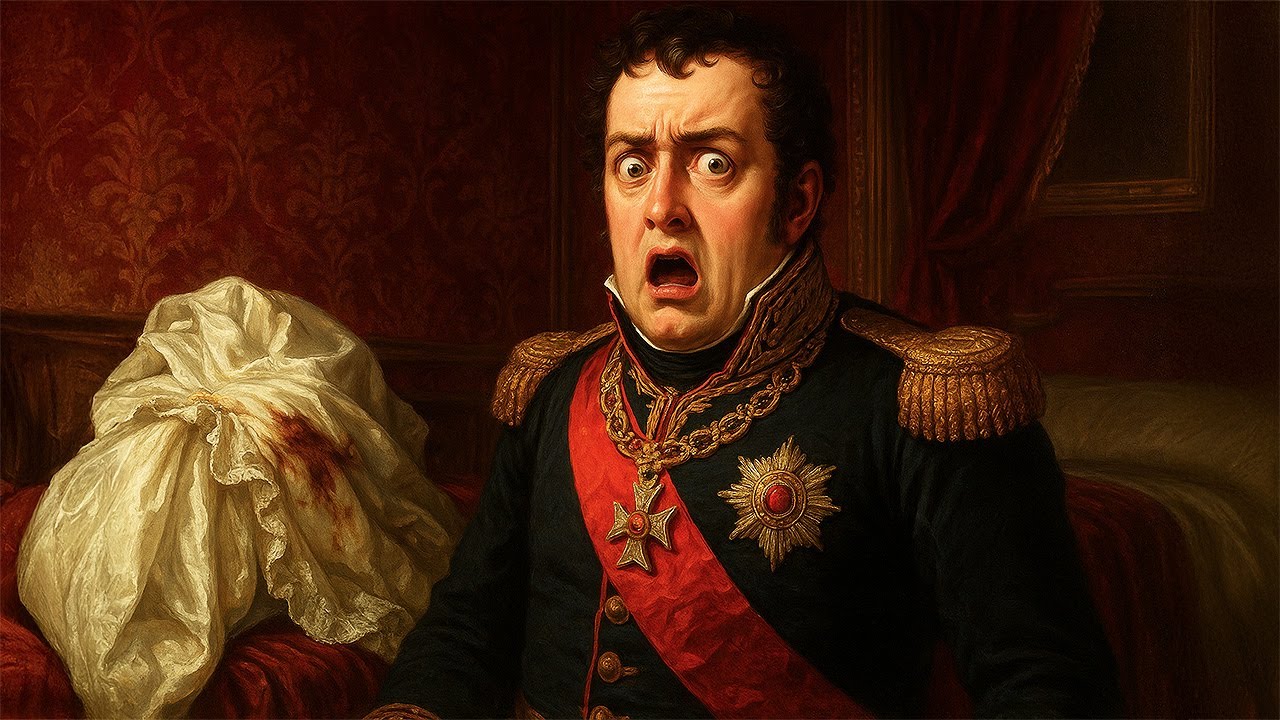
When Ferdinand returned to power in 1814 after Napoleon's defeat, he was thirty years old, sexually frustrated, and drunk on absolute power. What followed was a decade of debauchery.
Every night, the king would slip out of the palace wearing a dark cloak. His destination was the seediest brothel in Madrid. His favorite was run by a madam nicknamed Pepa La Málaga, an establishment so notorious that decent people crossed the street to avoid walking past it.
Ferdinand did not go alone. He assembled a crew of young aristocrats as morally bankrupt as himself, and together they turned Madrid's red-light district into their personal playground.
Ferdinand was so proud of his deformity, the very thing that had humiliated him in youth, that he turned it into a party trick. Multiple witnesses report the same stomach-turning scene.
The king of Spain, drunk on cheap wine, would challenge his companions to measurement contests. Each man would expose himself, and they would compare sizes. Ferdinand always won. His friends even gave him a nickname, El Bien Dotado, the well-endowed one.
The king would strut around the brothels, his anatomy on full display, bragging about his conquests. But the bragging was the least disturbing part.
Ferdinand had developed a particular fetish. In his own words, recorded by Count José María de Villa Lobos, the king boasted that women left his bed certain no other man could give them the pleasure he gave them. And what he enjoyed most after possessing them, he said, was collecting the rags stained with the proof of their maidenhood.
The king of Spain collected bloodied sheets from the virgins he deflowered. He kept them as trophies. This was not some medieval tradition. It was a personal fetish, a grotesque hobby he pursued with the same enthusiasm other kings collected art.
While the Prado Museum was being built, ironically by his neglected second wife, Ferdinand was building a collection of bloodstained evidence of his conquests.
The prostitutes at Pepa La Málaga's establishment were not his only victims. As he traveled around Spain, Ferdinand left a trail of ruined women: a widow in Aranjuez, a peasant girl in Sacedón, servants in the palace who could not refuse their king. Each encounter added to his collection.
Meanwhile, Spain was falling apart. While Ferdinand spent his nights measuring genitals and collecting trophies, his country lost its entire American empire. Liberal reformers were executed by the thousands. The economy collapsed. The king did not care.
This was the man who would take three more wives. Three more women who would discover that marrying the king of Spain meant entering a nightmare beyond imagination.
In 1816, Ferdinand needed an heir. His solution was to marry his own niece. Maria Isabel of Braganza was nineteen, plain-looking, and Portuguese, three strikes against her in the Spanish court. Madrid's gossips greeted her with a cruel rhyme mocking her as ugly, poor, and Portuguese.
But Maria Isabel had something her husband lacked: dignity. While Ferdinand continued his nightly brothel raids, she quietly founded the Prado Museum and opened the Royal Academy to women artists. She tried to bring culture to a court drowning in depravity.
Ferdinand barely noticed. To him, she was just a womb, a vessel for the heir he desperately needed. In 1818, she finally became pregnant.
When Maria Isabel went into labor, complications arose immediately. The baby was breach. The queen was fading. The royal physicians faced a choice: save the mother or save the child.
Ferdinand made the decision without hesitation. Save the child, he commanded. Cut her if you must.
What happened next was witnessed by twelve people, all of whom left matching accounts. The surgeons began performing an emergency cesarean. This was 1818, with no anesthesia beyond alcohol and opium. They sliced open the queen's abdomen, believing her unconscious.
She was not. Midway through the procedure, Maria Isabel's eyes shot open and she let out a scream that echoed through the palace. She was awake, fully conscious, as they cut through her womb.
The surgeons, panicking, continued as the queen writhed in agony. The baby was already dead, had been for hours. Maria Isabel bled out on the operating table, her final moments spent in unimaginable pain, sacrificed for a child that was never going to live. She was twenty-one years old.
The queen's sister publicly blamed Ferdinand for her death. Palace whispers suggested that his deformed anatomy had caused complications during conception. Others pointed to his syphilis, a gift from all those brothel visits, as the cause of the stillbirth. Ferdinand felt no guilt. Within a year, he was shopping for wife number three.
If Maria Isabel's death was a tragedy, what happened to Ferdinand's third wife was a farce so obscene that even the Pope could not ignore it. That wife was Maria Josepha, the sixteen-year-old who had soiled herself on her wedding night.
After the wedding night disaster, Ferdinand refused to touch his teenage bride for a week. When he finally returned to her bed, she fought him off with surprising strength. The girl raised by nuns to be meek and obedient turned into a wildcat when faced with her husband's advances.

She bit, she scratched, she kicked him in his monstrous genitals hard enough to send the king howling from the room. But the resistance could not last forever. Ferdinand was the king. Maria Josepha was his property.
So he tried a different approach: patience. Every night he would enter her chamber. Every night she would pray the rosary while he attempted to seduce her.
The queen had a powerful weapon in her arsenal: ignorance. She genuinely believed babies came from stalks. When Ferdinand tried to explain the facts of life, she accused him of lying, of trying to trick her into committing a mortal sin.
She declared that God would not create such a vile method of creating life, and that he was testing her virtue with lies. Weeks passed, then months. Ferdinand, the man who bragged about his sexual conquests, could not bed his own wife.
The court was whispering. Foreign ambassadors were reporting back to their governments. The king of Spain was being sexually rejected by a teenager.
Finally, Ferdinand played his trump card. He wrote to the Pope. Pope Pius VII, an elderly Italian who had survived Napoleon and thought he had seen everything, received a letter that must have made him question his faith.
The king of Spain, defender of the Catholic faith, needed the Holy Father to convince his wife to have sex with him. The Pope's response survives in the Vatican archives, a masterpiece of ecclesiastical diplomacy.
His Holiness delicately explained that marital relations were not only permitted but required by God. Producing an heir was Maria Josepha's sacred duty. To refuse her husband was to refuse God's will.
But even the Pope's letter was not enough. Maria Josepha agreed to submit to God's will, but only under certain conditions. She would pray the entire rosary before each encounter. She would keep her eyes closed throughout. And she would think of the Virgin Mary to maintain her spiritual purity.
Imagine being Ferdinand. You are the absolute monarch of Spain, with the power of life and death over millions, and you are lying there while your teenage wife recites Hail Mary while you try to consummate your marriage.
It was, by all accounts, the least erotic relationship in royal history. Maria Josepha would lie there like a corpse, lips moving in silent prayer, while Ferdinand attempted to create an heir. The king who collected trophies was reduced to begging for the slightest sign of enthusiasm from his own wife.
Ten years they spent in this matrimonial purgatory. Ten years of rosary-accompanied sex. Ten years without producing a single child. When Maria Josepha died in 1829 at age twenty-five, officially of fever, the court breathed a collective sigh of relief. Ferdinand had failed again.
Three wives, two dead, zero legitimate heirs. At forty-five, diseased from decades of debauchery, Ferdinand had one last chance. This time, he found a queen who was his equal in cunning, if not in perversion.
Maria Christina of Bourbon-Two Sicilies knew exactly what she was getting into. Unlike Ferdinand's previous wives, she came prepared. At twenty-three, she was beautiful, intelligent, and ruthlessly practical. She was also Ferdinand's niece, because apparently incest was the only Bourbon tradition he actually respected.
But Maria Christina had studied her predecessors' failures. She understood that producing an heir was not just about politics. It was about solving an engineering problem.
The solution came from an unlikely source: the royal physician, Dr. Antonio Hernández. After examining the king's anatomy and reviewing the medical records of his previous marriages, the doctor reached a startling conclusion. The problem was not just Ferdinand's size. It was the physics of the situation.
If you are trying to plant a seed but your tool is too large for the garden, you need to modify either the tool or the garden. Since modifying Ferdinand was out of the question, they had to get creative.
Dr. Hernández's solution was elegant in its simplicity. He commissioned the royal craftsman to create a special cushion, an almohadilla, made of the finest silk and stuffed with down feathers. Cut into its center was a precisely measured hole exactly four centimeters deep.
The physics were simple. Ferdinand would insert himself through the hole, which would act as a barrier, preventing him from causing the internal damage that had plagued his previous attempts at procreation. Only the tip, the functionally necessary part, would make contact.
Maria Christina presented this solution to her husband with the diplomatic skills of a seasoned negotiator. She framed it not as an acknowledgment of his deformity, but as a medical necessity for producing healthy heirs. Ferdinand's ego, always his weakness, accepted this narrative.
Their first night using the device was reportedly awkward. Ferdinand, used to bragging about his size, now had to accept a limitation. Maria Christina, ever practical, treated it like any other royal protocol, a necessary procedure for the good of the crown.
But it worked. Within three months, Maria Christina was pregnant. The entire court held its breath. Would this pregnancy end like all the others, in blood and death?
On October 10, 1830, the cannons of Madrid fired in celebration. Queen Maria Christina had given birth to a healthy daughter, the future Isabella II. Two years later, she produced a second daughter, Luisa Fernanda.

Ferdinand finally had his heirs. It had taken four wives, two deaths, one papal intervention, and a specially designed sex cushion.
The birth of Isabella created a new problem. Spanish law, the Salic law borrowed from France, forbade female succession. Ferdinand's brother, Don Carlos, expected to inherit the throne. But Ferdinand, having literally engineered these heirs into existence, was not about to let a technicality stop him.
In a move that would plunge Spain into civil war, Ferdinand issued the Pragmatic Sanction of 1830, overturning centuries of law to allow his daughter to inherit. When he died in 1833, his sexual dysfunction had one final consequence: the First Carlist War, a bloody conflict that would kill hundreds of thousands. All because a king with a monstrous deformity finally figured out how to use a cushion.
But there remains the matter of those trophies Ferdinand mentioned, his collection of bloodstained cloths. This is where his perversion reaches its darkest depths.
After his death in 1833, Maria Christina ordered a discreet inventory of the king's private chambers. What they found defied belief. Hidden in a cedar chest wrapped in silk were dozens of cloth squares, each carefully labeled with a date and a name.
One entry read: Carmen, Prado house, March 1821. Another: Isabella, palace servant, January 1823. Another: Maria, widow Vanes, September 1824. The king had not been exaggerating. He really had been collecting these grim mementos for nearly two decades.
Each piece of cloth represented a woman, some willing, some not, who had experienced Ferdinand's particular brand of brutality. But the collection revealed something else that palace observers had long suspected.
The dates clustered around specific events. After every political setback, after every liberal uprising he crushed, after every execution he ordered, Ferdinand would add multiple trophies to his collection in quick succession. Violence in the throne room led to violence in the bedroom.
The man who signed death warrants by day collected trophies by night. It was as if crushing political resistance and crushing female innocence were two sides of the same sick coin.
One entry stood out to the investigators. It read: Anna, fifteen years, daughter of Colonel Bermúdez, February 1823. Colonel Bermúdez had been one of the liberal officers executed after the failed constitutional revolt. His daughter Anna had come to the palace to beg for her father's life. She left with her father dead and her innocence destroyed, memorialized in Ferdinand's sick collection.
This was not just a king abusing his power for sexual gratification. This was systematic predation, using sex as another tool of political terror. The liberals Ferdinand could not execute, he destroyed through their daughters, their wives, their sisters.
The full inventory was never made public. Maria Christina, showing more wisdom than her late husband ever did, ordered the entire collection burned. But not before several courtiers saw it and recorded what they witnessed. Their accounts match perfectly, too perfectly to be dismissed as palace gossip.
We know Ferdinand kept these trophies. We know he labeled them. We know he added to the collection after moments of political violence. What we do not know is how many women suffered to build this grotesque museum.
The cloths that survived suggest dozens. The reality was probably worse. For every bloodstained trophy in that chest, how many women fought him off? How many escaped? How many were silenced before they could tell their stories? We will never know.
Ferdinand took those secrets to his grave, along with the names of victims whose only crime was catching the eye of a king who confused power with permission.
When Ferdinand VII died on September 29, 1833, Spain barely mourned. His own brother immediately declared war. His daughter would face multiple civil wars defending the throne he had engineered her onto. His widow quickly remarried a common guard, scandalizing the nation one final time.
But Ferdinand's true legacy was not political. It was personal. He had transformed the Spanish monarchy from a sacred institution into a sordid joke. Every king after him would be tainted by association. Every royal marriage viewed with suspicion.
His daughter Isabella II inherited more than just his throne. She inherited his sexual appetites. Her own scandalous affairs and rumored nymphomania led to her overthrow in 1868. The Bourbon dynasty that Ferdinand had literally engineered into existence would be driven out of power by his own bloodline's inherited depravity.
Think about that cushion for a moment. A king so deformed that normal human reproduction required engineering intervention. A monarchy so desperate for heirs that it turned the royal bedroom into a medical procedure.
That cushion, now lost to history, represents everything wrong with Ferdinand's reign: power corrupted to the point of physical deformity, legitimacy so fragile it hung by a thread, or rather by a carefully measured hole in a silk pillow.
Perhaps the cruelest irony is this. Ferdinand VII is remembered not for any great achievements, not for any noble deeds, but for his grotesque anatomy and the suffering it caused. He wanted to be El Deseado, the Desired One. Instead, he became a cautionary tale, a reminder that power without humanity creates monsters.
Every historian who studies his reign reaches the same conclusion. As one wrote, he was cowardly, selfish, grasping, suspicious, and vengeful. Another concluded he was the worst of the Habsburg and Bourbon monarchs. His own contemporary, the Duke of Wellington, observed that he was the most contemptible of God's creatures.
They are all correct, but they are also too kind. Ferdinand VII was not just a bad king. He was a predator with a crown, a man who turned his physical deformity into a weapon, a ruler who collected human suffering like others collected art.
In the end, that is his true legacy. Not the throne he passed to his daughter. Not the civil wars he sparked. Not even the grotesque cushion that finally gave him an heir. His legacy is in the unnamed women in that burned collection: the servants who could not refuse, the virgins who became trophies, the wives who died or lived in terror.
Ferdinand VII proved that monsters do not need to hide under beds or in dark forests. Sometimes they wear crowns and rule nations. Sometimes they are celebrated as kings. And sometimes, just sometimes, history remembers them for exactly what they were.