In May 1948, a farmer in the hills of the Ardèche in southern France found wreckage scattered across a ravine on the Plateau de Joux. The fuselage of a small twin-engine aircraft had struck the earth nose first. Four bodies were inside.
One of them was a 28-year-old American woman who had packed a suitcase for the Riviera that morning. She was the widow of a British marquess killed by a German sniper four years earlier. She was the sister of a future president of the United States. She was the daughter her mother had refused to forgive.
Her name was Kathleen Kennedy, and she had been on her way to meet her father in Paris to ask his permission to marry for the second time a man her family considered a mortal sin.
The Cavendishes of Chatsworth were one of the most powerful dynasties in England. Dukes since 1694, heirs to 175 rooms, 35,000 acres, and a political legacy woven into the fabric of the British state.
The Kennedys of Massachusetts were building a different kind of empire. Newer, Catholic, fueled by an ambition that would eventually reach the White House.
Between 1944 and 1948, these two families were bound together by wartime marriage, torn apart by religion, and shattered by a sequence of deaths that left no one untouched.
To understand what brought Kathleen Kennedy to a churchyard in Derbyshire, and what it cost two families on opposite sides of the Atlantic to put her there, you have to go back further than the war, further than the marriage, and further than the night she met a shy English marquess at a garden party and decided with the kind of certainty that would define and destroy her that he was the man she wanted.
The Dukes of Devonshire were not ordinary aristocrats. They were one of the five or six families upon which the constitutional architecture of England had been built and rebuilt across three centuries.
The family's origins lay with a woman, Elizabeth Hardwick, known as Bess of Hardwick, born around 1521, the daughter of a Derbyshire man who owned almost nothing. Through four increasingly strategic marriages, Bess became the second richest woman in England after Queen Elizabeth I.
Her second husband, Sir William Cavendish, purchased the Chatsworth estate in 1549. Her fourth husband was George Talbot, sixth Earl of Shrewsbury, one of the wealthiest peers in the realm and custodian of Mary, Queen of Scots.
After their bitter separation, Bess built Hardwick Hall, completed in 1597, its walls more glass than stone. Its six towers bore her initials, repeated 18 times against the Derbyshire sky. It was a building designed to say: I did this. I survived. Look at what I made.
Through Bess's son William, the family was elevated to Earls of Devonshire in 1618. But the decisive moment came in 1694, when the fourth Earl was created first Duke of Devonshire by William III, a reward for being one of the Immortal Seven who signed the invitation that brought the Dutch prince to England and triggered the Glorious Revolution.
From that moment forward, the Cavendishes were the foremost Whig dynasty in the country, champions of Protestant succession, parliamentary supremacy, constitutional liberty, and rational governance. They were not merely rich. They were foundational.
The dynasty's political reach spanned centuries. The fourth Duke served as prime minister from 1756 to 1757. Georgiana, Duchess of Devonshire, was the most celebrated political hostess of the 18th century, canvassing publicly for Charles James Fox in an age when women did not campaign.
The eighth Duke, Spencer Compton Cavendish, was offered the premiership three times by Queen Victoria and declined each time. His brother, Lord Frederick Cavendish, was assassinated in Dublin's Phoenix Park by Irish nationalists in 1882.
The ninth Duke served as governor general of Canada from 1916 to 1921. And Harold Macmillan, who married the ninth Duke's daughter, Lady Dorothy, became prime minister in 1957, tying the Cavendish web yet tighter around the apex of British power.
At the center of it all stood Chatsworth House in Derbyshire, rebuilt by the first Duke between 1687 and 1707 in English Baroque grandeur, then expanded by the sixth bachelor Duke with architect Jeffry Wyatville and head gardener Joseph Paxton, the man who would go on to design the Crystal Palace.
It held 175 rooms, a library of 35,000 volumes, and one of Europe's most significant private art collections. The estate encompassed approximately 35,000 acres of farmland, woods, rivers, and some 450 tenanted homes. The garden stretched across 105 acres. The park, landscaped by Capability Brown, covered more than 1,800 acres.
Beyond Chatsworth, the family held Bolton Abbey in Yorkshire, Lismore Castle in County Waterford, Ireland, and Hardwick Hall. Until 1919, there had been Devonshire House on Piccadilly, three acres of Whig political headquarters in the heart of London, capable of hosting 1,200 guests. It was sold and demolished in 1924.
By the time Billy Cavendish was born in 1917, the great fortune was already hemorrhaging. Death duties had been introduced in 1894, and the ninth Duke had paid over £500,000 on the eighth Duke's death alone.
To meet the bill, he sold the Caxton books and Shakespeare folios to the Huntington Library in California in 1912, let Devonshire House go in 1919, and sold Chiswick House to Middlesex County Council. The Great Conservatory at Chatsworth was demolished. The empire was still vast, but it was shrinking.
Edward Cavendish, Billy's father, inherited as 10th Duke in 1938 into a world of diminishing grandeur. He was a serious man, twice mentioned in dispatches during the First World War, appointed MBE, and president at the signing of the Treaty of Versailles.
He represented West Derbyshire as MP from 1923 to 1938, served in Churchill's wartime cabinet, and married Lady Mary Gascoyne-Cecil, daughter of the fourth Marquess of Salisbury and granddaughter of Prime Minister Lord Salisbury.
During the war, the Duke made Chatsworth available to Penrhos College, a Welsh girls school evacuated from Colwyn Bay. But the Duke was pessimistic. He did not expect to return to Chatsworth.
And there is one more thing about the 10th Duke that matters for this story. He was described consistently by those who knew the family as the most anti-Catholic Cavendish of them all.
Into that world in the spring of 1938 walked an 18-year-old Irish American Catholic from Brookline, Massachusetts, who chewed gum on the pavements of Mayfair, called the Duke of Marlborough "Dookie Wookie," and would within six years become the Marchioness of Hartington.
Kathleen Agnes Kennedy, Kick as everyone called her, was born on February 20, 1920, at 83 Beals Street, Brookline, in the same house where her brother Jack had been born three years earlier. She was the fourth of nine children of Joseph P. Kennedy Sr. and Rose Fitzgerald Kennedy.
She was raised inside a dynasty as fiercely tribal as the Cavendishes, but defined not by Protestant constitutionalism, but by Catholic faith. The Kennedys' wealth was newer, built on banking, bootlegging, and Hollywood. Their power was less embedded in the constitutional order.
Kick was educated at the Noroton Convent of the Sacred Heart in Connecticut, where the nuns nicknamed her "Mademoiselle Pourquoi" for her habit of questioning everything, and at the Holy Child convent outside Paris.
She was not the most beautiful Kennedy sister. That was Rosemary, before the catastrophe of the lobotomy. But she was by every account the most magnetic: quick-witted, fearless, idiosyncratically charming, and possessed of a warmth that cut through the studied composure of English social life.
Joe Jr., Jack, and Kick formed what the family called the golden trio. She was closest to Jack. They wrote to each other constantly, shared private jokes, and understood each other in the way that siblings sometimes do when they have both decided independently not to be quite what their mother expects.
In March 1938, Kick arrived in London. Her father had been appointed United States Ambassador to the Court of St. James's, the first Irish Catholic to hold the position. The British press treated the Kennedys as visiting royalty.
On May 12, 1938, Kick was presented at court before King George VI and Queen Elizabeth. She wore white as presentation required, and her photograph appeared in newspapers across England. The media declared her the debutante of the year.
And then at a garden party at Buckingham Palace in July of that year, she met William John Robert Cavendish, Marquess of Hartington, Billy as his friends called him. He was 20. He was tall, slim, quiet, and shy.
He had been educated at Eton and Trinity College, Cambridge, and carried through his mother the blood of the Cecils of Hatfield House, who had produced three prime ministers of their own. By every account, he was decent, thoughtful, and possessed of a gentleness that did not quite fit the armor he was expected to wear.
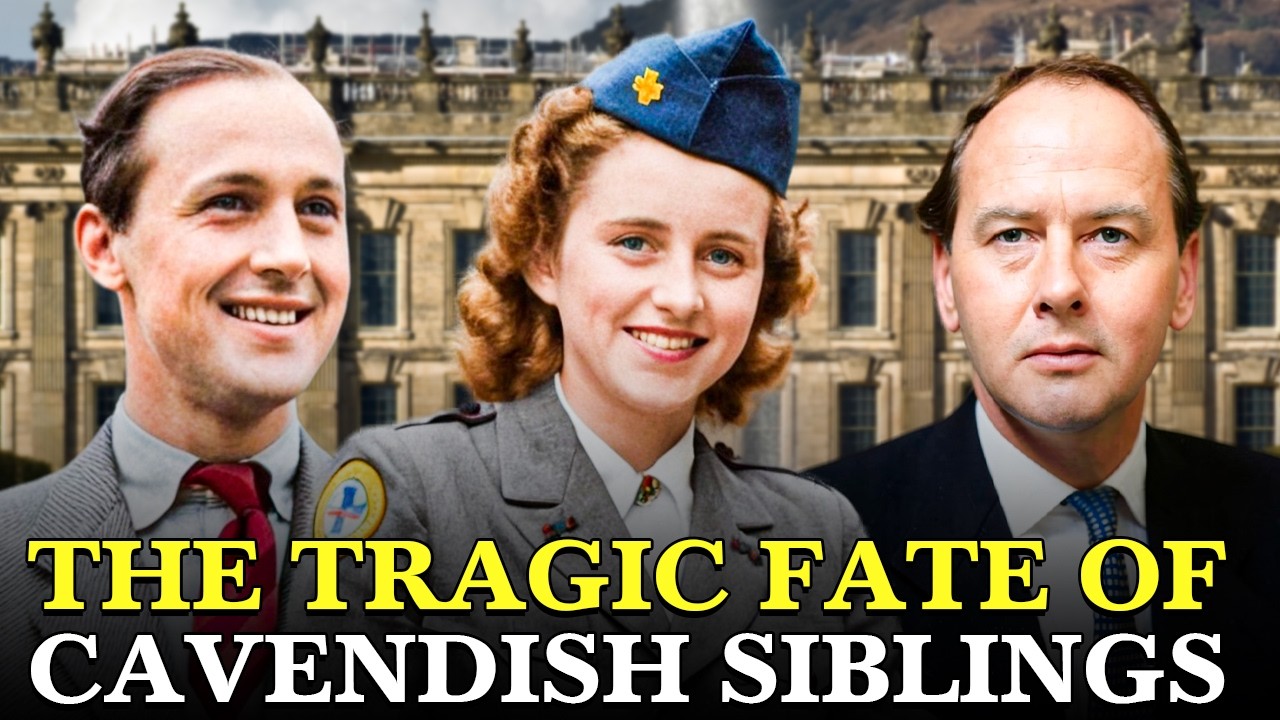
The attraction was instant and, to almost everyone who observed it, improbable: the vivacious, gum-chewing American Catholic and the shy, correct heir to the most militantly Protestant dukedom in England.
They grew closer across the summer and autumn of 1938. Billy was part of a foursome with his brother Andrew and Deborah Mitford, the youngest of the six Mitford sisters, who would later become central to this story in a way nobody could have predicted.
But between them lay a chasm that neither charm nor love could bridge on its own, and it was not a matter of nationality or class. It was theology.
Under Catholic canon law at the time, a marriage between a Catholic and a non-Catholic required a dispensation from the local bishop and a binding promise that all children would be raised in the Catholic faith. Without these conditions, the church would not recognize the marriage as sacramental. The bride would be living in mortal sin.
For the heir to the Devonshire dukedom, this was not merely inconvenient. It was existentially impossible. The Dukes of Devonshire were hereditary patrons of dozens of Church of England parishes across Derbyshire. The entire political, social, and spiritual architecture of the family rested on the heir being Anglican.
When war broke out in September 1939, the question remained unresolved. On September 3, Kick walked with her brothers Joe Jr. and Jack to the Palace of Westminster to hear Chamberlain announce that Britain was at war with Germany. She begged to stay. Her father overruled her, and she sailed home in early autumn. She would not return for nearly four years.
Back in Washington, she took a job at the Times-Herald as a research assistant to executive editor Frank Waldrop, eventually earning her own byline reviewing plays and films.
On June 25, 1943, she sailed back to England, having completed Red Cross courses at American University. She was posted to the Hans Crescent Club, a Red Cross center for servicemen near Harrods in Knightsbridge. A daily Mail photograph of her cycling through wartime London earned her the nickname "the girl on the bicycle."
She was 23 years old, and Billy Cavendish was still unmarried. The courtship resumed under the pressure of wartime, the sense that decisions deferred might become decisions denied.
The theological negotiations intensified. Meetings were held between representatives of both churches. Kick agonized. Billy agonized. Evelyn Waugh, the Catholic convert and novelist, reportedly warned Kick she would go to hell. He would later use her predicament as the raw material for Julia Flyte's anguished romance with an Anglican in Brideshead Revisited.
The eventual compromise was brutal in its specificity. Any sons would be raised Church of England, any daughters Catholic. In practical terms, it meant the heir to the dukedom would be Anglican, a concession so fundamental that it could not be described as a compromise at all. It was a surrender.
Rose Kennedy's opposition was absolute and annihilating. She described herself as disturbed, horrified, heartbroken. She took herself to hospital with a nervous collapse. She refused to speak to Kathleen before, during, or after the wedding.
She let it be known through family channels that marrying outside the church was the worst sin one could commit, that her daughter would be living in mortal sin, that she would go to hell. A younger Kennedy later explained the stakes as Rose understood them: it meant eternal damnation.
Joseph Kennedy was more sympathetic. He saw a strategic alliance with one of the premier families in England, but he could not attend and he could not soften Rose.
On May 6, 1944, Kathleen Kennedy married Billy Cavendish at the register office in Chelsea Town Hall on King's Road, London, a 10-minute civil ceremony that satisfied neither church. She wore a pink crepe dress paid for with clothing ration coupons and a small hat decorated with ostrich feathers.
She carried a posy of pink camellias brought that morning from the greenhouses at Chatsworth, a gesture from the Cavendish family that said, more eloquently than words, that she was already theirs. Billy wore his Coldstream Guards uniform.
Joseph P. Kennedy Jr., serving as a US Navy pilot in England, was the sole member of the Kennedy family present. He gave his sister away and signed the marriage register. The 10th Duke of Devonshire signed as well. Charles Manners, 10th Duke of Rutland, served as best man.
Some 200 people attended the reception at Eaton Square. JFK was hospitalized with back injuries from the PT-109 incident. Robert Kennedy was in naval training. Rose Kennedy was at home in Hyannis Port, consumed by grief and fury. Not a single other Kennedy came.
They had less than five weeks together. Billy was called up on June 13, one week after D-Day, and deployed to Normandy with the 5th Battalion, Coldstream Guards, Guards Armoured Division. They spent their brief honeymoon at Compton Place in Eastbourne, walking on the Downs, trying to be ordinary, knowing they could not be.
In the weeks that followed, Billy stood as the Conservative coalition candidate in the West Derbyshire by-election on February 17, 1944, the traditional safe seat held by his father from 1923 to 1938. Kick canvassed for him under a false name and loved the nightly strategy sessions in Bakewell pubs.
It was a disaster. Independent Labour candidate Charles Frederick White won with 16,336 votes to Billy's 11,775, a majority of 4,561. Churchill's private secretary, John Colville, recorded that a pall of the blackest gloom fell on the prime minister, who looked old, tired, and very depressed.
In August, Kick made her first public appearance as Lady Hartington at the Bakewell Fair in Derbyshire, where the Duke's political agent wrote afterwards that she would be enormously useful to the family's political life when the war ended. JFK, visiting England later, watched her give a speech and observed that she seemed like a possible candidate herself.
On August 12, 1944, Kick's brother Joe Jr. was killed when his explosives-laden aircraft, a converted B-24 Liberator, part of the top secret Operation Aphrodite, detonated prematurely over East Suffolk. He was 29 years old.
He was the only Kennedy who had attended her wedding. He was the brother who had been her confidant through the religious crisis, the man who had walked her to the register at Chelsea Town Hall, the one who had signed his name beside hers.
Kick traveled to Hyannis Port to grieve with her family. She was still in America, still mourning Joe, when the telegram arrived on September 9, 1944.
Major William Cavendish, Marquess of Hartington, led the 3rd Company of the 5th Battalion, Coldstream Guards, in an assault on the village of Heppen near Lommel in the Limburg province of Belgium. His unit had helped liberate Brussels just six days earlier.
On September 3, the Guards Armoured Division had rolled into Brussels to scenes of jubilation. Six days later, the jubilation was over. Under heavy artillery fire, Billy advanced toward a cluster of farmhouses at approximately 0845 hours where German Waffen-SS troops had dug in.
According to the regimental account and the Liberation Route Europe memorial, he was wearing a white mackintosh and beige corduroy trousers, conspicuous to the point of recklessness, as though the conventions of a gentleman's wardrobe had followed him onto the battlefield.
He called to his men to follow. He was shot through the heart while storming the Mangelhot family farmhouse. His second in command, Sergeant Major Cowie, took command and captured the position roughly an hour later, earning the Distinguished Conduct Medal.
Billy Cavendish was 26 years old. He had been married for four months and five days. He was buried at Leopoldsburg War Cemetery in Belgium, Plot 4, Row B, Grave 13. The personal inscription on his grave, chosen by his family, was taken from the Wisdom of Solomon: "He being made perfect in a short time, fulfilled a long time, for his soul pleased the Lord."
Kick received the news at Hyannis Port. In the space of 28 days, she had lost her brother and her husband. She was the widow of the Marquess of Hartington. She was the daughter Rose Kennedy had not forgiven. She was 24 years old, and she was about to make the decision that would define the rest of her life and end it.
She chose to stay in England. That fact alone tells you everything you need to know about Kathleen Kennedy, or rather everything you need to know about what England had become for her and what America and her mother no longer were.
She could have gone home. She could have returned to the Kennedy compound at Hyannis Port, taken her place among the grieving family, submitted to Rose's version of events: that the marriage had been a sin, that Billy's death was the hand of providence, that the prodigal daughter should come home and repent. She did not. She went back to London and she stayed.
The Duchess of Devonshire, Billy's mother, Lady Mary, wrote to her in the weeks after Billy's death with words that carried the weight of a family's gratitude and a mother's shattered heart. She told Kick never to forget that marrying Billy had given him complete happiness.
She told her that she would love her for the rest of her life, not only for herself, but because she had given such perfect joy to the son she loved above anything in the world.

This was the Duchess of Devonshire, a woman born a Gascoyne-Cecil, granddaughter of a prime minister, married into a family whose anti-Catholic convictions were woven into the very foundation of the dukedom. And she was writing to the Catholic girl from Brookline, Massachusetts, telling her she was loved.
Whatever theological battles had been fought over church registers and children's souls, whatever Rose Kennedy believed about mortal sin and damnation, the Cavendishes had claimed Kick as their own. The most anti-Catholic family in England had welcomed a Catholic daughter-in-law. And after her husband's death, they did not let her go.
She spent the autumn of 1944 in a kind of suspended grief. Holidays with the Cavendishes, a convent retreat, a brief return to Red Cross volunteer work at the Charles Street Club. And then she did something that nobody expected.
She bought a townhouse in Smith Square, Westminster, a few minutes' walk from Parliament, and she made it into something that resembled neither a Cavendish drawing room nor a Kennedy compound, but something entirely hers.
It became a salon, intimate, eclectic, and alive, where Anthony Eden sat beside George Bernard Shaw, where Evelyn Waugh turned up regularly and jested characteristically that she was in love with him, where politicians and writers in the leftover brilliance of wartime London gathered around a 24-year-old American widow who seemed to know everyone and fear nothing.
She gave speeches for the Women's Institute in Derbyshire, adopting Billy's county as her own. She visited the Cavendishes at Chatsworth and at Compton Place. She took her place in Billy's world with a naturalness that even the English, who prize naturalness above all social qualities, found remarkable.
When JFK came to London in June 1945 to cover the British elections for the Hearst newspapers, it was Kick who became his fixer and guide, driving him to Churchill's campaign speeches, introducing him to the politicians and journalists he needed to meet, translating the intricacies of the British class system for a brother who would one day need to understand how power worked on both sides of the Atlantic.
The London Times would later capture what she had become to her adopted country in a single sentence from her obituary: "No American man or woman who had ever settled in England was so much loved as she, and no American ever loved England more."
But the life she built in those post-war years was not serene. It was frenetic, restless, luminous, and brittle. She was 25, 26, 27 years old. She had been a wife for four months. She had buried a brother and a husband in the same summer.
She was estranged from her mother over a question of theology that Rose considered settled by Billy's death, by God's judgment, by the iron logic of Catholic doctrine. And underneath the social energy and the speeches and the dinner parties, there was a woman who had been cut off from her mother's love and had then lost the man for whom she had sacrificed it.
In 1946, at the Commandos' Benevolent Fund ball, she met Peter Wentworth-Fitzwilliam, 8th Earl Fitzwilliam. He was 35 years old. He was by almost any measure the worst possible man she could have chosen, and in a life defined by impossible choices, that may have been precisely the point.
Fitzwilliam was a war hero. He had served with the Commandos and the Special Operations Executive, earning the Distinguished Service Order for operations behind enemy lines. He was also one of the wealthiest men in England.
He had inherited in 1943, along with Wentworth Woodhouse in South Yorkshire, one of the largest private houses in Europe, its facade stretching more than 600 feet and containing more than 300 rooms, and the Coolattin estate in County Wicklow, Ireland, encompassing tens of thousands of acres. His fortune at the time of his death was estimated at £45 million.
He was charming in the way that men of immense confidence and immense recklessness are often charming. The kind of charm that burns people who get too close. He drank. He gambled on horses with the same abandon he had brought to wartime intelligence operations. He was known to be unfaithful.
Lynn McTaggart, who studied Kick's life more closely than perhaps anyone else, observed with devastating precision that the chances of Fitzwilliam being faithful to her were zero.
He was Protestant and he was married. His wife, Olive Dorothea Plunkett, "Obby" to friends, was the daughter of the Bishop of Tuam. She was struggling with alcoholism. They had one daughter, Lady Juliet, born in 1935. The marriage was collapsing, and Fitzwilliam was seeking a divorce.
None of this deterred Kick. If anything, the impossibility seemed to attract her, as though she had been conditioned by her own history to believe that love worth having would always require a sacrifice that most people would consider unreasonable.
She had already lost everything once for choosing love over her mother's faith. She had lived through it. She had survived. Whatever fear she might have felt, she told a friend, was manageable, that there were no fears left for someone who had faced love, marriage, and death before the age of 25.
Rose Kennedy's reaction went beyond anything she had unleashed over Billy. She threatened not merely disapproval but total excommunication. Not from the church this time, but from the family itself. Kick would be cut off from every one of her siblings. She would be disowned completely. She would cease to be a Kennedy.
The matriarch who had refused to attend her daughter's first wedding now made it clear that a second marriage to a divorced Protestant whose wife was still living would sever every remaining connection between Kathleen and the family name. It was an ultimatum without negotiation. Rose meant it.
Kick was undeterred. She planned to fly with Fitzwilliam to the south of France and then on to Paris, where she intended to meet her father and make her case.
Joe Kennedy Sr. had always been the more pragmatic parent, the one who saw strategic possibility where Rose saw sin. He had not stopped the first marriage with the ferocity Rose had brought to bear. If Kick could get Joe on side, she believed the rest of the family might gradually follow. It was a calculation born of hope rather than evidence.
On the morning of May 13, 1948, Kick and Peter boarded a chartered de Havilland Dove, a small 10-seat twin-engine aircraft, at Le Bourget airport outside Paris. The pilot was Peter Townend. The navigator was Arthur Freeman.
They took off in the early afternoon, climbing to 10,000 feet, bound for Cannes and the Riviera sunshine, a holiday that was also a strategy, timed together before the confrontation with Joe Kennedy that Kick hoped would secure her future.
Approximately one hour into the flight, somewhere over the Rhône Valley near the town of Yenne in the Ain, the Dove entered severe thunderstorms. Radio contact with the ground was lost.
For roughly 20 minutes, the aircraft was thrown through violent turbulence, bounced thousands of feet at a time, the wings flexing beyond anything their designers had intended, the instruments useless in the darkness of the storm.
When the plane finally broke through the cloud base, it was in a steep dive moments from the ground. The stress of the turbulence and the sudden attempt to pull out of the descent exerted forces that the airframe could not withstand. One wing tore loose, then both engines, then the tail assembly.
The fuselage spun nose first into a ravine on the Plateau de Joux near the village of Saint-Bauzile in the Ardèche in southern France. All four occupants were killed instantly. Kathleen Kennedy Cavendish, Marchioness of Hartington, was 28 years old. She had been a widow for three years, seven months, and four days.
Joseph Kennedy Sr. flew to France and identified his daughter's body. A friend named Aly Forbes, who was present in the days that followed, left an account that has survived in the biographical record with the clarity of something that could not be unseen.
Forbes described the stricken face of old Joe Kennedy as he stood alone, unloved and despised, behind the coffin of his daughter amid the hundreds of British friends who had adored her.
Deborah Devonshire, who was by then married to Billy's younger brother, Andrew, described Joe Kennedy standing in a crumpled navy blue suit, "and he was as crumpled as the suit was." It is one of the most quietly devastating descriptions in the entire Kennedy literature.
Rose Kennedy did not attend. She checked herself into hospital for routine medical tests. According to multiple Kennedy biographies, she received the news and responded with words that have followed the family through every retelling since. She said that God had seen what was going on, and he had pointed, and he had said no.
The Cavendishes buried Kick at St. Peter's churchyard in Edensor, the small village that sits just beyond the gates of Chatsworth, where the family had laid its dead for generations. They gave her a full Catholic funeral, arranged and paid for by the Protestant family she had married into.
The headstone reads: "In loving memory of Kathleen, 1920–1948, widow of Major the Marquess of Hartington, killed in action, and daughter of the Honourable Joseph Kennedy, sometime Ambassador of the United States to Great Britain."
And beneath it, the line that Billy's mother, the Duchess, composed for the girl who had made her son completely happy: "Joy she gave, joy she has found."

Billy lies in Belgium in the military cemetery at Leopoldsburg, Plot 4, Row B, Grave 13, close to where he fell. Kick lies in Derbyshire in English soil, surrounded by Cavendishes. They were married for four months. They are buried in different countries, separated by the same war that brought them together.
The family they left behind was not finished paying. On November 26, 1950, Edward Cavendish, 10th Duke of Devonshire, died suddenly of a heart attack at Compton Place, Eastbourne. He was 55 years old.
The circumstances bore a sinister footnote that would not emerge for years. His general practitioner, Dr. John Bodkin Adams, was later investigated as a suspected serial killer who may have been responsible for over 160 suspicious deaths among his wealthy elderly patients along the South Coast. Adams signed the Duke's death certificate stating natural causes.
Andrew Cavendish, the Duke's surviving son and now the unexpected heir, later observed dryly that the doctor was not appointed to look after the health of his two younger sisters, who were then in their teens.
In 1946, anticipating the punitive post-war tax regime, the Duke had transferred most of the estate's assets to Andrew, hoping to exploit the five-year rule that would exempt the transfer from death duties. He died approximately 14 weeks short of the threshold. The exemption did not apply.
Death duties were assessed at 80 percent of the full estate value. The tax bill came to approximately £7 million, the equivalent of roughly £200 million today. Professional advisers told Andrew that the position was irretrievable. One plan proposed surrendering Chatsworth to the nation, turning it into what someone described as a Victoria and Albert Museum of the North of England.
Andrew Cavendish, who had been in Australia when his father died and who had never expected to inherit the title, who had spent his life as the younger brother, the spare, the one freed from the weight of primogeniture, refused. He was 30 years old. He said he would fight to the bitter end.
What followed was a 17-year campaign of controlled destruction, a systematic dismantling of four centuries of accumulation to save the house at its center. Andrew and his wife Deborah, the youngest Mitford sister, sold tens of thousands of acres. The Derbyshire holding shrank from 83,000 to 35,000 acres.
Paintings by Rembrandt, Memling, Hals, and Van Dyck left the walls of Chatsworth, sold to collectors or transferred to British museums in lieu of tax. Hardwick Hall, Bess of Hardwick's masterpiece, the house where the dynasty had begun, with its 934 acres, was given to the National Trust in 1956. The London house at 19 Hill Street was sold. Compton Place in Sussex was left to a school.
Deborah Cavendish, Debo as everyone called her, was the engine of Chatsworth's survival. She was the youngest of the six Mitford sisters, that extraordinary sorority that included Nancy the novelist, Diana who married Oswald Mosley, Unity who worshipped Hitler and shot herself in Munich, and Jessica the communist who ran away to fight in the Spanish Civil War.
Deborah was the least extreme, steadier, funnier, and possessed of a commercial instinct that none of her more famous sisters shared. In 1959, she and Andrew moved into Chatsworth after major renovations: rewiring, plumbing, heating, 17 new bathrooms, and a kitchen that could serve the public as well as the family.
She created a farm shop, retail outlets, a farmyard attraction for children, restaurants, and eventually the Cavendish Hotel at Baslow and the Devonshire Arms at Bolton Abbey. She personally worked the ticket office. She turned Chatsworth into a model of how an English stately home could survive, not as a museum, but as a living, breathing commercial enterprise.
In 1981, Andrew established the Chatsworth House Trust as a registered charity, securing the house's future with a 99-year lease at one pound per year.
Andrew's later years were shadowed by the chronic alcoholism that Deborah described with characteristic bluntness as running through the Cavendish family. His uncle, Lord Charles Cavendish, the one who had married Adele Astaire and lived at Lismore, had died of it at 38.
Andrew also had well-publicized affairs. He served as a minister in Harold Macmillan's Conservative government from 1960 to 1964, cheerfully calling his appointment the greatest act of nepotism in British history. He was made a Knight of the Garter in 1996.
He died on May 3, 2004, aged 84, having once described himself with a modesty that contained its own pride. He said he had achieved virtually nothing in life, but the thing he was most proud of was securing Chatsworth's future.
Deborah outlived him by a decade. She died on September 24, 2014, at 94. The Prince of Wales and Duchess of Cornwall attended her funeral at St. Peter's, Edensor, the same church beside which Kick had been buried 66 years earlier.
Deborah's description of Kick, written in her book Chatsworth: The House, remains the most vivid portrait of her in the historical record. She wrote that Kick was not beautiful, but that her vitality and charm were such that she was the one who drew attention in a crowd.
That her high spirits, her funny Irish-American turn of phrase, so like her brother Jack's, and her extreme good nature made her far more attractive than most pale English beauties. She was loved, Deborah wrote, by everyone who knew her.
On June 29, 1963, five months before his assassination in Dallas, President John F. Kennedy made a private detour during a European tour to visit his sister's grave. He flew Air Force One to RAF Waddington in Lincolnshire, then took a US Army helicopter across the Derbyshire countryside to Edensor.
The Duke and Duchess of Devonshire met him, along with his sister Jean Kennedy Smith and his sister-in-law, Princess Lee Radziwill. Estate workers had built a small wooden bridge across a deer leap to allow the presidential party to reach the churchyard.
The group walked together to the burial ground. Then JFK walked on alone. He knelt at Kick's grave in silent prayer for several minutes, laying flowers he had brought from Ireland, from the country his family had left two generations earlier, the country whose faith had divided them.
On leaving, roughly 25 locals had gathered. They gave what a reporter described as a flutter of restrained applause, a very English response to a very American president. Kennedy smiled and waved before climbing into the Duke's Bentley.
Against Secret Service advice, he insisted on visiting Chatsworth House itself. He walked through the rooms where Billy had grown up, where Kick had spent her brief marriage, where the family that had accepted his sister still lived.
On July 12, 1963, he wrote to Duchess Deborah. He said he was sorry to have missed her and that all of them felt the arrangements she had made for Kathleen were beautiful. He wrote that the inscription "Joy she gave, joy she found" was so appropriate and moving.
He slightly misquoted it. The actual words are "Joy she has found," not "Joy she found." It is a small thing, the difference between a past completed and a present that endures. But it is the kind of detail that tells you something about grief and the way it alters even the most familiar words.
A memorial plaque was later placed beside Kick's grave in memory of John F. Kennedy, President of the United States of America, who visited this grave on June 29, 1963. Bobby Kennedy also visited the grave and stayed with the Cavendishes at Chatsworth.
The 12th Duke of Devonshire, Peregrine Cavendish, is 81 years old. He inherited on his father's death in 2004. He led a £32.7 million restoration of Chatsworth, completed in 2018, and oversaw the estate's transformation into one of England's most visited country houses.
More than 600,000 visitors pass through the rooms each year, and over a million walk the grounds. His estimated net worth is £910 million. His heir is William Cavendish, Earl of Burlington, whose son James, Lord Cavendish, born in 2010, represents the next generation. The family retains Chatsworth, Bolton Abbey, and Lismore Castle.
The dynasty that nearly ended with an 80 percent tax bill and a sniper bullet in Belgium has, against every reasonable expectation, survived.
Kick's grave is still there in the churchyard at Edensor, among the Cavendishes. Visitors come throughout the year. They leave flowers. They read the inscription.
And the story they carry away with them is always the same one. A story about two families, one built on Protestant constitutional power and the other on Catholic immigrant ambition, and a young woman who stood at the exact point where those families collided and chose love both times and lost both times, and was buried not by the family she was born into, but by the family she chose.
The Cavendishes survived because the spare and the youngest Mitford sister turned out to be exactly what the crisis demanded: tougher, more resourceful, and more ruthlessly practical than anyone had expected.
The Kennedys survived because they always did, though not without a pattern of loss that would take decades to fully unfold, and that began by some reckonings with the daughter who left.
And in a churchyard in the Derbyshire hills, beneath an epitaph composed by the mother of the man she loved, Kathleen Kennedy lies among people who were not her blood, but who accepted her without conditions. Which is, when you strip everything else away, the thing she had spent her whole short life trying to find.